

Hindutva Ideologue Mohan Bhagwat Is Touring the US, but the Hindu Right Has Stalled
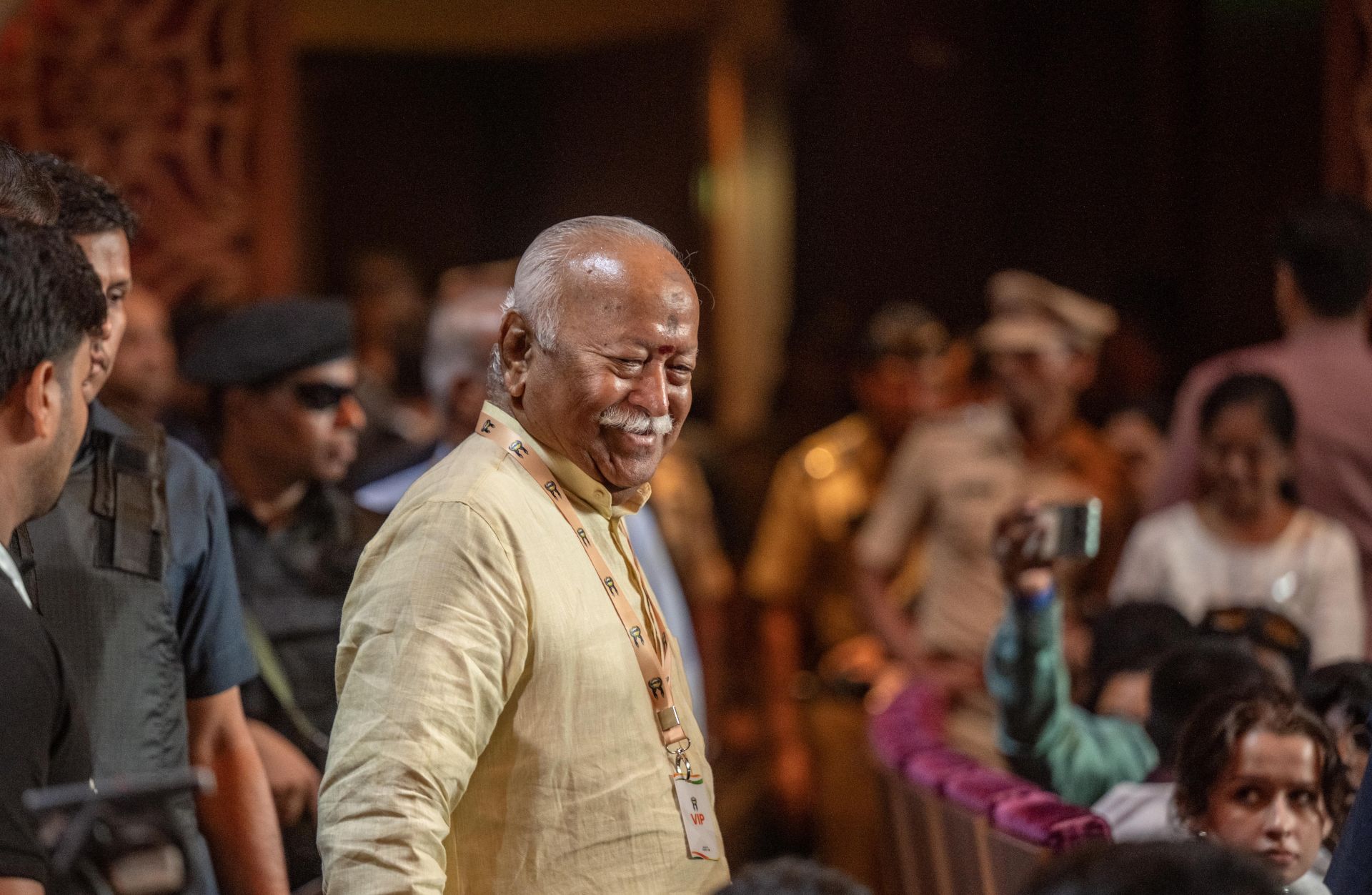
Mohan Bhagwat is neither an elected politician nor does he hold any office in India, yet he wields power that exceeds both. As the chief of Rashtriya Swayamsevak Sangh (RSS), the fountainhead of Hindu nationalism, Bhagwat presides over an organization whose cadre populates the ruling Bharatiya Janata Party (BJP) leadership at every level. Prime Minister Narendra Modi himself rose through the RSS ranks before entering electoral politics. Beyond setting the tone for Indian politics as the BJP’s main ideological guide, the organization leads a massive overseas network, building a global Hindu diaspora in its image.
This week, as Bhagwat embarks on an overseas trip covering the United Kingdom, the United States and Canada, the centerpiece of his travels will be a gathering of over 5,000 people at New York’s Madison Square Garden. Modi received a rock star welcome there from nearly 20,000 Indian Americans in 2014, effectively reorganizing the political relationship between India and its diaspora.
Bhagwat’s visit has prompted diaspora groups to mobilize both in support of his visit and against it. In New York, progressive South Asian and Hindu organizations are pressuring Zohran Mamdani, the city’s first Indian-American mayor, to take a public stance. Savera, a South Asian platform, released a report documenting the opaque inner workings of RSS networks in the U.S. Over 1,000 people from across the U.S. have written to Secretary of State Marco Rubio urging him to deny or revoke the visa issued to Bhagwat.
This trip, however, comes at a difficult moment for conservative Hindu-American groups in the U.S. For many years, they have worked to build political power modeled on the American Israel Public Affairs Committee, by building political action committees (PACs), tapping a wealthy donor base, endorsing candidates across the board and deploying “Hinduphobia” as a rights-based shield against criticism. They gained traction as Hindu-American politicians rose within both parties.
But that approach has recently hit a ceiling.
Raja Krishnamoorthi and Shri Thanedar, both Democrats and members of the Samosa Caucus who courted Hindu nationalist-aligned support, lost their primaries this cycle. Thanedar, notably, had been the first member of Congress to introduce a resolution condemning “Hinduphobia.” In California’s 14th district, an important hub for the Indian-American community, Rakhi Israni, a former board member of the Hindu American PAC, finished a distant third in the June primary, well behind state senator Aisha Wahab.
This is in part due to the rise of a progressive Hindu bloc that has been documenting Hindu right-wing funding networks in the U.S. and pushing back on their exclusionary politics. The progressive bloc’s rise exposed a divide within the Hindu-American, and broader Indian-American, community — revealing that not everyone supports Hindu nationalist politics, which may represent a fringe position within the diaspora. Progressive groups endorse candidates based on their stance on transnational repression affecting South Asian communities, support for anticaste discrimination measures and rejection of funding from RSS-linked groups.
Even with the rise of far-right and MAGA forces in the U.S., any hope that the Hindu right had of building alliances there has been complicated by the rise in anti-Indian sentiment, sparked by economic insecurity and the H-1B visa program.
An attempt to bridge the divide was made when Laura Loomer, a MAGA influencer with a history of calling Indians “third-world invaders,” was brought to Delhi in March to speak at the India Today Conclave on shared anti-Muslim ground. Even as she praised India and tried to mend ties, her impact was limited, since her past comments drew criticism across India’s ideological spectrum.
The Hindu right has currently reached the limits of its influence with both the Democrats and the Republicans.
A 2025 investigation by Prism Reports, an American nonprofit newsroom, revealed that the RSS had hired Squire Patton Boggs, a major Washington law and lobbying firm, to lobby Congress on its behalf. The disclosure led to outrage and, eventually, the termination of the contract. Since then, the RSS and its linked organizations have appeared to be building inroads with think tanks in Washington by shifting away from Hindu culture and yoga diplomacy toward hard security arguments, technology and an emphasis on India’s civilizational ethos.
The move could be seen in April of this year, when the Hudson Institute hosted RSS General Secretary Dattatreya Hosabale at its New India Conference. He also spoke at the Thrive 2026 summit at Stanford, and in the U.K. he addressed a session at Chatham House, among other events.
Recent events in India are also worth noting, as Modi’s standing at home and globally diminishes after the recent youth uprising. Even though the BJP dismissed the protests as “antinational” and “foreign-funded,” Bhagwat expressed support for the Gen Z movement. As the RSS creates some public distance from the BJP, the trip can be read as an attempt to project Bhagwat as a new voice and interlocutor for the Hindu right globally.
Bhagwat’s trip — and what he says at Madison Square Garden — will be one to watch, as it could help set the tone for the next phase of Hindu-American politics.