


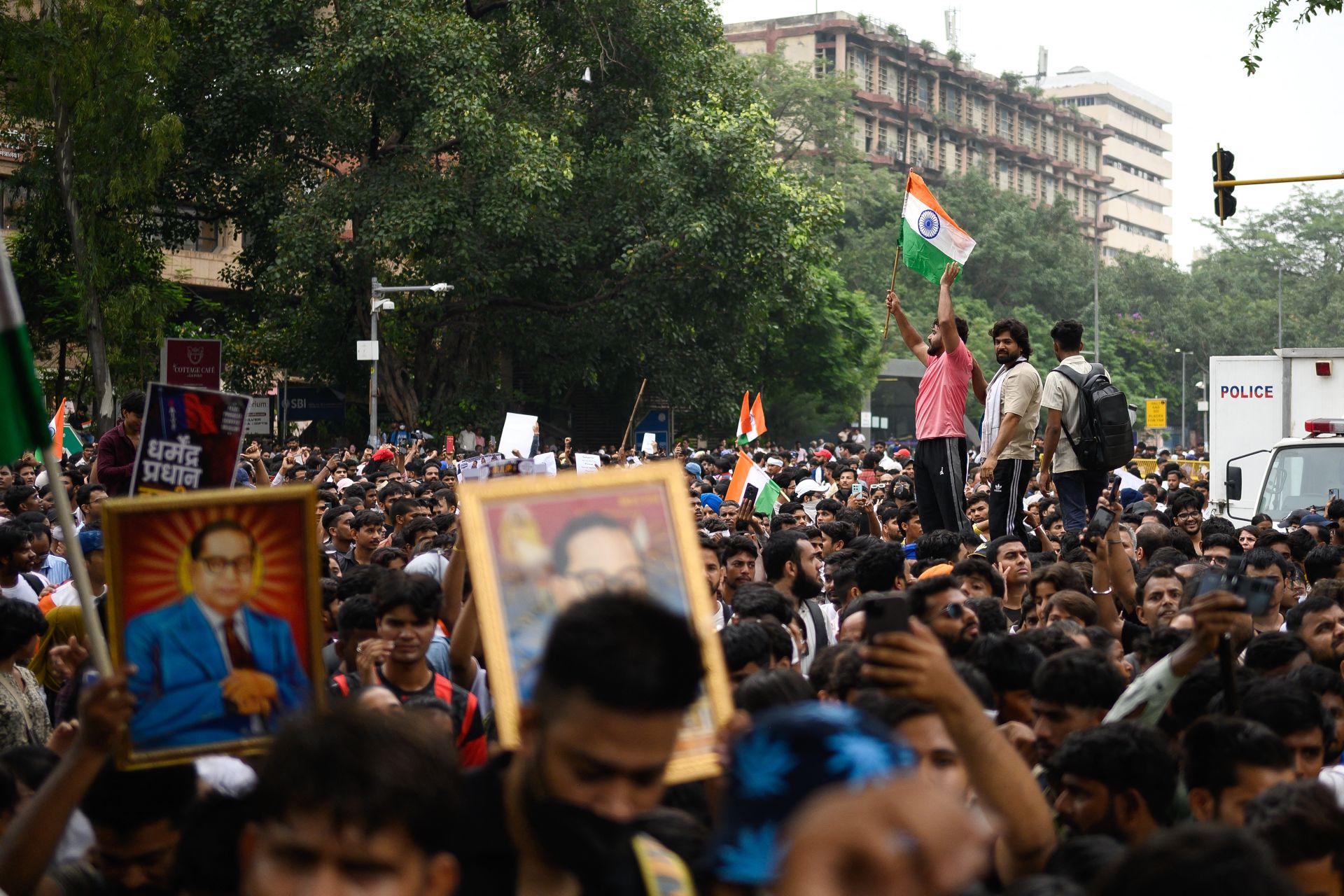
If the scenes emerging from Delhi reveal anything, it is that fear has begun to loosen its grip on a significant section of the Indian public — the fear of taking to the streets, of questioning the government, of demanding accountability and, above all, the fear of criticizing Prime Minister Narendra Modi. On Monday, tens of thousands of demonstrators filled the streets of the capital’s tightly controlled central district, home to the seat of India’s government, as chants of “Modi must resign,” “Remove Modi, save the country” and “Down with Modi” rang out with a force that would have been unimaginable just weeks earlier.
For many Indians watching, the images felt surreal. They could scarcely believe that a protest with such strong anti-Modi sentiment was possible in today’s India. Yet it was happening. History was unfolding in front of their eyes. An overwhelming majority of those pouring into the streets were high school and college students, graduates preparing for the fiercely competitive examinations that determine entry into India’s vast government bureaucracy, along with job seekers, young professionals and people from middle-class families, long frustrated with the Modi government.
This has been the biggest protest in Delhi since the mass anti-corruption movement against the Indian National Congress-led United Progressive Alliance government in 2011, which was followed by nationwide demonstrations after the 2012 gang rape and murder of a young woman in Delhi, known as the Nirbhaya case. But the level of rage and frustration visible among the public this time is unlike anything previously seen.
People had responded to a call by the Cockroach Janata Party (CJP), a satirical online platform named after the ruling Bharatiya Janata Party (BJP) that transformed into a broader protest movement, to march toward the Indian Parliament, demanding the resignation of Education Minister Dharmendra Pradhan over a series of examination irregularities that resulted in the deaths by suicide of at least 21 students across India. In an earlier era, before Modi, it was normal for ministers to resign and accept moral responsibility for national crises, but in the Modi era, ministers have clung on.
The CJP had been protesting at Jantar Mantar, Delhi’s designated protest site, since June 20, and gained momentum after engineer-turned-activist Sonam Wangchuk joined the protesters on June 28, beginning an indefinite hunger strike to demand Pradhan’s resignation. Wangchuk is a household name in India as the inspiration behind superstar Aamir Khan’s character in the 2009 Bollywood film “Three Idiots,” a popular satire about India’s education system.
For the first two weeks, the protest attracted relatively little public attention. But by the 17th day of 59-year-old Wangchuk’s fast, as concerns mounted that his health, and possibly his life, could be in jeopardy, the movement began to resonate more widely. Public anger intensified dramatically on the 21st day, when Delhi police officers forcibly removed Wangchuk from the protest site. Plainclothes officers carried him away to a public hospital against his wishes under the cover of white sheets. The images quickly spread online and sparked outrage across the country.
In the aftermath, the crowds swelled rapidly at the protest site, with protesters’ anger now increasingly directed at Modi, demanding his resignation too. By Sunday, an estimated 25,000 people were gathered in and around the protest site, even as they endured Delhi’s oppressive heat and humidity, turning it into the largest youth-led demonstration in recent years. Several politicians, activists and celebrities, such as veteran actor Shabana Azmi, also turned up in support.
On Monday, despite Delhi Police denying permission for the protest march, tens of thousands turned up in the capital. Authorities shut down metro stations to prevent people from gathering on the streets, resulting in protesters raising slogans inside the stations and coaches instead. Some alleged that intercity trains to Delhi were deliberately delayed. As an internet shutdown lasted nearly eight hours, police and paramilitary forces used baton charges and tear gas to disperse the demonstrators.
As testimonies and visuals of police brutality surfaced, including baton charges on young women and girls by male police officers, and images of many lying unconscious on the ground, it induced further indignation. In many videos, men in plain clothes were seen carrying police batons and beating people. Protesters alleged that expired tear-gas shells were used. Doctors in a public hospital said that nearly 90 people were being treated for injuries, many of them serious, while social workers helped over a thousand people with first aid. Many journalists said that the clampdown was unlike anything they had seen in recent times.
All of this unfolded despite India’s mainstream television news channels giving little to no airtime to the protests; instead, the coverage spread largely through social media, especially Instagram. This was significant given the right wing’s hold over social media in the country. TV news, friendly to the government, focused instead on Modi’s remarks ahead of Parliament’s session. Even so, opposition leaders raised the issue inside Parliament, leading to the session being adjourned multiple times.
The scenes in Delhi, and in different parts of India, are extraordinary and unprecedented in a country where public criticism of Modi and his government, whether expressed online, through art or cinema, or in street demonstrations, has, over the past decade, become increasingly marginalized, and, in some cases, criminalized. (Recently, the government ordered the removal of “Satluj,” the biopic of a Sikh human rights activist, from an Indian streaming platform.) That’s why, for most Indians, the idea of a mass protest openly demanding the prime minister’s resignation had itself come to seem almost inconceivable. Many had grown accustomed to thinking twice before criticizing the government in public. The expectation of silence had become so deeply internalized that the absence of protest came to seem natural.
“No one had expected the scale of people showing up in Delhi for the citizens’ march, not even many CJP folks. At some point it appears the protest grew into something bigger than where it came from,” Ravikant Kisana, an academic and author, wrote on X. “For many, the protest site and march became a collective venting space where all the ‘ghutan’ [suffocation] and individual helplessness they’d been feeling for long could finally be spoken out loud.” Many of them had previously voted for the BJP or belonged to BJP-supporting families.
The protests rattled the Modi government as they became bigger than Pradhan’s political fate, turning into a referendum on Modi’s last 12 years in power. As The Wire, an independent Indian news publication, argued in its analysis of the movement, whether the education minister stays or goes has become almost beside the point for protesters, who have redirected their anger squarely at Modi’s style of governance. The word arrogant has been used to describe him repeatedly.
This is not to say that India has been devoid of protest under Modi. The country has witnessed several major movements over the past decade, including the nationwide demonstrations against the Citizenship Amendment Act (CAA) and the proposed National Register of Citizens, the year-long farmers’ protests and the wrestlers’ protest against the country’s powerful wrestling federation. Each drew large crowds and shaped national conversations.
Yet while each attracted solidarity well beyond its core participants, they were rooted in the grievances of specific constituencies — the anti-CAA protests were led largely by Muslims and supported by civil society groups; the farmers’ movement was driven by agricultural communities, and the wrestlers’ protests centered on athletes demanding justice. Consequently, they were perceived as representing the concerns of particular groups and not the broader public.
But this time, in a country where education is a primary route to economic and social mobility, the growing toll of student suicides and the government’s apathy toward it has forged a broader coalition that cuts across religion, caste, class and region.
“It is a much broader, decentralised youth upsurge that has clearly spilled beyond the originating meme and organisation,” wrote The Wire. Unlike earlier mass movements, which the Modi government and its supporters in the media would contain or delegitimize through identity‑based vilification, the latest protests have been driven by students and young job seekers from “mainstream aspirational India.” That has made it far more difficult to cast them as an “enemy category” without alienating the very demographic that helped propel Modi to power.
The movement’s genesis lay in the alleged irregularities in the National Eligibility cum Entrance Test (NEET), which determines admission to India’s medical colleges and touches millions of middle-class families. More than 2.2 million students compete each year for roughly 137,000 undergraduate medical spots across 800 colleges in India. In May 2026, as the authorities canceled the results and ordered a repeat of the exam due to allegations of a paper leak, at least 13 students died by suicide in the weeks surrounding the scandal.
The outrage was further amplified when a teenage student hacked into the official system of the Central Board of Secondary Education, the national-level board of education for public and private schools, and alleged discrepancies were found between the students’ scanned answer sheets and the marks awarded through a new online marking system. Previously, teachers would manually check the answer sheets. It led to a wave of revaluations and reignited concerns about India’s most important high school examination, whose results form the basis of admission to many of the country’s leading public universities. The board’s grade 12 exams have shaped the educational trajectories of generations of Indians.
These controversies have arrived while India is already grappling with persistent youth unemployment, particularly among graduates (standing at over 15% in March 2026), which has eroded Indians’ long-held belief that education can secure upward mobility. The social contract of “study hard, succeed on merit and build a better life” has been steadily breaking down over the years, which is one reason why Indian young people are increasingly looking to move abroad for education and employment. It has become harder to imagine a future at home.
Pradhan’s own daughter, who studied at the Fletcher School at Tufts University, is one of 15 children of India’s 30 Cabinet ministers who hold a foreign degree or currently study overseas, an irony that is not lost on the public. People have been flooding the comments section on Tufts University’s Instagram page with messages against Pradhan.
It was in the midst of this that Surya Kant, the chief justice of India’s Supreme Court, likened activists and unemployed youth to “parasites” and “cockroaches” in a televised court hearing. He may have been speaking in a different context, but to many young people it seemed emblematic of the political establishment’s attitude toward them.
Gen Z embraced the label in an act of defiance and turned what had been intended as a slight into a rallying cry. Among those who seized on the moment was Abhijeet Dipke, a recent graduate from Boston University, who launched a satirical political platform called the Cockroach Janata Party, or the Cockroach People’s Party, which snowballed into a mass online movement, attracting more than 23 million followers on Instagram, more than twice the BJP’s following of 9.4 million.
It generated coverage across Indian and international media. Dipke returned to India attempting to transform it into an organized campaign. He appointed spokespeople, coordinated demonstrations across multiple cities and eventually established a permanent presence at Delhi’s Jantar Mantar.
Yet the movement’s early days were marked as much by skepticism as enthusiasm. Journalists and ordinary Indians across the political spectrum questioned whether it was genuine or a springboard for its founders’ political careers. That cynicism reflected the legacy of the 2011 anti-corruption movement, which gave rise to both the Aam Aadmi Party (AAP) and, indirectly, created the political conditions that facilitated the BJP’s ascent to national power. Dipke and several of his closest collaborators were themselves former AAP members.
But the movement gained credibility after Wangchuk joined, eventually leading to the protest march on Monday.
This frustration with the Modi government, in its third term, is not just about educational reform. The issue triggered the protests, but dissatisfaction with the Modi government has been brewing for some time, fed by a number of grievances.
These include anger over India’s foreign policy, especially with the U.S. pressuring India over its crude oil trade with Russia, which led to rising fuel prices and ethanol blending in the aftermath of the Iran war. Despite high taxes, major Indian cities have become unlivable, and the government has done little to address the country’s abysmal air quality. The perception that the Election Commission and other federal and executive institutions are compromised has taken root. The alleged embezzlement of tens of millions in donations at the Ram Mandir in Ayodhya was highly shocking, even for many BJP supporters, considering that it has been the ruling party’s signature religious project for decades. There is also growing exhaustion with the BJP’s tendency to frame issues through the lens of Hindu-Muslim divisions.
“This is no longer about Sonam Wangchuk or the Cockroach Janata Party,” Indian journalist Rana Ayyub wrote on X. “They may have provided the spark, but what we witnessed today was something far bigger: an organic outpouring of the collective anguish, helplessness, despair and anger of an entire generation that spent years screaming, only to be met with silence.”
Even as the government engaged with the CJP leaders to manage the “bad optics,” the protests in Delhi, India’s political center, and the relentless circulation of videos showing police brutality have not only galvanized public anger but also shattered any lingering illusion that dissent could still be contained or ignored. Anti-Modi protests have broken out in different parts of the country, from Arunachal Pradesh in the northeast to Mumbai and Goa in the west. Indians in the diaspora, from London to New York, have also come out in solidarity.
Rahul Gandhi, the leader of the parliamentary opposition, who has been raising the issue of the exam crisis for months, also led a demonstration outside the prime minister’s residence against police brutality meted out to young protesters. It was the first time in India’s history that the leader of the opposition protested outside the prime minister’s residence. He was joined by other members of Parliament, two sitting chief ministers and several political party leaders. Their detention by the police further escalated the situation into a political crisis that demanded wall-to-wall coverage from the media. Images of Gandhi being dragged by the police, nose bloodied, quickly spread, adding fuel to public outrage.
Tens of thousands of people continue to congregate in the heart of Delhi, despite the dismantling of the CJP’s main sit-in protest site. Indians the world over are closely watching the developments, wondering what will happen next. Every day adds another line to India’s history books.
Become a member today to receive access to all our paywalled essays and the best of New Lines delivered to your inbox through our newsletters.