


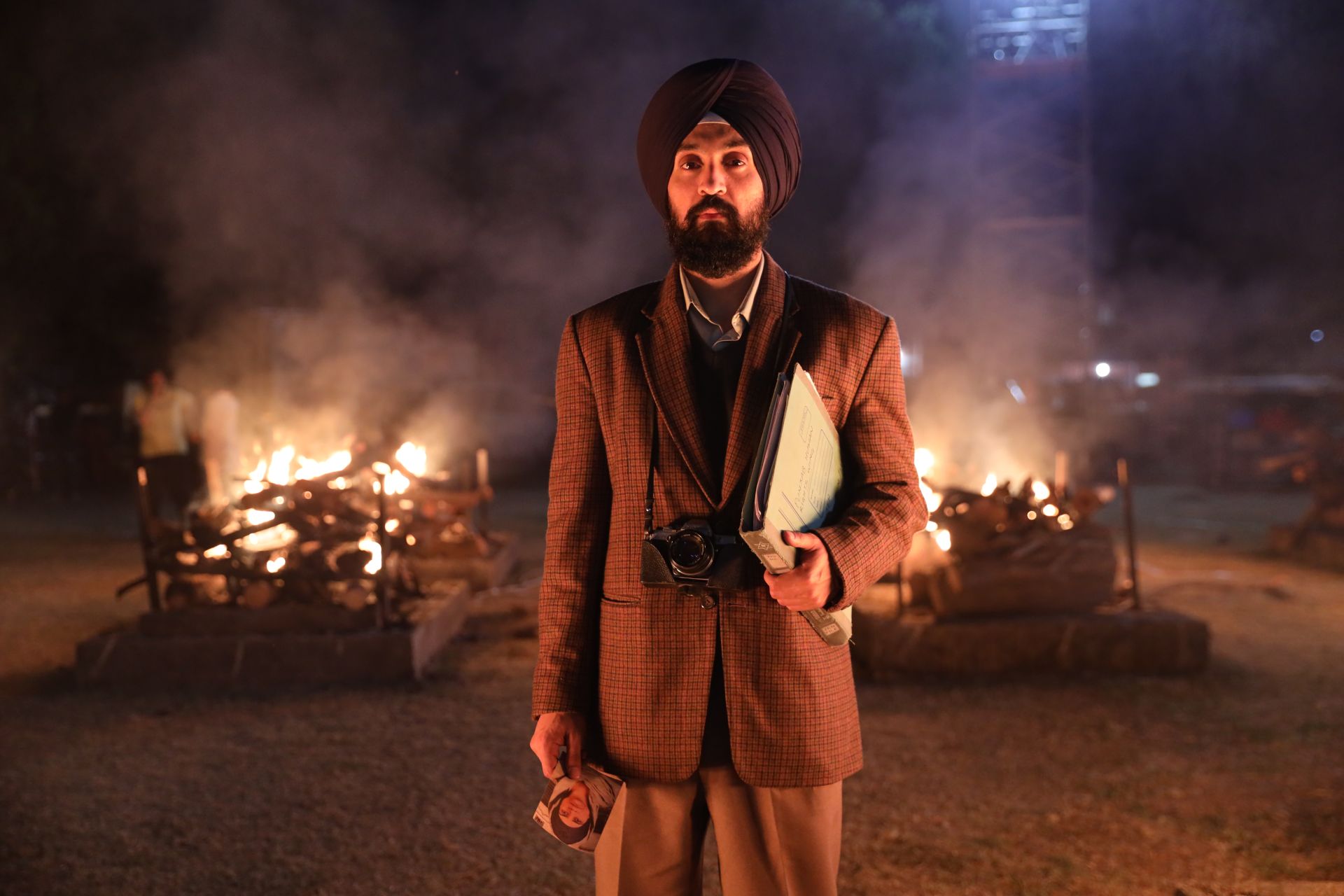
In January, Hindi-language filmmaker Honey Trehan made an announcement on Instagram. His second feature film, “Panjab ’95,” would release internationally on Feb. 7, meaning it would be released in countries other than India, despite it being based in and produced there. Three days later, however, another post followed — an apology. “We are very sorry and it pains us to inform you that the movie ‘Panjab ’95’ will not release on 7th February due to circumstances beyond our control.” Since then, there has been no news about the film’s release, and “Panjab ’95” has been in a state of limbo.
A stirring portrait of police brutality in the northwestern Indian state of Punjab during the 1980s and 1990s — when the state’s crackdown on the Sikh separatist movement led to widespread allegations of torture, illegal detentions, extrajudicial killings and disappearances — “Panjab ’95” revisits the era through the story of Jaswant Singh Khalra. The human rights activist uncovered more than 25,000 illegal killings by the Punjab police and was later abducted, tortured and murdered by them.
In December 2022, Trehan submitted “Panjab ’95” to the Central Board of Film Certification (CBFC) — a statutory board under the Ministry of Information and Broadcasting that regulates the public exhibition of films under the 1952 Cinematograph Act. Any film seeking a theatrical release in India must be certified by this board. But for Trehan, the routine process turned into a nightmare that continues to haunt him to this day.
After he submitted the film, multiple rounds of screenings followed, and several changes were suggested by the board, including changing the initial title “Ghallughara” (meaning “massacre” in Punjabi) and removing Khalra’s name. The board argued that the film might cause protests in the state, which prompted the makers to approach the Bombay High Court to challenge the CBFC’s demands. Meanwhile, the film’s submission at the Toronto International Film Festival in September 2023 was withdrawn. The producers hoped that this tacit obedience might lead to certification, but nothing changed.
When the board argued that the film might cause law-and-order problems, the judge responded that it was for the state government of Punjab to tackle, said Trehan. With one hearing left, the film’s producer, Ronnie Screwvala, was summoned for an emergency meeting in New Delhi. “He [Ronnie] called me to say we have to do an out-of-court settlement. We cannot fight the government,” the filmmaker told New Lines. Details of the meeting were not shared with Trehan.
From that point on, more and more changes were suggested by the CBFC, with no space for negotiation. “Ronnie tried to convince me, I tried to convince myself,” Trehan said. After they accepted the initial set of changes, the board questioned the authenticity of some facts and demanded 45 more cuts, which rose to 65 cuts, and later 85. Compliance followed in the hope of a certificate.
But the demands only increased and became more invasive, the filmmaker said. The board asked them to remove the “based on true events” tag, drop the word Punjab from “Punjab Police,” omit Khalra’s wife’s name, cut the opening sequence showing cops killing civilians, tone down the torture of Khalra’s character and not depict his death at the hands of the cops.
Trehan said that the board even asked to reduce the figure of 25,000 extrajudicial killings. He recalled asking them mockingly if 5,000 would be a better number. “It is absurd. They are saying that the death of 5,000 people is alright but 25,000 is not. They want to remove history.” At present, the number of cuts that have been demanded stands at 127.
This bewildering chain of events has pushed Trehan to put his foot down and speak up. “I was quiet for two years because I wanted to see through all the CBFC claims. But I realized that ‘Panjab ’95’ is about someone who sought dignity for unclaimed bodies,” he said. “Now, if I don’t stand up for him, then what right do I have to tell his story?”
His resistance also includes disassociating himself from the edited version of the project. The decision to release the film — with the changes — now rests with the producer, Screwvala, and his company, RSVP. “With this many cuts, it is not my film. It is edited and directed by the CBFC; they should take credit,” Trehan said.
The uncertain fate of “Panjab ’95” is emblematic of rising political censorship in India. Since 2014, when the Bharatiya Janata Party (BJP)-led government came to power, Hindi cinema — one of India’s most prominent cultural industries and long considered a beacon of secularism — has steadily devolved into the party’s mouthpiece. Many mainstream films now echo the Hindu nationalist ideology, often through the vilification of Muslims and the distortion of historical facts.
A pivotal moment occurred in 2019, when actor Mohammed Zeeshan Ayyub briefly portrayed the Hindu god Shiva in the Amazon Prime series “Tandav,” and it escalated into widespread controversy. Hindu nationalists accused the show of offending religious sensibilities, and multiple cases were filed against the streaming giant’s India head, Aparna Purohit, who almost faced arrest. This led to the creation of new “red lines” in Indian entertainment. Digital platforms, producers and filmmakers began tiptoeing around anything that could be seen as political or religiously sensitive. Self-censorship became, and remains, the order of the day.
“The walls have been closing in for a while now,” Abhishek Chaubey, a popular Hindi-language filmmaker and co-producer on “Panjab ’95,” told New Lines. “There are certain kinds of stories which, even in closed rooms and secure spaces, as filmmakers we look at each other and know instinctively will not see the light of the day.” Those who still dared faced dire consequences like social media boycotts and tax raids. Meanwhile, films supporting the politics of the current government were openly endorsed by ministers and received tax benefits.
Now, a new trend of intimidating filmmakers and forcing censorship has emerged. Even though the guidelines of the 1952 law, which provides the overarching framework for the CBFC, have not been drastically altered, certification of politically sensitive films has become thorny. It is telling that, of late, the CBFC has earned the disrepute of being called India’s “censor board.” A host of Hindi-language films have had to incorporate multiple senseless cuts, as sanctioned by the board, to get a release in India. Filmmakers refusing to do so don’t get the required certificate for release. The board has effectively become the establishment’s instrument to create pressure on filmmakers and force them to censor their works.
Although political films that critique the Indian government or society have declined in number, several recent works addressing police brutality, caste-based discrimination or communal violence have either been denied certification, forced to make cuts or rereleased in altered versions.
For instance, British-Indian filmmaker Sandhya Suri’s “Santosh” — the U.K.’s official Oscars submission last year, dealing with caste-based violence and anti-Muslim hate in India — could not be released in India after the CBFC denied it certification. Anant Mahadevan’s “Phule,” a biopic on social reformers Jyotirao and Savitribai Phule, who fought against caste injustice, was delayed and released only after the director accommodated “minor amendments” suggested by the board. Shazia Iqbal’s “Dhadak 2,” a love story between a Dalit man and a dominant-caste woman, had to accept 16 cuts to be cleared. Makers of the Malayalam-language film “L2: Empuraan” released a new version within the first week of its release, after at least 17 cuts were made because of its depiction of a Hindu right-wing mob killing a Muslim family. It was widely seen as an allusion to the 2002 Gujarat riots, drawing right-wing outrage.
But the most striking case has been Neeraj Ghaywan’s “Homebound,” which, despite receiving international acclaim, was allowed certification only after 11 cuts. Set in 2020, the film is a searing portrait of two childhood friends, a Dalit man and a Muslim man, forced into a desperate journey back home during India’s COVID-19 lockdown. Ironically, “Homebound” is also India’s official submission to the 2026 Oscars — a choice made by a committee appointed by the Film Federation of India, the industry body that selects the country’s entry each year. It is now among the 15 shortlisted films in the international feature film category at the Oscars.
This recent trend, in which the CBFC pressures filmmakers to alter or censor their films, began in 2023 with Anubhav Sinha’s “Bheed,” based on the 2020 migrant crisis, in which some 43 million Indians returned to their towns and villages after the pandemic lockdown essentially halted the economies of the cities to which they had migrated. The initial trailer for the film included a voiceover of Prime Minister Narendra Modi’s speech declaring the nationwide shutdown, which played alongside images of migrant workers being beaten up by the cops. But Sinha was asked to remove all references to Modi in the film. The same year, the CFBC asked writer-director Varun Grover to omit a cheeky reference to former Prime Minister Manmohan Singh in his coming-of-age drama “All India Rank.” “A person on the board said if they allow this, then tomorrow I may make fun of Modi,” Grover told New Lines.
Yet the situation has now become more arbitrary, with seemingly extraneous details, like names of characters, capable of invoking censorship. For instance, a Malayalam-language film, initially named “JSK: Janaki v/s State of Kerala,” was refused certification because the rape survivor’s name, Janaki, is another name of the Hindu goddess Sita. It was only allowed to be released after the Kerala High Court intervened and the title was modified to include a reference to the character’s full name: “JSK: Janaki V v/s State of Kerala.”
This week, the Ministry of Information and Broadcasting also denied giving censor exemption clearance — mandatory for festival screenings in the country — to 19 films, including “Santosh,” Sergei Eisenstein’s 1925 classic “Battleship Potemkin,” a Spanish film titled “Beef” and Palestinian titles, for the ongoing International Film Festival of Kerala. But the Keralan government, challenging the move, ordered the festival to play all films as per the schedule.
A lot of the issues with the CBFC have to do with its setup, explained Ira Bhaskar, professor of film studies at Jawaharlal Nehru University and a former member of the board. In India, a film submitted for certification is first watched by the Examining Committee, composed of people chosen from different walks of life by the government, and if concerns are raised, then the Revising Committee watches it with one CBFC board member in attendance. “Most of them do not have much idea about films, and they don’t want to risk controversy. They say no to anything they fear the government might object to,” Bhaskar told New Lines.
Bhaskar resigned in 2015, a year after the BJP came into power, but she recalls fighting for several films that were denied certification during her tenure. “I would tell the committee members that I am taking responsibility.” In most cases, it worked. But today, she said, the space for dialogue has shrunk. “The current government will not allow any conversation or discourse on things they find politically inflammable or inconvenient. They not only mistrust the public, they also mistrust dissent,” she added.
In the meantime, mechanisms of control are further tightening. In June, the CBFC discontinued the online feature that allowed the public to access the cut lists of the films. “These are deliberate calls taken by people at the top. They are not inefficient but very interested in controlling culture, which is perhaps a bigger priority to them than managing the economy,” Chaubey said. In 2021, the BJP-led government also abolished the Film Certification Appellate Tribunal (FCAT), a statutory board where filmmakers could appeal a certification decision.
When the FCAT existed, Chaubey had approached the tribunal to challenge the CBFC’s demands of over 90 cuts in his 2016 film “Udta Punjab,” which explored the drug addiction crisis in the Indian state. After further reviews, the film was later released with a single cut. But since the institution no longer exists, the only option left to filmmakers today is going to court, a route that is both tedious and expensive. And Trehan’s experience of being coerced to withdraw his case proves that even that stands at risk. “They are taking away my constitutional right to approach the court and fight,” he said.
“The CBFC has not given me one single answer regarding why they need these many changes,” he said. “They only argue that releasing ‘Panjab ’95’ will cause a law-and-order situation in Punjab. My question to them is, when so many state-based volatile propaganda films — ‘The Kashmir Files’ [2022], ‘The Kerala Story’ [2023], ‘The Bengal Files’ [2025] — are released and the decorum is still maintained in those states, then why is my film a threat?” He was referring to a new wave of Indian films centered on politically charged narratives and set in specific states, which have polarized audiences.
He alleged that their plans to release “Panjab ’95” internationally, given its lead actor Diljit Dosanjh’s global star power, were also stopped by the political establishment. “Ronnie got a call from a higher authority that it will not be taken in good taste. Technically, the law cannot stop me — then who is trying to stop the film?” Trehan asked rhetorically.
Political coercion in the country is so rife that even streaming platforms, free from certification rules until now, have relented. They stream censored versions instead of the uncut films provided by filmmakers (as Netflix did with “Bheed”). After its theatrical release debacle, “Santosh” was slated to stream in India on Lionsgate Play — something that wouldn’t normally require CBFC approval — yet its digital release was halted at the last minute.
Wary of trouble, streaming companies have shelved works that might be politically sensitive. The most popular example is Dibakar Banerjee’s “Tees,” a sharp political commentary on the precarious lives of Muslims living in India, which has been in limbo for three years. Netflix had commissioned it in 2019 but refused to stream it later. An adaptation of Suketu Mehta’s “Maximum City,” his 2004 nonfiction book that explored the political underbelly of Mumbai, was also dropped by Netflix days before production was about to start.
Such a stifling environment has compelled filmmakers to host private screenings of their films, hoping to reach some viewers. This year, Trehan screened the uncut version of “Panjab ’95” at the Cannes Film Festival and continued to show it to a growing circle of viewers, including the media, back home. “Judges from Punjab and Haryana reached out, so did [bureaucrats] in Amritsar,” he said. In Vancouver, someone booked an entire theater and screened the film — and it was packed. Banerjee has been doing the same for over a year now.
Traditionally, documentary filmmakers in India have relied on private screenings due to the broken distribution network for nonfiction films. But for a fiction film — especially one starring big names like Dosanjh, Suvinderpal Vicky and Arjun Rampal — this approach is unprecedented. It has also been short-lived. Trehan confirmed that even the private showings have been stopped. “Around three months back, I was called by the people in power to stop the screening.” He resists giving names, but the implication is clear. “They also put pressure on those with private studios to not play ‘Panjab ’95.’”
At the time of writing, Trehan was neck-deep working on a Netflix project, but despite his preoccupation with it, it was impossible to ignore how completely he had been cornered. “The attempt today is to institutionally trap the individual and make the process the punishment,” Bhaskar said.
The loneliness caused by the entrapment also inflicts self-doubt on filmmakers. “There was a point when I thought maybe I have a blind spot, maybe Punjab’s religious sentiments will be hurt by the film,” Trehan said. “So I showed ‘Panjab ’95’ to the Shiromani Gurdwara Parbandhak Committee, which manages gurdwaras [Sikh places of worship] in Punjab, and to the Akal Takht, the authority in Sikhism, based in Amritsar. They loved it. Even members of the Punjab media had no problem.”
The road ahead is uncertain, but the filmmaker is still optimistic. “The CBFC has told Ronnie to write off the film, but I am hopeful that someday something will happen. Ronnie is still trying.” This December marks three years since “Panjab ’95,” a film headlined by stars and primed to premiere at a prestigious film festival, was denied release.
But to see the filmmaker continue to envision a future for his film feels like defiance. “Thirty years ago, a police department had abducted Jaswant Singh Khalra, and he got justice after the center [the federal government] intervened,” Trehan said. “Today, again, he has been abducted by the CBFC, and I will request the center to intervene and rescue him.”
“Spotlight” is a newsletter about underreported cultural trends and news from around the world, emailed to subscribers twice a week. Sign up here.