


The message cropped up on my phone from a dear friend and ambassador for my charity INARA, the International Network for Aid, Relief and Assistance.
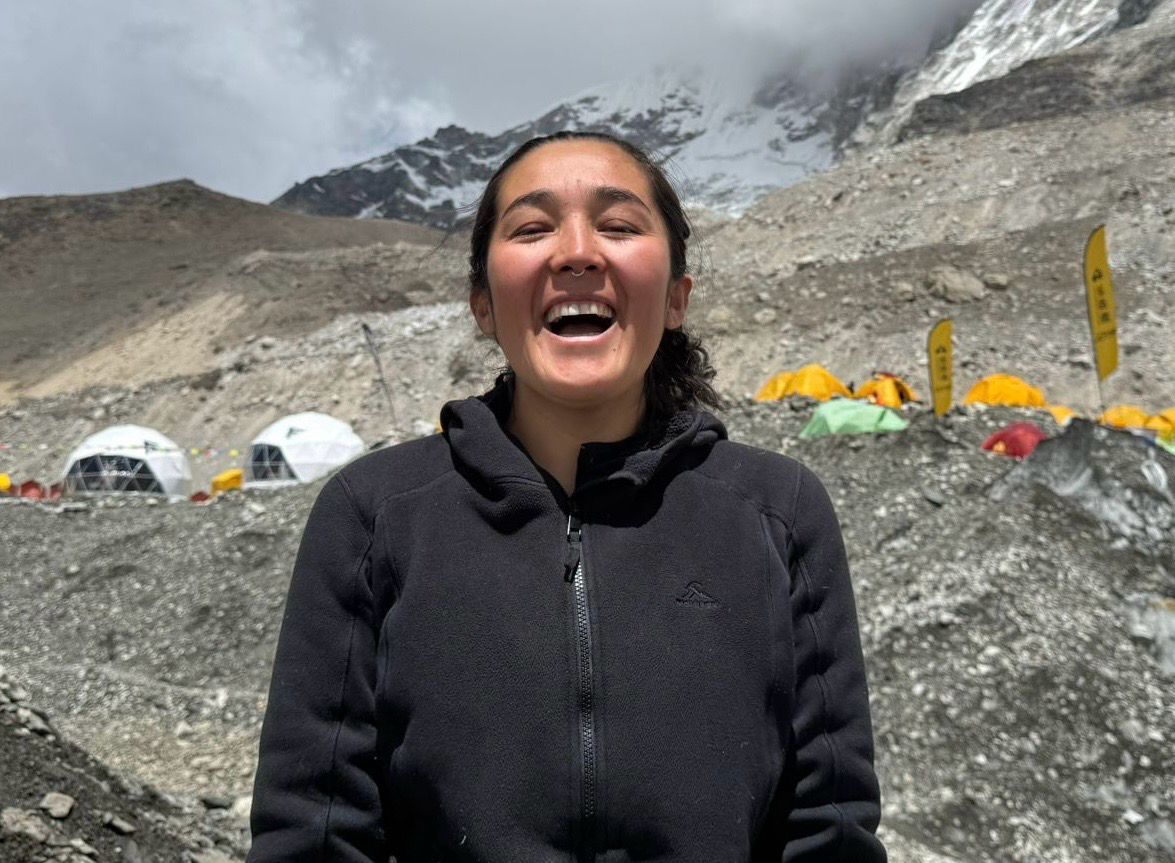
“We’re hopefully going for the summit on the 20th,” wrote Leonardo Avezzano, an adventurer and documentary filmmaker, before going on to tell me about a young Afghan woman he had met at Everest Base Camp and was mentoring and trying to support.
Her name is River Ahmad, and her story floored me.
I was in Afghanistan just last month with INARA, listening to girls who are in the 5th grade cry as they questioned what would happen to them the following year and whether they would be able to continue their schooling. I met sisters who had returned to their homeland because of the war in Iran, who spoke of how their dreams were dead because they would be unable to continue their higher education. I chatted with a tuk-tuk driver who said the most painful thing was hearing his daughter cry over not being able to learn and feeling so helpless, like he was failing in his duty as a father.
I am always left with an ache when I leave, at the injustice that has been done to Afghanistan, but especially to its women and girls. I messaged River immediately. Connectivity at the base camp is intermittent; we communicated through WhatsApp messages and voice notes.
“When my energy fades, I think about the women I’m climbing for. And I have chance to try harder even [if] they don’t have that,” she wrote to me.
She described how, when her lungs are burning, when her legs are trembling, when her body is screaming at her to give up, she forces herself on through the snow, the whipping winds, the altitude increases that rob the lungs of oxygen.
River doesn’t just want to make history as the first Afghan woman to summit Mount Everest, the highest mountain in the world and among the most dangerous to attempt. River wants people to remember that Afghan women and girls are powerful, and perhaps more crucially, she wants to remind Afghanistan’s women and girls of their own power.
River is still alive due to her sheer grit and quick thinking. She is from Afghanistan’s mountainous Ghazni province, and when she graduated from high school she begged, pleaded and sobbed until her father agreed to allow her to travel to Kabul for university. The year was 2014, the deadliest for Afghan civilians since the war there began in 2001. NATO was winding down its combat mission, despite deadly clashes between the Taliban and the Afghan security forces intensifying, roadside bombs increasing and overall security for the population deteriorating.
That day, River happened to be the only female passenger on the bus. Halfway to the capital, they were stopped by two armed men, she said. She assumed they were Taliban fighters. She said they just opened fire.
“My first thought was, ‘I’m dead. I won’t be able to save my life,’” she said. “But I was so quick to think what can help me to be alive. I had my period. I used my period blood and smeared it on my face and played dead.”
She could hear the gunmen talking, checking on the bodies. She remembers them talking about her, one of them saying, “Look, we killed a prostitute.” She did not dare move. She’s not sure how long she lay there among the bodies of the dead. When the men left and people arrived at the scene, they were shocked to find her alive. She said she was one of three survivors.
“I always carry that part of the attack with me. Sometimes in my dreams I see two gunmen coming for me and trying to kill me,” she said.
I asked River if the attack made her father more protective.
“When I said to my dad, he was proud of me that I saved my life. And after that he never said to me that I am not able to go to university. He was very supportive,” she responded.
She went on to study journalism and earn her master’s degree in international relations. She often advocated for women’s rights and equality, and as the security situation in Afghanistan continued to worsen, she came under threat from both the Taliban and the Afghan government, she said. By the end of 2019, it became too dangerous for her to stay. But she always thought she would return one day.
But in August of 2022, the Taliban took over. “When I heard news that Taliban took the country it was the darkest day of my life I was constantly crying,” she said.
It is still hard to believe that after all that was sacrificed in Afghanistan, the U.S. and its Western allies were so quick to abandon the country to those they had promised to defeat. In what felt like an instant, dreams were crushed, lives put on hold, and women and girls shoved back into the shadows that the U.S. had once promised to pull them out of with its rhetoric of freedom and democracy.
Today, under the Taliban, girls are banned from education past the 6th grade, women cannot hold most jobs and the authorities are passing more restrictive rules. Most recently, new judicial regulations appear to institutionalize child marriage and invalidate past divorces.
Despite all the efforts of Afghan women’s rights activists and their allies, the world has turned its back on the country. River hopes that her mission will shed light on the plight of women and girls in her homeland and send them a message as well.
“I’m trying to encourage them, I’m trying to do this climb for them,” she said. “This journey is not easy. Actually, I am not going to give up. Because I have a chance to try. But unfortunately, those women back home in Afghanistan they don’t have a chance to try.”
As part of the acclimatization process to get her body ready for her push for the summit of Everest, River summited Mount Meru. There’s a photo of her holding a small, creased white sign. Written on it by hand is the message: “From Afghanistan to Mt. Everest. Climbing for women’s freedom, education, and mental health worldwide.”
Mental health awareness became a part of her mission after her brother’s death by suicide. When River first fled Afghanistan, she went to India for a few years before obtaining a humanitarian visa for Australia, where she currently lives along with the rest of her family, who also eventually fled Afghanistan. She doesn’t talk much about her brother’s circumstances, but in a post on Instagram before starting her trek to Everest, she sobs as she shares how hard it is to leave her room in Nepal’s capital of Kathmandu.
“I am so emotional,” she says through her tears in the video. “Kathmandu looks like Delhi, and when we been refugee, I lived in Delhi, like, for a while and had lots of good memory with my brother. We did lots of bike riding and stuff. The vibe between Kathmandu and Delhi is the same, and I was having so many flashbacks and missing him so much.”
River first heard about Everest when she was a little girl in Afghanistan, and decided back then that she wanted to climb it one day. She would often escape to Ghazni’s mountains to avoid societal pressure and joined a climbing club, a bold move for a young woman in that area. When she got to Australia and climbed the Sydney Harbor Bridge, she decided that was it: She was going to make that little girl’s dream come true for all of Afghanistan’s dreamers.
“My mom had no idea what Everest or the highest mountain in the world is. She said, ‘Yeah, go,’” River said. “Then my younger brother, he is in primary school, and he said to my mom do you know what Everest is, it’s the most dangerous mountain in the world. When she got that people are dying up there, she started to worry, before she didn’t know.”
River began training intensely, between her full-time ongoing studies and part-time work at a radio station. She took any extra jobs she could find to start saving money for the trip and launched a fundraising page. She has completed all of the acclimatizing rotations with a speed that has impressed those around her. She’s still trying to raise the rest of the funds she needs to pay the company she’s climbing with before the window to reach the summit itself closes.
I asked her why she prefers to go by River over her old name, Zakia.
“After losing my brother and starting a new life in Australia, I thought I carry lots of trauma with my old name,” she explained. “My philosophy behind River is to flow like a river, nonstop able.”
“Spotlight” is a newsletter about underreported cultural trends and news from around the world, emailed to subscribers twice a week. Sign up here.