


Chinese politics watchers like to tell a story from the Tang Dynasty, one of China’s cultural golden ages from the seventh to the 10th centuries CE, of a secret police official called Lai Junchen, who was tasked by the empress with interrogating a notorious torturer called Zhou Xing. Uncertain how to get a man so immersed in methods of torture to confess, Lai asked him casually over dinner how he would get a particularly difficult suspect to reveal his crimes. Zhou enthusiastically explained that he would get a large jar, place hot coals under it and ask the suspect to either confess or go into the jar. At which point Lai revealed he had prepared just such a contraption for him. He then, in the idiomatic expression that has survived to this day, “invited the gentleman into the jar.” Zhou confessed.
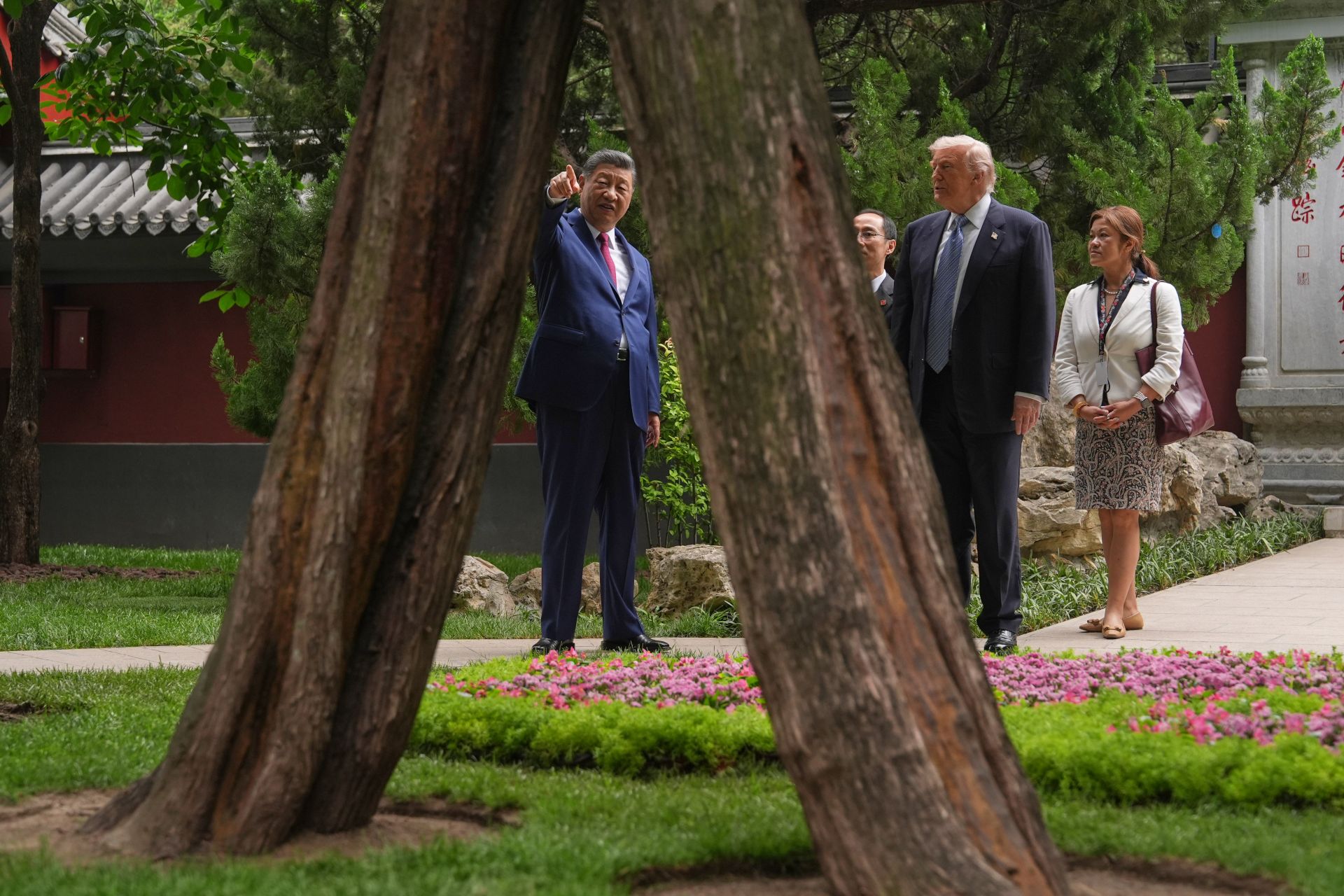
A thousand years later, Chinese diplomats have not forgotten how to set a trap for their rivals — or, to use the language du jour, frenemies. When Trump visited Xi last week, he was invited into a rarely seen imperial garden inside the Zhongnanhai government compound. The first thing Xi pointed out was two big trees, “growing together,” as the Chinese president pointed out archly.
If the metaphor were lost on the American president, Xi returned to it when he invoked the “Thucydides trap,” warning that the U.S. and China should be sure to avoid it. This trap, named after the ancient Athenian general whose “History of the Peloponnesian War” is a classic of military history, refers to the way that the rise of ancient Athens so frightened the established city-state of Sparta that it made war between them inevitable.
The Thucydides trap has been used as a metaphor for U.S.-China relations for over a decade. But Xi’s invocation of the concept is interesting because it reflects the way China sees itself, and frames the U.S.-China contest in a way that serves China’s interests.
Trump heard the message. He noticed, or was advised, that Xi was implying America was the declining power, and China the rising one, and responded in a Truth Social post that the U.S. was a “declining nation.” On that score, Trump wrote, Xi “was 100% correct” — but only because of Joe Biden.
Political frames matter. American presidents have changed their view on what China is over the past three decades, and that framing has influenced their policies. “China as Athens” is perhaps the framing most flattering to China’s self-image, but it’s also a framing that carries costs for the United States — because if Athens’ rise is inevitable, then the established power, Sparta, should not oppose it and not obstruct its peaceful rise. That would, in this telling, make Washington a party to the rise of Beijing.
The path to this new conception of China has been long. During the Bush era, with the focus on the war on terror, China was seen as a country that should be worked with. Robert Zoellick, deputy secretary of state under George W. Bush, used the term “responsible stakeholder” — the idea being that China would not merely operate within the international system the U.S. built, but would seek to sustain it.
By the Obama era, that view had shifted. During Obama’s second term, in 2013, China started its vast land reclamation projects on islands in the South China Sea. Obama’s last national security strategy in 2015 reflected this shift: The U.S., it declared, would “manage competition” with China, insisting the country “uphold international rules and norms.”
But it was Trump himself who first broke with this attitude, notes Suisheng Zhao, director of the Center for China-U.S. Cooperation at the Josef Korbel School of Global and Public Affairs at the University of Denver and editor of The Journal of Contemporary China.
“Trump’s first term launched a full-frontal U.S.-China great power rivalry, leading many observers to claim that the world was entering a new Cold War,” he told New Lines.
Shortly after taking office, Trump unveiled his “America First” national security strategy. America, the document said, would “rethink the policies of the past two decades. … The assumption that engagement with rivals and their inclusion in international institutions would turn them into benign actors … turned out to be false.” The target — and the direction — was clear.
This idea of China as a threat to be contained survived the first Trump term and was firmly fixed in the Biden years. Trump, in 2019, declared a national emergency and froze out Huawei, the Chinese telecoms giant, from being used in U.S. companies. (Trump and Biden pushed the Five Eyes Alliance to do the same, and by 2022, Huawei was banned in the critical 5G networks of Britain, Canada and Australia.) Biden went further, bringing in chip export controls on AI chips, explicitly intended to choke off China’s ability to compete technologically with the United States.
Yet once again, Trump reversed course. In the past year, Professor Zhao told New Lines, Trump has “refrained from criticizing China’s political system and human rights record, avoided references to the South China Sea and Taiwan issues, and focused instead on striking trade deals, effectively defusing the new Cold War.” This summit confirms that Beijing is now operating “from a position of assumed parity.”
“Xi wants to upload a framework in Trump’s head, and the Thucydides trap cautionary tale is an easy one to grasp,” said Van Jackson, co-author of “The Rivalry Peril: How Great-Power Competition Threatens Peace and Weakens Democracy” (2025) and host of The Un-Diplomatic Podcast. “It concentrates the mind on what can happen when political units compete for power.”
It also says something important about the current world order and America’s place within it. If China’s rise is inevitable, then America’s role is not to compete or contain, but to mold, mentor and manage the inevitable.
In some ways, the Thucydides trap is just a metaphor. “I doubt most people who invoke the Thucydides trap, in either country, could actually tell you that Athens was the rising power and Sparta the declining one — I’ve asked numerous Americans who couldn’t recall,” Iza Ding, an associate professor of political science at Northwestern University and author of “The Performative State: Public Scrutiny and Environmental Governance in China” (2022), told New Lines.
“As I understand it, ‘avoiding the Thucydides trap’ is really just shorthand for the idea that the U.S. and China shouldn’t go to war,” Ding said.
But in other ways, it frames the current reality and constrains future behavior. That’s the issue with political metaphors. The Thucydides trap framing is itself a trap — and Trump simply walked into the jar.
The other issue is that metaphors, like history itself, can rhyme — because part of the reason Sparta turned on its smaller rival, and part of the reason for Athens’ rise, was that Sparta had lost the Battle of Thermopylae 50 years earlier. The Battle of Thermopylae, for those who didn’t see “300,” was between Sparta and the Persians.
“Spotlight” is a newsletter about underreported cultural trends and news from around the world, emailed to subscribers twice a week. Sign up here.