


“Israel,” said Rahm Emanuel, “does not have a problem within the Democratic Party. Israel has a problem in America.” Throughout his July 8 interview with Yonit Levi, who presents the news on Israel’s most-watched commercial television news network, the powerful Democratic politician delivered one bombshell after another to Israeli viewers, in what amounted to a lecture accompanied by frequent finger-wagging and emphatic phrases like “let that sink in.”
Israel had become a “pariah state,” he told Levi, adding: “You’ve lost America, you’ve lost Europe, and you’ve gained Somaliland,” adding sarcastically, with a mock-Yiddish lilt obviously meant to signal Jewish identity, “as my mother would have said, ‘such a deal!’”
Israel, continued Emanuel, had conducted a “reckless” war in Gaza that did not serve its security interests — he added that senior members of Israel’s security establishment agreed with him — and its chosen policy was “unsustainable.” The U.S. should stop subsidizing Israel’s military budget, he said, and instead sell weapons to Israel at the same prices and under the same conditions “as any other trusted ally.” He added: “Israel should be an ally, not a dependent.”
Referring to a poll published on July 7, the day the interview was recorded, Emanuel said to Levi, “I don’t know if you saw this, but there’s a poll out today that shows Mamdani is more popular with American Jews than your prime minister.” Levi nodded and confirmed that she had seen the report, which was published by the Associated Press.
As Andrew Cuomo, another centrist Democrat who embraces a tough-guy image, did during the October 2025 mayoral debate, Emanuel mispronounced the New York City mayor’s surname, calling him “Mandani.” This felt deliberate, meant to convey disdain for the young mayor and his increasingly influential politics — particularly his affiliation with the democratic socialist wing of the Democratic Party, which Emanuel explicitly rejects. Emanuel wants the world to know that he represents the center of the party, and he understands that it has shifted leftward on Israel.
If Emanuel had voiced similar criticism of Israel as recently as five years ago, his political career would have been dead. Supporting the end of aid to Israel, questioning U.S. support for Israel, even criticizing Prime Minister Benjamin Netanyahu, were all but taboo. Expressing support for Israel was an essential element of every presidential candidate’s campaign. The phrase “no daylight” was used to describe the favored ally relationship between Israel and the U.S. government.
Americans were sympathetic to Israel on Oct. 7; Biden flew to Israel to hug Netanyahu for the cameras, while senior members of the Israeli security establishment praised the U.S. for its support. Emanuel reiterated his abhorrence for the brutal Hamas-led attack. But nearly three years into the war in Gaza, with at least 80,000 Palestinians dead and several leading experts on international human rights law having said that Israel is committing genocide in Gaza, Gallup polls show that 53% of Jewish Americans disapprove of Israel’s military response to the Hamas-led attack, while just 8% of Democrats overall approve of Israel. Even long-time pro-Israel stalwart Sen. Nancy Pelosi voted this week, along with 103 House Democrats, to slash aid for Israel.
Emanuel, the 63-year-old former mayor of Chicago, former ambassador to Japan, former chief of staff in the Obama White House and former senior adviser to President Bill Clinton, is now planning his campaign to run for president in 2028. And he is establishing his credibility as a candidate by positioning himself as a centrist who rejects the social democrats on the left of the Democratic Party and embraces the role of credible, tough-love truth-teller on Israel.
Emanuel delivered nearly identical criticism of Israel in several recent media appearances. He delivered a keynote speech at Tel Aviv University that was covered by The New York Times, and he was interviewed by David Remnick for The New Yorker, by Gideon Rachman and Edward Luce for the Financial Times and by Wolf Blitzer for CNN. He was a guest of Jim Acosta and of Dan Senor on their respective independent streaming programs, and participated in panels at the Aspen Institute and the Council on Foreign Relations.
Emanuel frequently mentions his Jewish identity and strong personal connections to Israel. His father was born in Jerusalem during the British Mandate and fought in Israel’s 1948 war. Emanuel spent summers in Israel as a child, and he was a civilian volunteer with the Israeli army during the 1991 Gulf War. He is also explicit about his dislike of Netanyahu, reminding his interlocutors that he has known and been dealing with the Israeli leader since the 1990s.
Identifying Netanyahu, who has been prime minister longer than any previous Israeli leader, as the reason for Israel’s “unsustainable” path and “pariah” status appeals to both liberal Jewish Americans and to Israelis who identify with the opposition parties and want to see Netanyahu toppled from power in the upcoming national election. They all want to believe that the solution is to elect a government composed of opposition parties, although none of the leading parties has offered a policy on Gaza that differs from the government’s.
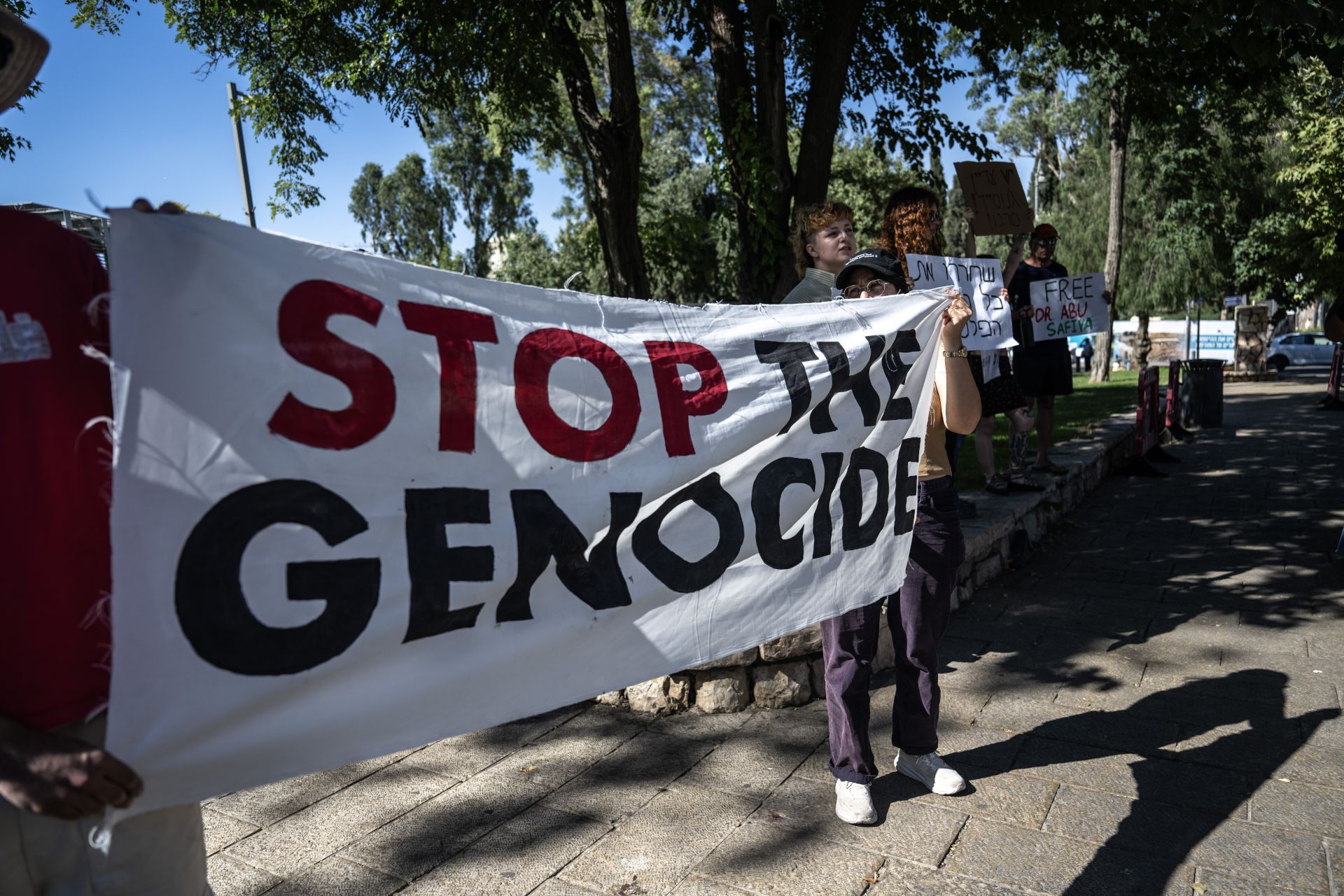
By avoiding mention of the genocide accusation as the real source of Israel’s pariah status, by using the relatively anodyne word “reckless” to describe Israeli actions that caused the deaths of around 80,000 Palestinian people (a conservative estimate), the destruction of nearly all of Gaza’s infrastructure and the deliberate withholding of food and medical aid, Emanuel is pandering. He knows that while the majority of Jewish Americans are disgusted by Netanyahu, most are having a very hard time with the word “genocide,” partly because it was originally coined by a Jewish human rights lawyer to describe the murder of 6 million Jews by the Nazis. They are emotionally connected to Israel and want to believe that it is fundamentally sound, that its problems can be solved with new leadership.
The vast majority of Israeli Jews, including those who fall on the liberal left of the Zionist spectrum, who still talk about Palestinian human rights and a two-state solution, reject the term “genocide” completely. It is absent from the public discourse and used only by a vanishingly small fraction of Jewish Israelis, most of whom identify with the non-Zionist far left. Israelis are still deeply traumatized by the Oct. 7 Hamas-led attack. The images of dead Israeli civilians have become part of the national story, while everyone knows the names of all the hostages — or at least all the Jewish hostages (several were Palestinian citizens of Israel and Thai workers). If they think about the death and destruction of people and property in Gaza, they describe it as unfortunate collateral damage in a necessary war.
But the hostages have been released, the soldiers have been withdrawn from Gaza and, incredible as this might sound to outside observers, for Israelis the war is over, despite the ongoing daily bombardments, the killings that still continue, the massive destruction and the tens of thousands of corpses. They are well on their way to memory-holing the war in Gaza. This is made easier, no doubt, by the fact that the Israeli media reported absolutely nothing of the deaths of Palestinians and the destruction, except insofar as they affected the lives of Israelis.
Two recent podcast episodes for leading liberal Hebrew media outlets demonstrate that the conversation inside Israel is entirely detached from the one people on the outside are having about Israel. In one, a Haaretz journalist and an academic who specializes in Israel’s public image in the U.S. tell the podcast host that the Iran war is the reason Israel’s image in the U.S. is at a historic low, because Americans blame Netanyahu for dragging them into it and causing a rise in the price of oil. The way to improve Israel’s image is to help Americans get to know them better, said the academic expert.
In another podcast episode, a military correspondent who repeated a commonly held sentiment when he said, during the war, that he was unable to feel compassion for Palestinian civilians while Israelis were hostage in Gaza, confirmed that the decline in support for Israel in the Democratic Party was due to “the death and destruction we caused” in Gaza. But then he moved directly to describing a bipartisan turning away from Israel. He cited the split within MAGA, with the Tucker Carlson and Nick Fuentes wing having turned against Israel while President Donald Trump objected in principle to foreign aid for any country.
At least in the second podcast, there was some awareness that the world was disturbed by what Israel did in Gaza. But while some Israelis acknowledge that outsiders are critical of their military’s actions, they don’t accept that the criticism is justified. Even for liberal Israelis, the war was a necessary response to the Oct. 7 attack, and the scale of death and destruction is an unintended consequence. One prominent Israeli journalist, a liberal who is highly critical of Netanyahu’s policies, told me angrily just a few weeks ago that Israeli soldiers (“our soldiers”) would never target civilians deliberately, or target hospitals. He then asked me to explain why civilians in Gaza never blamed or criticized Hamas for bringing the war upon them by attacking Israel on Oct. 7.
Meanwhile, Netanyahu’s Likud party is not doing well in the polls. He faces a national election on Oct. 27, one that is widely perceived as determining whether Israel will be able to claw back its status as a democracy and a member of the global community in good standing, or become a pariah state that is forced to seek friends of convenience among other rogues and authoritarians.
The prime minister might be feeling a bit desperate, if a recent campaign video that he posted to his social media is any indication. It’s an AI-generated clip that shows Gadi Eisenkot, the former chief of staff who is now a serious political challenger, running with his arms spread open through an Elysian field, toward a smiling young man who bears a remarkable resemblance to his son, who was killed in combat in Gaza. The young man is wearing a T-shirt emblazoned with the slogan “Israeli unity.” But just as they are close enough to embrace, Eisenkot runs past his son and into the open arms of Mansour Abbas, a Palestinian-Israeli politician who heads the United Arab List party. A voice-over intones, “Eisenkot can’t form a government without Yair Golan [head of the Democrats, a left-Zionist party] and the Arab parties.”
Two opposition leaders — Yair Lapid and Naftali Bennett — have vowed they will not invite the parties that represent Palestinian citizens of Israel to join a governing coalition, even if a Jewish-Arab coalition is the only way to form a government. Eisenkot has given some indication that he might be slightly more flexible on the matter, and race-baiting against Palestinian citizens is historically one of Netanyahu’s go-to tactics. It’s quite effective in Israel, perhaps all the more so since Oct. 7.
The AI clip caused an outpouring of outrage in Israel. On his social media channel, commenters called Netanyahu names like “garbage” and “filth” for exploiting Eisenkot’s tragedy for political gain. Others mocked the prime minister for showing his hand with desperate tactics. He is notorious for such tactics, but many wondered if he crossed a red line with this video.
For Israeli Jews, the tragedy of the war in Gaza is in the deaths of soldiers. For the rest of the world, it’s in the deaths of the Palestinians killed by those soldiers. There’s no reason to believe this cognitive gap will narrow anytime soon. The failure of Israelis to understand how they are perceived by the world could soon lead to real political isolation from the community of nations.
“Spotlight” is a newsletter about underreported cultural trends and news from around the world, emailed to subscribers twice a week. Sign up here.