


In December 2023, Siddharth, who asked to be identified only by his first name, had applied to 10 American universities — including New York University, Columbia, Dartmouth, Stanford and UCLA — for graduate programs related to finance and business analytics. The Indian student eventually enrolled at Brandeis University, graduated last December and now works at a management consulting firm in Boston as part of Optional Practical Training (OPT), a program that allows graduates to work in the U.S. for a limited period.
In April, he received an unexpected email from the Massachusetts Institute of Technology Sloan School of Management. After reviewing its records, the school said it believed Siddharth was “better suited” for its MBA program than the Master of Finance he had applied for and had therefore updated his profile. Siddharth had never applied to the MBA. The email informed him that he would begin receiving “tailored information” about the program and that no further action was required from his side.
The message was most likely an automated recruitment email rather than an admissions offer. But to Siddharth, it reflected a growing desperation among universities to chase international students.
Recently, a Wall Street Journal report (which informed a viral post on X by Polymarket) reignited debate over the declining prestige and utility of the MBA degree. The questions followed news that several business schools had begun offering steep tuition discounts, in some cases cutting fees by nearly half amid slowing demand, a job market increasingly disrupted by AI and declining hiring for white-collar jobs.
Falling tuition particularly reflects waning interest from international students. Poets&Quants, a publication that closely tracks the business school industry, reported in February that MBA programs had witnessed some of their sharpest declines in applications from outside the U.S., in some cases as much as 20% to 30% during the current cycle.
The phenomenon is not limited to MBA programs. A 2025 study by the nonprofit Institute of International Education (IIE), which collected data from 825 higher education institutions in the U.S., noted that the number of newly enrolled international students had dropped by 17% across programs in the 2025-26 academic year. Another study put that number at 20%.
They attributed this decline to the uncertain immigration environment under the second Trump administration, which has been discouraging prospective international students from attending U.S. universities, including by putting in place more stringent visa vetting procedures. The IIE study said that almost all schools (96%) cited visa concerns as a factor, and 2 out of 3 blamed declining attendance on travel restrictions.
In the last year, the rise in visa delays and rejections, proposals to cap the number of international students at universities and the revocation of some student visas have added to uncertainty around student life in the United States.
The administration is now considering another rule change: imposing fixed timelines on student visas. Previously, international students could remain in the U.S. for as long as they maintained full-time enrollment status.
Concerns have also grown over the fragility of the post-study work pathway, which starts with OPT. In 2025, a bill was introduced to eliminate OPT, while another — the bipartisan “Keep Innovators in America Act,” introduced earlier in March — seeks to formally codify OPT in U.S. immigration law. Recently, Immigration and Customs Enforcement announced that it had identified more than 10,000 cases of fraud in the OPT system involving employers and students.
The H-1B visa system, which enables skilled foreign workers to remain employed in the country long-term, is also under threat. Last year, the administration introduced greater restrictions and costs for employers hiring foreign workers, including an unprecedented $100,000 fee for new H-1B applicants from abroad. On social media, the American right wing has been incessantly targeting the visa program, arguing without evidence that foreign workers are displacing American employees.
These restrictions have made the high cost of an American MBA — or any graduate program — harder to justify, as international students pay full tuition and are largely ineligible for financial aid. For many of these graduate students, most of whom are from India, a higher degree has long served as a pathway to immigration and employment in the U.S. As that pathway is closed or becomes restricted, the incentive to study in the U.S. diminishes.
International students have also long subsidized the modern American university and cushioned the effects of decline in domestic enrollment and escalating operating costs. They have also reduced universities’ dependence on federal funding. But this buffer is now weakened, and the financial model that supported large parts of U.S. higher education is experiencing strain. Last year, credit rating agency Moody’s warned that falling enrollment could present a credit risk for some schools.
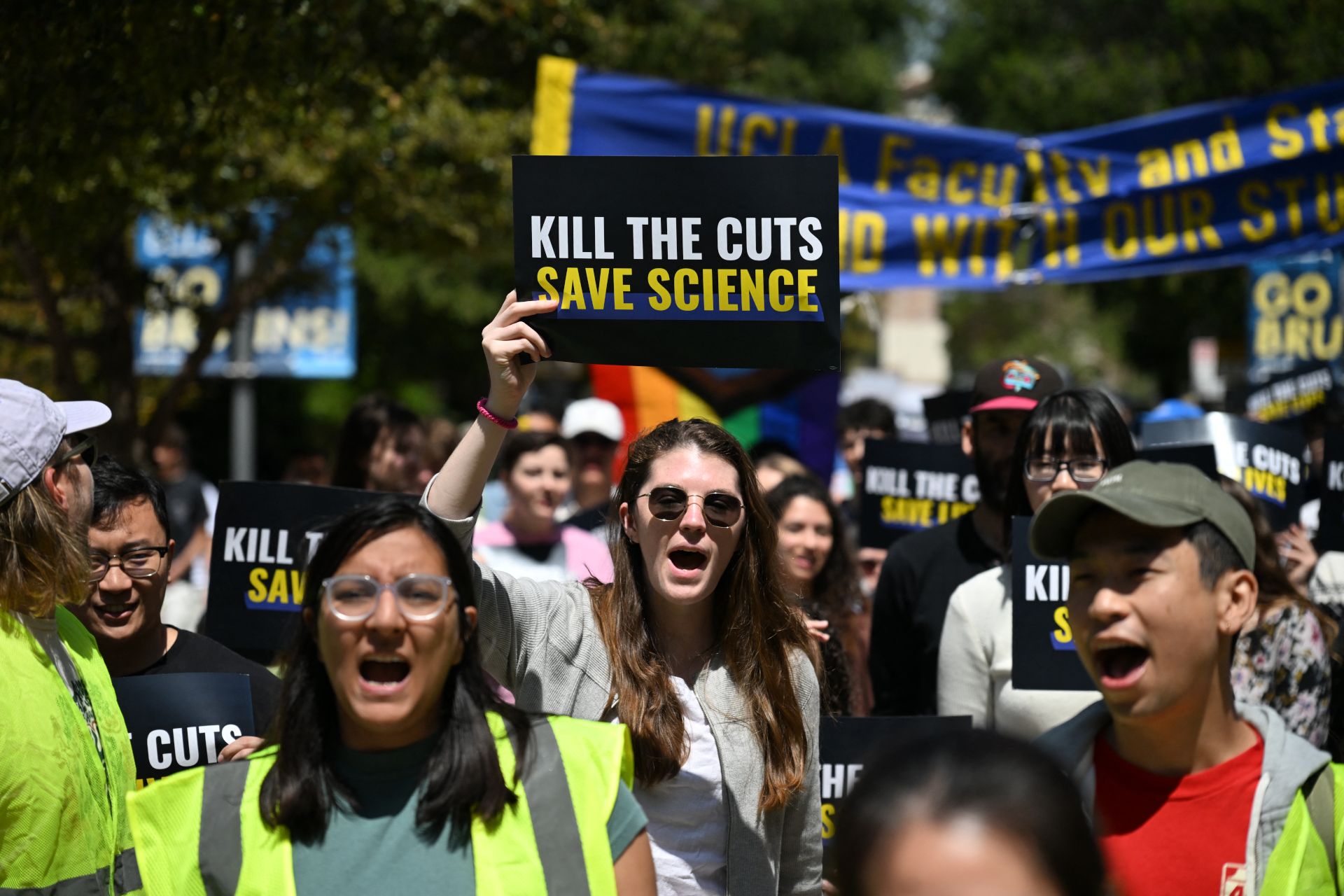
The hit to MBA programs has, in fact, been mild compared to what’s been unfolding in liberal arts and science schools. Hundreds of graduate and doctoral programs have been cut across universities. They have frozen hiring and are undertaking mass layoffs, orchestrated with the help of consulting firms. Last week, it was reported by The New School Free Press that The New School in New York plans to conduct mass layoffs of up to 20% of its full-time workforce.
While there are no nationwide trackers, Inside Higher Ed tracked more than 9,000 job cuts and buyouts in 2025, which it said was an undercount due to unreported personnel actions. The journal Science said that the U.S. government had lost more than 10,000 employees with doctorates in STEM last year, amid reports of scientists leaving for universities in Europe, Australia and Asia, where many institutions are offering “scientific asylum.” A survey by the American Institute of Physics said that departments across the U.S. are shrinking cohorts and limiting funding guarantees.
Last year, students at Montclair State University, New Jersey’s second-largest public university, held a mock funeral outside its College of Humanities and Social Sciences building, with tombstones inscribed with the names of the school’s 15 departments, including English, history and sociology, to protest the university’s plan to consolidate them.
In Indiana, legislation forced its public universities to cut or consolidate some 400 academic programs, with most in the humanities and social sciences. The University of Chicago has paused graduate admissions for nearly all its humanities programs. These are just a few examples of what is unfolding across the U.S.
In fact, the Master of Arts program that I pursued at Columbia Journalism School has paused admissions for its business and science concentrations, amid rumors that the entire program may be paused in 2027. Recently, the Dart Center for Journalism and Trauma, which operated out of the school for 15 years, lost the funding it needed to stay there (its work is continued by the independent Global Center for Journalism and Trauma).
Humanities programs are being shuttered, science labs are being hollowed out and business education is being reshaped in the U.S. — all under the combined pressure of declining international enrollment, shrinking federal funding and an increasingly hostile political environment. American universities are hurting, but who is paying attention?
“Spotlight” is a newsletter about underreported cultural trends and news from around the world, emailed to subscribers twice a week. Sign up here.