


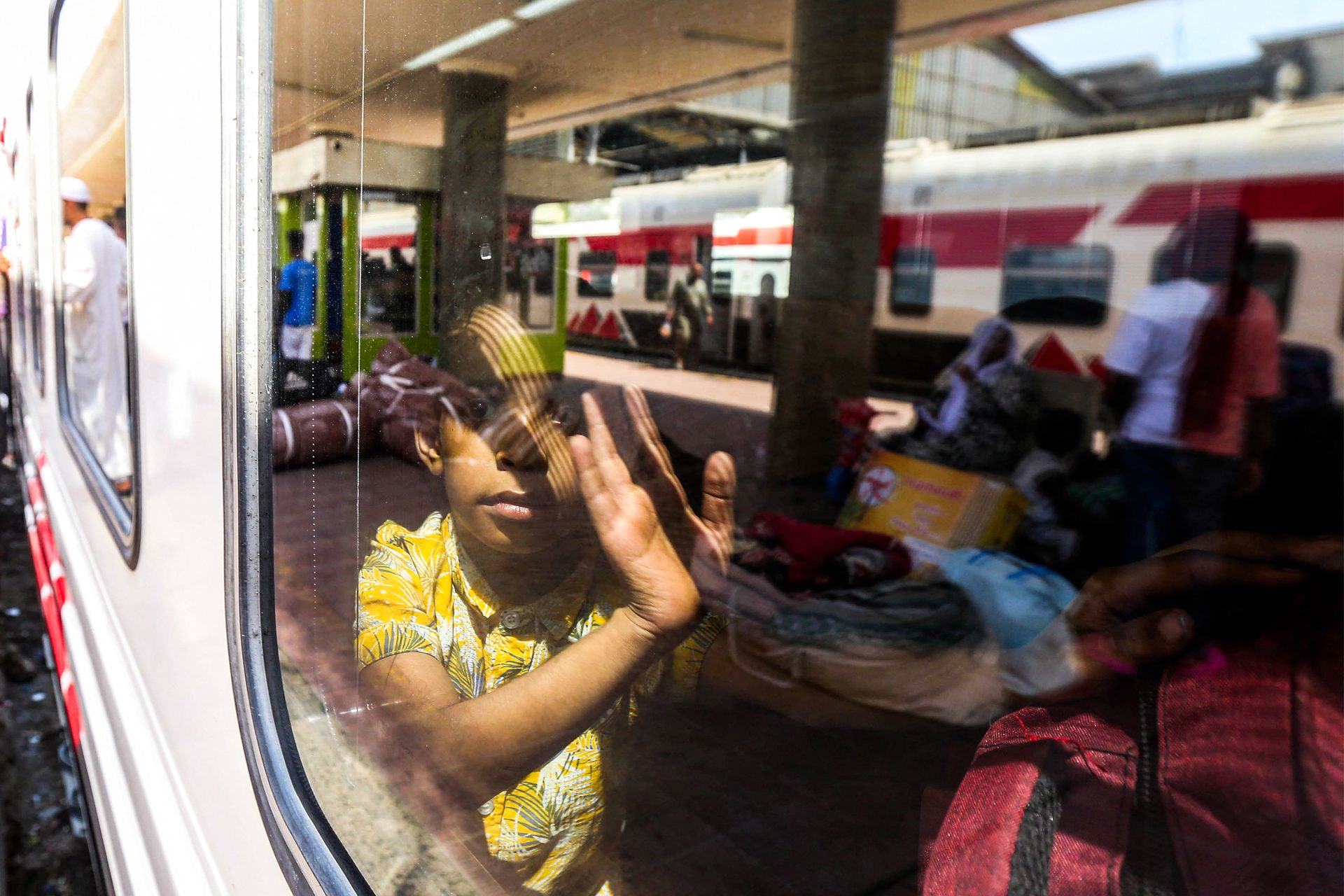
Dr. Adel spends his days putting out fires and problem-solving amid the day-to-day realities of life for refugees: finding food for families without any, convincing landlords to rent homes to the dispossessed without papers, many of whom are already homeless, and overseeing a series of makeshift schools he and his team of volunteers have strung together as part of the community center they run in the suburbs of Cairo.
But it’s on the night shift that he encounters the worst problems. From 8 p.m. to 1 a.m., he works at a windowless three-room clinic, where he sees roughly 60 patients per night — all Sudanese refugees who moved to the neighborhood after having fled the war in Sudan. On any given shift, he treats an array of physical ailments, including deep wounds, tuberculosis, diabetes and acute hypertension, but he finds the most difficult injuries are mostly invisible: the wounded psyches of those who have experienced terrible violence, often over and over again.
Many of those who survived the perilous journey are suffering from chronic trauma. Nightmares, anxiety, depression, post-traumatic stress disorder (PTSD), paranoia, self-harm and suicidal ideation are common. He sees, on average, 3-4 suicide attempts a day.
Since the war in Sudan began in 2023, more than 13 million Sudanese have been forced to leave their homes. At least 1.5 million of these displaced people have streamed across the border into neighboring Egypt, making it the primary destination for those fleeing the world’s largest displacement crisis. But in May 2025, having received less than 30% of the funding required for operations in Egypt, the United Nations’ refugee agency, the UNHCR, eliminated nearly all nonemergency medical care, and most housing and cash assistance — effectively dissolving an already fragile safety net for survivors of a war that the U.N. has said bears the “hallmarks of genocide.”
Other nongovernmental organizations and community initiatives have struggled to fill the void. But they, too, have been affected by a global aid shortfall and the gutting of USAID under President Donald Trump. Abandoned by the international community and left to fend for themselves in Cairo’s overstretched urban landscape, with Egypt already hosting an estimated 10.5 million refugees, a generation that escaped ethnic violence and the siege of El Fasher is being lost to a hidden mental health crisis.
Omar Nourain, 21, is one of a growing number of uncounted casualties of the war that occur long after the border is crossed. One night at dusk in December 2024, fighters from the Rapid Support Forces (RSF), a Sudanese paramilitary group, burst into the family home in the Nuba Mountains. As they scrambled to find a place to hide, the fighters grabbed Omar’s aunt. “My sister was beheaded. They beheaded her in front of us,” Omar’s mother, Amal, told me. The family fled that night.
But in June 2025, after less than six months in Egypt, Omar jumped to his death from the family’s apartment in Cairo — paralyzed by PTSD so severe that he would stop eating for days at the sight of any man in uniform. “We were normal before this, before the war happened,” Amal said, tears falling down her face, etched with the quiet agony of a mother unable to save her child. The pain of her grief filled the room, and we fell silent. The windows were open, and we heard the chatter and laughter of a group of young Sudanese boys kicking around a soccer ball outside. It began to rain a little, and the boys started cheering with excitement. One of them stretched out his arms, twirling in delighted circles and opening his mouth to catch a few drops of the drizzle. Watching these children, who have likely also seen terrible things before they came here, enjoy this moment of simple happiness was both a relief and unbearable at the same time. I couldn’t help but wonder what would become of them.
I asked Amal what Omar was like before that terrible night, and she described a boy who was outgoing and always smiling. He had dreamed of being a pilot, and she had been diligently saving, contributing to a “gamaya” — a traditional money-saving circle — to cover the cost of flight school tuition.
But in the months leading up to his death, Omar’s mental state was spiraling. He spent most days holed up alone in his room, eating little and seeing no one. Amal would go into the room around noon every day to check on him and open the window to let in a little fresh air, the only connection between him and the outside world. He would tell his older sister that he wanted to die, but worried about leaving their mother alone. The family tiptoed around him, careful not to talk about anything he might find upsetting when he was in the room. Amal also told her nephew — the son of the deceased woman who lives nearby — not to visit, knowing that he reminded Omar of his aunt’s death. “I told him, ‘Please don’t visit, because I don’t want my son to be gone like your mom,’” she said.
When Omar became aggressive, she took him to a psychiatric hospital where he stayed for three months. She said that upon his release, the doctors told her his mental state was fragile and to try to keep him away from anything that might trigger him again. But everyday sounds, like children playing with fireworks or cars backfiring, would send him into a state of panic. “He would shut down if he heard these sounds,” she told me.
After his death, the family moved, finding it too painful to stay where he ended his life. Even so, Amal can’t bring herself to stay at home or in one place for long. She moves around instead, staying with friends. Often, she sleeps outside the UNHCR building. “Home for me now is a very difficult place,” she said. “I see him everywhere.” Amal worries for her other children. Omar’s brother Hossam hasn’t been the same since he died; the boys were best friends as well as twins, inseparable since they were small. Hossam would sit with Omar for hours, trying to soothe his despair. Amal told me that since Omar died, Hossam had stopped seeing friends and spent most of his time in seclusion, while her daughter divorced and came back to live with them.
Attitudes to mental health have shifted significantly in Egypt in recent years, and talking about psychological distress has become a more normalized part of the mainstream public conversation. But in the Sudanese community, there is no language to talk about mental health or what people have been through in the context of the war. “For us in Sudan, mental health awareness or psychology is not something that is widely discussed, so we don’t talk amongst ourselves about mental health issues,” Adel told me.
Stigma remains one of the biggest barriers to treating the current crisis. “For someone to be described as mentally ill, this is such a shame in our community,” he added. “People will be afraid of you. They won’t sit with you. No one will hire you or marry you.” Talking about rape is considered particularly shameful, and there is an expectation of silence about even the most shattering experiences. This adds a further layer of pressure, given that rape has been systematically used in the war at a scale that the U.N. has called “staggering.” Adel sees firsthand how shame keeps people frightened and isolated. “Even though thousands of people have experienced sexual abuse, it’s still considered shameful to talk about, even within the confines of families,” he told me. But how does a community that has experienced such devastation begin to repair itself, if it’s shameful to discuss all that has been lost?
If mental illness is frowned upon, suicide remains the ultimate taboo — both religiously forbidden and socially unacceptable. For many, it remains difficult to acknowledge that a member of the community took their own life. I have noticed that when discussing suicide, people will often say someone “fell” instead of “jumped.”
Adel is 31 years old. Originally from Darfur, he arrived in Egypt in 2020 and is well acquainted with the panorama of losses his patients are facing. He was 11 when his village was raided by an armed militia during the Darfur war in the early 2000s, and his father was kidnapped and held for two years. During those years, as the family searched for his father, going from village to village inquiring as to his whereabouts, his grandfather succumbed to tuberculosis because there was no hospital nearby equipped to treat him. His 6-year-old sister died of malnutrition in the internal displacement camp where they were living, and it was then, he told me, that he decided to become a doctor.
He also understands how trauma inevitably follows refugees, having faced his own mental health struggles. In 2023, he was watching the war from abroad and trying to assist people arriving at the center who had recently fled, while also inundated with messages about the brutality that was unfolding at home, where most of his family still is. He became overwhelmed, falling into a deep depression. “The situation was miserable, people were sending us pictures showing: ‘This person is a relative, we lost our relative.’” It was during this time that he was able to connect with an Egyptian psychiatrist, whom he speaks of warmly and who treated his depression. They are still in touch, and he now refers cases to the same doctor for treatment.
Adel has been running awareness sessions at the community center on mental health to educate families that mental distress is both normal and treatable, in an attempt to encourage people to speak up and seek help. He also runs activities where he speaks to young people about the need to talk about what they have experienced. He told me he believes that educating the community, combined with early treatment and ongoing access to mental health support, is essential to preventing the trauma and psychological distress people have experienced as a result of the war and its aftermath from turning into chronic mental health conditions that become severe and much more difficult to treat.
One day, while I’m in the neighborhood, I meet a rare success story: a woman who sought psychiatric treatment in Egypt against the wishes of her family. Amira is 29 years old and from North Kordofan, and is being treated by a psychiatrist. “I reached a point where I was going to commit suicide,” she told me. But since she was able to get help and take medication, she is doing better. Amira had ferried her mother, who has Alzheimer’s, into Egypt for medical treatment and suffered a series of abuses on the way. At the same time, her children were not in school because they hadn’t yet received their U.N. cards, which often take months and multiple UNHCR appointments to receive. The situation was overwhelming. Unable to afford private mental healthcare, she tried to access treatment for more than a year before the UNHCR sent her to a psychologist. During the one session with a psychologist, she was diagnosed with depression and anxiety. The doctor promised to follow up for more sessions, but she said that nothing happened. Adel eventually connected her to a psychiatrist, which she credits with saving her life. Still, when she told her father that she intended to see a doctor, he advised her against it. She told me that changing attitudes within the community is crucial to helping people like her seek out treatment without the fear that they might be rejected by their own families.
Since the fall of El Fasher in October 2025, the number of new arrivals needing housing and mental health support has surged. Asem Afify, who leads a mental health team at an NGO in Cairo, says there has been a 30% increase in the number of people needing help since the city fell to the RSF. At the same time, his agency has been affected by USAID cuts and has had to reduce its staff and services by more than a third. They operate housing and mental health hotlines, both of which are inundated with thousands of calls a day — many of which go unanswered because they are staffed by a skeleton crew.
Just as funds have been cut and support is more difficult to come by than ever, the newest arrivals are some of the worst off. Many women have come alone or with their surviving children; their husbands are dead or missing. While the UNHCR previously had three offices in Cairo to process applications for yellow and blue cards — which give refugees legal status to access basic services and the ability to legally rent homes — cuts have shuttered two of these. Until recently, 4,000 people were lining up outside the one remaining office every day. To have any chance of getting inside the building, many people sleep outside the night before. While those numbers are easing, the UNHCR’s funding shortfall remains critical. As of April, the agency said that without extra funding it will be forced to cancel the limited remaining cash assistance for the most vulnerable families, including households headed by women.
Merna Ibrahim is one of them. “In El Fasher, they were murdering people in front of us,” she told me. Her husband was among them. “I don’t know where he is. They shot people in front of us, and they all fell in a ditch.” After that, she spent a year during the siege hiding in holes underground with her children, as the RSF relentlessly shelled and starved the city, finally arriving in Egypt in December 2025.
But the journey to escape Sudan was no less harrowing. She and the children were repeatedly assaulted on the road by RSF fighters. “I was raped more than once.” At one point, fighters raped her while her children looked on. “I wanted them to kill me instead of having my children watch, but they refused to kill me.” Later, they were again stopped by fighters who demanded money. When she told them she didn’t have any, they replied, “Okay, you don’t have money — we will take two of your kids.” When she protested, they beat her eldest son, who is 17 and has kidney problems, until he was unconscious. Thinking he was dead, the fighters left.
Days later, she and the children hid among piles of corpses, pretending to be dead to evade the attention of the RSF. “All of our clothes had blood on them,” she told me.
They also faced repeated drone and aerial bombings. People would run in every direction. During one scramble for shelter, she lost her children, only finding them in another town three days later.
After leaving El Fasher, they spent two weeks walking to find somewhere they might access transportation. She thought of walking to Libya to try to get on a boat to Europe, but she had no money, so she decided to try to get to Egypt. Maggots had invaded her eldest son’s wounds, and the other children could barely walk, telling her they didn’t want to go to Egypt and that they would “rather die and be at rest.” Seeing their sorry state, passersby helped her carry the children and collected money to pay for their passage to Egypt.
Eventually, she connected with Adel and the other volunteers who rented her an apartment, giving her mattresses and blankets. “The apartment is very cold; we sit on the floor. The mattresses are all usually wet because of humidity,” she told me. She sweeps the streets to earn money to feed her children, but it’s not enough to even cover food. She became distressed while explaining that to get some salt, “I go to a restaurant, and they give me some for free.”
For Merna, given everything she endured to get her children to safety, it’s especially painful to watch her eldest son, Mohamed, spiral into suicidal ideation without access to care. Often, he has episodes where he doesn’t recognize who she is, telling her “he’s finished” and that he wants to die. He’s 17, but physically he looks much smaller. Many of the children in the neighborhood act out the violence they saw in Sudan, and Mohamed has begun hurting other children. Recently, Merna went to the UNHCR pleading for psychiatric care for him. “They told me: ‘Leave, we will call you,’ but they didn’t call.” When I checked on her a week later, she told me that a worker from one of the most active NGOs dealing with mental health issues came to visit Mohamed but found his case complex and beyond her capabilities. “She came and met with him and was deeply emotional after meeting him and said they would take care of it, but nobody came.”
The other children are also mentally unwell, existing in a state of extended terror; they don’t leave Merna’s side. If she tries to leave the house to buy food, they think she won’t return and beg her not to go. They talk in their sleep, saying things like, “Please don’t hurt me; please don’t kill me.” Her 14-year-old wets the bed, screams in his sleep and runs to hide if anyone knocks at the front door. The younger children are too scared to go outside, fearing they will be detained and returned to the war. While Merna believes that they can never forget what they have seen, she says they urgently need help to live with it. “We have scars on our hearts.”
Before the war, she was a high school math and science teacher. The only physical item she was able to take with her from her old life is a plastic file containing her degree and teaching certificates, which she carefully preserved by burying them in a bucket underground. She wants to teach again, but suffers from chronic pain as a result of untreated injuries she sustained when she was raped.
Merna finds herself struggling to carry on, wading through grief that she has neither the time nor space to process. She told me she is haunted by memories of the children she passed on the road as she was fleeing, still alive but stranded next to their dead parents — many of them babies and toddlers — and how she couldn’t rescue them, barely able to manage carrying her own five children. “Many times I think to myself: Death is much more merciful than this,” she said. But then, looking over at her children, she added, “But there’s no one else to look after them, so I try to be patient.”
Merna has been dogged in her attempts to access care for her children. But like many others I have met, her situation illustrates both how urgently mental health support is needed, and that without their basic needs being met, such as having a secure place to live and food to eat, it will be impossible for these refugees to get out of survival mode, let alone have any real chance of healing.
Mahmoud Hussein, a father in his 60s, is still wearing the same set of clothes he arrived in Egypt with in April 2025. He was forced to leave Sudan after RSF fighters raided his home in Khartoum, raping his wife and repeatedly beating his two teenage sons on the back of the head with their rifles. Doctors told him they suspect the severity of these blows may have caused the brain to smash into the sides of the skull, triggering the PTSD and schizoaffective disorder the boys now suffer from. Without money to pay for an MRI and other recommended tests, Mahmoud is unable to confirm this diagnosis. “The war ruined my children,” he told me through angry tears.
Mahmoud is also deeply in debt to his landlord, to whom he owes more than a year’s rent. While the landlord was initially sympathetic after seeing the condition of the boys, the situation has become tense. “Whenever I go home, I am shaking because I owe this debt,” he told me. Although the family receives a small monthly stipend from the UNHCR of 2,300 Egyptian pounds [$44 at the current exchange rate], it’s not enough; Mahmoud spends his days begging on the streets for money from other Sudanese to buy food and cover the cost of the psychotropic medications the boys require. Often, he comes back empty-handed, and the children have to sleep hungry.
Mohamed Naggar is a community leader who has been living in Egypt for two decades. He told me that the situation has never been this dire. “Imagine someone is living a good life and then suddenly they lose everything. They are homeless,” he said, explaining that this was the reality for many from Khartoum who had never before experienced war. “This causes people to want to end their lives.” All of the community leaders, mental health workers and refugees I spoke to agreed that as the war dragged into its fourth year, the unremitting violence, combined with the lack of financial and medical support, was creating a desperate situation for people already pushed to the limits of endurance.
One night last week, as the sun was setting, I visited Adel at the clinic where he works. His shift hadn’t started yet, but patients had begun to trickle into the waiting room. I met his boss, a portly, improbably jovial man who came to Egypt from Sudan a decade ago to complete his master’s degree. Despite getting offers to open a clinic in a middle-class area, he stayed on, telling me simply that there was no one else.
Α grisly scene unfolded while I was at the clinic. A 30-year-old man had been brought in. He had attempted to take his own life by slashing his wrists. Adel’s boss returned from the next room after attending to the man’s injuries. The room was cramped and, as he stood next to me, explaining with resigned matter-of-factness the man’s inability to take care of his family and the desperation that followed, I could not help but notice that his fingernails were still stained with the man’s blood. “This is what happens,” he told me, grinding his hands together over and over, while repeating a single word: “pressure, pressure, pressure.”
The toll is immense. I asked Adel how he continues. “There’s nothing humanitarian about this,” he told me. Many of the volunteers who work with him at the community center now need mental health support to cope with the stories that they hear from the people they are trying to assist. He is also struggling to carry on.
Perhaps the only remotely hopeful part of this horrific war is the remarkable civic spirit of the Sudanese people themselves, who have mobilized grassroots efforts to aid their community at home and in the diaspora. I notice this spirit among all the people I meet, but particularly among those from Darfur. When I asked a Darfuri who runs an NGO in Europe about this, he suggested that perhaps their past experience with war has left them resigned to the reality that no one is coming to help — and so they have had to become their own last resort. But looking at Adel and his dedicated colleagues, it could not be clearer that despite all that they have survived and their relentless efforts to organize themselves, they are running out of time.
Names in this article have been changed at the request of sources because of privacy concerns.
“Spotlight” is a newsletter about underreported cultural trends and news from around the world, emailed to subscribers twice a week. Sign up here.