

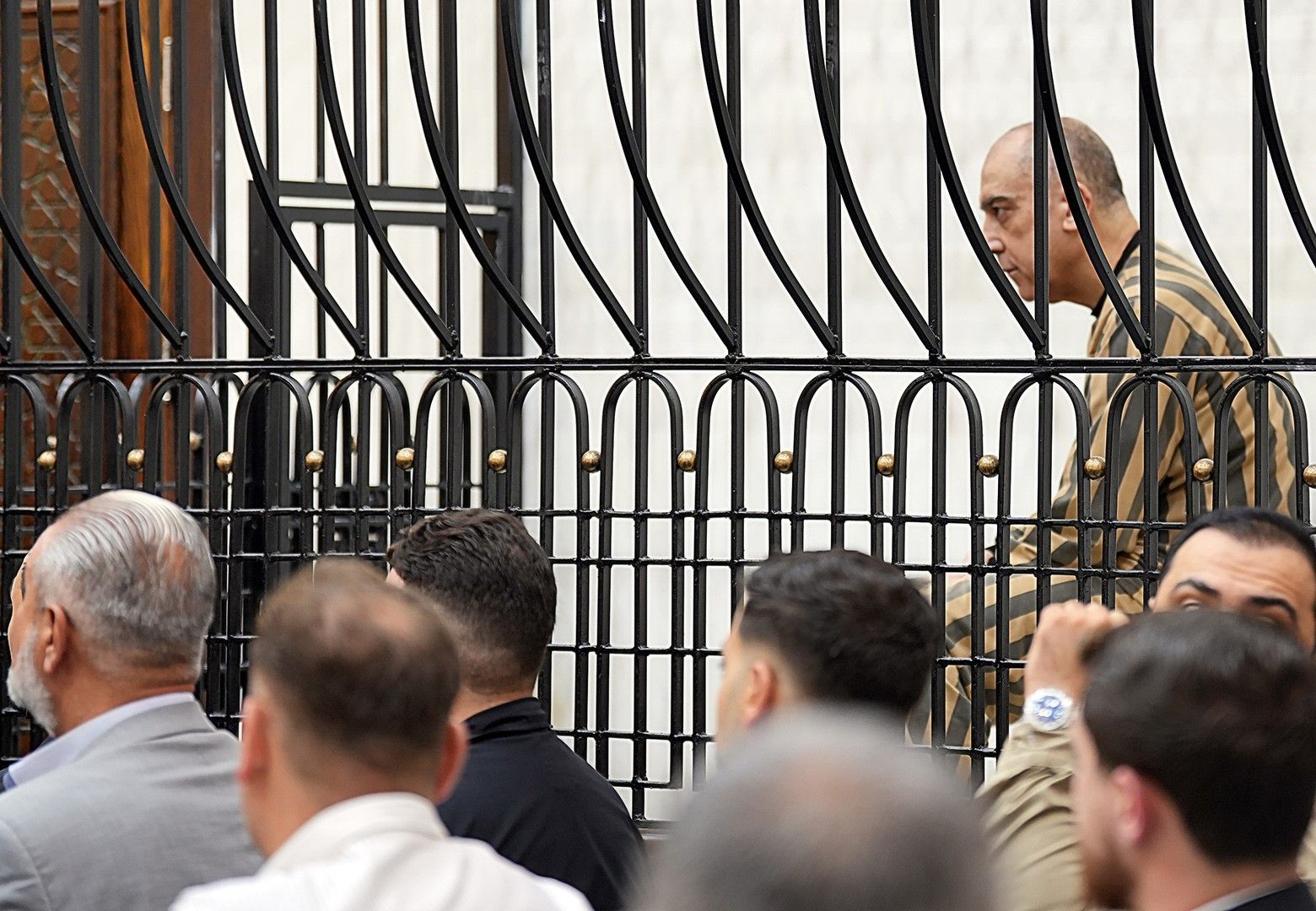
On Tuesday, Aug. 11, the 4th Criminal Court in Damascus sentenced the country’s deposed president, Bashar al-Assad, to death, along with his brother Maher and seven security officers who had served the family, chief among them Atef Najib. All were convicted of violations and crimes committed in 2011.
For Mouawiya Syasneh, the verdict brought back memories of the day he stood in front of Najib as a 15-year-old detainee. Najib ran the Political Security branch in southern Syria’s Daraa in 2011. Syasneh had written “Your turn has come, doctor” on a wall in Daraa al-Balad, a reference to the Syrian dictator and to the ongoing Arab Spring protests at the time. The words helped instigate the early protests of the Syrian revolution.
The adult Syasneh has never lost the painful memories of his childhood arrest. “They tortured me and the boys at the Political Security branch. Electric shocks. ‘Shabah’ [suspension of the body by the wrists from an iron chain]. Hanging on the walls for hours. Many other forms of humiliation and degradation,” he recalled. “Though we never understood where all that hatred came from.”
Fifteen years on, Najib sits inside an iron cage and listens, while his victims speak.
For Syrians, Najib’s name is linked to the regime’s very first abuses against the revolution. In March 2011, he arrested 15 schoolboys and had them badly tortured for writing anti-Assad slogans on their school wall. He had run Political Security in Daraa since 2008 and, as Assad’s cousin on his mother’s side, he enjoyed unusually wide powers and security clout. He also directed the security operations against the peaceful protests that followed.
Syasneh described his testimony before the court. “Atef began by denying that he had anything to do with the case of the ‘Freedom Boys.’ I was one of them. So our testimony was backed by paperwork found at the branch with our names on it. They had forced us to fingerprint the blank sheets. We didn’t know what they wrote or why they made us do that.”
“I told the judge everything,” he went on. “I had documents proving that Atef had held me. After I spoke, he admitted that the other boys and I had been detained for 48 hours. I called that a lie to his face. I described how they tortured us, and how he had me move from one security branch in Daraa to the next.”
“He arrested me 15 years ago when I was a child. My dream came true and I’ve watched him stand trial. Now we want to see Atef, Bashar and Maher on the gallows.”
Standing in front of the man who once imprisoned him, Syasneh said he felt two things at once: elation at seeing one of the regime’s most notorious figures in the dock, but also grief for the friends and the thousands of others killed over nearly 14 years of Syrian revolution.
Hamza al-Khatib was the first child killed in the Syrian revolution. He died in the cells of the Political Security branch in Daraa on May 25, 2011, after a month of detention and heavy torture. His brother Hussam called the day of the verdict “the morning of transitional justice in Syria.”
“This is a joy for us and for every Syrian to see Atef Najib get what he deserves,” the brother told New Lines. “The verdict is a turning point,” he added. “It’s the first major trial of the deposed regime’s figures, and it sets accountability, not revenge, as the principle. These were war crimes, crimes against humanity. Najib ordered the storming of the Omari Mosque. He’s responsible for the killings that followed and for the torture of children. His hand was in a great deal of it. The court’s decision is a historic moment.”
Al-Khatib called for the net to be widened and the trials sped up, so that everyone accused of abuses, everyone with Syrian blood on their hands, is brought to court.
He wished to be there when Najib, the man who killed his brother, would be hanged.
Inside the Palace of Justice, the celebration began within minutes of the announcement. The mothers of murdered children and other victims ululated in the corridors. Hundreds gathered outside carrying photographs of their dead and Syrian flags, chanting the slogans first heard in Daraa in 2011, commemorating the start of the uprising.
Syrians also marched through the streets in Damascus, Hama, Tartus, Latakia, Idlib and Deir ez-Zor. They read the verdict as retribution against the regime’s criminals and as formal notice that the trials had begun.
Abdulrahman Farhoud, one of the revolution’s best-known singers from Hama, called the sentences a first step toward transitional justice, a recognition of what the victims’ blood was worth and a move toward trying every remaining criminal associated with the former regime.
Farhoud urged governments abroad to hand the regime’s wanted security officers over to Damascus so that they could face trial.
The elation on the streets at the verdict contrasted with critiques by human rights activists. The Syria Justice and Accountability Center, a monitoring group, said the trial was historic but “exposed major flaws in the justice system which likely jeopardized [Najib’s] right to a fair trial,” including rushed proceedings and testimony unconnected to the allegations against him, as well as threats to his defense lawyer. Hiba Zayadin, Syria researcher at Human Rights Watch, said the scenes outside the courthouse “reflect 15 years of pain and a justice long denied” but that the organization opposed the death penalty and said Najib’s appeal must meet “fair trial standards.”
The Syrian justice ministry defended the verdict, saying the trials were held before a specialized civilian criminal court, conducted by qualified judges and attended by victims and their representatives in accordance with legal procedures. It said the proceedings observed constitutional and legal safeguards as well as relevant rules and principles of international humanitarian law and international human rights law.
Muhammad, a Hama native in his 30s, thought the verdict came late, more than a year and a half after Assad fell. He wanted the government to move faster so that people across the country could recover what was taken from them.
Still, he said, the ruling puts the rule of law back at the center and gives victims redress through the courts rather than outside them. He hoped that justice would eventually reach everyone who wronged Syrians, from the men who made arrests and looted houses to those who killed, massacred and destroyed property.
Amer, a Damascene in his 60s, argued that the executions should be carried out in the city’s public squares, before the eyes of the victims’ relatives — those who lost their sons and watched their homes come down. He wanted every perpetrator who caused the uprooting of Syrian families pursued, in Syria and abroad. “Our joy will not be complete,” Amer said, “until Bashar al-Assad and his brother Maher are brought to account here, in the squares of Damascus.”
Syrian social media has been filled with photographs of civilian victims and of Hamza al-Khatib, placed beside the image of Najib in the dock as the sentence was read out.
“Spotlight” is a newsletter about underreported cultural trends and news from around the world, emailed to subscribers twice a week. Sign up here.