


The long roads leading out of the center of the Syrian province of Hama wind up and down along the Sahl al-Ghab, the forested plains that crown the northern part of the province. Large fields in various shades of green meet the eye, the path lined by pink blossoms marking the long-awaited Syrian spring.
Hassan Duleybi calls Sahl al-Ghab his home. He lives in Jamasat Udayat al-Sharia, a village of rows of gray cement houses, interspersed with the occasional grazing cow or goat. Children play on streets peppered by shadows of leaves under the sun, their laughter ringing out against a background of chirping birds. Duleybi’s compound, however, is home to another sound — less frequent but nonetheless familiar to people of al-Sharia — the croaking of frogs.
In September 2025, Duleybi set up the first frog farm in Syria in his village, less than a year after the ouster of Bashar al-Assad ended decades of dictatorial rule over the country. A few steps away from his home is a large frog pond barricaded by blue tarp, home to hundreds of thousands of the slimy green amphibians.
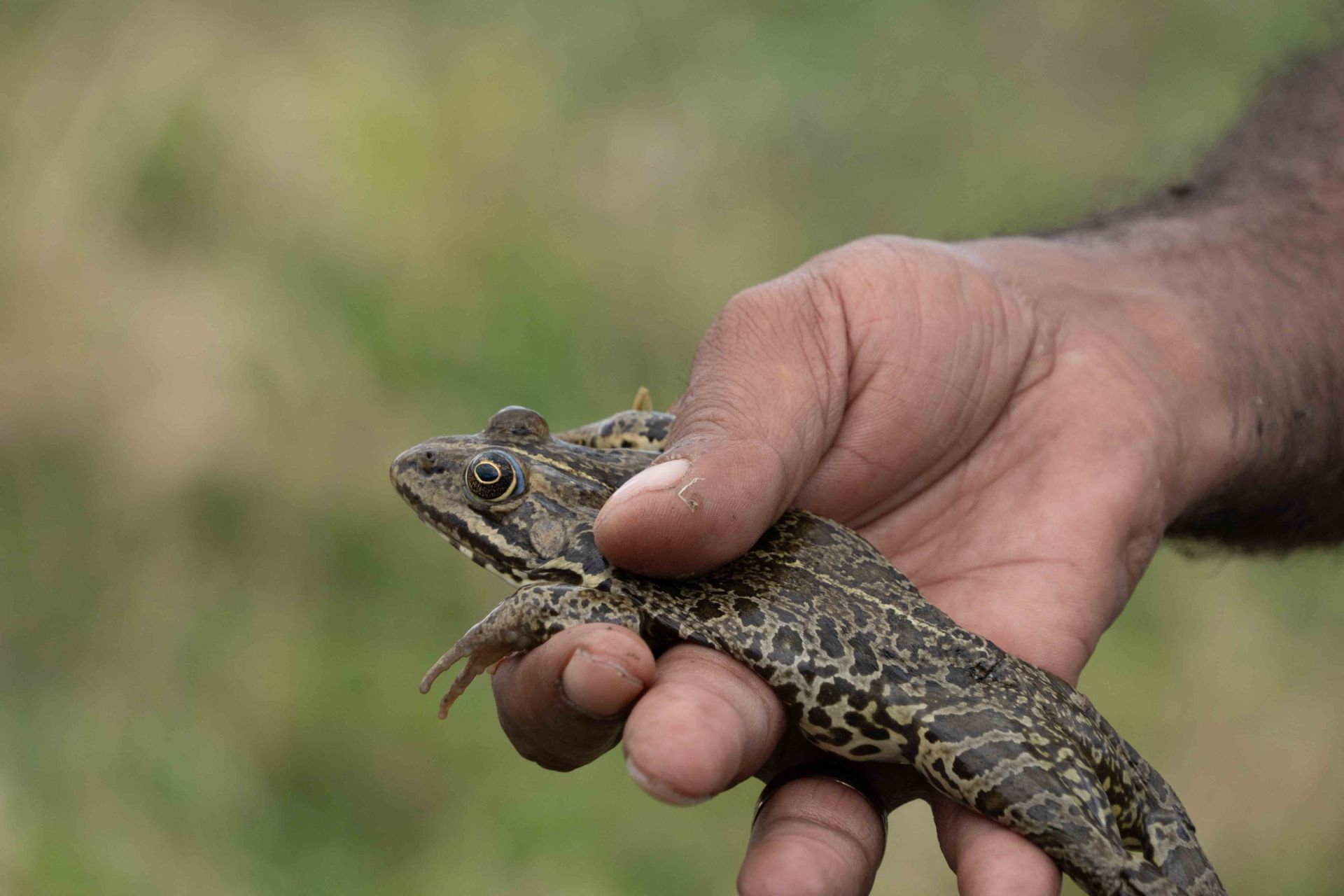
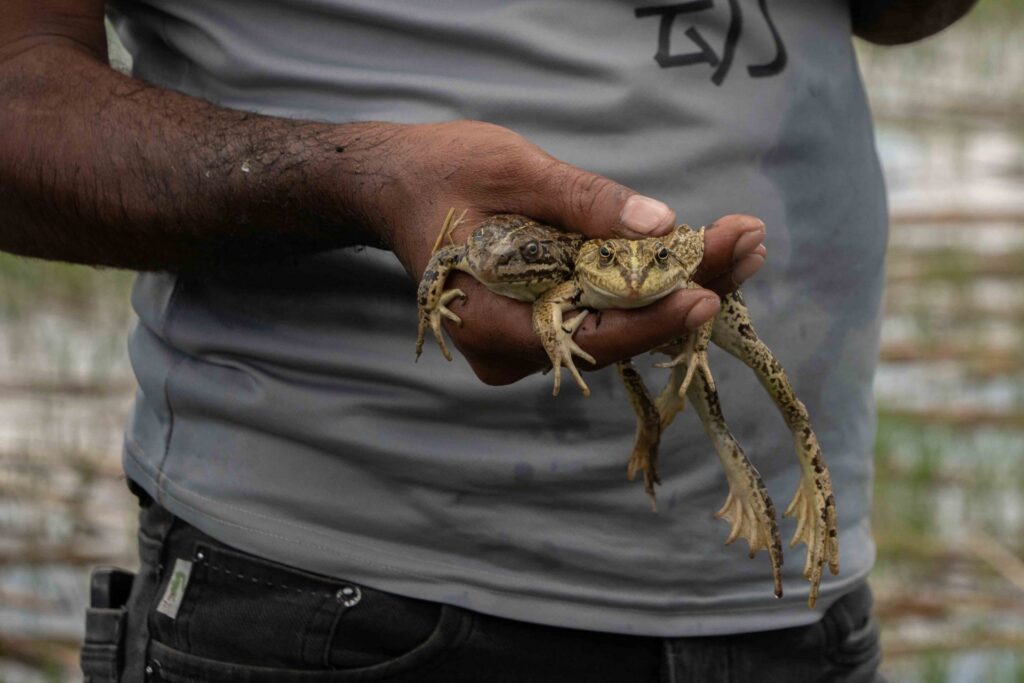
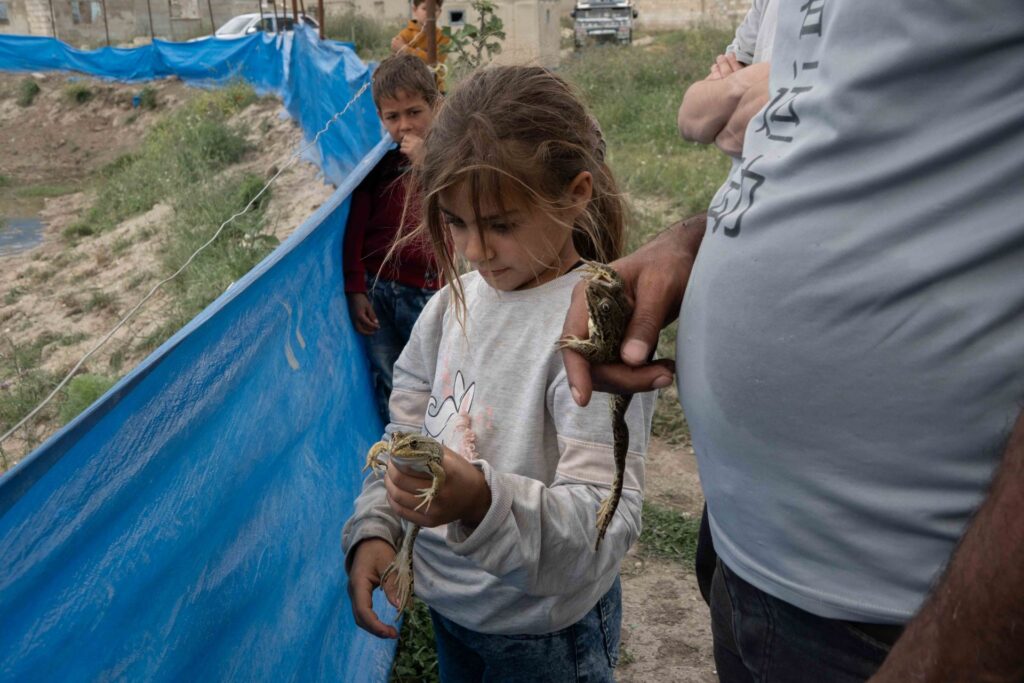
“They are so easy to manage. They don’t do anything,” he says, picking a couple of them up. I keep my distance as I photograph them.
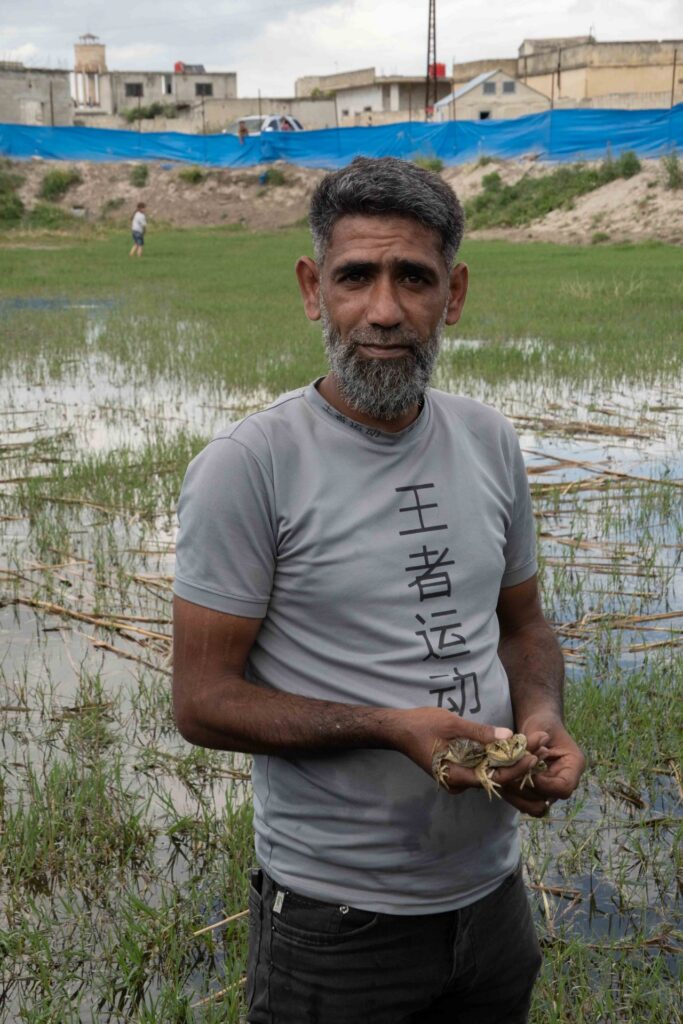
Duleybi first realized how lucrative the frog farming industry was when he was displaced from Syria to Turkey in 2014. After working in the industry for five years, he returned to his home country in 2019, working with the general security forces under the self-styled “salvation government” run by opposition factions in northern Syria. Once the Assad regime fell in December 2024, Duleybi returned to his home village and found, alongside utter destruction, an excess of an animal he was certain could change his life for the better.
“I saw that the frog population was very high in our al-Ghab area. We were even seeing them on the roads,” he explains. “So I built this pond.” He says that on other land he owns, he has made three more ponds, each roughly half an acre and able to hold about 20 tons of frogs.
Duleybi uses his three other ponds to breed the frogs. Mating is a chaotic process — often, male frogs gather around a single female to mount her, forcing her to play dead to ward off some of the competition. The incubation period for frogs is short, just over two weeks, after which tadpoles emerge from the eggs.
“For about the first three weeks, they eat only egg jelly, and later they begin to eat moss from the pond for about four months,” he says. “Then, they begin to eat insects, and that’s where we use the lights.”
Duleybi is referring to a feeding practice — placing artificial lights near the water’s surface to attract gnats for the frogs to eat at night. He explains that even fishers in the locality are supportive of his frog rearing because in natural rivers they often feed on small fish, which can otherwise be caught.
Syria’s economy struggled over the course of the civil war, with a heavily depreciated currency, the creation of a war economy and crippling sanctions imposed by the West. For Duleybi, frogs offer a potential pathway to economic recovery. In 2024, France imported over 3,000 tons of frozen frog legs.
Duleybi explains that he is not in a position to reveal the prices of his produce, either for local or international clients, because he is still in the process of getting licensed. Though prices vary, frozen frogs from Asia are priced at about $10 per pound, while those from Turkey fetch around double that price. Fresh frogs, when imported, are generally priced higher.
According to the Sahl al-Ghab branch of the Ministry of Agriculture, there are preconditions for the licensing of aquatic animal farms, including maintaining a specific distance from existing water sources and farms in order to prevent overburdening of the environment. A document shared by the branch with New Lines also mentioned that there would be multiple inspection teams, from departments including the Directorate of Water Resources and the Animal Health Department, to survey the farms. Duleybi says multiple delegations have visited his farm to ensure compliance and understand his business idea.
“This could be the most major field for investment after petroleum,” he says. For now, he supplies frogs to four restaurants in Damascus, and has contracts with universities in Aleppo and Latakia, where they use the frogs for scientific testing. He also has two exclusive contracts with companies in Turkey.
A government spokesperson, when asked whether the authorities had any reaction to the news of the establishment of a frog farm, tells me that Syrian citizens are free to make their own decisions. “We have a saying that goes ‘madness comes in many forms,’” he adds.
A spokesperson for People for the Ethical Treatment of Animals (PETA) says the frog farming industry is “widely regarded as one of the cruellest forms of animal agriculture,” adding that investigations in Vietnam, Thailand and Indonesia have documented “appalling conditions” and that capturing frogs from the wild threatens biodiversity and fragile ecosystems. “Frogs aren’t provided with veterinary care, they are crowded on top of one another, left to suffocate or freeze to death, and are often snipped apart while still alive.”
I’m chatting to Duleybi, seated on the veranda of his house. The frogs are silent. Our conversations are interrupted only by the chirping of birds. As I look around, I can’t help but wonder what his neighbors think of his business venture. “Were they a bit surprised?” I ask.
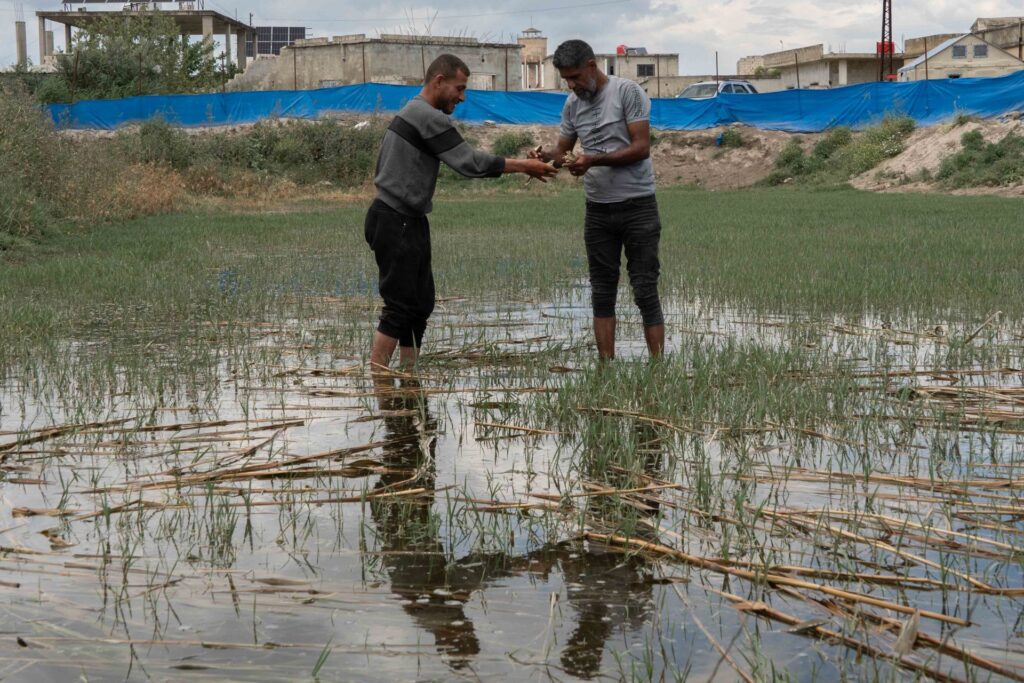
“On the contrary, they encouraged me,” he says, adding that it has become a means of livelihood for others too. “We have young men and children going out and catching frogs — at night with lights, and by day with fishing rods — and I buy it from them by the kilo.”
Duleybi had been a general security member for a long time, but decided to quit his job to focus on frog farming. One reason for this was that members of Syria’s security apparatus are not allowed to start projects that bring investment into the country. Secondly, the long working hours of the job and the level of commitment were difficult for Duleybi to balance alongside his venture.
“I want to start my own project and make a lot of profit,” he explains. “Plus, I don’t have the qualifications; I only have a high school diploma. There are people more deserving than me; why did they give me a position as a district manager? I have experience, but my qualifications aren’t enough to be a district head.” He says he is not “muthaqqaf,” meaning “educated” or “cultured.” I quietly protest.
“Our country is looking for experience, qualifications and education. It’s important to be an educated person; an educated person can succeed fully. It’s displacement and migration that have taught us a lot,” he replies.
Duleybi lost his wife and two of his children during the conflict. He now has four wives and seven children. He hasn’t yet brought his wives to his home to stay, but he says they’ve visited and seen his frog farm. His nieces and nephews are at ease with his frogs, too. They stand on their toes, peering over the edge of the pond to watch them. They hold and catch the frogs without batting an eyelid. For him, the frogs are purely positive and come without any drawbacks.
“They’re so harmless — even fish are scarier than them. Fish are so annoying, if you want to kill one, you need a whole day of washing, sterilizing, perfuming and so on to get rid of the fishy smell,” he says. “With a frog, you just wash your hands and there’s no smell at all.”
Mwaffak Chikhali, a Syrian national resources management expert, believes frogs play an extremely important role in the ecosystem, including in natural pest control, which can reduce the need for farmers to turn to chemical pesticides. He says that their diet of organic matter in ponds when young also helps maintain water quality.
Frog farms “meet the growing global demand for frog meat. This regulated production prevents the overhunting of frogs in their natural habitats, thus maintaining the ecological balance in the wild,” he explains.
Speaking to Duleybi, I get a sense that he knows his idea is unconventional, but I detect pride in his voice at his innovation. He truly believes in his venture.
“There are truly zero losses — I could only lose out if someone comes and poisons my pond. This is not going to happen, but I’m just talking about the least likely of possibilities,” he says.
I ask him, as we wrap up, what his dreams are for the future.
“I will continue to pursue this project to prove that it is one of the best in Syria,” he says decisively.
“Spotlight” is a newsletter about underreported cultural trends and news from around the world, emailed to subscribers twice a week. Sign up here.