


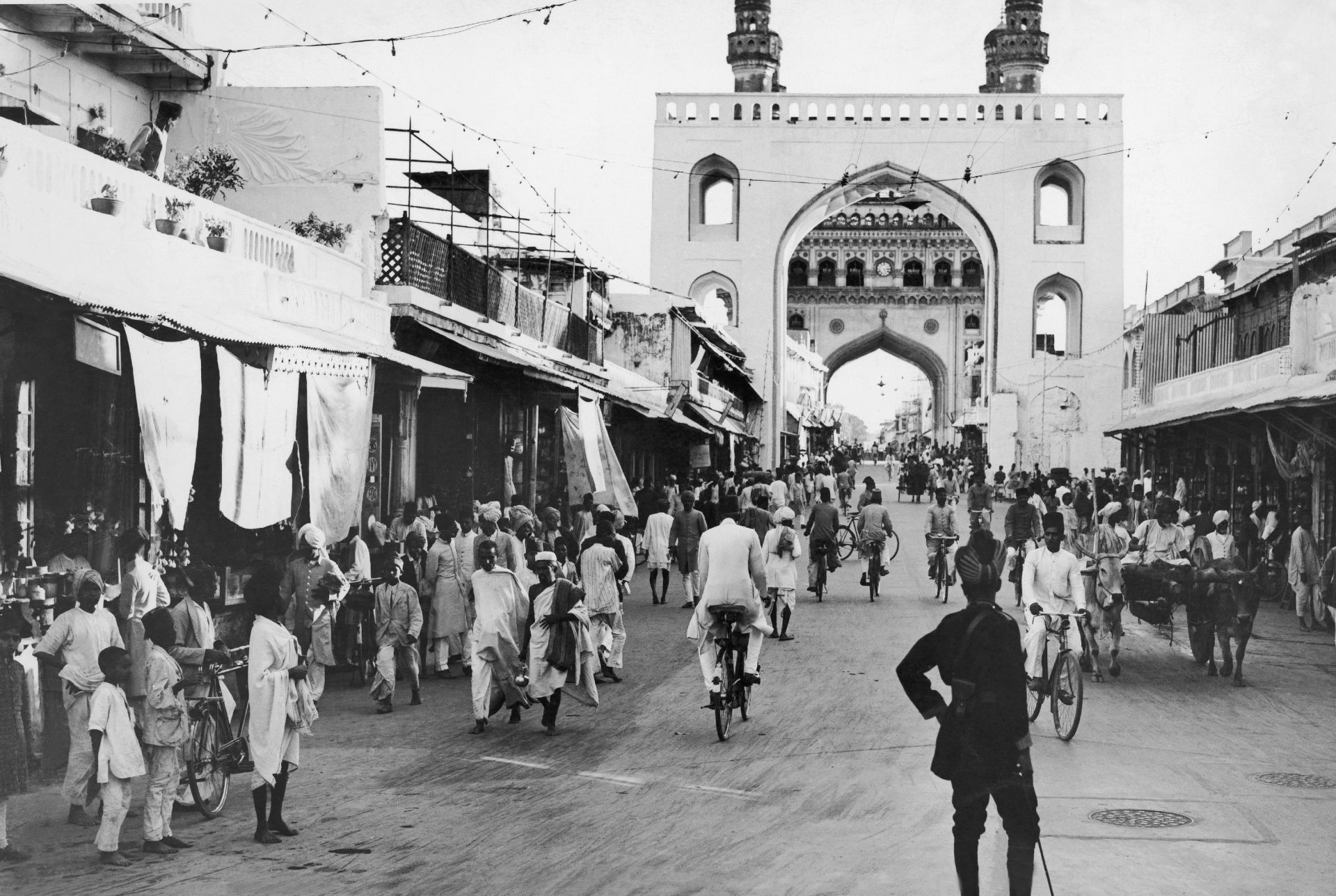
In September 1948, as the Indian Army arrived at Hyderabad’s doorstep during a military offensive called “Operation Polo,” the princely state found itself cornered. A year earlier, its ruler, Mir Osman Ali Khan, had chosen not to join India or Pakistan and instead to attempt to remain independent after Partition. But Hyderabad was a large, landlocked state in the heart of the Indian Union. It had a majority Hindu population ruled by a Muslim elite. Those in New Delhi feared that its continued independence could threaten India’s territorial integrity and internal stability. Eventually, it became the last state to join India during the upheaval of independence.
The pivotal year of 1947 saw the creation of India and Pakistan and the determined efforts of its new leaders to court the princely states that had been semiautonomous under British rule. For most, the choice was swift. But Nizam Osman Ali Khan and the Majlis Ittehadul-Muslimeen (MIM), a powerful political party, strongly favored Hyderabad’s independence and fought for it longer than any other state.
As the region convulsed, its residents were forced into stark choices about where they belonged. Members of the Yemeni-origin community, whose ancestors began migrating to Hyderabad from Hadramawt in the late 18th century, were employed as soldiers, religious scholars and guards under the Asaf Jahi dynasty, the royal Muslim house that ruled Hyderabad, whose rulers are known as the nizams.
With the turmoil and violence of Partition and the social unrest that came with the changes, some Yemeni-origin Hyderabadis migrated to the newly created Pakistan, while others moved to Yemen, Saudi Arabia and the Gulf. But many remained and continue to call Hyderabad home, serving as a living testament to Yemen’s historic ties with India.
Hyderabad was founded in 1724 by Mir Qamaruddin Khan, a high-ranking Mughal general who had broken from the collapsing empire to establish an autonomous kingdom in the Deccan. It had become India’s wealthiest princely state due to several factors, but its decisive advantage lay in its inheritance of Golconda, once one of the world’s most important diamond centers.
Despite this wealth, the Asaf Jahi dynasty came to rely on the British to fend off regional rivals, and came under British suzerainty in 1798. By the early 19th century, the British were consolidating control over the subcontinent, largely through alliances with princely states rather than direct rule: By 1947, there were officially 565 such states. Chief among the Asif Jahi’s rivals was the Maratha Empire, a powerful confederacy based in western and central India, which had challenged both Mughal authority and British expansion.
Arab migration to Hyderabad predated this period of consolidation. Some sources trace the first arrival of Hadrami soldiers to 1797, during the reign of the second nizam, Ali Khan, when they served as guards to his powerful prime minister, Arastu Jah. Known for being elite mercenaries and bodyguards across the subcontinent, they were valued for their military skill and also for their lack of local ties, which made them politically neutral and deeply loyal to the nizam.
In 1817, the third Anglo-Maratha war began, a final conflict that, after two years of violence, decisively ended Maratha power. The nizam’s forces supported the British, and his Arab troops participated in the war. When hostilities ended in 1819, the war proved to be a turning point for these soldiers. Though some were repatriated, those unable or unwilling to make the journey back were formally granted refuge by the third nizam, Sikandar Jah, and absorbed into the military and palace guard. This laid the foundation for the formal incorporation of the Yemeni regiments into Hyderabad’s forces.
Over the decades that followed, their presence became more formalized, and they were granted land and rights to settle permanently. In 1875, more than 400 soldiers were settled in the Maisaram neighborhood on the outskirts of Hyderabad. Five years later, the regiment was granted land to establish permanent homes with their families, with the nizam’s most loyal soldiers receiving additional plots. Alongside the new barracks — whose Urdu pronunciation gave rise to the name “Barkas” for the local neighborhood — the soldiers were also allotted land for cultivation.
By the late 19th century, as Hyderabad became a flourishing center of Urdu literature, scholarship, sports and elite administration, the Yemeni migrants had emerged as one of the most trusted communities under Mahbub Ali Khan, the sixth nizam.
Over time, the Yemeni-origin community came to be known as “Chaoosh,” a term derived from the Turkish “chavush” and its Arabized variant “shaweesh” (meaning sergeant or foreman), which expanded to include Arabs beyond Hadramawt and even those without any military background.
The Chaoosh were trusted figures within Hyderabad’s ruling elite and sought after by the state’s prosperous Marwari merchant community, who employed them to collect debts and guard shops and homes.
Distinctive in appearance, the Hadrami guards typically wore a sarong, carried a dagger and wore the Rumi topi — a red fez with a tassel, bearing the nizam’s emblem — which signified their official role as soldiers or retainers of the royalty and aristocracy. And some of these would play a central role in the final, failed struggle for independence.
In September 1948, the Indian government launched “Operation Polo” — called “Police Action” locally — to force Hyderabad’s integration. It was presented as a limited operation to restore order and dismantle the Razakar militia.
Hyderabad’s bid for independence unfolded not only against this backdrop of seismic shifts in the subcontinent, but also amid deep internal fractures. In the Telangana region, large sections of the predominantly Hindu peasantry rose in armed rebellion against the local Hindu landlords who had held them in various forms of bonded labor. Drawing on Marxist ideas, this peasant movement challenged both the feudal order and the nizam’s authority. The MIM’s paramilitary wing, the Razakars, aligned with the aristocracy and moved to quell the rebellion, often brutally. They ran riot through parts of the countryside where pro-India activism had taken root, targeting those, including many Hindus, who opposed Hyderabad’s refusal to accede to the Indian Union.
In the months leading up to the operation, Maj. Gen. Ahmed El-Edroos, the Yemeni-origin commander in charge of Hyderabad’s state forces, led frantic and covert efforts to procure arms in London to defend the princely state. He also explored the possibility of acquiring tank guns in Switzerland. But his efforts did not succeed, and Hyderabad’s forces could not withstand the onslaught with their outdated rifles. Eventually, El-Edroos surrendered, and Hyderabad became the last princely state to join India after five days of the military offensive.
El-Edroos’ grandfather, Ahmed bin Ali El-Edroos, a religious scholar, had migrated to the state in 1887, and his father, Mahdar, was part of the Arab regiment in the nizam’s army. Despite this lineage, and even though El-Edroos was one of the most prominent Hyderabadi officers of his generation and had served in both world wars, folklore has cast him as “ghaddar-e-khaum,” or a traitor to the community, among sections of the city’s older residents. They argue that he surrendered an army of tens of thousands without mounting meaningful resistance.
But the truth is that the opposing forces were superior. The military campaign swiftly overwhelmed Hyderabad’s forces and ended the nizam’s bid for independence. In its aftermath, large-scale reprisals followed, particularly against Muslims, who were targeted on the pretext of being Razakar sympathizers. Contemporary estimates suggest that at least 30,000 people were killed in the weeks surrounding the operation.
For the small community of Yemeni-origin people, Police Action meant the abrupt loss of the royal and aristocratic patronage that had sustained them for generations. As the Indian government moved to dismantle the remnants of the Asaf Jahi guard, either through prison sentences or severing their ties to Hyderabad, even those who had remained apolitical were uncertain about their futures. Some considered migrating to Pakistan.
“My grandmother believed our time in Hyderabad was up. She called the former head of the disbanded nizam army and fellow Arab, Gen. Edroos,” Jaber Khulaqi told New Lines, while speaking about his uncle Saleh Khulaqi. This uncle was not only president of Ittehad-ul-Arab, which represented the Arab community to the new ruling authorities, but also a legendary wrestling guru in the last nizam’s era.
After MIM President Qasim Razvi was taken into Indian custody, he had “spitefully singled out many Arabs as his accomplices, as many Chaooshes,” he added. This included those acquainted with his uncle, “who had opposed how the MIM chief sought to determine the state’s post-1947 future.”
El-Edroos personally vouched for the Khulaqi family to the Indian commander J. N. Chauduri, and his intervention secured their right to remain, along with those of 500 other Arabs. This effort was aided by Saleh Khulaqi. El-Edroos’ own son Saleem chose to migrate to Pakistan.
After Hyderabad’s integration into India, many Yemeni-origin families, now part of a religious minority in Hindu-dominated India, began encouraging their children to seek opportunities abroad. India’s private sector at the time was still limited, and economic opportunities were scarce. This prompted community members to migrate to Saudi Arabia and other Gulf states, well before the oil boom of the 1970s, establishing the beginnings of a transnational community.
Osman Baghaffar (name changed at his request) realized that holding a British passport, rather than an Indian one, would make this migration easier. Because he was born in India, he needed a fellow member of the Hadrami tribe — technically a subject of the Aden protectorate under British rule — to attest to his Hadrami ancestry.
Once Baghaffar obtained his British passport, he left for the young Saudi kingdom in 1959. By the late 1950s, many Yemenis in Saudi Arabia were becoming naturalized citizens as they helped build the kingdom’s nascent business and financial institutions.
With Yemeni tribal networks already established in Saudi Arabia, Baghaffar quickly found work. His brother secured a position at NCB Al Ahli Bank (now part of the Saudi National Bank), which was founded by the Hadrami Bin Mahfouz family.
In 1967, following the communist takeover of Southern Yemen, which included the Aden Protectorate, Baghaffar once again faced a difficult choice: He could either surrender his British passport or relocate to Britain.
He surrendered his British passport and remained in Saudi Arabia to ensure his children could receive a Saudi education and eventually gain citizenship. Once North and South Yemen were unified, he obtained a Yemeni passport.
Although the Khulaqi family had been given Indian citizenship, Jaber Khulaqi traveled to the UAE for employment opportunities. He was helped by members of his tribe who had already moved to the country, and who found him a position as a soldier in the Emirati army. Apart from earning a living, both Baghaffar and Jaber Khulaqi also focused on honing their Arabic, since they only had moderate proficiency in Hyderabad.
Mohammed Al-Bosi, a fourth-generation Hyderabadi Arab, is a property developer in Hyderabad. In 1983, his father Abdullah set sail for Saudi Arabia, joining many Hyderabadi Muslims who sought work as expatriates. His fluency in Arabic proved invaluable, as did his Yemeni ancestry, which helped him secure a position at a construction conglomerate founded by Mohammed bin Laden. After his stint at the Saudi Binladin Group in Jeddah, Abdullah went on to work at AlAhli Bank. But since there are no avenues for citizenship for Indian nationals, the family eventually returned to India.
Those members of the Yemeni community who stayed behind continued to pursue traditional trades. Without the nizam’s patronage after 1948, they had to become more entrepreneurial to survive. “Many resorted to growing fruits and rearing cows to get by. Other than some exceptions, one wouldn’t find many of us at high-level government positions before and after Police Action,” Isa Amoodi, a retired imam, told New Lines.
Still known as Chaoosh today, the Yemeni community is active in a range of businesses in the city and is also closely associated with the traditional sport of wrestling called “kushti.” The neighborhood of Barkas, home to several well-known “akhadas” (wrestling gyms), is known for producing several state- and national-level wrestlers, such as Khalid Bamas, Mohammed bin Yousuf Bawazeer and Habeeb Abdullah Jeelani.
Omar Basalama, a 31-year-old Barkas resident, is the co-founder of Al-Rabea, a rapidly growing chain of local food shops in the city. He grew up observing his grandfather, Saeed, running several general stores alongside Hindu mercantile families in their neighborhood, as well as a travel agency. His father, Asim, now 62, would take Omar to the bustling morning bazaar at Barkas in the 1990s. As a child, his routine included waking up at 5:30 a.m. to observe older Arab fruit merchants and farmers sell their produce. This sparked his entrepreneurial instincts.
It is common for many Arab families in Hyderabad to encourage their children to start working young or at least gain exposure to vibrant commercial environments, so that they cultivate “real-world experience” and an entrepreneurial spirit. For instance, right after high school, Mohammed Al-Bosi was sent to work at the Saudi automotive giant Naghi in Jeddah. He then took on a role at King Abdulaziz University’s School of Dentistry, where he would maintain and repair dental chairs in the classrooms, and eventually returned to Hyderabad for college, after which he co-founded a real estate development company that he continues to run to this day.
In India today, where Hindu nationalism continues to be on the rise, Hyderabad is among the few Muslim strongholds in the country. Its political scene is diverse in both regional and national parties, including All India Majlis-e-Ittehadul Muslimeen, the pro-India reincarnation of its pre-1948 predecessor.
Yet across the spectrum, the Chaoosh community is often suspected of being the muscle in land-grabbing and other coercive activities, which has led to the image of the Chaoosh becoming conflated with the idea of a henchman. The late Mohammed Al-Yafai of the Barkas, who trained as a wrestler, saw his moniker “pelwaan” (wrestler) gradually acquire a pejorative sense, coming to signify a “thug” in popular imagination.
For these pelwaans, politicians were a source of protection. Moreover, with limited state support for athletes, offering their services became an accessible stream of income for some trained wrestlers.
Nasir Khulaqi, Jaber’s son and a wrestling coach, laments this corruption that has crept into the community. He makes a distinction between a “pelwaan” and a “pehelwan.” To him, the former was a goon who intimidated or extorted, while the latter preserved the sport’s original dignity. “The pelwaan is a rowdy-sheeter,” he said, using a term in Indian English for someone with a long criminal record. “But a wrestler is someone who takes initiative.”
For Khulaqi, “pehel” embodies more than the discipline of wrestling. It is a philosophy of action and responsibility that has guided the Yemeni community in Hyderabad for generations. From their arrival as trusted guards and scholars to their adaptation as entrepreneurs and athletes, he feels that the Chaoosh have navigated political and social upheaval with resilience and initiative for centuries.
Become a member today to receive access to all our paywalled essays and the best of New Lines delivered to your inbox through our newsletters.