

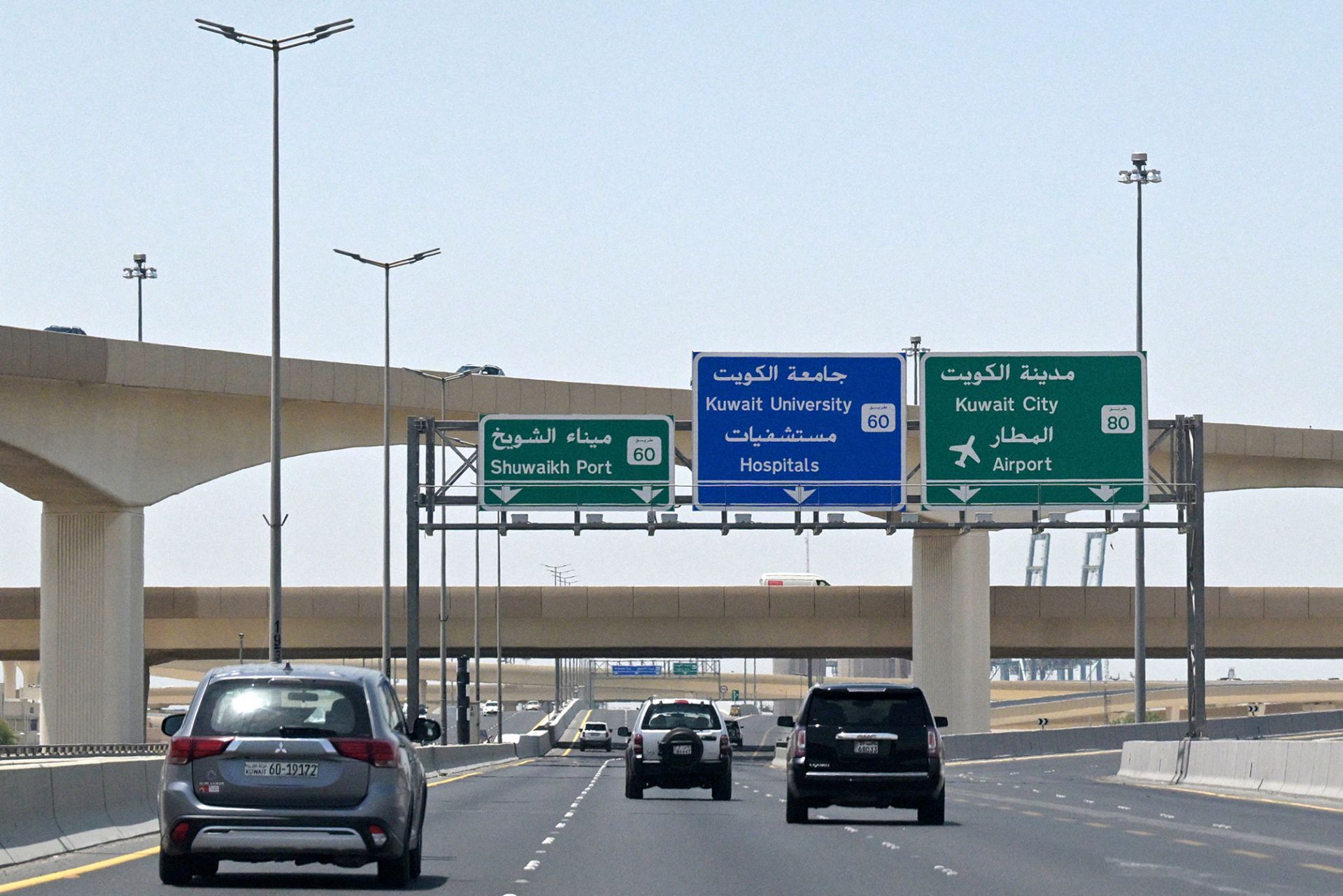
I booked my flight from the United States to Kuwait for June 3, the same day an Iranian strike on Terminal 1 of Kuwait International Airport killed one person, injured at least 63 and disrupted 248 flights across the Gulf.
To reach Kuwait, I, alongside many other Kuwaitis, had to fly first to the Saudi capital, Riyadh, then fly again to a small airport in the Saudi oil town of Qaisumah, from which I was able to travel by road to Kuwait.
During this journey, and contrary to the impression given by following the war from afar through social media, I was struck by how differently the conflict was experienced across different regions. It felt closer the farther I got from Riyadh and the nearer I came to Kuwait. While it was the main topic in almost every conversation I had with friends and strangers in Qaisumah and Kuwait, it was almost absent in the Saudi capital. Saudis in Riyadh talked more about economic issues, such as real estate, job opportunities and affordability within the context of Vision 2030. Kuwaitis, on the other hand, were much more occupied with the war, the mass citizenship revocation campaign and the state of politics.
It was not my decision to go to Riyadh in order to reach Kuwait. It was a solution devised by the airline, after repeated failed attempts to find a flight back home. After my original booking from the U.S. to Kuwait via Riyadh was canceled, I was rebooked on another flight that went through Dubai, which was also then canceled. Neither cancellation had anything to do with Riyadh or Dubai — it was the Kuwaiti airport that kept shutting down, due the military tensions between Iran and the U.S.
In the end, the airline rerouted me around the problem entirely: U.S. to Riyadh, a six-hour layover, then a domestic flight to Qaisumah. From there my only option was to cross into Kuwait by car, much as many Kuwaitis did in 1991 following the liberation of the country from Iraq, a journey I had heard about thousands of times growing up but never imagined taking myself.
This was my first visit to Riyadh since 2016. I was struck by the changes I encountered, not caused by the war, but by the government’s comprehensive reform project, Vision 2030. The first thing was the visible presence of Saudi women in the public sphere. I was surprised to see women working at the airport — far more than I have ever seen in Kuwait, where women have been employed and driving cars since long before Saudi Arabia lifted its ban on women driving in 2018. Despite the end of legal and physical gender segregation, however, I saw that in Riyadh, as in Kuwait, social norms continue to push men and women into separate clusters, even within the same shared spaces.
Since I had a six-hour layover in Riyadh, I went out to spend some time in the city. Riyadh looked to me as if it were actually two cities living next to each other, in two different time zones — a sense I have often felt in the U.S. The first Riyadh was in the northwest, the city’s high-income zone, where green spaces, commercial centers and projects linked to Vision 2030 were concentrated. The other one, farther to the northeast and south, looked like the Riyadh I had known before 2016: high-walled public schools, bare streets with little greenery, old shop signs and aging residential buildings with small windows.
This same contrast could be seen on the short drive from the neighborhoods of Qurtubah and Ash Shuhada to Al Yarmuk, places only a few miles apart that tell very different class stories. A friend of mine from Riyadh confirmed what I was seeing: a gentrification process steadily pushing lower-income and older residents outward, and likely to continue doing so. He showed me how a building for foreigners in senior government or private-sector positions, with amenities such as an upscale gym and swimming pool, costs about 120,000 riyals ($32,000) a year to rent, while buildings just a few streets away, inhabited by Saudis and pre-Vision 2030 immigrants — mostly Arabs and Asians — can be rented for 50,000 riyals ($13,000).
I left Riyadh with two takeaways: The war had left few visible traces, and the impact of Vision 2030 was uneven, exacerbating inequalities to levels previously unknown to me.
Vision 2030 was replaced by the marks of war as I left Riyadh for Qaisumah, a town 260 miles north of the capital that was built in the 1950s. Here, the local region is inhabited by the tribes of Otaiba, Mutair, Herb, Dhafer and others, who came from the central Najd and Hejaz areas in the 1920s and ’30s, during the rise of the “Ikhwan” (“Brethren”) religious militants who helped King Abdulaziz Al Saud, aka Ibn Saud, exert influence in the period of Saudi expansion and border negotiations with the British. The region then transformed into a collection of small settlements when the oil company Aramco started to build its Trans-Arabian Pipeline (or “Tapline”) from Qaisumah to Lebanon’s Sidon, changing the political economy of the local communities, turning nomadic Bedouins into settled workers, employed as laborers at Aramco or foot soldiers in the Saudi military.
I had assumed buses would be waiting, as they had been during previous closures of Kuwait’s airport, when Kuwaitis used Qaisumah to enter and leave the country. But there were none. Instead, there were regular airport taxis and the informal drivers known as “kadad,” men who run deliveries on the side without official paperwork, paid in cash rather than by card — a detail I had forgotten to prepare for. My driver, who appeared older than 60, told me that the price of a trip to Kuwait had hit 800 Saudi riyals ($214) and their business was thriving due to the war. While I thought it was overpriced, I had no option but to accept his offer of 400 riyals, as few other drivers were around.
We took the road, which was as I remembered it: dark, thinly lit, a little dangerous, but also beautiful. Kuwait’s borders lay roughly 50 miles to the north, around a two-hour drive. From my driver’s accent, I guessed he was from either the Otaibi or Mutairi tribe, and it turned out I was right. He also guessed my own tribal background correctly, a practice those from tribal backgrounds enjoy. He had retired from the military. “I worked in the military for 20 years, like all my cousins and our parents.” You know, he said, “we did not have degrees to be teachers or anything else.”
Assuming I was a safe audience, due to our shared tribal heritage, he turned to politics at once. He offered his opinion on how the Saudi government had dealt with the war. He argued that while he would prefer a tougher position against Iran, the government and other Gulf Cooperation Council countries should not join a U.S.-Israeli war. Then he shifted to talking about how the cost of living had increased, remembering the good old days when gas, electricity, water and food were much cheaper. Unlike those in Riyadh, he did not seem to be preoccupied with Vision 2030, and didn’t mention it once. He appeared to think of the current Saudi Arabia in terms of corruption and efficiency versus affordability.
He then shifted the conversation to Kuwaiti politics, describing how the recent controversy over mass revocations of citizenship had become a major topic even in Saudi Arabia. Many Kuwaitis have relatives on both sides of the border, as many Saudis left for Kuwait in the 1950s to find work either in the military or at the Kuwait Oil Company. He argued that those people, who included my grandfather, were the nation’s true founders, who took difficult decisions to leave their towns and tribes to move to Kuwait with nothing but the will to work hard, a fact the state, which became independent in 1961, failed to recognize. Feelings of resentment at being overlooked by the government are widely shared among tribal people, in both Saudi Arabia and Kuwait. Even so, his words were bolder than those voiced by the groups directly targeted by the revocations in Kuwait themselves.
I arrived around 11 p.m., roughly two hours after leaving Qaisumah airport. Being late on a Saturday, the crossing was almost empty. The driver told me it would have been far busier earlier in the day, since Kuwaitis cross into Saudi Arabia on the weekend. He dropped me off at a Kuwaiti gas station, where he could fill his tank for around half the price he would pay at a Saudi station. I had no cash on me, so I asked for his bank details to transfer the fare, which seemed to unsettle him a little. He had expected that someone local like me would know to pay in cash.
While I was waiting for about half an hour at the station for a relative to pick me up, many Kuwaitis saw me standing there with two large travel bags, yet none stopped to ask whether I needed a ride. I assume they took me for someone already waiting for one, but only a few years earlier, this would have been unusual, as people would have stopped every few minutes to offer help.
Since I left in 2024, just before the citizenship revocations and the war occurred, I had never experienced such an intense political atmosphere in Kuwait. My relative arrived with a friend of his. After about 10 minutes of the usual greetings, the friend, whom I was meeting for the first time, began to talk about politics. “You will find Kuwaitis in a very different mood,” he said. “Everyone is depressed by what’s going on.” I understood at once that he meant the political situation and, specifically, the revocations, which had stripped nearly 400,000 Kuwaiti citizenships. He went on to describe people he knew and what had happened to them.
When he and my relative referred to the Kuwaiti emir, they used nicknames, like the soccer players “Messi,” “Mbappé” and “Ronaldo.” The government became “the team,” while the emir’s most trusted government official, the interior minister, was “the captain.” This kind of coded speech is a familiar feature of life under autocracy, the sort of “acting ‘as if’” described by Lisa Wedeen in her 1998 journal article “Acting ‘As If’: Symbolic Politics and Social Control in Syria.” While I’m familiar with the political literature around it, it felt foreign in the mouths of Kuwaitis, who had long enjoyed a margin of free speech rare in the Gulf region. They occasionally glanced furtively at their phones, as if they were being surveilled.
I asked how people were absorbing the government’s actions. The two men with me were both Badu, the segment of the population more affected than the Hadar component. They told me that some Badu, whose citizenship rests on Article 1 of the Nationality Law — the “founders” who settled in Kuwait before 1920 and who therefore feel less threatened by the campaign — were actually among its supporters. By their own estimates — and there are no official figures to go on — perhaps 3 in 10 Badu support the campaign, which I found remarkable. Their explanation was that those people had bought the government’s narrative, namely that a smaller population meant more for those who remained — faster access to housing, more jobs and larger benefits.
Politics, regarding both the citizenship issue and the Iran war, dominated conversations in Kuwait. I saw this firsthand almost immediately one day after my arrival, when I attended a dinner hosted by friends for people returning from the pilgrimage to Mecca. I saw friends I had not seen in years. Usually, politics is avoided in large social gatherings, especially one like this, where conversations about the pilgrimage, God and social matters would normally take precedence. Yet that evening turned out to be intensely political.
The war and citizenship revocations took over the conversation entirely. Of the roughly 20 people there, almost no one stayed silent on the subjects. Most, if not all, knew a relative or close friend who had been stripped of citizenship, and almost everyone had a direct experience of the war, such as seeing a missile or having difficulty sleeping due to siren alerts. A very close friend told me he had started feeling depressed, not knowing if this was due to the war or the news about friends losing their citizenships. Another described how he felt unsettled by the war, as though it were overwhelming him. Yet another, who manages an investment fund worth around $3 million, said that he had taken all of the fund’s money out of the Kuwaiti stock market, arguing that there was more bloodshed to come and that he did not want to reinvest until the total withdrawal of U.S. forces. This was in late spring, a time of year when Kuwaitis used to plan for their summer vacations and talk about where they were going to travel. This year, most of those I met had made no plans, or had canceled them, due to irregularities in airport traffic and the frequent unavailability of flights.
Many of the people attending were serving in the military and police, men who would normally avoid politics and withhold any critical opinions, even in private or during political campaigns before the suspension of parliament in 2024. Yet, in the current environment, with the war and citizenship revocations dominating public life, they were openly discussing politics and expressing critical views. I was surprised that they were in fact among the most critical views I had heard, because many of their colleagues had lost their citizenship while defending their country in the time of war. One said he knew more than 12 officers from the air defense forces stripped of their nationality while remaining in their barracks for weeks under the wartime military alert. The conversation went on for hours, and not a single person defended the government’s policies.
Later, I went out with a friend who told me that if we drove somewhere with little light pollution, we would see drones all over the sky. Of course I did not believe him. But only a few miles outside the urban area, it was astonishing: I counted more than four drones high overhead in less than an hour. They seemed to be everywhere. He said that, in the first weeks, the military had tried to bring them down, but it proved ineffective and too costly to fire a defense missile at each one, so they were left alone. I asked him, since he was in the military, what the drones were doing. “I’m not sure,” he said. “I guess that they scan the areas to mark potential targets.”
A woman who had just graduated from Kuwait University asked to meet me for advice about her plans to complete a graduate degree in the U.S. When we met, she started asking me questions about the citizenship revocations, which I found puzzling. Once she sensed that I had a critical opinion, she apologized for the “white lie,” as she described it, and said she actually wanted to talk about her citizenship revocation situation. She felt unsafe saying so before we met.
She was frustrated, not only about the legal and political situation the government had put her in, but also about her particular struggle as a woman. “I feel, with many other women, that we are left in the darkness,” she said. “The government from one side and men in our family from another.”
She was struggling to understand why the government revoked her late grandfather’s citizenship, which caused the whole family to lose theirs too. Since the government does not provide reasons on a case-by-case basis, she asked her father and uncles about the history of their family: When and why did her grandfather come to Kuwait, and what was her grandfather’s legal status? “They just tell us, ‘Don’t worry, things will be better, and focus on other things,’” she said. “What other things? I’m not a citizen!” She continued, “Studying abroad isn’t an option now, and my dream is dead before it even sees the light.” Then she said, “It’s studying, getting a job, and getting married — all these are affected, so what other things?”
The journey had taken me more than 24 hours, between flying and driving, something I would never have imagined enduring as a consequence of war. It felt surreal and overwhelming. While the economic issues and big pictures dominated in Riyadh, and partially in Qaisumah, politics felt personal in Kuwait.
Become a member today to receive access to all our paywalled essays and the best of New Lines delivered to your inbox through our newsletters.