



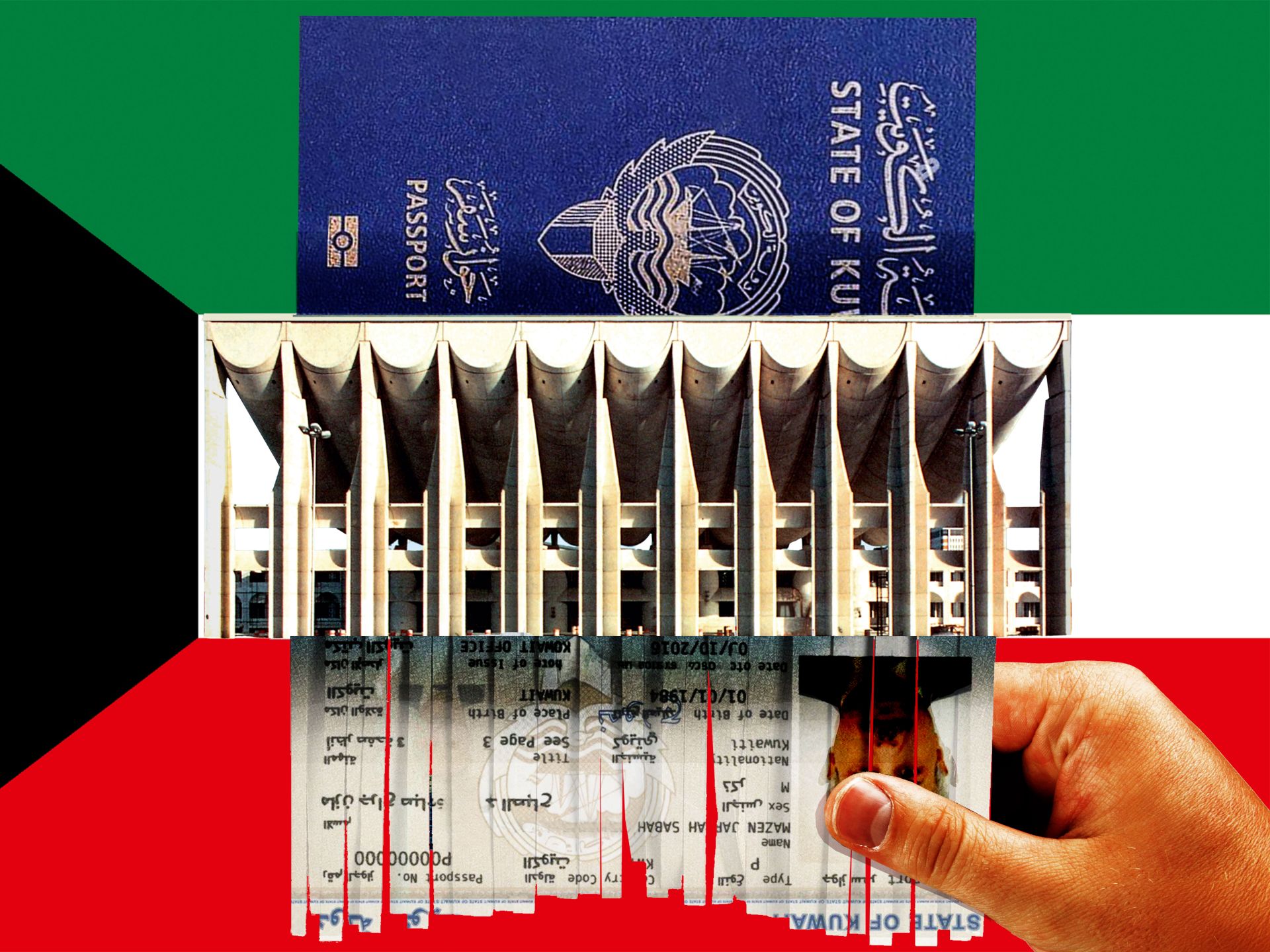
“Those whose nationality has been revoked must go to the other hall,” shouted a police officer at 60-year-old Sharifa, as she stepped into a government building responsible for issuing identification documents to citizens and residents.
Sharifa was born and raised in Kuwait, and was recently widowed after 21 years of marriage to a Kuwaiti man. But at the end of December 2024, she discovered that her name was included in the list of Kuwaitis stripped of their nationality. She came to this building to present documents that proved she was Kuwaiti. She was guided into a hall where many women like her were waiting their turn to surrender their Kuwaiti documents. Sharifa’s gaze was drawn to a woman draped from head to toe in the Kuwaiti flag, in a desperate attempt to elicit sympathy.
Sharifa is one among at least 70,000 Kuwaitis whose nationality has been revoked in an unprecedented government campaign that began in March 2024. Sheikh Fahad Yusuf al-Sabah, a member of Kuwait’s royal al-Sabah family and the first deputy prime minister, interior minister and chair of the Higher Committee for the Realization of Kuwaiti Nationality, stated in a meeting with Kuwaiti press in December 2024 that these measures were taken “to rectify detected irregularities, a decision that may be difficult because of its consequences, but one that is necessary in the interest of the nation and the rule of law.”
Beyond this campaign, an amendment to the citizenship law has codified a tiered apartheid-like hierarchy, classifying nationals as Kuwaitis either by origin or as naturalized citizens. Only the former are eligible to vote and run for parliamentary office. The descendants of naturalized citizens are classified as naturalized in perpetuity. These changes have reversed the democratic and civil rights reforms introduced since Kuwait’s liberation from the Iraqi occupation of the early 1990s.
When the war on Iran began in February 2026, the government halted its weekly announcements of citizenship revocations. Iranian missiles and drones were largely indiscriminate in their targets, and the government softened its rhetoric accordingly. But just days after the ceasefire between the United States and Iran was declared last Tuesday, Kuwait revoked the citizenship of more than 2,000 people.
The ongoing campaign is part of a political drive to take Kuwait back to the period before 1990. People living in Kuwait were then divided into three categories: Kuwaitis by origin, who had settled before 1920 and remained until the Nationality Law was issued in 1959, who had the right to participate in parliamentary life; naturalized Kuwaitis, denied along with their children the right to political participation; and the stateless “Bidoon,” a name taken from the Arabic for “without” because they hold no nationality even though they were born and raised in Kuwait. Although Kuwaiti law distinguishes between revocation and withdrawal of nationality, the term “revocation” will be used hereafter to cover both.
This nativist ideology grew as a reaction to the democratic wave that followed Iraq’s invasion, which expanded electoral rights to naturalized citizens and women and nearly extended them to the Bidoon. Kuwaiti nativists demanded a “correction” of what they perceived as manipulation of the citizenship file — the records of individuals’ citizenship status — in the era before the invasion, which had allowed many to become Kuwaitis by origin or through naturalization while they were, in their view, “forgers,” that is, people who had obtained their citizenship fraudulently, or “dual citizens.” With Meshal al-Ahmad al-Sabah’s assumption of power as emir at the end of 2023, nativism moved from the margins of political life to become the official discourse, its demands shaping a government campaign that has changed, and keeps changing, the lives of tens of thousands of Kuwaitis.
Emir Meshal al-Ahmad has focused on the citizenship issue since he assumed power on Dec. 16, 2023. Four days after taking office, in his first speech before the National Assembly, the emir criticized the “cooperation of the legislative and executive branches … in harming the interests of the country and the people,” citing particularly the “citizenship issue” and the way it was “altering the Kuwaiti identity.” Less than three months later, Kuwait launched the largest campaign of citizenship revocation in the history of the Arab World.
On March 4, 2024, the citizenship of eight women and three men was revoked, notably including Hakim al-Mutairi, the founder and secretary-general of the Islamist Ummah Party, residing in Turkey. Later in the month, citizenship was withdrawn from a dozen others. The campaign then expanded in the absence of parliament: The emir had dissolved the National Assembly on Feb. 15, and when a new parliament was elected in April, he delayed its convening for an entire month before dissolving it unconstitutionally on May 10 and issuing a decree suspending several articles of the constitution.
The government initially struggled to obtain information on those it considered forgers or dual citizens, so it turned to citizens to inform on one another. On March 15, the Nationality Investigation Department designated a hotline urging citizens to provide “all credible information regarding forgers and dual nationals of Kuwaiti nationality, an embodiment of the saying ‘Every citizen is a guard.’”
This created an opportunity for some Kuwaitis to blackmail others. While conducting fieldwork in Kuwait’s capital for this investigation, we learned of the case of a Kuwaiti man who had registered a boy of Arab nationality who worked for him, using the identity of a deceased son. When the man passed away, the boy, now a young man, renounced any inheritance since he was not a real son. But his renunciation did not spare him from the man’s other sons repeatedly demanding thousands of dinars in exchange for their cover-up.
In December 2024, the government amended the Nationality Law to allow authorities to use “modern scientific methods” to strip citizens of their nationality, a decree later clarifying that these methods included DNA tests. We learned from sources who requested anonymity for their personal safety that DNA samples had been taken by force, resulting in the revocation of the nationalities of citizens and all those who had obtained nationality by descent from them, after tests revealed a discrepancy between official documents and DNA analysis.
The pace of nationality revocations grew slowly until October 2024, when the figures began to grow rapidly. According to the Newsroom Initiative, an independent Gulf media tracker monitoring the decrees published in Kuwait’s Official Gazette, the number of revoked cases reached over 71,059 as of April 15, 2026, representing 4.6% of Kuwait’s official population of 1.545 million.
Yet this massive number does not reflect the full picture. The effects of revocation extend beyond the named individuals to wives, children and grandchildren who had obtained nationality through them. “The figure may reach between 250,000 and 300,000,” said a Kuwaiti academic who specializes in political affairs and who spoke to us on condition of anonymity, with later sources confirming this number if counting dependents. This means a truly astonishing 1 in 5 Kuwaitis will lose their nationality. Meanwhile, Interior Minister Fahad Yusuf stated in an interview with Al-Qabas on Aug. 9, 2025, that the number was close to 50,000.
Before Iraq’s invasion of Kuwait, participation in parliamentary life had been restricted to men from the founding category of citizens, while naturalized Kuwaitis, their children, and all Kuwaiti women were excluded. This changed with National Assembly Resolution No. 44 of 1994, which reclassified the children of naturalized citizens as Kuwaitis by origin. Eleven years later, after persistent demands from women’s groups, the National Assembly granted Kuwaiti women the right to vote and to run for office, and the Bedouins, who constitute the majority of naturalized Kuwaitis, became the principal component of the parliamentary opposition.
These new forces did not content themselves with entering the political arena; they also raised the banner of naturalizing the Bidoon. The Bidoon are residents belonging to northern tribes whose range spans parts of Kuwait, Iraq and Saudi Arabia, where they had lived long before the current borders were drawn. Kuwait did not grant them nationality, and over the years the demand for their naturalization became a matter of particular sensitivity for the state.
On the margins of the Kuwaiti political scene, there was a reaction against these developments that gave rise to an exclusionary discourse, one that draws sharp distinctions between categories of residents and counts only founding Kuwaitis as native. Its most extreme expression was the rhetoric of former Kuwaiti representative Mohammed al-Juwaihel, who in 2009 established a satellite channel called Al-Soor (“The Wall”), named for the wall built in 1920 to repel attacks by tribal Wahhabi forces affiliated with Saudi Arabia. The date of that wall’s construction had become a foundational reference in the Nationality Law, marking the temporal boundary between “native Kuwaitis” and the rest.
Al-Juwaihel and Al-Soor did not stop at rejecting the naturalization of the Bidoon; they advanced the slogan “Kuwait for Kuwaitis,” meaning those of founding nationality, the majority of whom are urban dwellers. The claim was that Kuwaiti identity had been “polluted” by those whom al-Juwaihel derisively labeled “Iranians, Iraqis and other interlopers,” implying these groups were inauthentic and alien to Kuwait. Followers of this discourse also accused large segments of Kuwait’s Bedouin population, particularly those descending from the Mutair, Otaiba and Ajman tribes, of being Saudis concealing their Saudi identity “to seize Kuwait’s wealth and resources.” In one speech broadcast on his channel, al-Juwaihel displayed a list of names that he alleged belonged to dual nationals who had changed their names, declaring that Kuwaiti names were “being stolen just as everything else in Kuwait is being stolen.”
The propaganda of Al-Soor sparked a crisis in December 2009, when a demonstration of 5,000 people, joined by members of parliament, demanded that the government put an end to this rhetoric and stop the loyalty of the tribes from being questioned. The government shut down the channel and referred al-Juwaihel for investigation, yet none of this diminished his popularity: He won a seat in the National Assembly in 2012, which allowed him to question the minister of interior over the citizenship file.
A group of journalists, politicians and businesspeople holding founding nationality formed a political pressure bloc called “The Group of 80,” selecting journalist Adel al-Zawawi as its general coordinator. They sought to translate this exclusionary discourse into a political and legal program that not only opposed the naturalization of the Bidoon, but aimed at revoking the nationality of dual nationals and those the group deemed forgers. When opposition forces secured a significant number of seats in the 2016 elections, some parliamentarians proposed transferring revocation authority to the judiciary. The Group of 80 considered this “a dangerous initiative” because it limited politicians’ power over citizenship. The group mobilized to defeat it, making national identity and nationality its central cause. It succeeded in preventing its passage, though its influence remained confined to exerting pressure and media campaigns.
This discourse shifted from the margins to become official policy with the accession of Emir Meshal al-Ahmad in December 2023, the appointment of Fahad Yusuf as minister of interior, and the dissolution of the National Assembly. The nationality issue featured in the emir’s very first speech, and he returned to it in May 2024, announcing the unconstitutional dissolution of the National Assembly for just the third time in the country’s history, and calling for a review of cases involving “those who entered the country unexpectedly and cloaked themselves in nationality without right, those who claimed lineage not their own, or those who hold dual nationality.” He went on to assert that democratic tools were being employed in ways “inconsistent with the customs and traditions of the good, native Kuwaitis.”
The emir reiterated this in his March 2025 speech, after the number of revocations had surpassed 50,000, praying for God’s assistance in “returning Kuwait to its native people, clean and free of the impurities that have clung to it,” describing critics as “advocates of division and inciters of strife” and reaffirming his commitment to the campaign.
This discourse was echoed by Fahad Yusuf. In an interview on the program “Theater of Life” in early March 2025, he stated that Kuwait had been “hijacked” by “various nationalities” who were “alien to Kuwaiti society in their social life, language, temperament and family relations,” adding that “this, of course, had continued … for 40 or 50 years.” When the Saudi host, Ali al-Alyani, remarked that the campaign might reduce the number of Kuwaitis, Fahad Yusuf responded: “Let the population be whatever it will, but let it be from the people of Kuwait and the descendants of native Kuwaitis … whose fathers and grandfathers lived in Kuwait since ancient times.”
This exclusionary discourse would not have produced a nationality revocation campaign of such magnitude and speed had Kuwait’s legal framework not been prepared for it.
The 1959 Nationality Law divided Kuwait’s population into citizens by origin and citizens by naturalization. Citizens by origin were defined as “those settled in Kuwait before 1920” who remained residents until the law’s enactment. All other residents acquired nationality by naturalization through an emir’s decree and a recommendation from the minister of interior, which could also be granted to long-term residents, those who had rendered distinguished service, the wives of Kuwaiti citizens and the children of Kuwaiti women, among other categories. The law described three reasons why nationality might be lost: a Kuwaiti voluntarily acquiring another nationality, a Kuwaiti woman marrying a foreign man and acquiring his nationality, and denaturalization. It distinguished between “denaturalization,” applying to all citizens by origin or naturalization, and “revocation,” applied exclusively to naturalized Kuwaitis in cases of forgery or crime within the first five years following naturalization.
The evidentiary standards for citizenship were structurally biased. Farah al-Naqib, a history professor at California Polytechnic State University, notes in her 2014 study that urban residents were able to provide birth and death certificates, landownership documents and travel papers, which facilitated their acceptance as citizens by origin. Bedouin residents, whose lifestyle was based on oral culture, mobility and herding, faced difficulty producing similar documentation.
From the establishment of the Kuwaiti National Assembly in the early 1960s, it was evident that the Constitutional Drafting Committee intended to restrict participation to citizens of origin. The committee’s records from 1962, reviewed by us, show the idea prevailing that naturalized citizens should be deprived of the right to run for office, while gaining the right to vote only after a period following their naturalization. While the constitution promised equality in trade and education, Minister of Justice Hamoud al-Zaid al-Khaled drew the line at political power. “We do not want [intellectual and political] forces to flood into the country that we are currently distant from,” he said, possibly referring to Arab nationalist and leftist currents, before adding, “but to hand them our necks so that they govern us, this we cannot allow.” The participants concluded by denying naturalized citizens the right to run for office. Law No. 35 of 1962 granted them the right to vote 20 years after obtaining nationality.
The denial also extended to their children. The Egyptian constitutional expert Dr. Othman Khalil Othman pointed out that the son of a naturalized citizen cannot have his nationality revoked, since he did not acquire it by grant. The minister of interior conceded: “His nationality cannot be revoked, but nevertheless he is considered naturalized, and we write on his certificate that he is a Kuwaiti by naturalization, just like his father.” Dr. Othman noted, “The law, in this form, is extremely harsh, because children and grandchildren will inherit, indefinitely, the status of naturalized citizens.” The disagreement ended with the opinion prevailing that the children of naturalized citizens should be treated like their fathers in being denied political participation.
Parliamentary life in Kuwait thus began with citizens divided into two categories: native or original Kuwaitis, who had the right to vote and run for office, and naturalized Kuwaitis, who had the right to vote only 20 years after naturalization, although neither they nor their descendants ever had the right to run for office.
Hardly had this exclusionary parliamentary system come into force before members of the ruling family faced challenges they had not anticipated, driving some of them to manipulate and politicize the citizenship issue. It is precisely this stage of Kuwait’s history that is being used, selectively, to justify citizenship revocations today.
The Kuwaiti constitution requires that the crown prince be confirmed by a majority of National Assembly members, turning the assembly into an arena of contestation among rival aspirants. Nationalist forces, led by figures such as Ahmad al-Khatib, formed a parliamentary opposition bloc with an urban base rooted in the very intellectual currents, Arab nationalist and leftist, that some members of the Constitutional Drafting Committee had feared would enter political life through naturalized citizens.
To weaken the opposition bloc and secure the assembly’s confirmation, Jaber al-Ali al-Sabah registered large numbers of Bedouins as citizens by origin, creating a loyal electoral base. A struggle emerged between Jaber al-Ali and Jaber al-Ahmad al-Sabah over succession, culminating in Emir Sabah al-Salem’s unconstitutional dissolution of the National Assembly in July 1976, the first in the country’s history. The conflict ended only with Sabah al-Salem’s death and Jaber al-Ahmad’s accession to the throne, when he appointed Saad al-Abdullah al-Sabah crown prince in 1978 without the approval of the dissolved assembly.
Although Jaber al-Ali failed in his bid for the succession, his role in manipulating the citizenship file remains his most consequential action. His manipulation consisted of reclassifying large numbers of Bedouins from naturalized citizens to citizens by origin, enabling them to run for the assembly and support his position. American political scientist Jill Crystal writes in “Oil and Politics in the Gulf” that these policies raised the proportion of Bedouin voters from 21% in 1963 to 45% in 1975, while the number of Bedouin representatives in the 50-seat parliament rose from 14 to 23.
This opened the door for others to exploit the citizenship file for far smaller gains. One anecdote, recounted to us by a Kuwaiti source who requested anonymity, illustrates the scale of the issue. An acquaintance of the source was a shepherd who had never grasped the importance of applying for citizenship and thus remained stateless. One day, a man came to buy sheep from him but left without making a purchase. A bystander informed the shepherd that the would-be buyer was a member of the naturalization committee, and that the shepherd had squandered his chance at citizenship by failing to treat him well. The shepherd promptly gathered three sheep, took them to the man’s house, and offered them as a gift. The man asked how he could help. The shepherd requested citizenship. The official retrieved a completed file belonging to someone who could not be located and offered the shepherd to place his photo over that of the original applicant. In this way, the shepherd transformed from a Bidoon into a Kuwaiti by origin, under a different name and tribal affiliation.
The Kuwaiti government attempted to restore the pre-Jaber al-Ali order, but to no avail. In 1970, a new article was added to the Nationality Law, allowing the state to strip citizenship by origin from individuals and their dependents if obtained through fraud. When Emir Jaber Al-Ahmad unconstitutionally dissolved the assembly in the summer of 1986, he issued further amendments: The Nationality Law had promised naturalized Kuwaitis the right to vote that year, 20 years after their waiting period officially began, but a decree extended that period by another 10 years.
The shock of the Iraqi invasion ended these efforts. The invasion convinced key ruling family figures, Emir Jaber al-Ahmad, Crown Prince and Prime Minister Saad al-Abdullah, and the emir’s brothers Foreign Minister Sabah al-Ahmad al-Sabah and Interior Minister Nawaf al-Ahmad al-Sabah, that opening the parliamentary system to all Kuwaitis would bolster Kuwait’s international standing and provide democratic legitimacy in case of another crisis. The period following the invasion saw a major expansion of political participation: Naturalized citizens and their children were reclassified as citizens by origin, women gained political rights and the Bidoon issue nearly reached a resolution.
This path of parliamentary openness continued through the successive reigns of the next four rulers, until Emir Nawaf’s death in 2023 and the accession of Emir Meshal al-Ahmad, who appears determined to dismantle it and return to a closed parliamentary system restricted to citizens by origin.
Some Kuwaitis interviewed by us, both those who still hold citizenship and those who had theirs revoked, attributed the campaign to Emir Meshal al-Ahmad personally, interpreting his vision through the lens of his security background and lack of political experience prior to becoming emir. Others argued that the true purpose of the campaign was to target the constitution and Kuwait’s democratic experiment. A former MP told us: “Racism is not the driver of this campaign; it is about targeting Kuwaiti democracy and compensating for the absence of a national program.” This was not the only Kuwaiti to describe the campaign as part of a broader effort to “clip the wings” of the National Assembly, foreseeing its replacement with a toothless national consultative council like those elsewhere in the Gulf.
Although the government’s justifications focused on the claim that those targeted were forgers or dual nationals, the majority of those stripped of their citizenship actually belonged to three other categories of people who had obtained nationality legally. The first consists of the wives of Kuwaiti men who renounced their original nationalities to acquire those of their husbands. This category is commonly referred to locally as Article 8. The Newsroom Initiative estimated that 31,703 women in this category lost their citizenship between Dec. 12, 2024, and Feb. 8, 2025. A former member of parliament told us that “this is the largest operation ever carried out against women, an outright assault taking place for the first time against Kuwaiti mothers.”
We tried to reach the affected women shortly after the decision was announced, but doing so was extremely difficult. The vast majority initially agreed to be interviewed, only to withdraw before the meeting or request that their testimony be deleted afterward. This can be understood in light of a televised interview by Interior Minister Fahad Yusuf, in which he stated that privileges would only be restored to women who lost them under Article 8 “if their security file is clean.” We did meet a Kuwaiti woman of Arab origin with children, one of whom has special needs. She depends on the state allowance given to widows and housewives, but today, after losing her citizenship, she faces the prospect of being unable to pay her rent or cover her basic needs. She cried while speaking to us, not only because she had lost her sole source of financial security, but because she no longer had any identity other than being “a Kuwaiti belonging to this land” with absolute loyalty to it. We also interviewed another woman who had renounced her Saudi citizenship to obtain Kuwaiti nationality under the law. She was in denial, repeating over and over: “Maybe they will give it back to us.”
The second category consists of those naturalized under the clause of “exceptional service to the nation,” whose citizenship was revoked despite having been acquired lawfully. This group includes well-known artists whose names are deeply associated with Kuwait, such as the singer Nawal al-Kuwaitiya and the actor Dawood Hussein. When asked why such figures had been stripped of their nationality, Fahad Yusuf offered no legal justification, only his personal view of what “exceptional service” should mean: “What did the artist give? What does it mean to obtain nationality in exchange for art? You got paid for the work you did.” A former parliamentarian from the category of native Kuwaitis criticized this approach, citing the novel “The Scorching” by Nasser al-Dhafiri, a Kuwaiti writer from the Bidoon community. The novel grapples with complex questions of belonging and homeland, which the parliamentarian described as an “existential struggle” far deeper than the minister’s framing. In the novel, a young Bidoon declares after the Iraqi invasion: “Perhaps you do not know what the homeland means inside me, and you want to measure it by its relationship to me, not by my relationship to it.”
The third category consists of sons and daughters of female Kuwaitis but non-Kuwaiti fathers. Like many laws in the region, Kuwait’s Nationality Law grants the father an automatic right to pass his citizenship on to his children, even if the mother is not Kuwaiti. By contrast, a Kuwaiti mother does not enjoy this right except in specific cases, such as when there has been an irrevocable divorce, the father is unknown or in other limited circumstances. The post-Iran war revocations targeted mostly individuals in this category.
Notably, and despite the scale of the campaign and the nativist discourse accompanying it, there is little criticism of it among Kuwaitis. A former parliamentarian who asked not to be named said: “Even during the days of the Iraqi occupation, Kuwaitis took to the streets and wrote on the walls their stance against the occupation. But today, no one dares even to mention what is happening, let alone point to it, because anyone who tries is immediately silenced.” The clearest precursor, he argued, was the crackdown on opposition that led to Musallam al-Barrak, the icon of opposition, being jailed in 2013. “Since then, the political scene has withered away.” At that time, stripping opponents of their citizenship was “one of the regime’s swords.” He recalled how the weapon of citizenship had been used against the al-Barghash family, Saad al-Ajmi, and others, calling it a “commodification of nationality,” and describing what is happening now as a “republic of terror.”
Other parliamentarians and citizens who spoke to us on condition of anonymity pointed to another explanation: public disappointment with opposition figures. In an interview with a Kuwaiti family whose mother had lost her nationality, one of the daughters explained that today’s silence is “the result of a long process in which people lost faith in those they thought were opposition leaders,” specifically mentioning former representative Obaid al-Wasmi and former parliamentary speaker Ahmed al-Saadoun. The mother, however, held a different view. Of Iraqi origin but born in Kuwait, she obtained citizenship in 2002 after marrying a Kuwaiti in 1989, and was keen to stress that her marriage took place before the Iraqi invasion, knowing the symbolic importance of that timing among Kuwaitis. She had been waiting eagerly for 20 years to gain political rights, only to lose her nationality just as her turn came.
We also met a young Kuwaiti man who feels threatened despite his family having committed no violations. Given the “arbitrariness of decision-making,” he said, he could not rule out losing his nationality or seeing a family member lose theirs. When asked directly, “Could you wake up tomorrow and no longer be Kuwaiti?” he answered calmly, as if he had already asked himself the question many times: “Yes.” Another young man, from a Bedouin background, rejected the notion that what is happening is a targeted campaign against the Bedouins. He argued that the Nationality Law, from the moment it was issued, relied on a model unsuited to Kuwaiti society, which is composed of many different elements, and that the regime’s logic is procedural, not political.
We also spoke with two members of the Bidoon community. One said: “I believe my situation is much better than those who have just lost their nationality. Over the years, I have adapted to this injustice and found ways to cope with it. I have my job, and nothing worse can happen to me. That, I think, is a kind of advantage.” He pointed to cases where citizenship was revoked in 2018, restored in 2023, and then revoked again, adding that he could not imagine what those families must be going through. The other said, “Killing hope in this way will do no good for anyone.”
The campaign continues, empowered by a new legal foundation, with no end in sight. In his Aug. 9 interview with Al-Qabas, Fahad Yusuf emphasized that “all citizenship files in Kuwait are under scrutiny and subject to thorough examination without exception.” When asked about the media blackout, a journalist told us: “None of this matters compared to what is happening in Palestine. We have been conditioned for a whole year to see everything else as trivial by comparison.”
The Kuwaiti government, for its part, is intent on secrecy and silencing dissent. The Supreme Committee for Nationality Affairs recently stopped including overall figures in its statements about citizenship revocations. Adel al-Zawawi, coordinator of the “Group of 80,” called this “a wise policy,” arguing that “some malicious actors exploit those figures to serve their agendas and desires.” As more Kuwaitis resort to anonymous social media accounts to express discontent, Deputy Prime Minister Fahad Yusuf told Al-Qabas that Kuwait is preparing to implement a new system “to permanently eliminate all anonymous accounts.”
Those already stripped of their citizenship have begun adapting to a new life that increasingly resembles that of the Bidoon. While frustration and despair prevail among most of those interviewed by us, a small minority remains hopeful that this is only a temporary phase tied to the current emir, and that things will return to normal once Crown Prince Sabah Khaled Al-Hamad al-Sabah ascends the throne.
Become a member today to receive access to all our paywalled essays and the best of New Lines delivered to your inbox through our newsletters.