


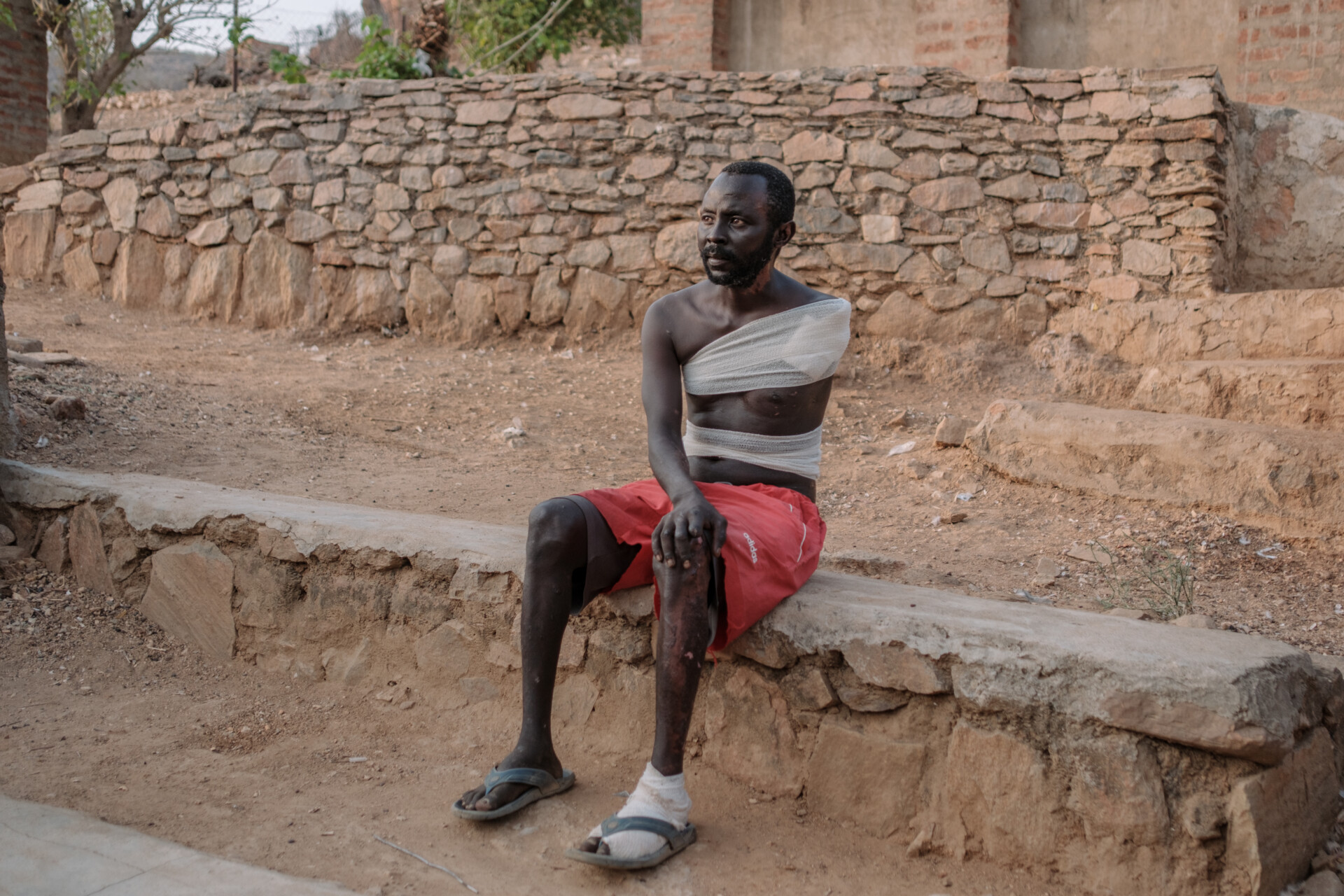
A brilliant orange sun sank behind spiny hills, turning the sky lavender and then gray. Baballa Hassan watched it go, sitting on a concrete ledge outside his hospital room in the town of Kauda, deep in Sudan’s Nuba Mountains. The evening was quiet and almost peaceful.
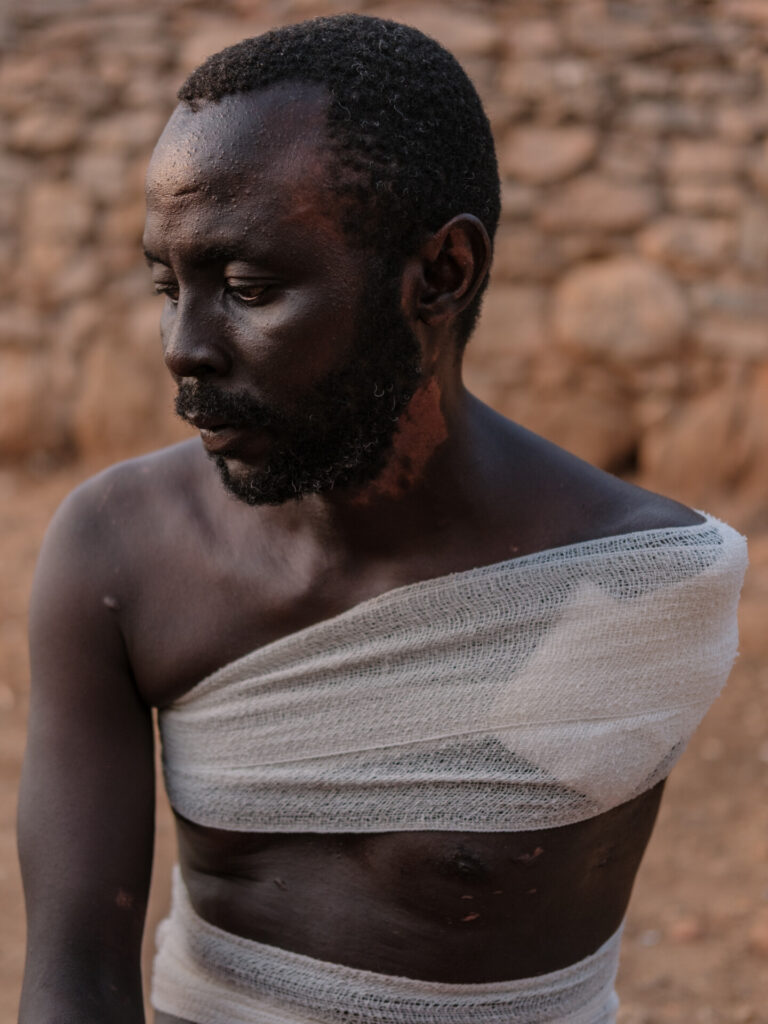
Hassan’s body told a different story, a living reminder of the violence that now shapes these isolated slopes. A patchwork of raw, pink burns climbed up his leg and over his torso to the place where his left arm once was. The strike also took toes from his left foot and the fingers from his right hand.
Just before Sudan’s war started, he had joined one of the country’s fractious armed groups. Hassan was injured by a drone late last year. “I don’t know what will be in the future,” he told New Lines haltingly. A volunteer cadet, he’d farmed to feed his family between skirmishes. Losing a limb means that he can no longer work the land and make a living.
Drones like the one that hit Hassan have reshaped Sudan’s war, leading to increased casualties and blurring the lines of accountability. They are also a sign of rising international influence in the conflict. Drones have allegedly been provided to the Sudanese Armed Forces (SAF) by Egypt and Turkey, and to their rivals in the Rapid Support Forces (RSF) by the United Arab Emirates.
It is part of a global shift in how war is waged. Drones are commonplace in Ukraine, and deployed in Israeli strikes in Gaza and Lebanon, in a form of fighting that is both impersonal in its remoteness and devastatingly deadly. Sudan provides just one example of this new type of conflict.
Long before it was waged from the skies, Sudan’s civil war began as a rivalry between two generals. During the pro-democracy movement of 2019, widespread civilian protests unseated long-serving President Omar al-Bashir. Army chief Abdel Fattah al-Burhan then seized control of the state, with RSF commander Mohamed Hamdan Dagalo, better known as Hemedti, as his deputy.
Before that, RSF fighters had gone by a different name — the Janjaweed, or “devils on horseback.” Loyal to the government, they roamed from village to village in Darfur in the early 2000s, slaughtering non-Arab inhabitants with Kalashnikovs and machetes. Even after the Darfur war, the paramilitaries still helped the government stamp out dissent.
Hemedti and Burhan governed smoothly at first, but their alliance collapsed as the pair scrambled for influence over Sudan’s powerful military. In April 2023, RSF forces attacked SAF sites in Khartoum. Conflict spread rapidly from the capital city to towns and villages across the country.
From the start, both Burhan’s SAF and Hemedti’s RSF had access to heavy weaponry. At the outbreak of the war, combatants drove tanks down the streets of Khartoum, shelling apartments and shops. By early 2024, videos emerged showing the RSF shooting an SAF drone out of the sky. In the weeks that followed, more evidence of downed SAF drones appeared. Then the RSF began to make use of drones, too. Now the weapons are ubiquitous across Sudan.
“The strategic use and frequency of drone strikes in this conflict is quite unlike anything else we see in other parts of Africa,” said Ladd Serwat, a senior Africa analyst at Armed Conflict Location and Event Data (ACLED), a Wisconsin-based research group. But while it may be unprecedented in Africa, his comments underscore how the fighting in Sudan mirrors the global shift in how war is being waged.
Hassan, the soldier recovering in the hospital, lives in Kauda, which serves as the administrative capital of the Nuba Mountains. Four years ago, he enlisted with the armed wing of the Sudan People’s Liberation Movement-North (SPLM-N), the rebel group that controls the area. Hassan bluntly told New Lines he took up arms out of frustration with the authorities in Khartoum for failing to provide resources and education to people like him. “The government is not helping us,” he said.
For decades, the SPLM-N has run a de facto state, administering a mountainous territory the size of Austria. Its roads are made from dirt pounded down by motorcycles and pickup trucks. The mobile signal cuts out shortly after crossing the border from South Sudan. For the last few decades, its rebels have claimed to fight for a secular and democratic government.
When the war first began, foot soldiers like Hassan held off the RSF on one side and the SAF on the other. But last year, the SPLM-N announced an alliance with the RSF, bringing the feared paramilitary force into their previously isolated territory.
While the alliance meant one fewer enemy for the SPLM-N, it also turned the wider Kordofan region, in which the Nuba Mountains sit, into a flashpoint in the war. Located between the RSF-held west of the country and the SAF-held east, Kordofan is among the last disputed areas of Sudan. The RSF is using the Nuba Mountains as a thoroughfare to fight its way back to the capital. For the SAF, maintaining control of Kordofan means it can launch attacks on RSF-held Darfur.
Late last year, Hassan was practicing military drills, as he would on any other day, at a facility on the outskirts of Kauda. The strike happened rapidly, he recalls. There was no warning and no time to hide. One SAF bomb fell as the soldiers marched, another as Hassan tried to climb into a car for safety. By his count, 22 people were killed and another 50 injured.
When Hassan met New Lines in February, he was waiting for doctors to remove the shrapnel still painfully embedded in his stomach and chest, passing his time chatting with survivors of similar assaults.
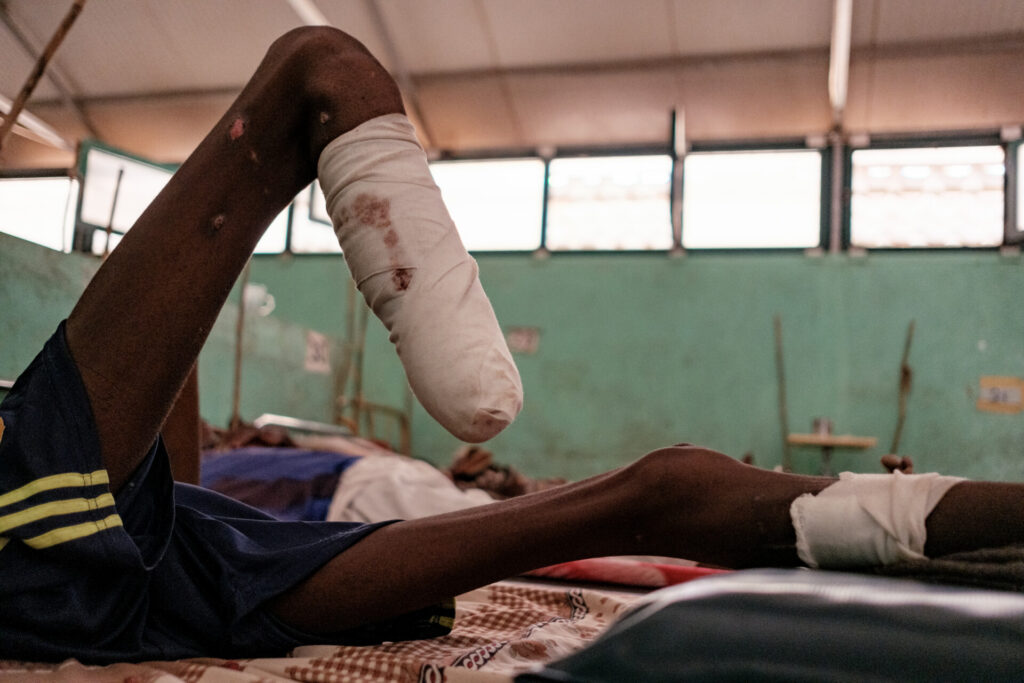
Soldiers like Hassan are far from the only people facing the risk of drone warfare. “One of the worst impacts of the use of drones is the impact on civilians. It does not only lead to the death and injuries of civilians, but it also leads to destruction of key civilian infrastructure,” said Abdullahi Hassan, a researcher focused on Sudan at Amnesty International.
Meanwhile, ACLED reported that there were 500 drone strikes last year alone in Sudan. The majority of those killed and injured were civilians, with nearly half of the strikes hitting civilian targets. In total, around 780 civilians were killed by RSF drone strikes between 2023 and 2025, while another 1,800 perished in SAF attacks, according to a brief by Al Jazeera citing additional ACLED data.
“It’s been beyond horrific,” said former United States special envoy to Sudan Tom Perriello, of the civilian toll of the war. “It’s hard to even get our heads around the total destruction.”
Jabre Sharif al-Din lost his teenage son Ahmed in one such attack.
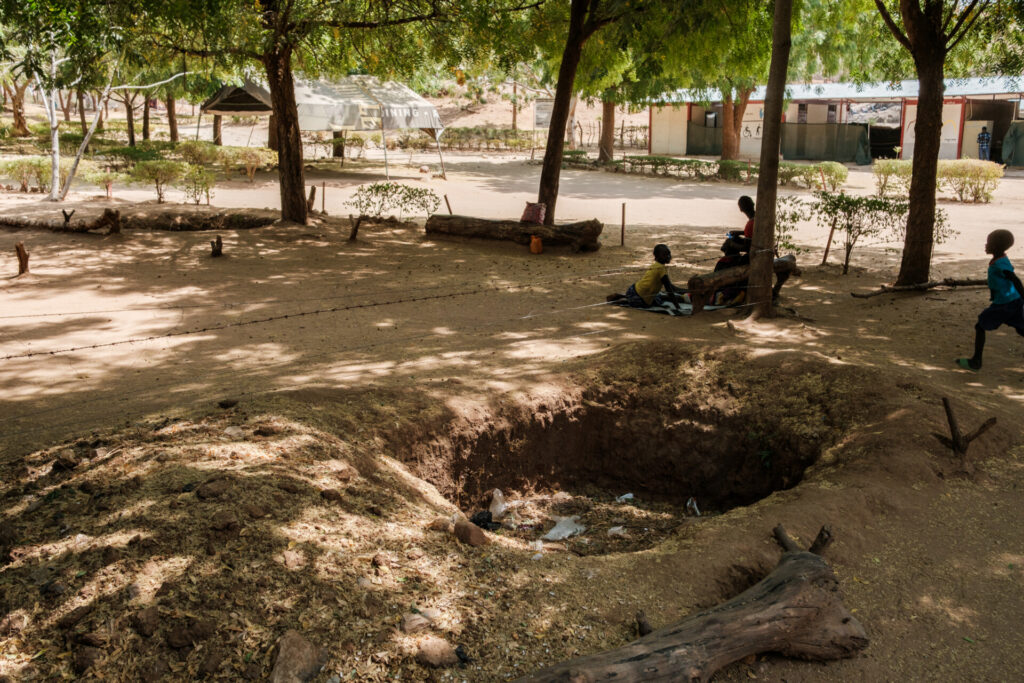
Sharif al-Din lives in al-Hilu camp in the town of Tongoli, some 31 miles away from the hospital where Hassan was recovering. The camp sits in an arid expanse of dirt between craggy hills, the heat so intense that the earth is devoid of greenery. Sharif al-Din’s family fled fighting further north in Al Quoz in early November, with only the clothes on their backs. “Nothing was left for us there,” he said, still wearing the same dirty shirt he ran in.
The family built a hut from yellowed grass and slept on the hard ground, grateful at least for their safety, but Sharif al-Din still worried for relatives left behind in Al Quoz. In November 2025, his 17-year-old son Ahmed volunteered to collect them, traveling back by car with one of his uncles and some two dozen other displaced people.
A drone struck their vehicle, killing both Ahmed and his uncle. Another traveler delivered the news to Sharif al-Din by telephone. The bodies, he heard, were shredded to bits. There was no money for a proper funeral, or to host the well-wishers who would normally come to offer condolences. “I feel dead, not alive,” Sharif al-Din said.
Drones have blurred responsibility in a war where both sides already operate with relative impunity. It can be hard to tell when they were intentionally aimed at civilians — which would make the strikes a war crime under international law — and when deaths were the result of the fog of war. For example, the area where Ahmed and his uncle were killed was heavily contested between the SAF and the RSF, meaning either could have been the culprit. It is also unclear whether drone operators intended to hit a noncombatant car.
“It’s already difficult to hold individuals accountable for all the violations that are taking place in Sudan,” explained Hassan of Amnesty International. “When the parties add another layer of complexity by using technology like drones, then it really complicates the issue of accountability.”
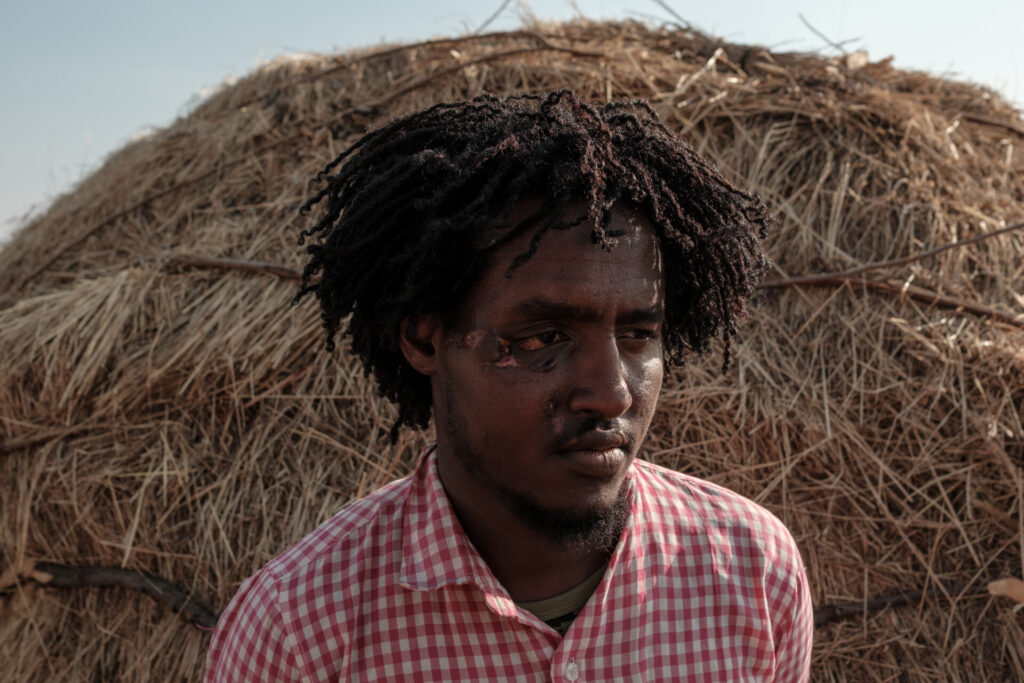
Ahmed enjoyed studying English in school and always helped to care for his two younger siblings, his father recalled. Sharif al-Din was also close to his brother, Ahmed’s uncle, but could bring himself to reveal little more. Another four of Sharif al-Din’s siblings remain trapped in Al Quoz, along with 20 of his nieces and nephews. Conflict has carved boughs off of his family tree. As New Lines spoke with Sharif al-Din, his uncle Yehia Sharaf al-Din walked over and said he had something to share as well.
Yehia is a local leader in Al Quoz. He said he’d personally counted some 250 deaths in the area between January 2025 and the time he fled in November, as a result of both aerial bombing and drone strikes. He still remembers the sound of drones overhead, like the mechanical buzz of a motorcycle revving. He made no written record of the deaths but can recite the names from memory, he said. Including Ahmed, a total of six of his nephews have been killed.
“This war is finishing the Sudanese people bit by bit,” Yehia said. “We are almost finished as a people.” He blames the strikes on the SAF, claiming the attacks came from the direction of SAF-held territory. New Lines could not independently verify this claim. But Yehia added that, in response, local youth joined the RSF, the drone strikes not only causing direct destruction but driving recruitment for the war.
At the start of the conflict, the SAF had the upper hand in the skies and the RSF had no air force at all. That balance is shifting as both sides expand their use of drone warfare. The SAF was responsible for some 280 drone strikes across Sudan last year, and the RSF for 200, according to ACLED. Increasing use of drones led to a sixfold increase in fatalities in 2025 compared to the previous year.
The United Nations reports that another 700 civilians have been killed by drones since the start of this year, which accounts for three-quarters of the total civilian deaths in 2026 so far. Drone strikes occur almost every day, and are particularly common in the disputed Kordofan region, where New Lines reported.
Drones have also expanded the geographical scope of the conflict, engulfing more of the country in violence. RSF drones can travel hundreds of miles, while SAF drones can travel thousands. “The drones are capable of striking positions well beyond areas held by ground forces and reach targets behind the opposing armed group’s front lines,” said Serwat of ACLED.
The flow of drones into Sudan is accelerated by foreign countries backing each side. The RSF allegedly uses drones paid for by the United Arab Emirates. The army allegedly relies on an arsenal of Iranian and Turkish-made drones, while a joint investigation by Reuters and The New York Times found that some of the drones launched into Sudan originated from a desert military base on the Egyptian side of the border, with Cairo providing support to the SAF.
The war in Iran might change these dynamics. As the UAE and Iran face their own aerial bombardments, they could choose to cut off support to warring parties in Sudan. The same war, however, will also make it even more difficult and costly for aid to reach the 34 million Sudanese people in need of humanitarian assistance.
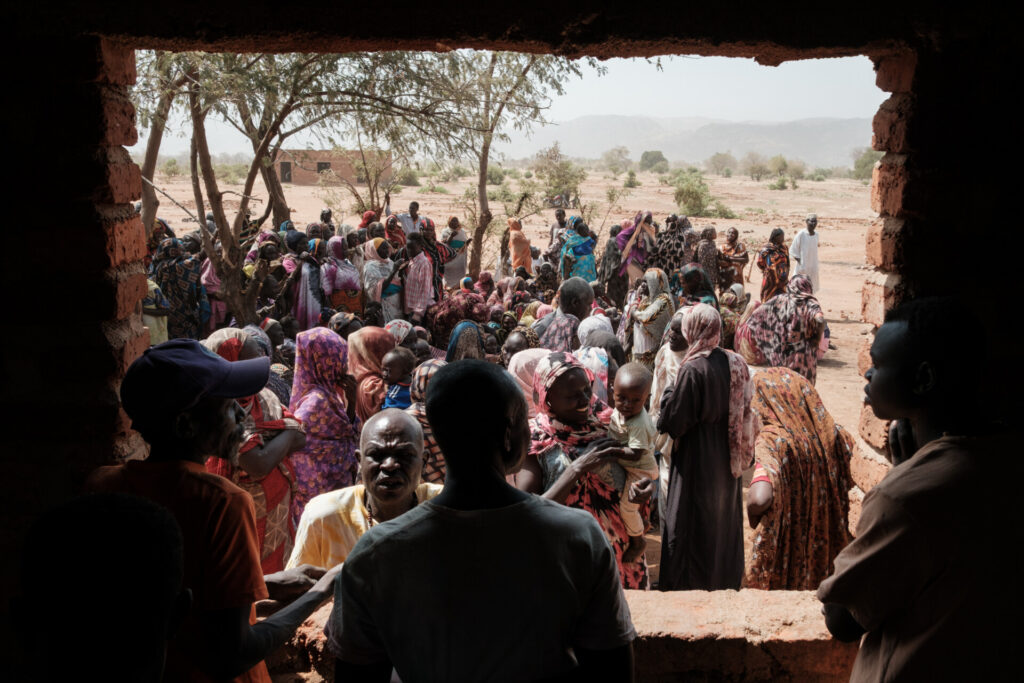
Among them is Fazia Rahim, who is living in a displacement camp. For the past three years, the RSF had laid siege to Rahim’s home in Kadugli in the southern Nuba Mountains, sealing it off from food and medicine. The SAF claimed to have broken the siege of Kadugli in February 2026, but the RSF continued to rain drones into the city.
New Lines met Rahim the morning she’d turned up on foot in a displacement camp in February, her legs aching as she tightly clutched her son Zachariah. Nestled between farming villages and a small market serving roasted goat meat, the camp itself is almost a copy of the barren place where Sharif al-Din lives.
Three weeks before we met her, a drone strike had hit her husband, badly injuring him, Rahim told New Lines. He was still in the hospital when she fled. “My hope for the future is simply that Sudan will find peace,” she said through tears. Then, holding a blue abaya around herself, Rahim walked off with a camp administrator, who showed her the patch of ground where she could hang a tarp for shelter and finally rest.
Drones slip into Sudan over land and sea borders, bypassing international law. There has been a U.S. arms embargo on Darfur since 2005, with calls from advocacy organizations, including Amnesty International and Human Rights Watch, to extend that embargo to cover the entire country. “The current arms embargo on Darfur is ineffective, and it’s frequently violated by various actors,” said Hassan of Amnesty. “To ensure proper protection of civilians and to limit the impact of the conflict on civilians, it is very important for the U.N. Security Council to expand the arms embargo.”
On the three-year anniversary of the war this April, representatives of the African Union, the European Union, the United Kingdom and the United States gathered in Berlin to pledge almost $1.8 billion in aid to the country, while calling for an end to fighting. The same conference aimed to accelerate now stagnant peace talks, but neither the RSF nor the SAF was present. The SAF, for its part, called the conference “surprising and unacceptable,” while the RSF accused its attendees of favoring the government in Khartoum.
Meanwhile, it’s unclear how effective promises of support will be on the ground.
“The question is not just is $1.8 [billion] enough, but how much of that $1.8 [billion] ever turns from pledges to cash?” said Perriello, the former special envoy. Meanwhile, he added that grassroots community kitchens in Sudan have done more to feed the hungry than international organizations, leading him to another question. “How much of that supports these higher-impact mutual aid efforts?” Perriello asked.
Back at the hospital outside Kauda, it was growing dark. Hassan, the wounded soldier, thought of his children, sounding regretful. He said that if his young son wanted to join the army when he grew up, too, he would stop him. He hoped he would not be called back to fight himself. The sky was dim and quiet for a moment, free from the sound of drones.
The reporting for this story was supported by the Pulitzer Center.
Become a member today to receive access to all our paywalled essays and the best of New Lines delivered to your inbox through our newsletters.