

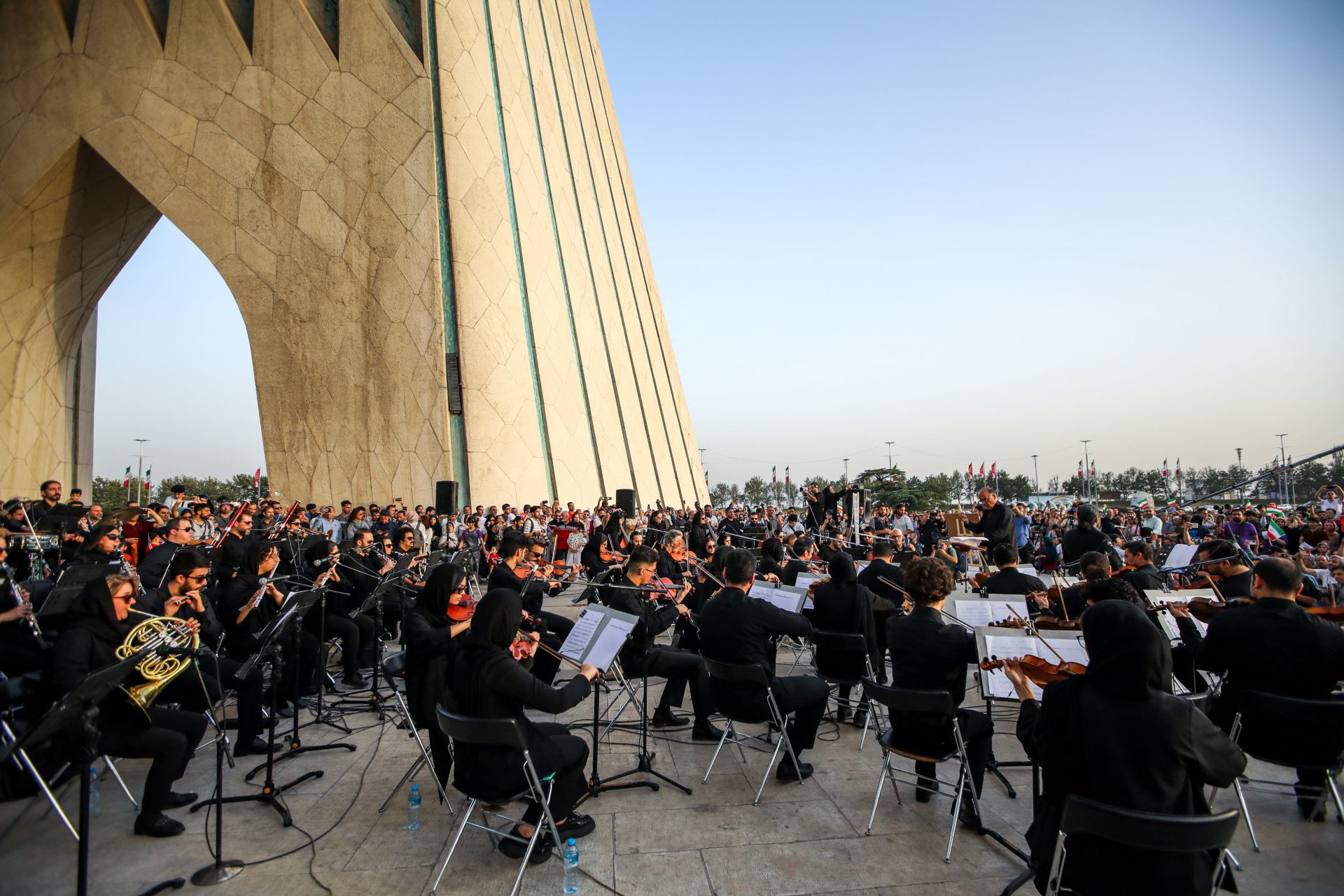
For Parvaneh, a 45-year-old native of Tehran and professional musician, the war against Iran began with a traffic jam. On the morning that the United States and Israel started bombing the country, traffic in the Iranian capital ground to a halt for several hours, as parents desperately rushed to schools around the city to try and bring their children home just an hour after the beginning of the school day. In panic, some abandoned their cars in the middle of the roads and continued on foot to collect their children.
Like many others, Parvaneh, who had spent a lifetime training to play the double bass and saving to purchase her own, decided to leave Tehran for villages and towns on the outskirts of the city to seek refuge from the attacks.
“We thought it would be like last summer’s 12-day war. At most, it would last a few days, and we would come back,” she said. “I packed for a short trip nearby. I wasn’t packing up my life to take it with me. For example, I didn’t take my double bass.”
But just hours after she arrived in the village, she received a phone call informing her that the life and career she had spent years building were suddenly over.
“We had just arrived at the village. Maybe only a few hours had passed, and we were still exchanging news about the war and speculating about what might happen next, when my phone started ringing. Within minutes, there must have been dozens of messages across different apps, followed by one phone call after another,” she recalled. “I answered the first one, and a friend on the other end asked, ‘Parvaneh, are you OK?’ I said, ‘Yes, I’m fine. Has something happened?’ I think my question made her realize I hadn’t heard the news yet, so she replied, ‘No, no. I was just calling to see how you were.’ But the second call was different. After asking where I was, my friend said, ‘Don’t panic, but it looks like they’ve struck somewhere near your house.’”
As it turned out, this was a kind way to describe it. In reality, Parvaneh’s home in the Niloufar Square area of Tehran had been destroyed in a bombing attack.
Located in the eastern part of Tehran, a city that spreads across 300 square miles, Niloufar Square is considered one of the capital’s central districts. The streets on either side are lined with reasonably priced cafes and restaurants, popular gathering places for families and, especially, young couples. Nightlife in this part of the city usually continues until the early hours of the morning. There is also a police station and a criminal investigations office in the area. Both buildings, however, had been evacuated several days before the war began because security alerts for Iran’s law enforcement agencies had been raised.
A large part of Niloufar Square was reduced to rubble during a series of attacks carried out on the night of March 2, including a double-tap bombing that killed a number of first responders. At least 20 people were killed in the attacks. Some had gone there to eat, while others worked in the cafes and restaurants nearby, or were simply passing through the lively commercial streets.
The Niloufar neighborhood — named after the Persian word for nymphaea, or the family of plants that includes water lilies — dates back more than five decades. By the standards of Tehran’s roughly 250-year history as Iran’s capital, it is considered relatively young, but in terms of urban planning, it belongs to an older generation of neighborhoods: large residential buildings, generally three or four stories tall, built with steel-frame foundations, featuring expansive windows and generous balconies. Its location at the intersection of several of Tehran’s main arteries, connecting north, south, east and west, has made living there an aspiration for many young people. To rent a home in this neighborhood, one must either be very wealthy or very fortunate.
Parvaneh, who came from a working-class background, had been fortunate. The following morning, wracked with grief and anxiety over the news, she struggled through the heavy traffic leaving Tehran to make her way back home.
By the time she arrived, a couple who were close friends and had not yet left the city had already reached the house. They had been searching for the most valuable possession that Parvaneh had left behind, her prized double bass, hoping against hope that some miracle had spared her instrument. Their hopes vanished when they found it among what remained of the house. The wooden soundboard of the double bass had been shattered.
The loss of her home, as well as the instrument she had spent years saving to purchase and which was also the source of her livelihood, plunged her into a deep grief. After the collapse of her relationship, she had received this place as a rental property from a woman whose children had departed Iran to live in the U.S. Within it, Parvaneh found solace and a place where she felt she belonged.
“It suited my life as a woman living alone and working as a musician. In the end, I rented it for an amount that, at the time, was equivalent to my entire monthly salary from the Tehran Symphony Orchestra. I covered the rest of my living expenses by teaching and through the occasional concerts I performed,” she said. “Life was difficult, but I loved that large old house, with its floor-to-ceiling windows and its soft northern light. After years of moving from one place to another, that house, even though it wasn’t truly mine, gave me a sense of belonging.”
Even worse was the loss of her beloved double bass. Before the war, the price of an ordinary double bass in Iran could reach up to $5,500, a daunting sum for most people in Tehran. Parvaneh’s instrument, however, was a professional model, and she estimated its value at nearly $10,000. That amount would be equivalent to a midsize car in the city.
For Parvaneh, after losing even the ability to generate an income, the double bass was irreplaceable.
“When I was 19, I took the entrance exam for the University of Broadcasting Arts with no background whatsoever in string instruments. I had chosen music simply because I loved it. The only instrument I owned was a very cheap student violin,” she recalled. “I had heard beforehand that almost nobody chose the double bass as their major because it was such an expensive instrument and there were so few specialists in the field. I thought that if I chose the double bass, my chances of being accepted into the university and staying in Tehran would be better.”
Parvaneh had come to Tehran from a traditional, religious family in Mashhad. The prospect of living in such an enormous city and studying music already felt overwhelming, she said, so she was willing to do whatever it took. The university accepted her on the condition that she catch up with the other students within a single semester. Only then did the problem of finding an instrument arise: She did not own a double bass and could not afford to buy one, and the university had only one.
Her days began at 6 a.m., when she arrived at the university to practice before classes. She attended her courses and then remained in the studio for as long as possible afterward, continuing to practice on the university’s instrument. Taking it off campus required her to provide a financial guarantee worth several times its value.
After a few semesters, once she had demonstrated her commitment and signed the required guarantee, the university allowed her to take the instrument to Mashhad during breaks, when the dormitories were closed. A double bass could not be checked in the train’s luggage compartment, and she lacked the money to purchase a second ticket for herself.
“Every time, I bought a single ticket and placed the instrument on the seat,” she said. “Then I spent the entire 12-hour journey from Tehran to Mashhad standing or walking through the train’s corridors. That was what it meant to be a music student without an instrument.”
Ten years after graduating, Parvaneh finally bought her first instrument with the income she earned from teaching and performing with the orchestra. It took another 10 years before she was able to save enough money to sell that first instrument and buy a professional one. Such was the history of the double bass that now lay broken on the floor of her destroyed home.
On the morning of the third day of the war, Parvaneh stood among the ruins of her home, holding her destroyed instrument. Yet, she says, this was neither the first nor the worst shock she had experienced during those days.
“Something else had happened before that day that had turned my entire life upside down. The missile hitting my house and breaking my instrument only made public something that, until then, many people did not know about my life.”
She is referring to the days following the events of Jan. 8 and 9 in Tehran. The protests that had begun several weeks earlier, following a call from the son of Iran’s deposed shah, ended on those two nights with armed confrontations between groups of people and security forces. The violence left many civilians, police officers and people who had no connection to the events dead.
Following the psychological crisis created by this incident, some professional groups, led by artists, joined boycott movements. By shutting down their work, they expressed their protest against the open violence that had taken place in the streets.
Parvaneh, however, was not among those who joined the boycott.
The Tehran Symphony Orchestra had performances scheduled for Jan. 10 and 11. In an atmosphere of fear, when no one yet understood exactly what had happened, the musicians had to make their way through riot control forces deployed across the city to reach their stage in Vahdat Hall.
For Parvaneh, who had spent more than 20 years away from her family home, living for long stretches in dormitories and temporary rentals in Tehran, the orchestra had become her home. “The hall, which is a second home for every symphony orchestra musician, was my first home,” she said. “It was the only point of stability in my life, the one place where I knew that no matter what changed, I could return there and be my true self.”
Like many of the musicians, Parvaneh did not feel mentally able to perform in the days after the violence. When the Fajr Music Festival arrived several weeks after the confrontations, she wrote to the orchestra’s director explaining that she could not take part, then traveled to Mashhad to visit her mother, who had just begun radiation therapy for cancer.
“When I returned, I found out that the Tehran Symphony Orchestra had ended its collaboration with me,” she said.
Less than a month after losing her job, Parvaneh now stood amid the ruins of her home, watching her friends try to gather what remained of her life — a piece of clothing from here, an intact dish from there, a stack of musical scores buried beneath the soil.
“Twenty years of my life could not fit into a single suitcase,” she said.
Parvaneh is among several thousand people housed in hotels with government assistance during the war. Her room in central Tehran bears little resemblance to the life she once had. She forces herself out of bed for meals, served to displaced residents separately from the hotel’s other guests, and spends her days visiting government offices, writing letters and explaining her circumstances to qualify for assistance. The number of displaced people remaining at the hotel dwindles each day.
The experience, she said, has given her a new understanding of people who endured earlier wars. Those who have lost their former lives have become a tribe bound together by a devastation only they can fully comprehend. Losing either a home or a job leaves something from which to rebuild, she explained, whereas losing both at once leaves nowhere to turn.
At 45, Parvaneh worries that she no longer has the time or hope to reconstruct what took two decades to create. “Sometimes I tell myself, ‘You will start again,’” she said. “Then I ask myself, ‘What guarantee is there that the life I rebuild will not disappear again in the blink of an eye?’”
With the war continuing and efforts to secure a permanent ceasefire still precarious, she increasingly thinks about moving away. Her instrument is gone, but the skill she spent a lifetime developing remains.
“The only thing this war and chaos could not take from me is my hands,” she said. “I wish I could find refuge somewhere that, for a while, I could simply be a double bass player, not a member of a population that some group, here or elsewhere, wishes to destroy for its own political purposes.”
Five months after the strike made her homeless, Parvaneh said that she still feels as though she has “not emerged from beneath the rubble.” In an entry from the daily journal she has kept during her displacement, she wrote about the feeling of alienation and devastation that has taken hold of so many of Tehran’s homeless and bereaved in the wake of the U.S. and Israeli war against the country.
“For months now, all that has remained of life in the ‘hotel’ is the building itself. They treat us like excess baggage, like strangers. Perhaps they have the right to, we are not very different from strangers,” she wrote. “With the few clothes we managed to pull from beneath the rubble of our homes, with no possessions and no life of our own left, we are nothing but outcasts.”
Become a member today to receive access to all our paywalled essays and the best of New Lines delivered to your inbox through our newsletters.