



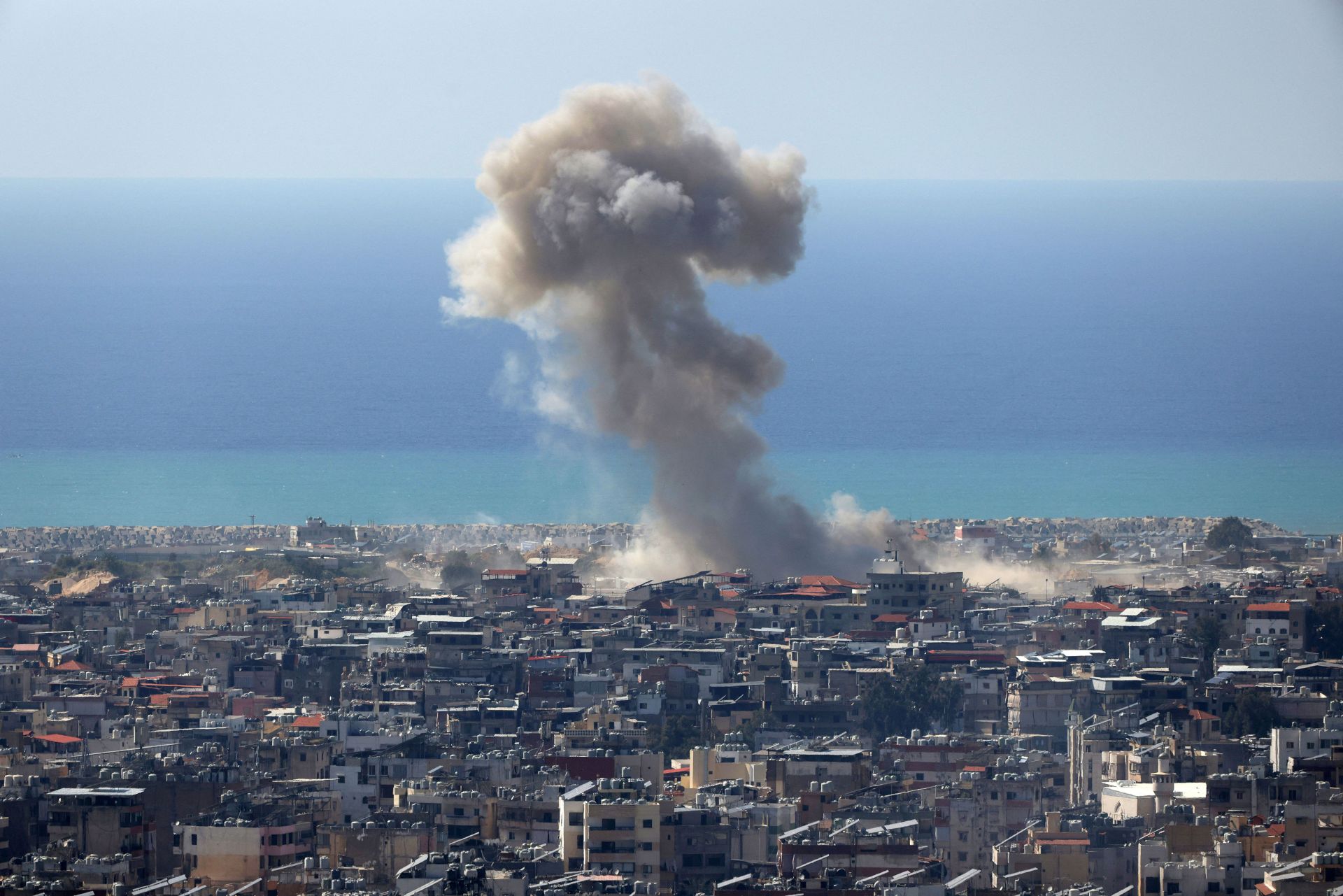
Israel has repeatedly described its attacks in Lebanon as “precision” or “targeted” strikes against specific Hezbollah officials and military targets. Embedded within those statements is a broader claim: that Israel can identify, locate and distinguish a specific individual from the civilians living around them.
A New Lines investigation has tested that claim, by examining in detail five Israeli strikes in and around Beirut in March and April. Together, they reveal a spectrum of destruction — ranging from a single room to two residential buildings — and raise questions about what accounts for those different outcomes.
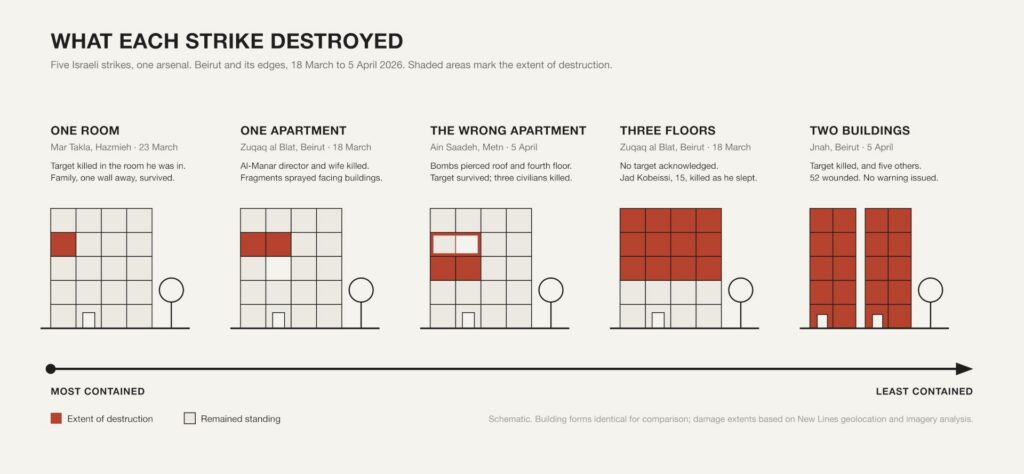
At one end of the spectrum stands a strike in the Mar Takla area of Hazmieh, southeast of Beirut. The attack killed Muhammad Ali Kourani, whom Israel identified as an operative in the Quds Force of Iran’s Islamic Revolutionary Guard Corps (IRGC), inside a single room, while his wife and children, separated by little more than a wall, survived. In central Beirut’s Zuqaq al-Blat, another strike killed Mohammad Sherri, director of political programming at the Hezbollah-affiliated Al-Manar TV station, along with his wife in their bedroom, while other family members survived. The strike scorched the apartment but left the floors around it intact.
In Ain Saadeh, east of Beirut, the intended target of another strike survived, while Pierre and Flavia Moawad, together with their neighbor Roula Mattar, were killed on another floor. Hours earlier, also in Zuquq al-Blat, an overnight strike tore through three floors of a residential building, killing 15-year-old Jad Kobeissi as he slept. At the far end of the spectrum lies an attack in the southern Beirut suburb of Jnah, where a strike reportedly intended to kill a single target largely destroyed two densely populated residential buildings.
The question of why the extent of destruction varied so widely carries a particular charge in Lebanon, where neighborhoods are often thought of as belonging to one particular community or another. Mar Takla and Ain Saadeh are predominantly Christian areas; Zuqaq al-Blat and Jnah are not. If the degree of precision were deliberately made higher in some places than in others, the variation would appear less like the contingency of individual operations and more like a judgment made in advance about whose surroundings are more worth sparing.
Whether the pattern of these five strikes supports that reading is a question this investigation explores, rather than a premise it assumes. Differences in intelligence, in the target’s location, in the munitions available and in the structural integrity of the buildings themselves may account for part of the variation, or all of it. The cases that follow should be read with both possibilities in view.
Israeli leaders repeatedly presented these operations as evidence that their campaign was directed against Hezbollah rather than the civilian Lebanese population. On June 10, Prime Minister Benjamin Netanyahu said Israel was “not at war with the Lebanese people” but with Hezbollah, while military statements described strikes against named, and sometimes unnamed, Hezbollah officials, commanders and military infrastructure. Whether those claims are reflected in the physical consequences of individual strikes is the question addressed by this investigation.
Understanding that question requires distinguishing between precision as a technical capability and precision as it is often described publicly. Wes Bryant, a former U.S. Air Force Special Operations targeting expert and former chief of civilian harm assessments at the Pentagon, draws that distinction.
“Precise targeting of combatants and precision warfare is different from precision destruction,” Bryant said. “Precision warfare should be using the least resources necessary to precisely target military objectives while limiting damage, destruction and death to the civilian environment and population. What we have seen in Gaza, and now in Lebanon — and to a smaller extent in Iran — is essentially precision destruction carried out over an extended period of time.”
Mar Takla
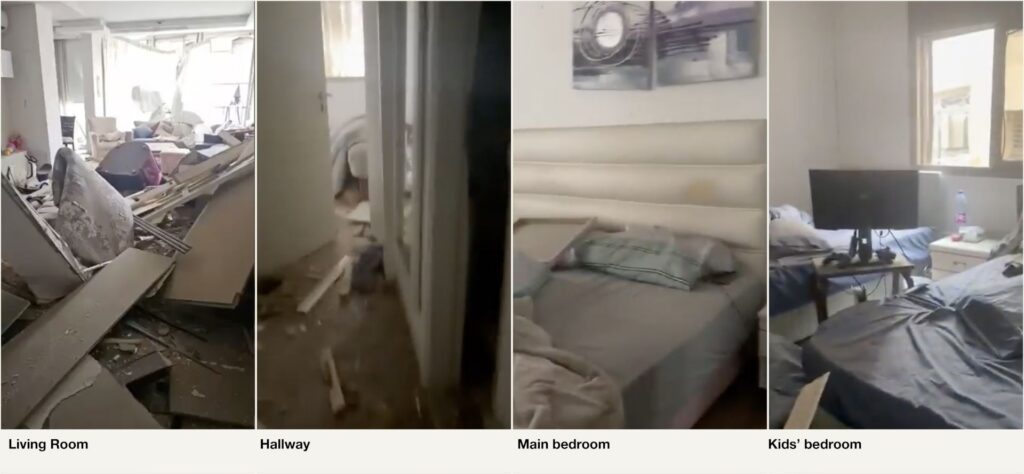
On March 23, Mohammad Ali Kourani had been inside the apartment for about an hour when the missile found him, a timeline later confirmed by the local mayor. The room he was in was torn apart, but the rest of the apartment remained intact. A few yards away, adjoining rooms were still recognizable. His wife and children, elsewhere inside the apartment, survived. The apartment had been rented six months earlier, in his wife’s name.
The strike took place in Mar Takla, a residential quarter of Hazmieh, a predominantly Christian municipality on Beirut’s eastern edge, better known for its schools, businesses and diplomatic missions. It is an unlikely place to begin a story about Israel’s campaign against Hezbollah, which is precisely why it begins here. Israel later identified the target as a member of the IRGC’s Quds Force, the branch responsible for Iran’s military and intelligence operations abroad and its network of allied armed groups, of which Hezbollah is the most capable. Kourani, Israel claimed, had been directing attacks against it from Lebanon. Earlier that month, he had reportedly survived another Israeli attempt on his life at the nearby Comfort Hotel. The Israeli military later said that the operation relied on intelligence supplied by the Shin Bet security agency before the navy struck the apartment in which he had been found.
New Lines’ reconstruction begins with the physical evidence. After geolocating the apartment in Mar Takla, photographs and videos of the interior from after the strike were examined. The munition entered the building without collapsing the floor or bringing down the entire building. It did not destroy the apartment. It did not kill the family. It killed one man in the room where those who fired it appear to have known he would be. The apartment therefore can be used as a baseline, to which the strikes that follow can be compared.
Bryant said the operation likely relied on a combination of cellular geolocation and human intelligence. In his assessment, Israeli forces likely identified the side of the building, the apartment and possibly even the room in which Kourani was located, suggesting either that a suitable munition was immediately available or that the operation had been planned in advance.
“In my assessment, it was pure luck that the wife and child survived. The operational decision would have been that whatever collateral damage or civilian casualties resulted from the strike were considered acceptable.”
For this investigation, Mar Takla serves as a benchmark. It demonstrates that, under at least some operational circumstances, Israel possessed both the intelligence and weapons capability to locate a single individual inside a shared civilian residence and confine the blast to the room he occupied. Whether the survival of his family was by design or, as Bryant suggests, fortunate, the strike demonstrates a degree of spatial containment not seen in the other cases examined here.
Once that capability has been demonstrated, the question is no longer simply what Israel could do. It becomes how that capability was exercised, when it was exercised, and when it was not.
Zuqaq al-Blat 1
At approximately 8:16 a.m. on March 18, an Israeli strike hit a residential building in Zuqaq al-Blat, in central Beirut. The building was a short walk from a branch of a financial institution affiliated with Hezbollah, known as Al-Qard Al-Hasan, which Israeli aircraft had struck in the dark seven hours earlier, as part of an overnight attack sequence examined below. This strike came at the start of a working day, on a Wednesday morning, in broad daylight.
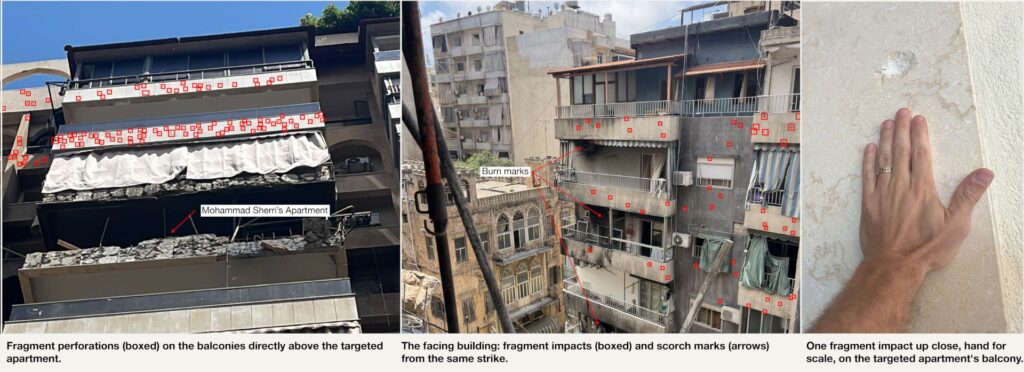
The strike killed Mohammed Sherri, political programming director at Al-Manar TV, a network affiliated with Hezbollah, and his wife in their bedroom. Their children and grandchildren, who were elsewhere in the apartment, survived with injuries. Poststrike photographs examined by New Lines show heavy fire damage across much of the couple’s apartment, with walls charred black, though the destruction ended at its boundaries: The floors directly above and below remained largely intact. This was not the surgical containment of Mar Takla, where a single room was torn apart and the adjoining rooms still recognizable; here the blast reached well beyond the bedroom. But measured against the strikes that follow in this investigation, it was still comparatively contained: one apartment, and no further.
The street tells a different story. The main facades of the buildings facing Sherri’s apartment were sprayed with small perforations, dense and roughly uniform, resembling bullet holes, which New Lines documented across balconies and exterior walls. The same perforations appear on the balconies directly above the targeted apartment on the strike building itself. On the building opposite, balcony curtains caught fire, and scorch marks ran along the building. At the hour the missile struck, people were walking the streets between those buildings.
New Lines could not identify the munition used, but the damage indicates the warhead detonated on initial contact with the building rather than deep inside it, spraying fragments outward as well as inward. Trevor Ball, a former U.S. Army explosive ordnance disposal technician who reviewed the damage pattern at New Lines‘ request, assessed it as the work of a single weapon.
“This is likely just one munition that detonated on impact with the external wall, or after partially penetrating,” Ball said. Some warheads, including Israeli ones, he noted, contain a relatively long fragmentation liner. A detonation at the facade would spray those fragments radially from the point of impact — up across the balconies above, down into the street and across to the buildings opposite — while driving blast and fire into the apartment behind the wall.
The apartment and the street are not two contradictory readings of the same strike; they are two different measurements of it. The rubble measures what the munition did to the structure it was aimed at; the perforations, the burned curtains and the debris measure what it put into the air around it. By the first measure, Sherri’s killing approached the precision of Mar Takla. By the second, the strike filled a street with high-velocity fragments at the start of a working day.
New Lines visited the building and spoke to residents. None of those interviewed said anyone living in the building was a fighter or member of an armed political faction. One woman living on the floor above Sherri said that she worked with a member of parliament for the Amal Movement, another Lebanese Shiite political party, but said no one in the building was involved in armed activity.
Adil Haque, a professor at Rutgers University and an expert on the law of armed conflict, said that journalists are presumed to be civilians under international humanitarian law.
“Journalists are presumptively civilians and not lawful targets unless they take a direct part in hostilities or … [are] also a member of Hezbollah’s military wing.”
Based on the publicly available information, Haque said: “On its face, this looks like a violation of distinction. This looks like a very precise attack, but directed at a civilian.”
Measured in physical containment alone, the strike that killed Sherri was among the narrowest of the war: The missile reached the apartment it was aimed at, and the building stood. What that measure misses is everything else the strike did on a Wednesday morning: fragments across two facades and the balconies of neighbors; burning curtains; debris across a street where people were walking to work; and a couple dead in their bedroom — a man whose work, on the available evidence, was television programming, and his wife beside him. The scale this investigation traces, from a room to two buildings, records how much of the civilian environment each strike consumed. Sherri’s case marks the scale’s limit. A strike can sit near its narrow end and still fail the law’s first question, which is not how carefully it killed, but whom.
Ain Saadeh
At around 9:00 p.m. on April 5, two bombs pierced the roof of a residential building in Ain Saadeh, a predominantly Christian town east of Beirut. New Lines geolocated the building using photographs and videos published immediately after the strike, corroborating the location through architectural features, surrounding buildings and satellite imagery.
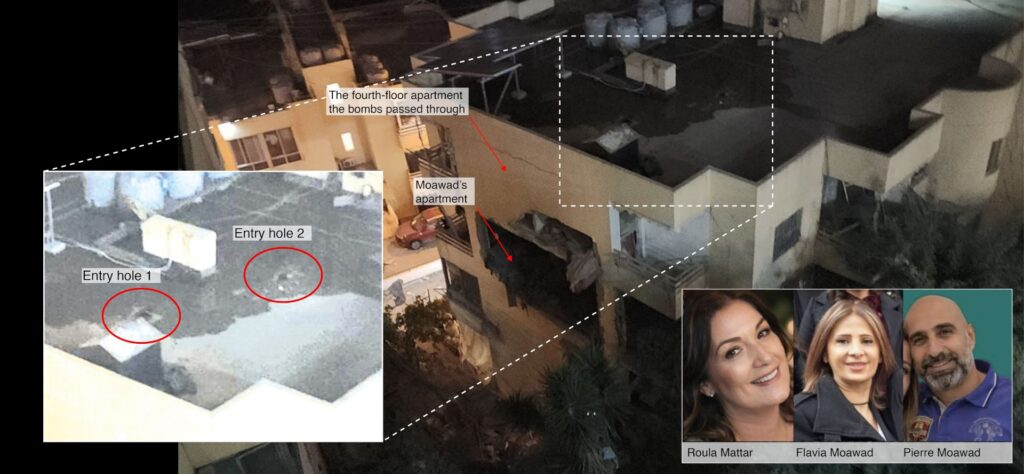
According to the Lebanese army, investigators identified both munitions as GBU-39 small diameter bombs. Rather than detonating on impact, they continued through the roof and the fourth floor before exploding inside an apartment on the third. Three people were killed: Pierre Moawad, head of the Lebanese Forces political party office in the municipality of Yahchouch, his wife Flavia and their neighbor Roula Mattar, who had come upstairs for coffee. Several other residents were injured. The building remained standing.
Unlike in Mar Takla in Hazmieh, the intended target reportedly did not die.
Israel said it had struck a “terror target east of Beirut” and later stated that it was reviewing reports that “several uninvolved individuals were harmed.” An Israeli military spokesperson, Lt. Col. Nadav Shoshani, subsequently said that Pierre Moawad “was definitely not a target.”
That statement raised a different question from the one posed in Hazmieh. The issue was no longer whether the strike had been physically precise. The physical damage itself suggested that it was. Two relatively small bombs entered through the roof, penetrated two floors and detonated inside the building without bringing it down. The intended target, however, survived, while residents on another floor were killed instead.
According to Bryant, the use of GBU-39 small diameter bombs does not, on its own, determine how much of a building will ultimately be damaged. While the munition is capable of penetrating multiple floors before detonating, military planners cannot know with certainty exactly how much of a structure will survive. Instead, they make an informed estimate based on the weapon’s characteristics, including the programmed fuse delay and previous operational experience.
Israel has never publicly explained its own collateral damage estimation methodology, making it impossible to determine whether it follows a process comparable to that used by the U.S. military. Bryant said that, under the latter process, planners would assess every floor through which the bomb was expected to travel, together with at least one or more floors below the intended point of detonation. Depending on the circumstances, the entire building could form part of the collateral hazard area before a proportionality assessment was made.
“We would have assessed every floor the bomb needed to go through, and at least one or more floors below. Potentially, the entire structure would have been designated as the collateral hazard area. The risk to civilians would have been known before the strike.”
For Bryant, the question was therefore not simply where the bombs detonated, but what level of anticipated civilian harm decision-makers had accepted before authorizing the strike.
The mechanics of the strike are relatively clear. What happened inside the building beforehand is not.
The Lebanese army said its investigation found no evidence that the apartment above the Moawads’ had been rented to new tenants, a conclusion reportedly shared by both the local mayor and the building’s landlord. Yet within hours of the strike, an alternative narrative began circulating. Relatives of the victims suggested that the apartment may have been rented to someone linked to Hezbollah, and several Lebanese media outlets repeated similar claims. Subsequent reporting questioned those accounts, noting that no public evidence had emerged to substantiate them and that many of the early reports appeared to rely on unverified rumors. One man seen leaving the building immediately after the strike was later widely reported to have been a delivery driver rather than the intended target.
Haque said that even if reports of a Hezbollah-linked individual in the building were accurate, that alone would not resolve the legal question.
“A person is not a lawful military target simply because they are affiliated with Hezbollah,” Haque said. “They would have to be a member of Hezbollah’s military wing or otherwise directly participating in hostilities.”
Even assuming a lawful military target had been present, Haque said, the legal analysis would not end there. The remaining questions would be whether all feasible precautions had been taken to minimize civilian harm and whether the expected civilian harm was proportionate to the military advantage anticipated from the strike.
For investigators, those competing narratives matter because they leave unanswered one of the central questions of the strike: Who, if anyone, was actually inside the apartment Israel intended to hit?
Unlike in Mar Takla, where the available evidence suggests the intelligence identified one man inside one room, the Ain Saadeh strike points to a different kind of uncertainty. The evidence indicates that the weapons reached the building they were aimed at and detonated inside it. The uncertainty lies elsewhere: whether the intelligence correctly identified the intended target, correctly placed that person inside the building at the time of the strike, whether the munitions detonated a floor short of their intended point, or whether the decision to attack proceeded despite unresolved uncertainty.
That distinction matters because it shifts the focus of the investigation. The Mar Takla strike demonstrated what Israel’s intelligence and precision-guided munitions were capable of achieving under favorable circumstances. The Ain Saadeh attack suggests that even when a weapon reaches the building it was aimed at, the outcome still depends on additional factors: the intelligence that identified the target, and the exact floor on which the bombs were aimed at. A bomb can strike with precision and still kill the wrong people.
Zuqaq al-Blat 2
At around 1:28 a.m. on March 18, Israeli aircraft struck central Beirut several times. One attack targeted a branch of Al-Qard Al-Hasan, a Hezbollah-affiliated financial institution that has long functioned as an alternative banking network for the party’s supporters, providing loans and financial services outside Lebanon’s traditional banking sector. Israel has repeatedly described the institution as part of Hezbollah’s financial infrastructure and has targeted its branches during previous conflicts, including the 2006 war and in 2024. Human Rights Watch argued that the 2024 strikes amounted to unlawful attacks on civilian objects, disputing Israel’s characterization of the institution as a lawful military target.
At the same time, some 45 meters away, another strike tore through three floors of a residential building, killing 15-year-old Jad Kobeissi and injuring several members of his family. Speaking from the hospital to Sky News, his father, Muhammad Kobeissi, struggled to describe what had happened.
“Our family used to be four — now it’s three. I have lost my son. He was just 15. What did he do? We are just civilians. Stop the war. Stop this killing.”
The following day, Beirut Annunciation Orthodox College published a mourning notice for its student.
“Beirut Annunciation Orthodox College mourns its student Jad Muhammad Kobeissi (15 years old), who was killed in the targeting of a residential building in Zuqaq al-Blat.”
To reconstruct what happened, New Lines first geolocated both strike locations, confirming that the residential building stood approximately 45 metres southeast of the Al-Qard Al-Hasan branch.
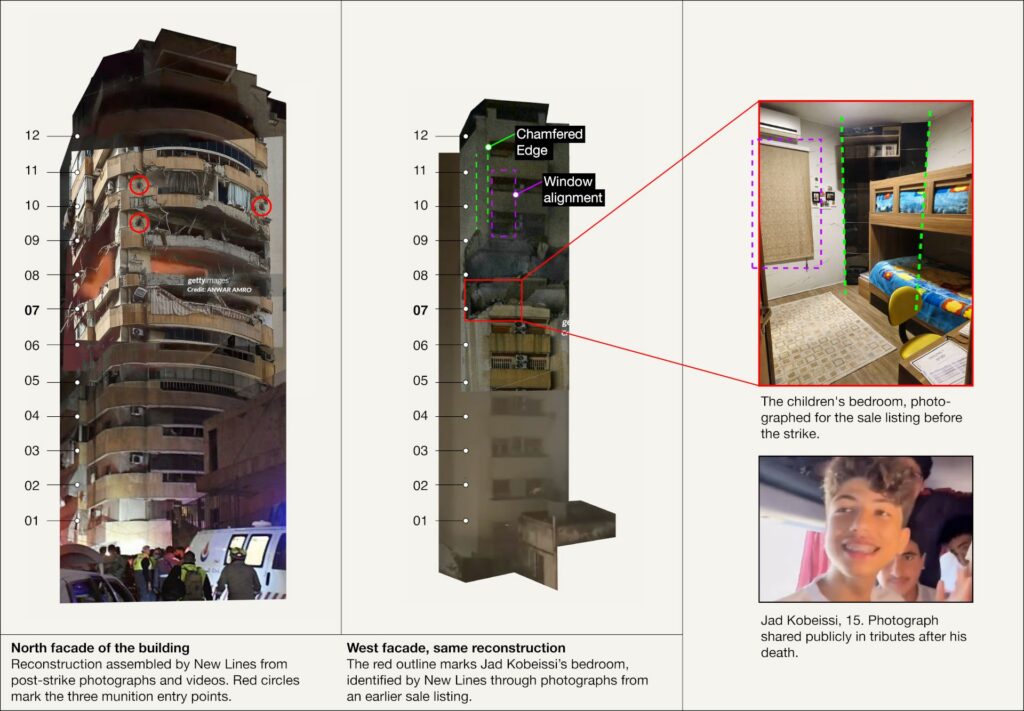
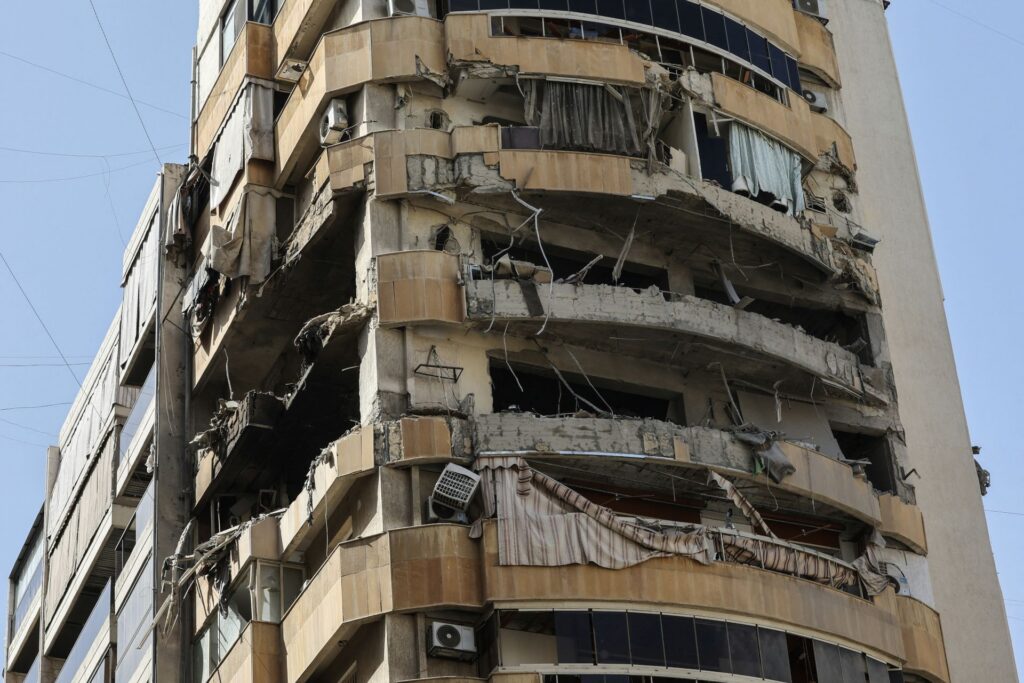
New Lines‘ examination of poststrike photographs and videos of the damaged facade identified three entry points: two on the ninth floor and one on the eighth. Where each munition detonated cannot be determined from the imagery alone, though the pattern — one munition entering the eighth floor directly, two piercing the floor above it, and the destruction concentrated on the eighth and below — makes the eighth floor the most likely aim point in New Lines‘ assessment; an inference Israel has never confirmed.
What the imagery does show is where the destruction concentrated. Apartments on the eighth and seventh floors were destroyed outright; the Kobeissi family lived on the seventh. New Lines could not establish who occupied the eighth-floor apartments or whether anyone was killed there. The ninth floor was pierced rather than leveled, its apartments damaged and the people inside them endangered. Israel has not identified the individual it targeted that night or the floor on which it believed that person to be. Whichever floor it was, the strike’s physical footprint spanned three floors of a residential building. Under the collateral damage assessment process Bryant described, every floor a munition passes through, together with at least one floor below its point of detonation, would have been designated part of the hazard area before the strike was approved.
New Lines identified the Kobeissi family’s apartment through material the family had shared publicly before the strike. In the days after the strike, tributes posted by Jad’s mother led us to an earlier post advertising the apartment for sale a month before the strike, with numerous photographs of the home’s interior. The apartment’s distinctive balcony railings matched those visible on the damaged facade in poststrike videos and photographs, and its orientation could be reconstructed by elimination: Laundry lines visible on the balcony placed the kitchen on the opposite side of the building; the reception rooms, with their wider openings, corresponded to the main facade; which left the bedrooms along the west facade.
New Lines then set out to locate the room in which Jad was killed. Among the sale photographs was a bedroom with bunk beds, consistent with the room he shared with his brother. The elimination that established the apartment’s orientation left two bedrooms, and two windows, on the west facade. The listing photographs distinguished them: The chamfered corner and placement of the window visible in the bunk-bed room matched one of the two positions exactly. Because the building’s apartments share an identical layout floor to floor, that position could be confirmed against intact apartments higher in the vertical stack and projected down onto the destroyed seventh floor. Matched against poststrike photographs and videos of the damaged facade, the reconstruction places the bunk-bed room within the section of the floor the destruction consumed: the room, with reasonable confidence, in which Jad was killed.
The Israeli military publicly acknowledged striking the nearby Al-Qard Al-Hasan branch. Separately, it stated that the Israeli navy had targeted a “key Hezbollah operative” in Beirut that night, without identifying the individual or the location. It has not explained whether that statement referred to the residential building. During our field investigation, a source speaking on condition of anonymity relayed secondhand claims that individuals associated with the IRGC had been in the residential building and were killed in the strike, adding that Hezbollah was discouraging discussion of the incident. New Lines could not verify those claims and did not rely on them in our analysis.
Haque noted that the timing of an attack forms part of the precautions analysis under international humanitarian law. An attacking force might argue that it only knew the intended target would be present at that particular moment, leaving a binary choice: strike then or not at all.
In this case, that moment was 1:28 a.m., when the Kobeissi family was asleep.
Bryant suggested that, unlike the Mar Takla strike, the military may have had less precise information about the intended target’s location, perhaps identifying only a particular floor or section of the building rather than a single room.
“Most of the collateral damage I’ve seen in Israel’s campaign is what we’d categorize as anticipated collateral damage. They knew civilians were at risk and chose the strike anyway because of the prioritization of the target.”
Israel has never publicly explained whether the strike on the residential building formed part of the same operation or identified the individual allegedly targeted there. Those unanswered questions remain central to understanding the legal and operational basis for the strike.
Jnah
On the evening of April 5, Israeli aircraft struck a residential area in Jnah, in Beirut’s southern suburbs, largely destroying two whole buildings. According to the Lebanese Ministry of Public Health, the attack killed five people and injured 52 others. Local reporting identified the intended target as Yahya Hussein Msheimesh, a Hezbollah military official from Kfar Sir in southern Lebanon’s Nabatieh district. Unlike in Ain Saadeh, the target did not escape: Msheimesh was reportedly killed in the strike, according to correspondents and announcements among the group’s supporters.
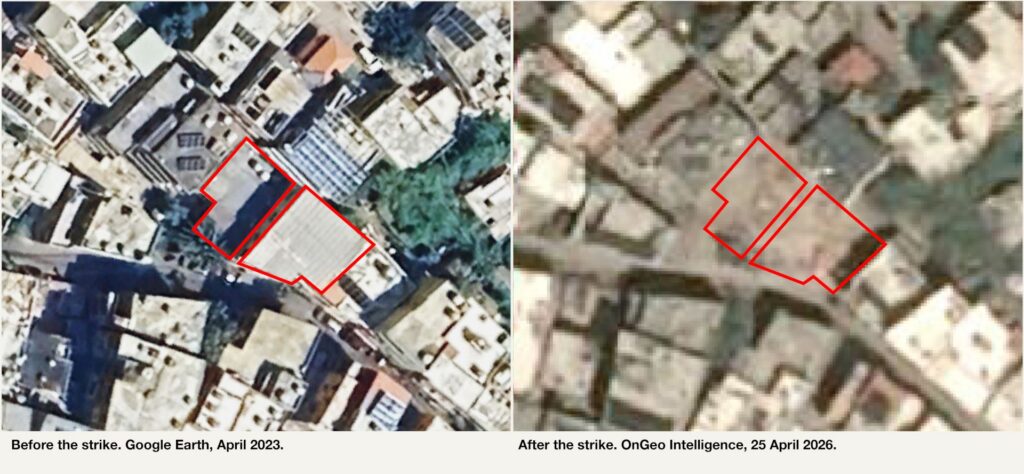
The strike on Jnah represents the far end of the spectrum examined in this investigation. Like the other cases, it was reported as a strike against a specific individual rather than an area bombardment. The question is therefore not how indiscriminate bombing affects urban neighborhoods generally, but how a strike presented as targeted or precise came to produce destruction on such a large scale.
The aftermath bore little resemblance to the other cases examined in this investigation. Rather than a damaged room or a single apartment, two residential buildings had been largely reduced to rubble. Adjacent buildings sustained extensive blast damage, while rescue workers searched through collapsed concrete for survivors and human remains. Days later, recovery operations were still underway, with some victims requiring DNA testing before they could be identified.
New Lines geolocated the strike site using satellite imagery, ground-level videos and poststrike photography, confirming that the destruction extended well beyond a single apartment or cluster of floors.
Much of what happened in Jnah can only be understood by speaking to the people who lived there.
When New Lines visited the site, residents consistently described the neighborhood as a working-class district, home to Lebanese families alongside large communities of Syrian and Sudanese migrant workers. Several said they had remained throughout the war because they could not afford to leave.
Their accounts suggest a higher death toll than the Lebanese health ministry initially reported. Residents consistently told New Lines that six people had been killed: three Sudanese nationals, two Syrian nationals and a 15-year-old Lebanese girl called Narjis al-Zein. According to multiple residents, the Sudanese victims were inside the buildings that collapsed, while one of the Syrian victims was killed inside a neighboring building that remained standing. Others described the teenage girl as killed while standing on a nearby street corner. Their accounts did not make clear whether she was included in the six fatalities they described. A friend standing beside her survived but reportedly required eye surgery after suffering injuries related to the blast.
Most residents interviewed said they were unaware of any Hezbollah presence inside the targeted building. One resident suggested that someone associated with Hezbollah could have entered without neighbors knowing, a claim New Lines could not independently verify. Photographs taken after the strike show a portrait of former Hezbollah leader Hassan Nasrallah displayed inside one of the damaged buildings, while a nearby shop openly displayed photographs of Hezbollah and Amal figures. These details illustrate the neighborhood’s visible political affiliations, but do not establish who, if anyone, occupied the targeted building or whether the intended target was present.
Residents also noted what did not happen. No evacuation warning was issued by Israel before the strike. Several recalled that the same neighborhood had been struck during Israel’s 2024 military campaign in Lebanon, in an attack that also killed Syrian and Sudanese nationals. New Lines previously geolocated that earlier strike on Oct. 22, 2024, placing the two attacks within the same working-class district.
Haque said that proportionality under international humanitarian law is not limited to civilian deaths. It also requires accounting for foreseeable injuries to civilians and damage to civilian property.
“In this case, there was a foreseeable risk of killing a significant number of civilians, a foreseeable risk of seriously injuring many more civilians, and extensive destruction of two residential buildings together with civilian property. All of that would have to be included in the proportionality assessment and weighed against the military importance of the target.”
By the time rescue workers finished clearing the rubble, the destruction had moved far beyond the confines of a room, a floor or a single apartment. Earlier cases in this investigation demonstrated that, under some circumstances, Israel possessed the capability to kill an individual inside one room while leaving the rest of an apartment largely intact. Whether that level of spatial containment was achievable in Jnah cannot be determined from the available evidence and may have depended on differences in intelligence, the target’s location or the physical characteristics of the buildings. The outcome, however, was markedly different. Two residential buildings were largely destroyed. Five people were officially reported killed alongside the intended target, while residents described a sixth fatality. More than 50 others were officially reported injured.
Several explanations remain possible: the quality of the available intelligence, the target’s location within the structure, the choice of munition and the physical characteristics of the buildings. This investigation cannot resolve which of them applied. What it does establish is that the same military demonstrated markedly different degrees of spatial containment across five strikes carried out within 19 days in and around Beirut. What it also establishes, if Israeli procedures resemble the collateral damage assessment process Bryant described from his experience with the U.S. military, is that the scale of destruction in Jnah would not have come as a surprise. The hazard area of a strike capable of bringing down two buildings would have been assessed, and the foreseeable civilian harm accepted, before the attack was authorized. Whether Israel employs a comparable collateral damage estimation methodology, however, has not been publicly established.
Taken together, these cases do not describe five different militaries. They describe one military, one intelligence apparatus and one arsenal, producing profoundly different outcomes in the span of 19 days, within a few kilometers of the same city. Mar Takla demonstrated that, under at least some operational circumstances, Israel possessed the intelligence and weapons capability to confine a strike to the single room its target occupied inside a shared civilian residence. The question is what accounts for the markedly different outcomes in the others.
For Haque, demonstrated capability can also have legal significance. Evidence that a military is capable of conducting more spatially contained strikes, he said, can play an important role in assessing whether all feasible precautions were taken in later operations. At the same time, he cautioned that differences in intelligence, the nature and location of the target, and the physical layout of buildings may also explain why different tactics or weapons were employed in different cases.
“Proof of capability is certainly significant.”
These were not broad bombardments of urban districts. Each was reported as Israel initiating targeted or precision strikes directed at one or more specific individuals. It is those targeted strikes — and the different forms they took — that this investigation compares.
Read together, the strikes form a scale. In Mar Takla, the destruction stopped at a room, and a family lived because a wall was enough to separate them from the intended target. In Ain Saadeh, it extended to an apartment, and the intended target reportedly survived, while residents on another floor were killed. In Zuqaq al-Blat, it spread across three floors, and a 15-year-old boy died in his bed. Hours later in the same neighborhood, it stopped at the walls of one apartment, aimed at a man the law presumed to be a civilian. In Jnah, it took two residential buildings, killing the intended target alongside five others and wounding 52 more.
Five strikes are too few to prove a pattern. What they show is still worth stating plainly. The most contained strike in this investigation took place in a predominantly Christian neighborhood. When civilians died in the other predominantly Christian area, Ain Saadeh, Israel responded within days: Its spokesperson said Pierre Mouawad was “definitely not a target,” and the military said it was reviewing the harm to “uninvolved individuals.” No comparable words followed the strike that tore through three floors in Zuqaq al-Blat and killed a 15-year-old in his bed, nor did any follow the strike that leveled two buildings in Jnah, a working-class neighborhood of Lebanese families and Syrian and Sudanese migrant workers. Differences in intelligence, in munitions or in the structural integrity of the buildings may account for part of the variation in destruction. They do not account for the variation in acknowledgment. Israel has never explained either. What the physical record shows is a military that could confine its violence to a single room when it chose to, and elsewhere chose otherwise. In a country where neighborhoods are read as belonging to communities, those differences do not stay technical: Whatever their cause, a war that appears to spare some areas and console others while consuming the rest presses on Lebanon’s oldest fault lines.
On April 8, in an operation Israel named Eternal Darkness, its air force struck some 100 sites across Lebanon in 10 minutes — about 160 munitions, without warning, hitting central Beirut, the Beqaa Valley and the south. Lebanese authorities said at least 357 people were killed, on a day Lebanon came to call Black Wednesday; Israel said it had killed more than 250 Hezbollah operatives. No strike-by-strike accounting was offered. If Mar Takla marked the floor of what was technically possible — one man, one room, one wall — then April 8 marked the ceiling of what was treated as acceptable. Each strike in this investigation sits somewhere on the spectrum between the two.
On June 10, Netanyahu told the people of Lebanon that Israel was not at war with them. Flavia Moawad was not at war with Israel. Neither was Roula Mattar, who had come upstairs for coffee. Neither was Jad Kobeissi, asleep in the bunk bed he shared with his brother, nor Narjis al-Zein, standing on the street corner in Jnah, nor the 52 people wounded around her. Each of them lived inside the same proposition: that Israel could distinguish the individuals it sought from the civilians living around them. Whether that containment was held depended on the strike. It is written in what was left standing: in Mar Takla, a wall. Everywhere else, less.
Become a member today to receive access to all our paywalled essays and the best of New Lines delivered to your inbox through our newsletters.