


On a Wednesday morning in January 2026, a small group of police officers stood at the gates of Addington Primary School in Durban, South Africa, mostly observing as tensions built outside the school gates. Their presence was not strong enough to contain what was happening. Behind them, children waited to be let in. In front, a group of protesters gathered, watching, calling out, stopping some parents as they approached and asking for their identification cards. They claimed the school was admitting more foreign pupils than local children.
The tension had been building since the start of the school term. Voices rose. Children stood close, listening, trying to understand what was going on. What should have been a routine drop-off began to feel uncertain, like something could turn at any moment.
“I held my child’s hand at the gate and told her everything was fine, even though I could see she was scared,” said 31-year-old Misozi Banda from Malawi, a domestic worker in Durban. “I just wanted to drop her at school like any other day … not have her look at me like something bad was about to happen.” The protesters eventually left and the children were allowed in, but the fear of the unknown still lingers with the parents.
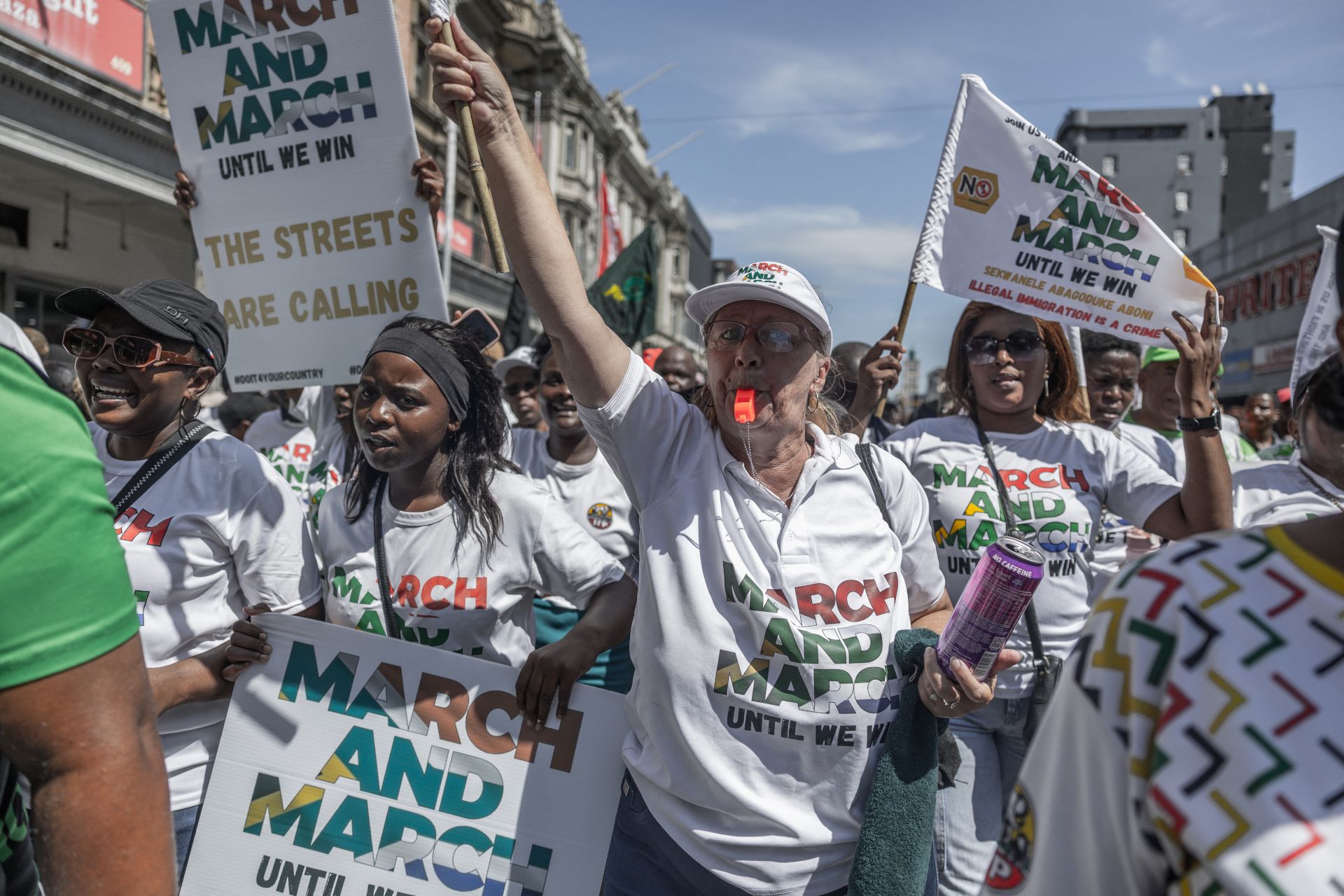
This incident is not just about one protest at a school in Durban. What happened at Addington Primary is part of a wider shift in South Africa, where questions of who belongs are increasingly being decided in everyday spaces. Schools, clinics and streets are slowly turning into places where access is challenged and controlled outside formal systems. What used to be isolated moments of xenophobic violence are now becoming more routine, more normal and more embedded in daily life.
Xenophobic violence in South Africa is not new. In 2008, attacks on foreign nationals, mostly Black African migrants, erupted across parts of the country, with people being blamed for taking jobs, straining hospitals and schools, contributing to crime and informal trade, and even in some cases “taking our women.”
At the time, the violence was largely seen as sporadic outbreaks driven by frustration over poverty and inequality. But what is emerging today feels different in form and reach. Migrants are still blamed for economic pressure and social ills, but the response has become more organized and more intrusive.
Data collected by Xenowatch, an organization that tracks xenophobic violence in South Africa, shows how widespread the attacks have become in recent years. Between 2022 and 2024, the group recorded 255 xenophobic incidents across the country, including 57 deaths, more than 6,000 displaced people and over 800 shops looted. In 2024 alone, Xenowatch documented 59 incidents linked to xenophobic discrimination and violence.
New data in May 2025, from South Africa’s Human Sciences Research Council, suggests hostility toward immigrants is now at its highest level since records began in 2003. The number of South Africans who said they would welcome no immigrants rose from 28% in 2020 to 42% in 2025, reflecting a sharp rise in anti-immigrant sentiment, particularly among poorer and working-class communities struggling with unemployment and rising living costs.
The change is not just in the violence itself, but in everyday life.
In some areas, stop-and-search actions are carried out through random profiling, with individuals questioned in local languages like Zulu or Xhosa and harassed and beaten if they fail to respond correctly. These reports of intimidation and physical violence indicate a shift from episodic unrest to more routine, everyday enforcement of exclusion.
This shift is also being driven by a growing “South Africa First” mood that is hardening on the ground. In a country facing high unemployment, deep inequality and overstretched public services, the idea that citizens must come before everyone else is gaining a lot of traction. It echoes similar sentiments elsewhere, particularly in the United States, where “America First” has reshaped debates around immigration and belonging. But it is no longer just political language in South Africa, it is turning into action. Vigilante groups are stepping in where the state is seen to have failed, deciding for themselves who should be here and who should not. For some, this feels like necessary intervention, a response to years of frustration and neglect. For others, it signals something more troubling: a move away from law and toward a system where belonging is decided in the moment, often by whoever holds power in that space.
Sharon Ekambaram, spokesperson for the civil society organization Kopanang Africa Against Xenophobia, told New Lines that while these trends mirror global politics, South Africa’s case is shaped by its own unresolved inequalities.
“In South Africa, the particular reason for the xenophobia is the scapegoating of migrants to distract us from dealing with the real problem,” she said. “The real problem is that leaders failed to fix the economy and share wealth more fairly after apartheid. Instead of dealing with poverty and lack of opportunities, they blame migrants for problems they created.”
But this is no longer just about jobs and resources. It is also about who gets to decide who belongs in South Africa.
What is unfolding in South Africa is no longer just about anti-immigrant sentiment. It is also raising deeper questions about the authority of the state and the erosion of the rule of law, as ordinary citizens increasingly take on roles traditionally reserved for law enforcement.
Loren Landau, a scholar of migration and urban governance at the University of the Witwatersrand, told New Lines that the rise of informal stop-and-search operations and civilian-led immigration checks points to a broader failure of the state.
“I think it represents a danger not only to immigrants, but to the rule of law more generally and to people who are unpopular with the community,” he said. “Whether that’s based on gender, race, ethnicity, sexuality, etc.”
Landau argued that by allowing citizens to carry out forms of immigration enforcement in public spaces, the government is effectively surrendering part of its authority.
“This is effectively the state trying to exercise a form of indirect rule,” he said. “It’s asking citizens to enforce laws that the state itself has failed to provide, but beyond that, to deliver on promises the state made decades ago that it has failed to deliver.”
There is also a growing pattern of what many are calling medical xenophobia in South Africa. In places like Gauteng and KwaZulu-Natal, groups such as Operation Dudula have been showing up outside public clinics and hospitals, stopping people at the gates and asking for ID documents before they are allowed in.
Foreign nationals, including pregnant women, children and elderly people, are often turned away even when they need urgent care. Dudula says they are trying to protect overstretched public services, arguing that hospitals are too crowded and under pressure because of illegal immigration. But on the ground, access to health care is being controlled by ordinary citizens rather than the state, even though the South African Constitution, undoubtedly the strongest on the continent, guarantees medical care for all.
In some cases, the response from authorities is inconsistent and uncertain. At some clinics and school gates, police are present when these groups first arrive, standing by while ID checks or stop-and-search actions take place. In a few moments, they step in and tell people to move along, but the intervention is often brief. Once officers leave, the same groups return and continue as before, sometimes within the same hour. For many people on the ground, this creates confusion rather than protection. It is not clear whether the state is unable to control the situation or simply not willing to hold a consistent line.
This uncertainty about the strength of the state is exactly why these groups say they are needed.
For movements like Operation Dudula, these actions are framed not as xenophobia or vigilantism, but as a necessary response to state failure. Thami Madondo, a member of the movement’s National Executive Committee, told New Lines that years of weak immigration enforcement had pushed ordinary citizens to take matters into their own hands.
“The immigration laws of the country have never been enforced by the law enforcement agencies,” he said. “And that’s why we’re sitting with all of these crises. … We are stressing the fact that illegal foreigners in the country must leave.”
In Madondo’s view, the pressure on schools, clinics and other public services is proof that the country’s immigration system has collapsed. He dismissed criticism that groups like Dudula are beating and intimidating foreigners, insisting that the movement is simply demanding that the law be applied.
Even ideas like “Ubuntu,” which translates as “I am because we are,” a philosophy long associated with solidarity and shared humanity in postapartheid South Africa, were rejected by Madondo in the context of immigration.
“That narrative of Ubuntu, unfortunately, is the nonsense that has put us where we are today,” he said. “Ubuntu doesn’t mean that you must come into the country illegally.”
At one point in the interview, Madondo laughed off suggestions that Operation Dudula was a vigilante movement, despite repeated reports over the years of migrants being assaulted and intimidated during some of the group’s actions and demonstrations. He insisted the organization would continue applying pressure until what it describes as the problem of illegal immigration is resolved.
A shift is going on in how belonging is being enforced in everyday life, often outside the formal reach of the state. The explanations for it are different. Some see it as a state failure, where the government has lost control and others are stepping in. Others point to deep inequality and a long history that has not been addressed, where migrants become an easy target for wider frustration. Groups like Operation Dudula, on the other hand, frame it as simple law enforcement in response to a broken system. But despite these different views, the outcome is the same on the ground: Access is becoming more conditional, and exclusion is becoming normal.
As this becomes more visible inside South Africa, the consequences are beginning to spread beyond its borders.
What began as local frustration inside South Africa’s townships and cities is now spilling beyond its borders. As anti-immigrant actions become more visible and more normalized in everyday life, frustration is also growing in other African countries whose citizens are being targeted. Some governments increasingly see South Africa as failing to stop the violence or protect foreign nationals, despite its position as a country expected to lead on the continent. That frustration is starting to take a diplomatic form and, in some cases, could eventually translate into pressure or retaliation, especially given the depth of South African businesses’ involvement across the region.
What is emerging is not just a domestic issue, but a wider test of how belonging, responsibility and accountability are conceived both inside and outside South Africa’s borders.
“Spotlight” is a newsletter about underreported cultural trends and news from around the world, emailed to subscribers twice a week. Sign up here.