



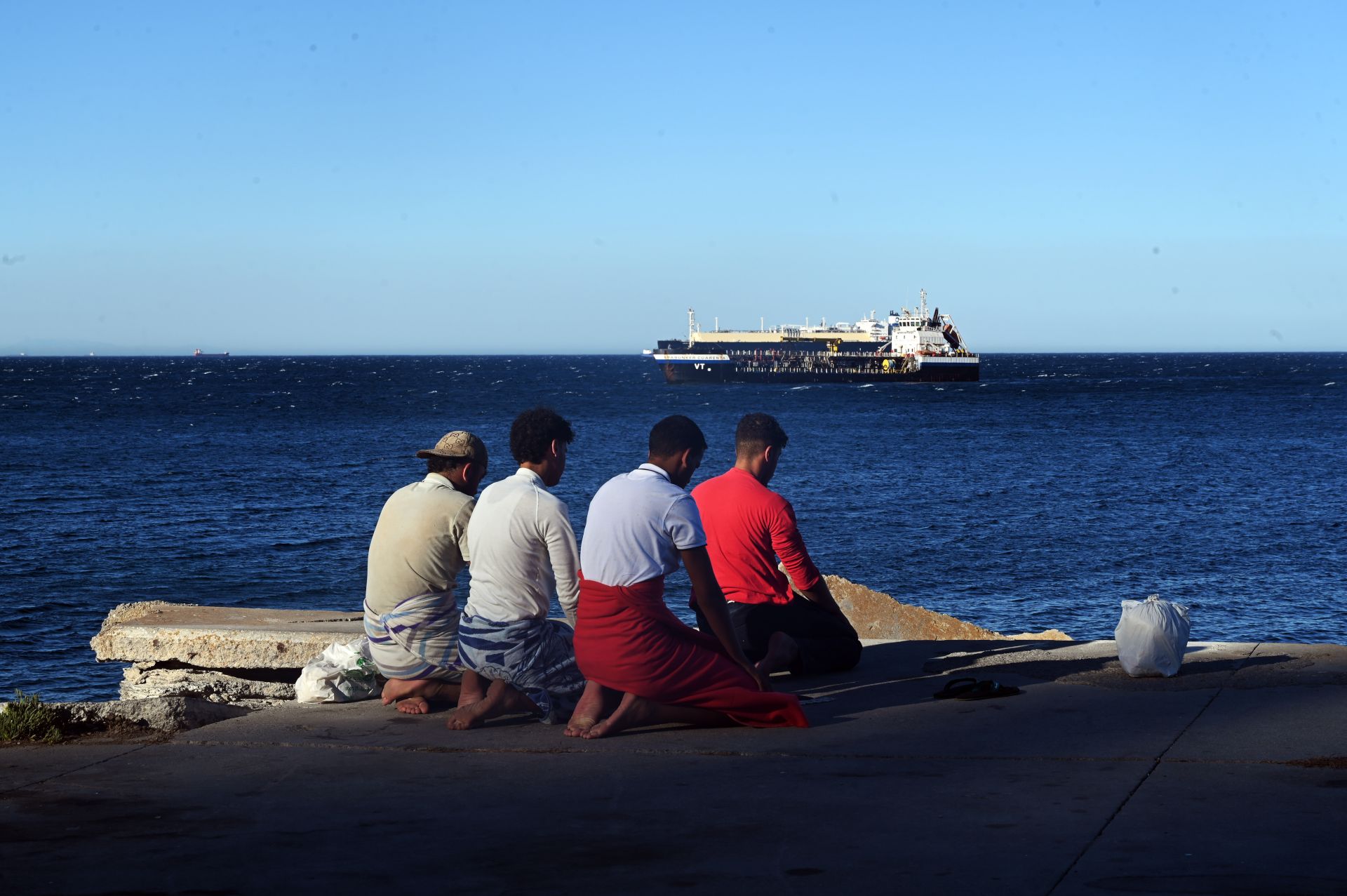
Around Ceuta’s temporary migrant reception center, perched on a hill overlooking the city, hundreds of people lie on the ground waiting for someone else to decide their future. They languish in the summer heat — the combination of the hard North African sun and thick humidity from the Mediterranean is as overwhelming as the cacophony of the cicadas ringing through the eucalyptus forest.
Wherever the trees thin looking north, the view of the Spanish peninsula — just 13 miles away — feels like a fever dream: so close, yet hazy and seemingly impossible to reach. But in the immediate moment, there’s something much closer that feels equally impossible: crossing the threshold of the reception center.
“My mother has a heart condition and my dad is very old,” says Saad, a 21-year-old Moroccan, his expression clouding with sadness as he speaks about the family he left behind. “I’m here just so I can help my family — to feed them and give them a better life. I want to support them while I still can,” he says. “Everything I earned went straight back to supporting my family, but I struggled just to help them survive. That’s why I decided to come to Ceuta.”
Saad is one of the tens of thousands of Moroccans who crossed into Ceuta, the small Spanish enclave bordering Morocco on the shores of North Africa, in a mass movement in late July. Most, like him, hoped that landing in Ceuta would enable them to continue on to Europe in search of better opportunities. Many of them, however, were swiftly returned to Morocco by Spanish authorities.
Morocco has made significant economic progress in recent years, but unemployment remains stubbornly high, particularly among young people, and the country struggles to create enough quality jobs. Last year, a wave of protests swept the nation demanding more and better social services and an end to the inequality that was keeping so many Moroccan families struggling to achieve a decent life.
Saad said he first learned about the border being open on social media, after posts claiming that Spain would not be able to send back anyone who reached Ceuta by sea spread rapidly across the country. The claims were based on a recent Spanish Supreme Court ruling limiting summary returns of people intercepted at sea. Spanish authorities later stressed that entering Ceuta irregularly does not automatically grant the right to remain in Spain or travel onward to the mainland, and that those who reached the enclave have no automatic pathway to legal status simply by arriving there.
Some of Saad’s friends made the journey with him, but eventually returned to Morocco after struggling to find enough food in the small enclave. As many as 72,000 people streamed into the city, which has a population of 84,000. Resources were stretched thin and few could find even basic necessities. Saad is now alone, sleeping in the forest near the center, where he has befriended a group of Egyptians.
The migrant reception center, which has become a magnet for those hoping to continue their journey to Europe, has an official capacity of 512 people but is operating well beyond that limit, with around 731 people already inside. Thousands more camp outside, hoping to get in. Many approach journalists with a single request: to borrow a phone so they can call home and tell their families that they are still alive.
Those Moroccans who were unable to access the area around the center before police began the mass deportations are scattered in neighborhoods on the outskirts of the city.
Near the Muslim cemetery we meet Ashraf, a 28-year-old Moroccan who once worked in the aluminum industry, who arrived in Ceuta with a friend late on July 30. The chaos during the crossing haunts him. “There were so many people in the sea. Everyone was trying to grab on to you to save themselves, and you were trying to escape and move forward so that they would not drag you down or drown you. The Moroccan police were pushing us into the water and telling us, ‘Swim, swim.’”
Ashraf says he had expected a very different reception in Ceuta. “I thought they would welcome us in Ceuta, but, as you can see, the reality is that we are sleeping on the street. I have been going hungry for two days. There is nothing, absolutely nothing.”
Scattered among the Moroccans who made the crossing were asylum-seekers from other parts of the world — Sudan, Afghanistan, Palestine and Egypt. Some had arrived before the mass influx, and were now worried that their chances for having an asylum claim processed were essentially nil. The uncertainty eats at them. They spread blankets across sidewalks, parks and the scrubland surrounding the facility, waiting for a decision from Spain on whether their asylum claims will be registered — a decision that could determine the course of their lives.
However, days without proper food, sleep or even a chance to wash have taken their toll. Whenever a Ceuta resident pulls up to hand out some sandwiches, bottled water or spare clothes, dozens of people rush toward the car in the hope of receiving something. As supplies have dwindled, hunger has begun to fuel tensions among the migrants themselves.
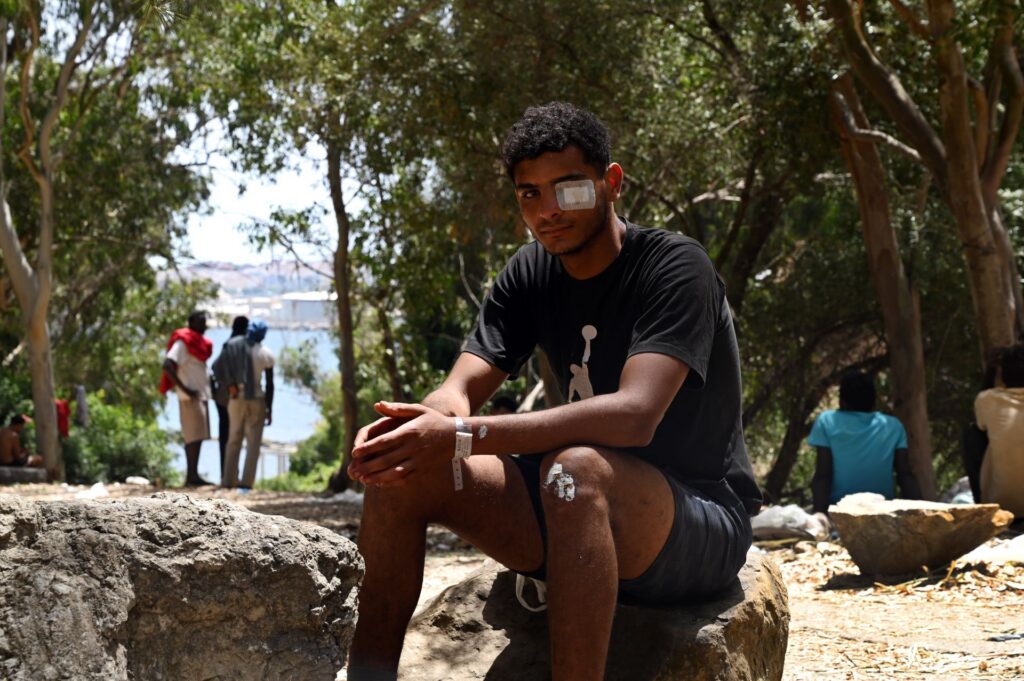
Sitting beneath a tree near the reception center is Shaaban, a young Egyptian. Bruises are still visible on his face, and injuries mark both of his feet and his left knee. His left eye is completely swollen and covered under an eye patch. Shaaban says he reached Ceuta on July 27, two days before the mass crossing, swimming nearly 2 km (1.2 miles) across the sea in search of a fresh start in Europe.
The first few days, he recalls, bore little resemblance to the situation today. “My friends and I swam across and made it safely. We took a taxi to the reception center. Until Wednesday or Thursday, they were bringing us food from inside the center and things were fine. We had something to eat and drink every day, and we could go into the city. But once thousands of people started arriving all at once on Thursday, everything ran out. There was no food, no water. Getting something to eat became almost impossible.”
He said that one night, when he went out to look for food, he was attacked by a group of young Moroccans and beaten.
Yet what he fears most, he says, is being returned to Morocco, a fear shared by many of the Moroccan migrants in Ceuta. For them, the prospect of going back is not about returning to a country at war, but to one where they say they see few opportunities to build a stable future.
“We don’t know how to survive there. My dream is to live in Spain. I don’t want to be sent back to Morocco or Egypt.”
After finally reaching Spanish territory, Shaaban — like thousands of others — discovered that arriving in Ceuta does not necessarily mean being able to continue into mainland Europe. Although Ceuta is part of Spain and the Schengen Area, its geographical isolation and a system of enforced checks mean that people who enter irregularly cannot simply board a ferry and travel on to mainland Spain, so migrants must remain in the enclave until their legal status is resolved or they are granted international protection.
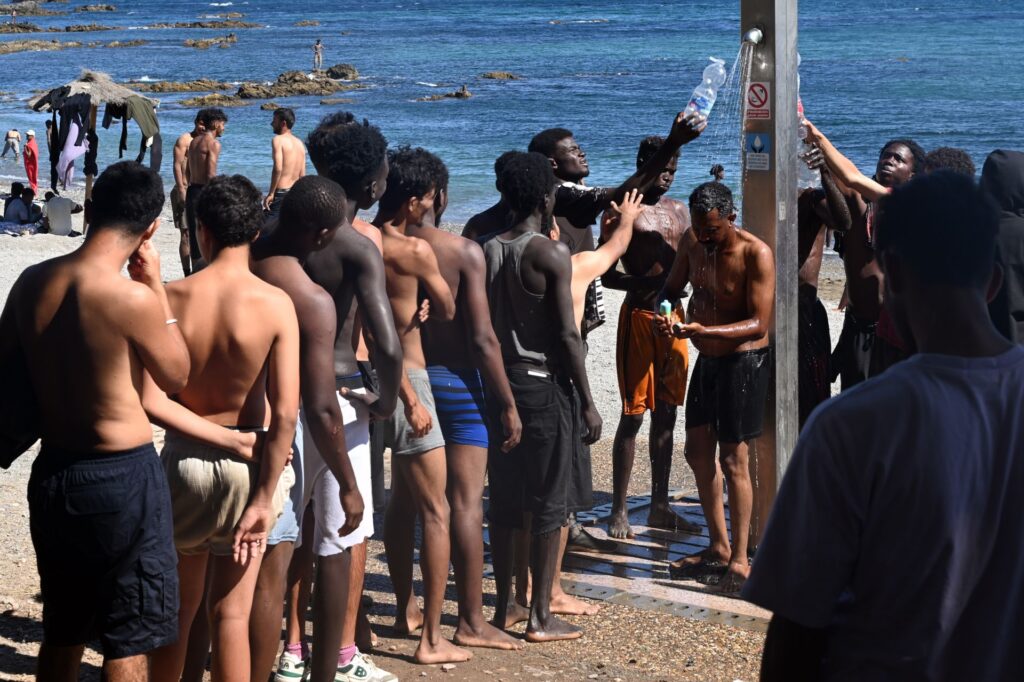
Omar, who tells us he’s 17, says his journey to Europe began in Nyala, Sudan, before taking him to Libya, where he says “there were prisons, suffering, extortion.” From there, he says he crossed the Sahara into Algeria and then Morocco, where he spent the last few years trying to reach Spain. During that time, he explains, he attempted to cross the land border more than 17 times before finally making it to Ceuta.
But reaching the Spanish enclave was not the end of his journey. It was the beginning of another period of uncertainty. “We came here seeking protection and asylum, but no human rights organizations have stepped in.” He gestures toward a group of young Sudanese men sitting nearby. “We’ve been here for four days. Some of our friends have fainted from hunger and exhaustion. Others have been forced to eat from rubbish bins.”
As we spoke, several Spanish military vehicles suddenly pulled up. Soldiers got out and instructed everyone to gather in one place. Through an Arabic-speaking journalist, one Sudanese man asked where they were being taken.
One of the soldiers replied: “To Morocco. We’re sending everyone back to Morocco. Things are relatively calm now, but they’ll get worse in the coming days.”
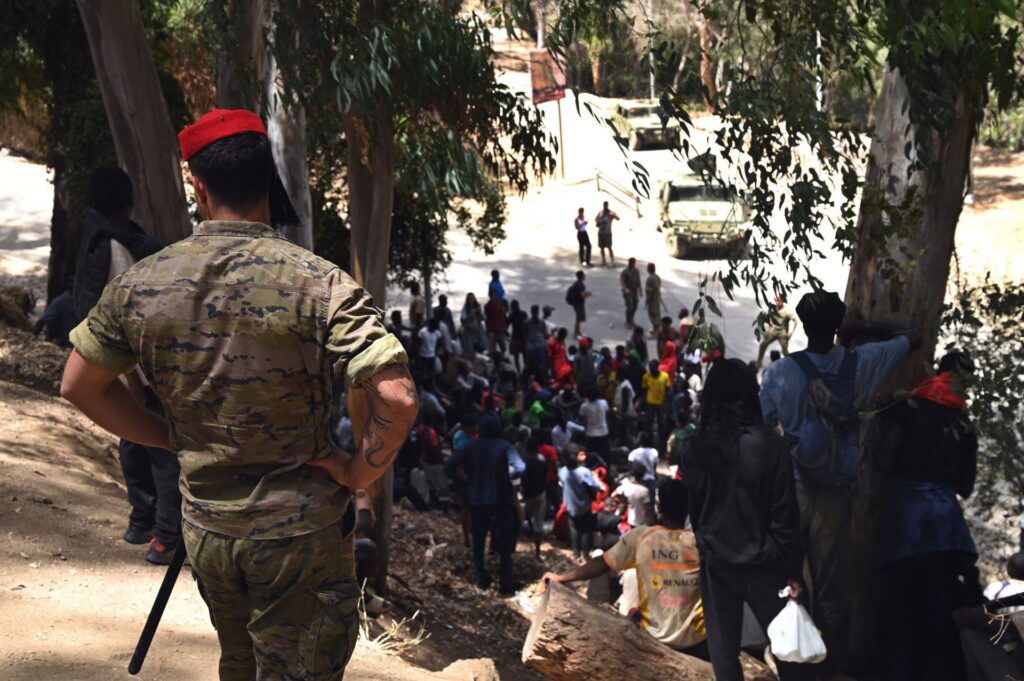
Among those camping out around the center are dozens of unaccompanied minors, who are entitled to additional legal protections and cannot simply be treated as adults according to Spanish law. They remain stranded in Ceuta, stretching the city’s child protection system to its limits. Hundreds could still be in the enclave.
Throughout the first days of the crisis, the authorities carried out organized return operations involving large groups of migrants, primarily Moroccan nationals, who were escorted by police and military personnel to the border. We heard directly from soldiers who said they had been instructed to return unaccompanied minors in the same manner as adults, as the city’s child protection center was full, contrary to Spain’s legal obligations that do not allow summary returns for unaccompanied minors.
Patricia Fidez Vicens, a Spanish lawyer specializing in migration and children’s rights, says human rights lawyers have managed to halt several deportations in recent days, including an attempted return of a group of Sudanese migrants. But she adds that other cases have already gone ahead, including the return of an unaccompanied Palestinian minor and several Yemeni nationals.
“We’re working to stop the authorities from carrying out these returns, but we already know that a number of them have taken place.”
While migrants remained preoccupied with finding food and somewhere to sleep, the crisis was rapidly taking on a political life of its own beyond the city’s streets.
Spain’s central government initially blamed the mass crossing on human trafficking networks that had exploited rumours circulating on social media after a Spanish Supreme Court ruling on the summary return of migrants intercepted at sea while trying to reach Ceuta or Melilla, the other North African Spanish enclave. Interior Minister Fernando Grande-Marlaska also stressed that Moroccan authorities had cooperated with Madrid from the first hours of the crisis, helping contain the situation and facilitating the return of thousands of people.
Local officials in Ceuta, however, offered a markedly different account. The city’s president, Juan Jesús Vivas, told Spanish media that the mass crossing was “if not orchestrated, then at least encouraged or permitted by Morocco.” Rabat rejected those accusations, insisting that criminal networks had taken advantage of the online rumors and maintaining that security cooperation with Spain had remained intact throughout.
As the chaos of the mass crossing gradually subsided, a different kind of pandemonium was beginning to unfold: not on the shoreline, but in the political arena, as leaders and supporters of Spain’s far-right parties descended on the city, eager to fold the crisis into their political narrative.
The far-right Vox party and its leader, Santiago Abascal, described the events as an “Islamist invasion,” calling for the border to be “permanently militarized” and for the crossing with Morocco to be closed indefinitely. Abascal also urged the European Union to suspend its preferential trade agreement with Morocco, arguing that what had happened was not simply a migration crisis but a threat to Spain’s national security.
Yet the Spanish far right’s narrative found little support among many of Ceuta’s own residents.
When Alvise Pérez, leader of the antiestablishment party Se Acabo La Fiesta (“The Party’s Over”), arrived at the city’s port, dozens of locals were waiting for him. Dressed in a green shirt and sunglasses, and flanked by several muscular bodyguards, he had barely stepped outside the ferry terminal before angry chants erupted.
“Why have you come now? To defend Spain?” shouted one young Ceuta resident, draped in a Spanish flag. “We are Spanish Muslims from Ceuta. We know how to defend our own city. Go back where you came from.”
Police officers formed a line between the two groups as residents — many of whom had lived through the crisis from its first hours — rejected what they saw as an attempt to turn their city’s suffering into a stage for political campaigning.
The backlash was not limited to politicians. The arrival of members of Nucleo Nacional, a far-right nationalist group that had announced plans to travel to Ceuta during the crisis to beat up migrants, also provoked anger among locals. Standing just yards away, a lifelong resident watched the confrontation with tears in his eyes.
“Why didn’t they come until the crisis had begun to ease?” he asked. “They’ve come to exploit Ceuta’s suffering for political gain and to spread their racism against the people who live here.”
Aisha Mohamed Mohamed, 52, who was born and raised in Ceuta, says that what she witnessed in the first days of the crisis was, above all, a humanitarian tragedy, not a political one. She says many of those who crossed the border were simply desperate people who believed they might find a chance at a better life on the other side. “There were children, women and entire families. The first thing we saw wasn’t an invasion, we saw human beings who needed help.”
In the days that followed, Aisha joined other Ceuta residents in handing out water, food and clothing to migrants, while also helping unaccompanied children wandering alone through the city’s streets, before the Red Cross eventually mobilized.
She believes the arrival of far-right politicians had little to do with helping either the city or those caught up in the crisis. “They came here to exploit Ceuta’s suffering for political gain. Here they call us Moroccans, but we are Spanish Muslims. We don’t need people coming from outside to tell us how to defend our city.”
For Shaaban and Omar, the political battle raging around Ceuta is little more than distant noise. Their world has narrowed to the search for food, a patch of ground to sleep on, and a decision that will determine whether years of flight end with the possibility of asylum in Europe — or send them back to the place they risked everything to leave behind.
“Spotlight” is a newsletter about underreported cultural trends and news from around the world, emailed to subscribers twice a week. Sign up here.