



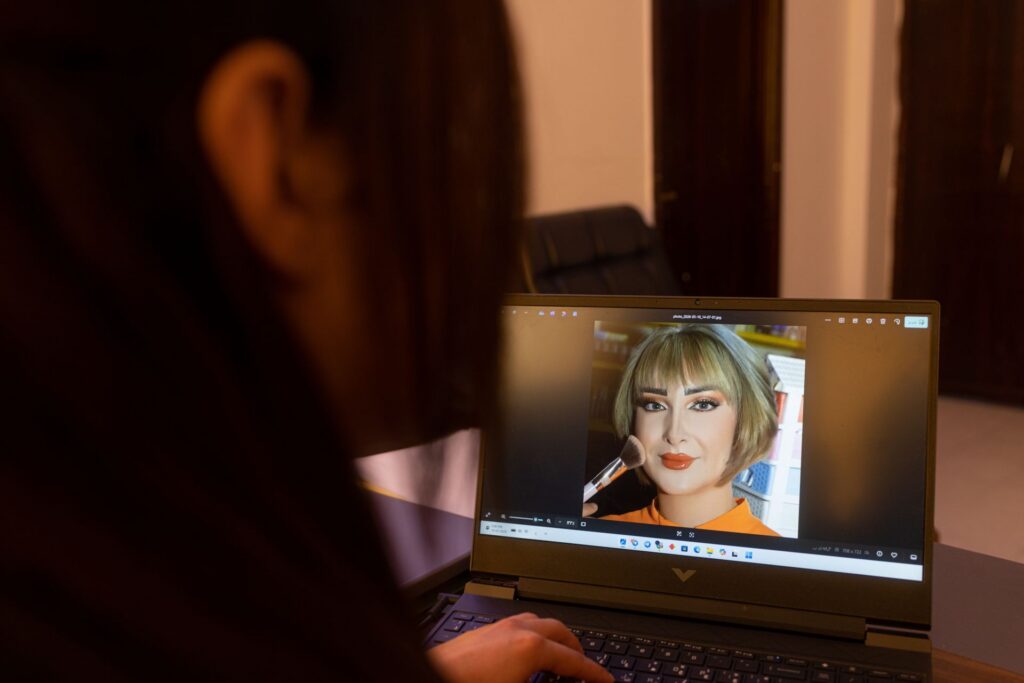
More than 7,000 people follow the professional page of the Syrian hairdresser and makeup artist on Facebook. It scrolls endlessly through blowouts, before-and-after hair transformations, blonde highlights carefully worked between her fingers, bridal makeup and engagement styling.
Under photos of an engaged couple, comments pile up. “May God bless your beautiful hands,” one client writes. “Sweetheart Halushe” — an affectionate nickname for Hala — “thank you for the mindblowing job,” the bride comments. “Thousands of congratulations.”
In the most recent photos, the fan of hair coloring appears with mauve-dyed hair cut into a bob, smiling widely, carefree, as she teaches a hairstyling class. To her parents, she is Hala — their beloved daughter, the eldest of four children.
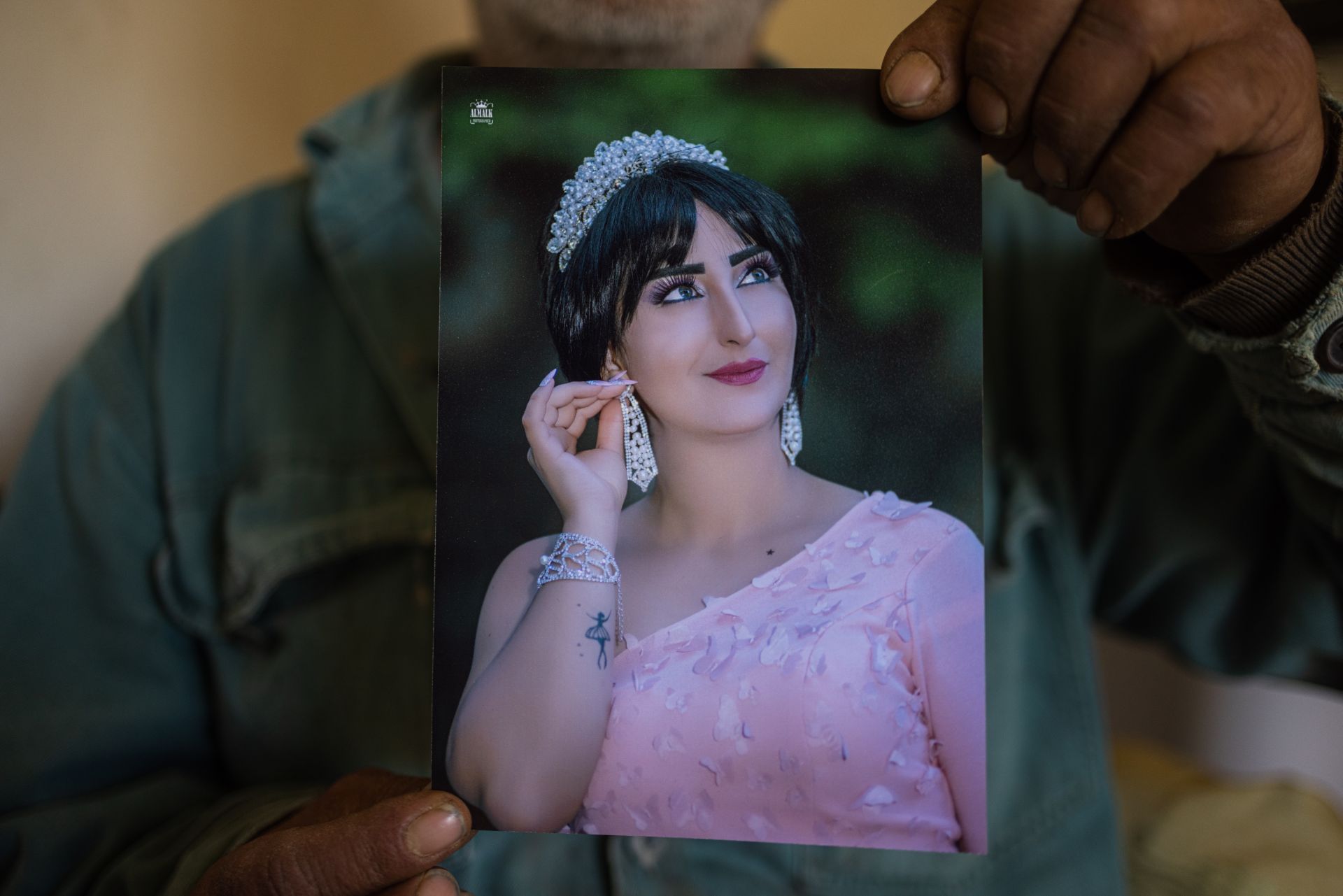
Inside the family home in the mountains of Jableh, in Latakia governorate, once a stronghold of the Bashar al-Assad regime, her parents show portraits from her 2021 engagement. In the pictures, she wears a pale pink dress with sheer veils, a silver tiara, matching necklace and earrings, silver heels, bright red lipstick and a pink rose pinned to her chest. Her makeup highlights the piercing blue eyes she inherited from her father. She poses, almost dancing in front of the lens. The photographs overflow with ordinary happiness.
Nothing in them suggests the fear she inspired elsewhere. At the time those photographs were taken, Hala was already serving as a guard in the women’s section of a prison run by the Assad regime. Inside the prison, several former detainees say, even her temporary absences were greeted with relief. Her engagement had been experienced “like a vacation.” Even as she worked as a popular hairdresser, Hala moonlighted as a torturer in the regime’s Air Force Intelligence service, tormenting detainees and delighting in their suffering, a double life that personified a cruel dictatorship and the acolytes who operated its machinery of oppression.
Her father works in construction. On Friday, May 8, as New Lines visits him, he is wearing a blue work uniform stained by farm labor and animal care. Her mother is a housewife. At their home in Jableh, where Hala grew up, her father keeps a herd of around 20 goats. The youngest had been born only five days earlier. The house overlooks green hills covered in spring poppies. Sitting on a bench in the living room, her parents drink mate with reddened eyes. Hundreds of miles away, former detainees still remembered the sound of her voice echoing through prison corridors.
On March 18, Hala was arrested. She was charged with “alleged abuses and torture” against prisoners under the Assad regime. She will be tried before transitional justice courts.
Inside the corridors of the Air Force Intelligence prison in al-Mazzeh, Damascus, Hala had another name: Mounira. Air Force Intelligence was among the most feared branches of Assad’s security apparatus and has been repeatedly accused by rights groups of systematic torture, executions and enforced disappearances.
A 2025 report found that more than 1,000 Syrians died in detention at al-Mazzeh military airport alone under Assad, while at least 29,000 detainees passed through the site between 2011 and 2017. Rights groups estimate that more than 100,000 people disappeared in Syria during the war, many through the regime’s prison network.
Several former detainees say she was among the guards whom prisoners had learned to fear. Her voice alone, they recall, was enough to silence entire cells. For the first time since her arrest, Hala’s parents spoke to New Lines from their home in the mountains of Jableh. “She was just a girl,” her father says.
At al-Mazzeh 86, the Damascus neighborhood where Hala had settled a few months earlier, many residents still say they do not understand why she was arrested. The salon she occupied until her arrest sits on a lively street lined with cafes, grocery shops and small businesses where, residents say, everyone seems to know each other: a village atmosphere.
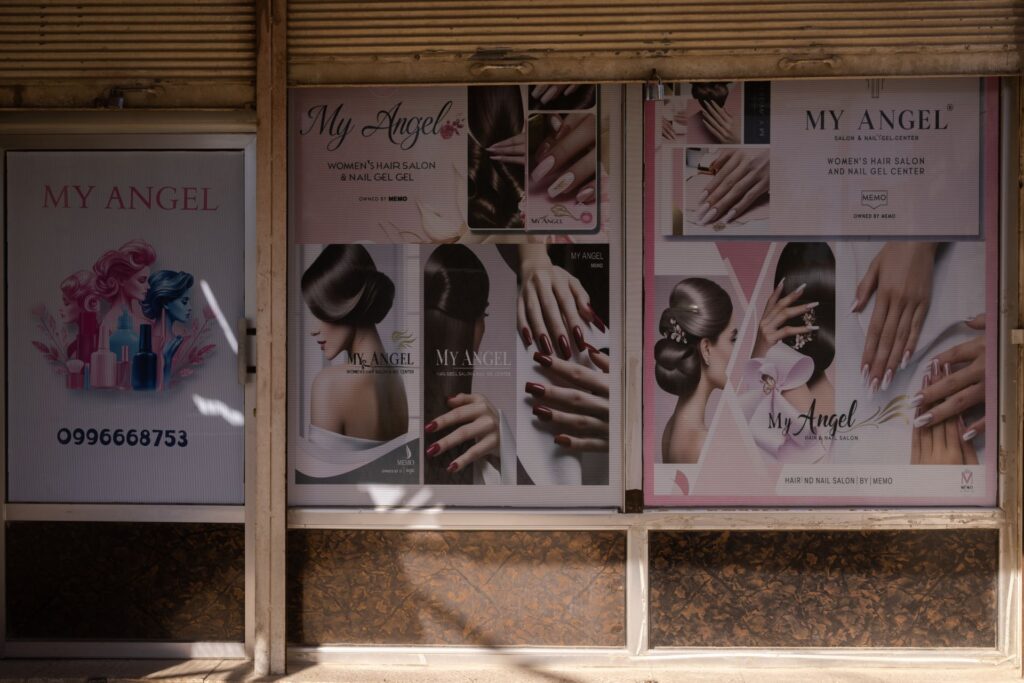
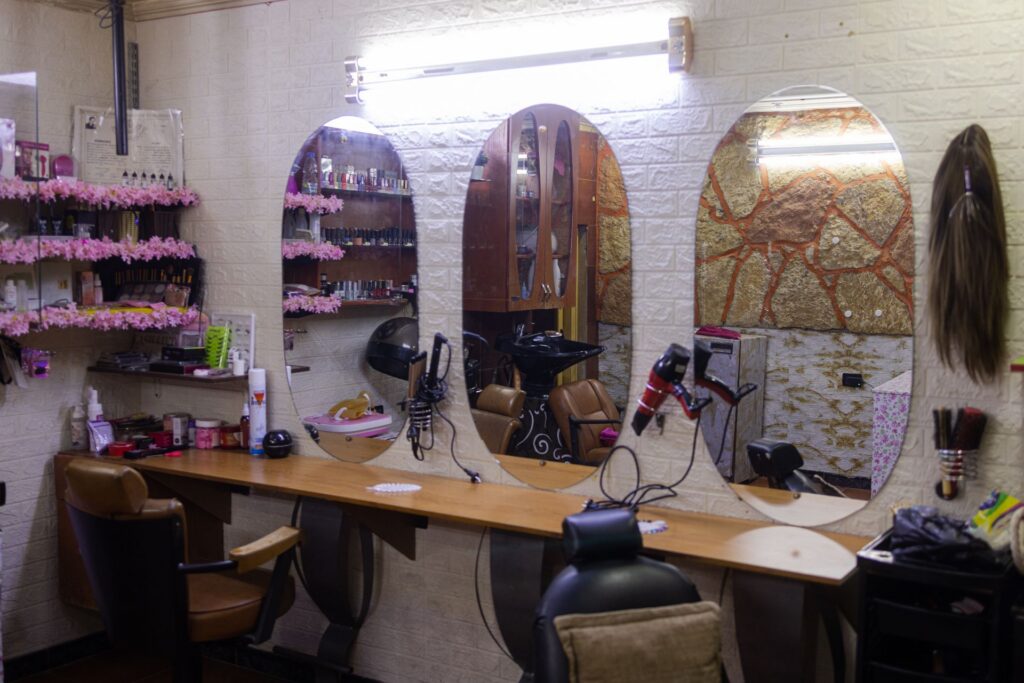
On the storefront, the old sign — “Beauty for You” — is still faintly visible beneath the new name installed by the two women who took over the salon a month earlier. Inside, three large mirrors surround a small table where neighborhood women gather to drink mate, eat or talk for hours while sitting on a yellow sofa. This was also where Hala lived. She had placed a bed at the back of the salon.
Nearly every woman interviewed in this neighborhood describes the current situation in Syria as “very bad.” One of the women who took over the salon says her husband — who, according to her, drove for Assad’s army for years — was repeatedly arrested.
Since the fall of the regime, they say, an accent, a birthplace or a former military job can be enough to attract suspicion. In the neighborhood, conversations revolve less around the prison system Hala is accused of having served — one long associated with torture, disappearances and deaths in detention — than around fear: arrests, revenge and settling scores. Hala’s arrest shocked them.
“There were arrests in the neighborhood before,” says one of the women now working in the salon, referring to detentions linked to the former regime after Assad’s fall. “But this is the first woman.”
Many in the neighborhood speak of “exaggeration.” “Accountability should be for those who gave the orders,” another woman says. “A lot of people were just machines following orders,” says the husband of one of the hairdressers who took over the salon, an argument repeatedly heard in former regime strongholds after Assad’s fall: Responsibility belonged somewhere above, elsewhere.
One of the women raises her arms in disbelief at the accusations. “She’s just a hairdresser working in women’s beauty,” she says. “How could what we’re reading possibly be true?” Less than a hundred yards away, the manager of the beauty institute where Hala also taught classes says she had given Hala her car keys a few days before the arrest so she could have the car cleaned. “She gave two classes and then vanished,” the manager says. Three days later, she learned Hala had been arrested.
In one corner of the now-empty beauty institute, a blond-haired mannequin head used for hairstyling practice remains abandoned. On the institute’s Facebook page, the same mannequin appears in photos dated March 14, four days before the arrest, showing Hala teaching hairstyling techniques to two students. People in the neighborhood consistently describe her work as “very professional.” “If she was not good, she wouldn’t have become that popular,” the manager says.
She explains that she hired Hala without asking for a resume, simply based on what residents in the neighborhood said about her reputation. Hala completed a test session, after which the institute posted an announcement on Facebook: “Transform your passion from a hobby into a profession with a complete beauty and nail design course.”
Before her arrest, Hala dreamed of settling permanently in al-Mazzeh 86. In this neighborhood, predominantly populated by Alawites — the community from which Assad hails and to which Hala herself belongs, and which for decades formed one of the pillars of the Syrian regime — the young woman had quickly been embraced. Women came to drink mate at her salon. One of her clients had even invited her to her wedding. She moved to the neighborhood in March 2025, three months after the fall of the Assad regime. The real estate agency that rented her the salon is located directly across the street. Employees there say they saw a single woman arrive alone and described her as “kind” and “friendly.”
Very quickly, they say, she became a familiar figure in the area, so much so that one of the real estate agents recalls her asking how much it would cost to eventually buy the salon outright.
She wanted to stay there “for good.” Residents insist they knew nothing about her past. Then one of the agents admits that about a year earlier, a man had stopped outside the salon and claimed to recognize her face. The man allegedly said Hala worked at the al-Mazzeh military prison.
“I just thought she was a strong woman,” the agent says simply. Then he adds: “And she was beautiful. Everybody said that.”
New Lines collected testimonies from five former detainees who independently described similar patterns of abuse inside the prison by Hala.
For Hiba Drubi, memories of Hala also begin with appearance, particularly her pale eyes, her colored contact lenses, her hair. And always, in her hands, the green plastic pipes Syrian detainees nicknamed “Lakhdar Brahimi” — a sarcastic reference to the former U.N. envoy whose first name means “the green” in Arabic — which guards used to beat prisoners. “She never hesitated to use it,” Hiba says.
Arrested in September 2017 alongside her mother, on suspicion that Hiba’s husband had ties to the armed Islamist group Hayat Tahrir al-Sham, Hiba would spend seven years in Assad regime prisons before being released on Dec. 8, 2024, the day Assad fell. Inside al-Mazzeh prison, she says, some women were targeted more than others.
“Everyone knew that the prettier a girl was, the more she was targeted,” another former detainee recalls. “And Hiba was very beautiful.” Hiba told New Lines her first encounter with Mounira/Hala came during the body search before entering the cell.
Mounira forced her to undress. She examined her hair, asking whether it was real. Another time, she did the same with her hair before violently pulling it. Originally from Homs, one of the cradles of the Syrian uprising, Hiba says she quickly understood that Mounira carried a particular hatred toward the prisoners. “She called us ‘the Sunnis,’” Hiba says. “She said we deserved to burn.”
Of Mounira’s life as a hairdresser, Hiba says she saw only one trace inside the prison: her scissors. One day, Hiba recalls, Mounira entered their cell accompanied by two male guards. Five women were inside. In her hands was a pair of scissors. “It’s either the tire or the scissors,” Hiba remembers her saying. The tire is a torture method in which detainees are forced into a tire before being beaten. “We were terrified,” Hiba says. “So we accepted the scissors.”
Mounira then began cutting their hair randomly. “There were screams. Crying.”
All of the women had long hair. “She grabbed our hair violently,” Hiba says. “And she laughed. Laughed while ripping chunks of it out.” The laughter, Hiba says repeatedly, is what marked her most. “I could see she was enjoying it.” While cutting their hair, Hiba says, Mounira insulted them. “You girls are whores. You come from cabarets. Work in the night.”
Another time, Hiba says, Mounira opened the cell while several women were praying.
“You Sunni, why are you praying? We defeated you. You deserve to burn.”
On the day of a referendum organized by Assad to extend his rule in 2021, Hiba remembers Mounira opening the cell wearing a military cap. “With our blood, with our soul, we sacrifice for Bashar,” she shouted as she opened the doors. Then she ordered the detainees to repeat the slogan.
Across the testimonies collected by New Lines, certain details surfaced again and again: the silence inside the cells when Mounira arrived, the insults, the fear of asking permission to use the bathroom when she was on shift. In the women’s accounts, Mounira appears less as an ordinary guard than as a presence that saturated the prison with terror. “We were all questioned about another female guard who was also arrested,” Hiba says. “And all of us said she did not treat us the way Mounira did.”
“The interrogations already included violence and beatings,” she continues. “But normally the guards had no reason to hurt us outside interrogation. Mounira abused us outside of that.”
The humiliations, detainees say, were constant. Inside the cell, even ventilation became a form of punishment. When temperatures were high, Mounira turned the airflow off. When it was cold, she turned it on. When food arrived in plastic containers, prisoners say, Mounira would give them only three minutes to finish eating before forcing them to hand the boxes back. Requests to go to the bathroom were often denied altogether. Women were forced to relieve themselves inside their cells. One day, Hiba says, Mounira threw water across the cell floor. The women remained for 14 hours in soaked clothes on the wet concrete floor.
“How dare she not flee Damascus?” Hiba says. Several survivors say they were shocked that Hala remained in the capital after the fall of the regime, continuing to work publicly and share pictures on her social media.
Safah al-Awaed, another former detainee, spent roughly a year in the prison between 2015 and 2016 before being released in a prisoner exchange. She remembers Mounira’s arrival inside the prison. At the time, authorities had begun introducing female guards into detention facilities under the justification of improving “security” and supervising women prisoners. Very quickly, Safah says, detainees became more afraid of Mounira than of the interrogation officers themselves. “I’m a survivor from the investigation center of the Air Force Intelligence branch,” Safah says.
When the female guards first entered the prison, there were five of them. “When they came in, I was standing near the door waiting to go to the bathroom,” she recalls. “Mounira hit my hands with the green pipes. That was the first time I saw Mounira.”
Like other former detainees, Safah remembers the green plastic pipes constantly in Mounira’s hands. “She always had it with her,” Safah says. She remembers Mounira insulting detainees and wishing death upon them. “Die, you!” she would say.
“She treated us as if there was blood between us,” Safah says. “As if she wanted revenge on us.”
Years later, Safah says the first moment she truly felt the fall of the regime was not on the day Assad fell. It was when Hala was arrested. “It was unbearable,” she says. “To see someone living normally as if nothing had happened.”
The investigation that ultimately led to Hala’s arrest began with a group of women who refer to themselves simply as “survivors.”
One of them is Haneen Omran, who published her investigation with Syria TV. An elegant woman with brown hair, she arrived at Rawda Cafe in Damascus wearing a black coat. She smiled easily. For months, she searched for “Mounira,” the woman who, she says, terrorized her. Together with other former detainees, she eventually identified her: Hala Mounir Mohammad.
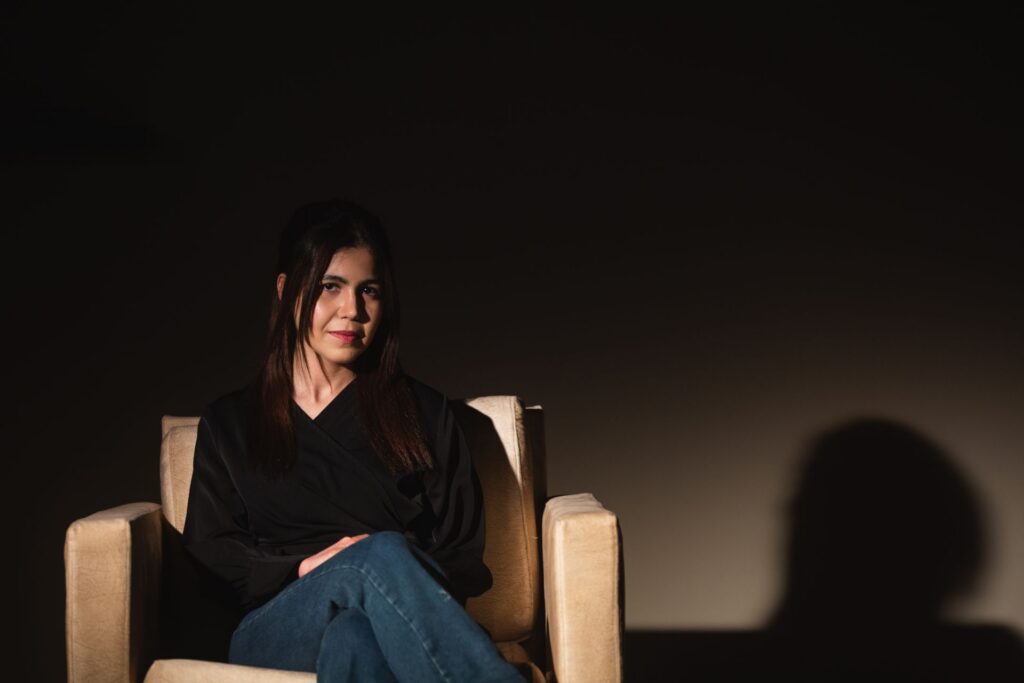
For years, Haneen herself had lived under a number rather than a name: 901. “Forget your name,” guards repeatedly told her in prison. Arrested in 2024 because of her journalism work, Haneen spent a few months in al-Mazzeh before being transferred to another prison. She was freed when the regime fell.
Before her arrest, she had worked secretly as a reporter for Syria TV, Syria Monitor and a clandestine Syrian radio station, Nasaem. She says Hala beat her repeatedly. “Whenever she had the opportunity, she hit us,” Haneen says.
“I’m embarrassed to say this,” Haneen says. She was told Mounira ordered shower heads removed from detainees’ cells. “She said: ‘We don’t know what they do with this.” The implication, she says, was that detainees might use them for sexual pleasure.
Months later, Haneen and the survivor collective discovered that Hala had moved her salon to al-Mazzeh 86. When Haneen found Hala’s Facebook page, she says she went directly to the salon.
She stared at the storefront, the windows, the salon’s name. Like many women’s salons in Syria, the curtains were closed. Behind them, Haneen knew, could be the woman she had spent months searching for. “I was tempted to confront her,” she says.
But she ultimately chose not to enter. She feared Hala would realize she had been recognized and disappear before authorities could arrest her.
The Syrian Ministry of Interior later became aware of the investigation conducted by the survivor collective and by Haneen herself, which began six months before Hala’s arrest. The group identified Hala in December 2025. Three months later, in March, authorities arrested her. “Seeing them free outside feels like a new injustice,” Haneen says. “She is not the only one having a normal life in Syria, after abusing people,” she adds.
Haneen later published an investigation with Syria TV collecting the first testimonies against Mounira, but refused to become an official witness at trial.
Even now, she says she fears entering any Syrian security branches again. When she needs official paperwork for journalism work, she sometimes asks colleagues to retrieve documents for her instead. “There are soldiers who refused to be part of the system,” she says. “She stayed in the system because she could benefit from it.”
Haneen says she spent months trying to understand how a woman capable of teaching beauty classes could also participate in prison violence. “For them, it was normal,” she says. “They had a place in society.”
“Those who were doing this had options,” she adds. “And they chose to act this way. Some soldiers left Assad’s army.”
Several survivors told New Lines they fear Syria’s transitional justice process is moving too slowly. “It’s a slow process,” Haneen says. “People are losing hope for accountability.”
So they continue speaking publicly. “When we talk about it, we put pressure,” she says.
Outside the prison, meanwhile, Hala’s life appeared to continue almost normally for years.
Beginning in 2016, according to several testimonies, Mounira alternated between prison shifts and work at her hair salon — one day a prison guard, one day a hairdresser.
Another hairdresser from Moadamiya, who asked not to be named, says she is still in shock over Hala’s arrest. In this predominantly Alawite suburb on the outskirts of Damascus, Hala had become a familiar figure. Some families even hosted her in their homes for years. One couple who sell mana’eesh (flatbreads made with zaatar or cheese) say they welcomed her into their house alongside their three daughters.
In the small courtyard facing the street, the father explains that he worked for years in state media under Assad. His wife insists Hala had “problems” inside the prison because she “cared too much about the prisoners.”
When the allegations of torture are mentioned, the husband shrugs.
“Maybe at the beginning she hit someone,” he says. “That’s all.” Then he adds: “All of this [the claims against Hala] looks like artificial intelligence.”
The mother interrupts. “Maybe 10% of people were jealous of her,” she says. “Ninety percent loved her.” She acknowledges that violence inside prison existed. “Maybe casually in prison it’s normal that you hit someone in the back,” she says. “That’s all.”
“She’s very sensitive,” the woman continues. “If she sees a cricket, she feels sorry for it.” At another moment, she recalls Hala telling her: “If I help them, I would end up in their place.”
The husband insists that the detainees themselves were not innocent. “All the people in prison were not people who had done nothing,” she says. “Some had families in Idlib,” referring to the last major rebel-held enclave in Syria.
“There are no innocents,” the woman says, echoing language widely used during the war to justify mass arrests and collective punishment against communities associated with the opposition. Then she adds: “People’s lives are ‘maktoub’” — written by fate — “but nobody is destined to torture.”
If Hala committed abuses, she suggests, perhaps they came in reaction to prisoners’ behavior. “Of course she was not there to bring them coffee and fulfill their wishes,” she says.
The couple’s eldest daughter, now 18, says Hala had become like a confidante to her. Sometimes they went out together for ice cream or shopping.
Residents in the neighborhood continue describing Hala as generous and professional. Several say she financially helped the family hosting her while regularly sending money back to her own relatives in Jableh.
After the fall of the regime, some people asked her why she did not leave Syria. According to one acquaintance, Hala replied: “My branch has a bad reputation but not me.”
She had completed a “taswiyeh” (a legal “status settlement”) process introduced after the regime’s fall, allowing some former members of state institutions to clear their legal status with the new authorities.
Back in her native village, the accusations against her are rejected almost entirely. Born in 1995 in an isolated village in Syria’s coastal mountains, Hala is the eldest of four children. She has one sister and two brothers, both of whom also served in Assad’s military. At 14, she left school and began working in a hair salon. Using the money she earned, she later resumed her education and eventually obtained her high school diploma. In 2013, she volunteered for the Syrian army.
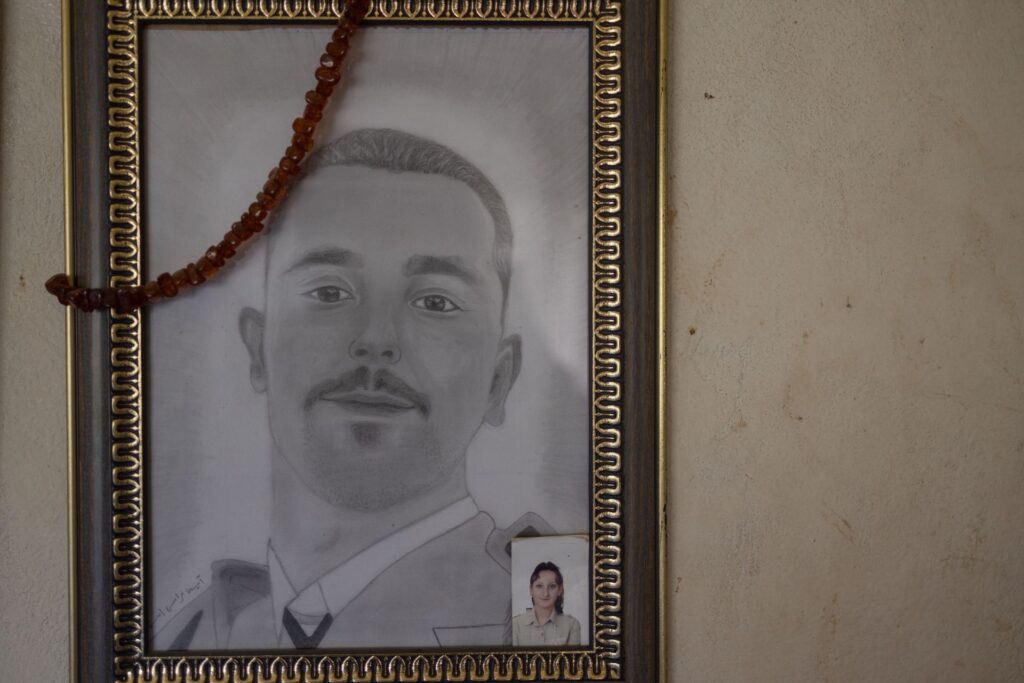
“I felt comfortable for her future,” her father says. “The state gave her a salary, stability. She could live by herself.” He describes her decision as “a source of pride.”
For roughly a year, Hala remained stationed in the Jableh area before being transferred to Qasioun, where, according to her parents, she worked in the “National Guard.”
Several former detainees told New Lines that Mounira frequently claimed, proudly, to have previously served as a sniper in Daraya and the Yarmouk camp that year. A source who reviewed her military file confirmed that the word “sniper” appears in it.
Several former detainees also remember Mounira speaking proudly about killing people.
Hiba recalls hearing her describe shooting five people while serving as a sniper.
“She told us she sniped five people,” Hiba says. “One time, she said she thought she was shooting at a trash bag. Then she realized it was an old man.” Hiba pauses. “She was saying this proudly.” Another former detainee remembers similar conversations. “She told many stories about how happy she was when she sniped people,” the woman says. “And how proud she was.”
“She felt she was finally giving something back to the country and to the leader of the country,” she adds.
At the time, Assad’s military was waging a war to crush the Syrian opposition, which controlled parts of Damascus’ suburbs. In 2016, Hala was deployed to the women’s prison in al-Mazzeh.
According to former detainees, most of the women assigned there came from military backgrounds.
Her mother says Hala returned to the mountains every few months for short visits. According to her mother, Hala often complained that some colleagues “did not treat prisoners well.” She says her daughter occasionally brought homemade food from the village for detainees she called her “favorites.”
But several former prisoners describe something very different. Some detainees may indeed have received slightly better treatment than others, they say, but because their families were being extorted outside prison in exchange for information or hopes of release.
When confronted with the accusations of abuse, Hala’s father shakes his head. “She’s just a girl,” he repeats. “Why would they send a girl to do this?”
In his view, female guards existed only to supervise women prisoners “for their privacy” — not to torture them. “At the end of the day,” he says, “she was just a servant there. She had leaders. She followed orders.”
“There is no blood on her hands,” he adds.
“A lot of people were serving at that time,” says one neighbor. Another insists that many accusations against Hala are rumors amplified after the regime’s collapse. “Maybe 1% is true,” her mother whispers. “But this is not her nature.” The detainees themselves were largely absent from these conversations.
In the family home, traces of the old political order remained visible. Posters appeared to have recently been removed from the walls, leaving lighter rectangles against the paint. In 2014, one of the family’s cousins also disappeared during the war, they claim. “We also have martyrs,” a relative says.
The family still speaks about attacks on buses transporting female soldiers to Damascus during the early years of the conflict by the opposition. None mentions the mass bombardments, forced disappearances or prison abuses documented under Assad’s rule during the same period.
In the Alawite villages along Syria’s coast, many residents now say they live in fear of arrests. Some young men avoid going out at night.
In Jableh, Hala’s parents still wait for her return.
Additional reporting by Hosam Katan.
Become a member today to receive access to all our paywalled essays and the best of New Lines delivered to your inbox through our newsletters.