




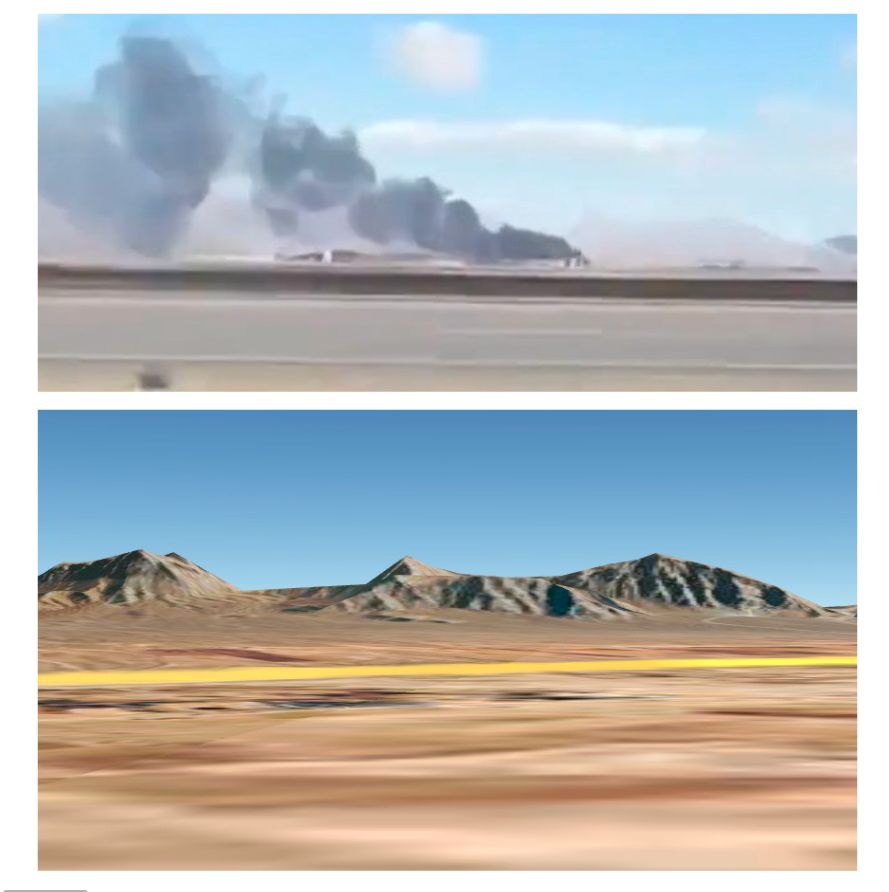
A cloud of black smoke billows into the air as a car moves along Varnamkhast Road in central Iran. The video, verified by New Lines, was filmed on March 27, shortly after Israeli airstrikes hit the Mobarakeh Steel Company in Isfahan, one of Iran’s largest industrial sites. A second major facility, the Khuzestan Steel Company in Ahvaz, was also struck the same day. Iranian media later reported a second round of strikes on Mobarakeh Steel Company on March 31.
Using satellite imagery, geolocated footage and 3D reconstruction, New Lines examined the impact of Israeli airstrikes on two of Iran’s largest steel plants. The analysis indicates that production was disrupted at both sites, with flare activity ceasing in the days following the strikes and significant damage sustained to the core steelmaking infrastructure. According to Iran Open Data, steel accounts for roughly 5% of Iran’s gross domestic product and supports an estimated 1.2 million jobs across the country’s supply chain, making the sector an important pillar of Iran’s industrial economy. As a result, the effects of the strikes extend far beyond the facilities themselves to workers, manufacturing, construction and civilian life.
Israeli officials later framed the strikes as part of a broader campaign targeting sectors tied to Iran’s military and economic infrastructure. “After destroying 70% of their steel production capacity, today we targeted their petrochemical plants,” Prime Minister Benjamin Netanyahu said on April 7. “These are key sources of funding for their war.”
After announcing it would intensify strikes on infrastructure, the Israeli military said it was targeting facilities that are largely “dual-use,” serving both civilian and military purposes.
In Iran, however, the boundary between civilian industry and state-linked infrastructure is often blurred. Beyond its military activities, the Islamic Revolutionary Guard Corps (IRGC) is deeply embedded across major sectors of the Iranian economy, including construction, energy, transportation, telecommunications and heavy industry.
Adil Haque, a professor of international law and armed conflict at Rutgers University, said that if the steel produced at the facilities were to go directly into producing weapons for use in the conflict, that would support a stronger dual-use claim.
“Simply raising revenue for the government or for IRGC officials would not qualify an industrial site as a military objective. The contribution to military action would be too remote, and the causal chain would travel outside of the military realm and into the civilian realm, where the revenue generation would be occurring,” he added.
Haque also noted that the United States takes a minority view, disfavored among states and experts, that a category of “war-sustaining” objects — economic objects that play a role in the overall economy and thereby sustain the overall war effort — could be liable to attack.
Haque said that attacks on economic objects are typically unlawful because any military advantage that comes from striking them will not emerge for months or years. The facilities would have to generate revenue, and then that revenue would have to be used to purchase weapons or pay salaries to members of the military.
“In a conflict like this, Iran is basically drawing down on its existing stockpiles of weapons, not manufacturing many new weapons, and not purchasing many new weapons on the open market,” Haque said. “It’s very hard to see a definite, or a concrete, or a direct military advantage from these strikes. It doesn’t seem like they’re going to make a difference on the battlefield,” which is the criterion that matters in international law, he added.
Iran is among the world’s leading steel producers. According to the World Steel Association, the country ranked among the top 10 globally in 2024, producing 31.4 million tonnes of crude steel. Steel is a major part of Iran’s industrial economy, entwined with construction, transport and manufacturing. When production halts, the effects cascade outward, from factories to infrastructure projects and livelihoods.
Founded in 1981 as part of Iran’s postrevolutionary drive for industrial self-sufficiency, Mobarakeh Steel Company has long been tied to broader efforts to build a domestic industrial base under conditions of sanctions and economic isolation. Over time, it has become not only a major industrial asset but also a symbol of economic resilience, often framed as part of Iran’s so-called “resistance economy,” which emphasizes reducing dependence on foreign imports.
Located roughly 45 miles southwest of Isfahan, Mobarakeh Steel Company employs tens of thousands of workers directly and indirectly. Its products feed into a wide range of sectors, from automotive manufacturing and construction to household appliances and infrastructure. Together with Khuzestan Steel Company, the facility is part of one of the most important sectors in Iran outside the oil industry.
In 2020, the U.S. sanctioned Mobarakeh and other Iranian metals manufacturers, stating that the IRGC was using revenue from these facilities to support proxy groups in the region. According to analysts, those sanctions may now complicate efforts to rebuild damaged industrial capacity.
“Iran cannot easily import replacement machinery and arrange international payments. Because of sanctions on SWIFT and financial restrictions, obtaining equipment, insurance, and rebuilding production lines will be very difficult,” said Dr. Umud Shokri, an energy strategist and senior visiting fellow at George Mason University.
For decades, the facility has functioned as a central node in Iran’s industrial economy, supplying more than half of the country’s domestic steel demand and supporting an extensive network of subsidiary companies and contractors. Kevan Harris, a sociologist at UCLA, confirmed that steel is one of the three export sectors other than oil that have been bringing in foreign exchange for the economy.
According to a monthly performance report filed by Mobarakeh to the Tehran Stock Exchange, production declined sharply in March following the strikes.
“Basically, Mobarakeh Steel is completely shut down,” one Isfahan resident told New Lines. “Salaries are uncertain. Some people aren’t getting paid at all, and others are receiving very little.”
Residents in Isfahan described both the immediate impact of the strikes and their aftermath in uncertain terms.
“Since last night, they’ve been hitting silently,” one resident said. “You don’t realize they’re above your head. Suddenly, everything starts shaking.”
In the days that followed, information about the casualties remained unclear. “Nothing has come out from Mobarakeh Steel,” another resident said. “Either they are hiding it, or they had measures in place to keep workers safe. But for me to know how many died, or even how many were on shift, I don’t know those things.”
Residents also pointed to the wider economic consequences. “When Mobarakeh is taken out of operation, thousands of companies and subsidiaries are weakened,” one said, describing the factory as deeply embedded in the country’s industrial network.
“If production is disrupted, the impact spreads quickly,” they said. “Construction slows, prices rise, and industries that depend on steel begin to feel it almost immediately.”
They added that the effects were already being felt across consumer markets. “Car prices have surged, and the cost of basic goods is increasing. Anything that relies on steel, from housing to household appliances, is likely to become more expensive and harder to access.”
Djavad Salehi-Isfahani, an economist at Virginia Tech, echoed the sentiment. “Almost all industrial manufacturing uses steel. Iran produces a lot of household appliances. It’s not just in construction or the auto industry,” he said. “These shortages can cause greater unemployment, far greater than the workers that worked in these factories. So we are talking about maybe 30,000, 40,000 people laid off because of being out of work because of the destruction of these two plants. But then you might get another 100,000 losing jobs each month.”
Reporting by IranWire, citing the company’s public relations department, said production lines had come to a “complete standstill” following the strikes. Key units critical to the production process were described as having suffered “fundamental destruction,” making continued operations impossible. At Khuzestan Steel Company, a senior official was quoted as saying that “all modules and steelmaking furnaces” had been damaged.
While these accounts and statements point to severe disruption, independently assessing the extent of the damage and whether production had in fact stopped requires a different approach.
At Mobarakeh Steel Company, some of the earliest observable indications of disruption were operational. Videos verified by New Lines from March 27 show smoke rising from the facility’s 914-megawatt combined-cycle power plant shortly after the initial strikes.
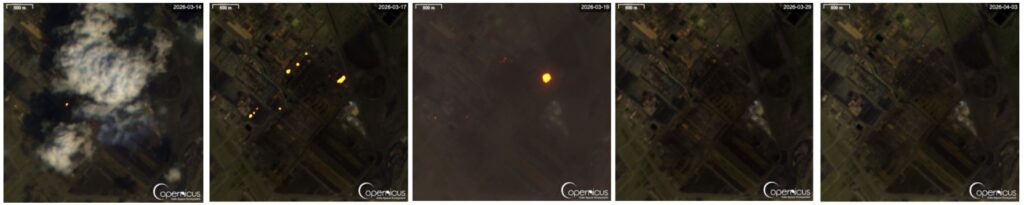
Satellite imagery taken in the days following the strikes showed a noticeable absence of flare activity, the intense heat emissions that typically accompany steel production. Before the strikes, these emissions were clearly visible across multiple parts of the facility. Afterward, they disappeared.
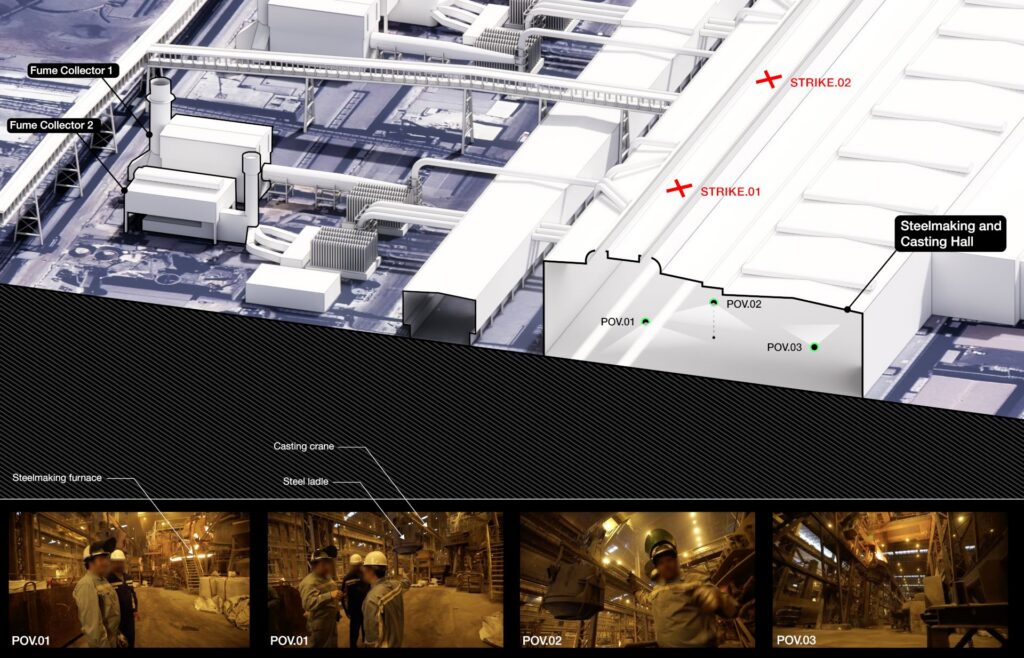
Iranian media reported a second round of Israeli airstrikes on Mobarakeh Steel Company on March 31. The timing aligns with changes first visible in Sentinel-2 imagery captured on April 3, which showed damage consistent with impacts to the steelmaking unit. Earlier imagery from March 29 did not yet show these visible changes. 3D spatial analysis conducted by New Lines later indicated that the strikes impacted furnace-linked sections of the steelmaking hall and associated crane infrastructure used to transfer molten steel through the production chain, disrupting core operations across the facility. Because these systems operate as part of a tightly interconnected industrial process, disrupting these processing points can halt production across much larger portions of the plant without requiring the destruction of the entire complex.
To examine this more closely, New Lines analyzed Sentinel-2 satellite imagery using a false color composite designed to highlight heat. In this imagery, very hot sources such as flares appear as bright signals. By applying a custom visualization that dims the surrounding industrial landscape and emphasizes these hotspots, it becomes possible to track whether the plant is actively operating.
At Mobarakeh, those signals drop off sharply after March 27 and do not return in subsequent images, indicating that key parts of the production process had ceased.
A similar pattern is visible at Khuzestan Steel Company in Ahvaz, the country’s second-largest steel producer. Prior to the strikes, flare activity was consistently present across the site. In imagery captured after March 27, these emissions are no longer visible, indicating a disruption in operations consistent with what was observed at Mobarakeh.
Khuzestan Steel Company, established in the late 1980s and based in Ahvaz, is one of Iran’s largest producers of steel ingots and a central pillar of the country’s heavy industry, supplying domestic markets and exports, with thousands of workers directly employed and many more linked through supply chains.
Local reporting by Shargh Daily described workers being evacuated from sections of the plant following the strikes, with multiple injuries reported in areas linked to steelmaking and direct reduction processes. One worker who spent 20 years of his life at Khuzestan Steel, was quoted as describing a sense of familiarity with such attacks. “During the Iran-Iraq war, Khuzestan Steel was struck several times,” he said. “It remains part of our collective memory that there is always a danger threatening it.”
The same reporting also pointed to wider economic effects. Khuzestan Steel Company employs thousands of workers directly, with many more tied to its supply chains. Workers described disruptions to transport, manufacturing, and construction, as the halt in production affected suppliers, truck drivers, and companies reliant on steel inputs. As with Mobarakeh, the impact extended beyond the factory itself into the wider economy.
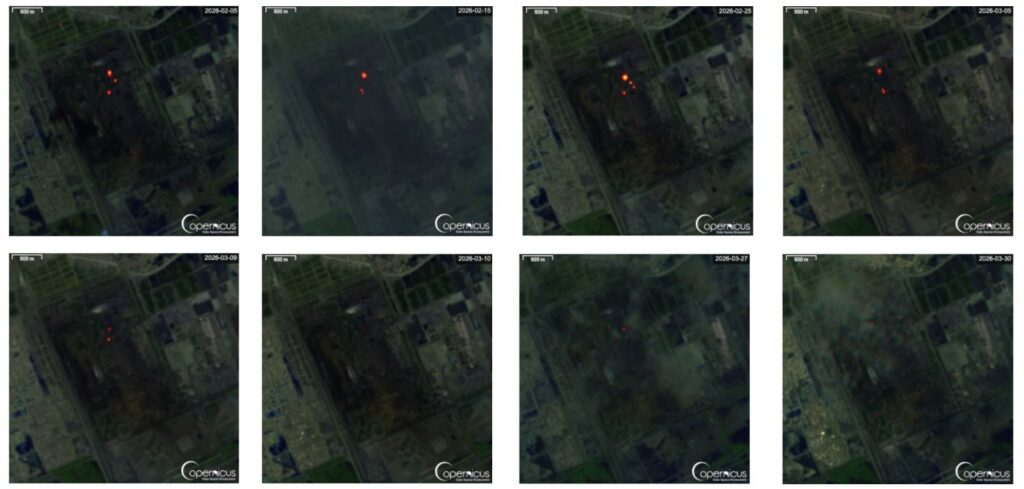
Determining whether a facility has been damaged is not the same as determining whether it can continue operating or recover quickly. In industrial sites such as steel plants, production can halt even when large parts of the wider structure remain standing if strikes affect critical bottlenecks within the manufacturing process.
For that reason, New Lines focused not only on visible damage but also on operational indicators. By tracking flare activity over time, it becomes possible to observe changes in how a plant functions rather than relying solely on structural observations from satellite imagery. When those heat signals disappear and remain absent, it is a strong indication that production has been disrupted.
At the same time, satellite imagery alone cannot fully determine the long-term coverability of the facilities or the extent of internal structural damage. Those assessments require direct access to the sites and detailed industrial inspections.
To complement this analysis, New Lines examined high-resolution satellite imagery from Airbus SPOT and Pleiades.
At Mobarakeh Steel Company, the satellite imagery from April 14 further confirms the damage sustained to the steelmaking unit.
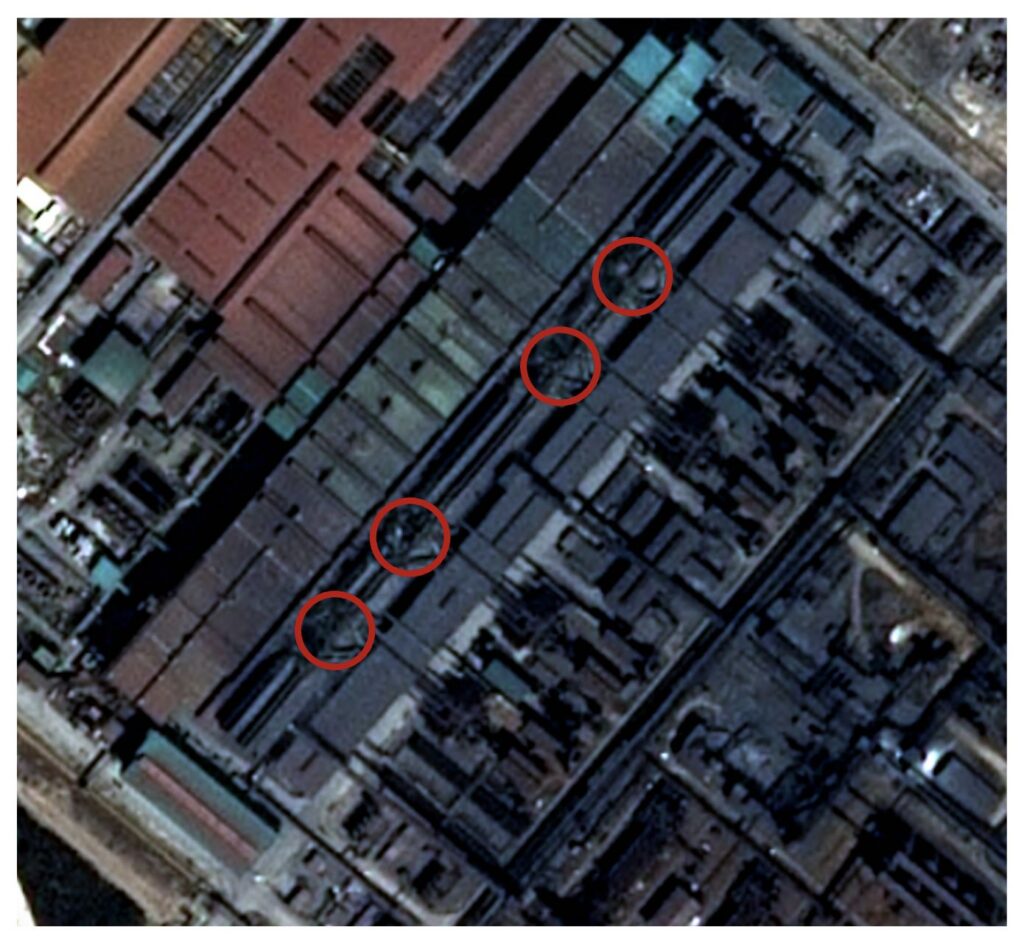
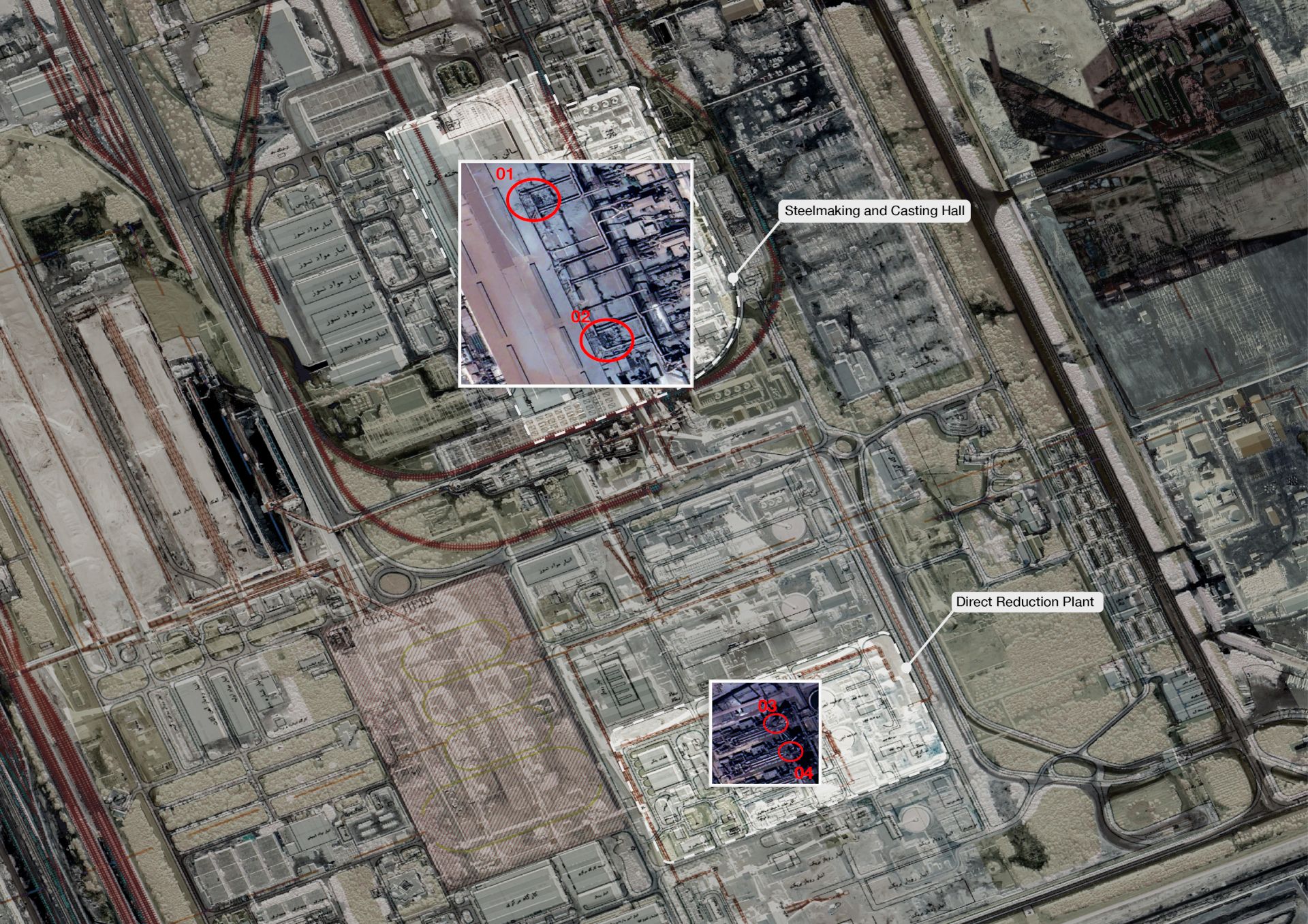
At Khuzestan Steel Company, satellite imagery from April 1 shows damage consistent with impacts to the melting and casting hall, Direct Reduction Unit 2, and the Zamzam 3 megamodule, key components within the facility’s steel production chain.
The observed strike patterns differed between the two facilities. At Mobarakeh Steel Company, damage was concentrated around the steelmaking and casting sections alongside associated power infrastructure. At Khuzestan Steel Company, the strikes additionally impacted direct reduction infrastructure, an earlier stage in the steel production chain where iron ore is converted into direct-reduced iron before steelmaking occurs.
In both cases, damage was sufficient to disrupt broader operations even where parts of the wider structure remained intact. Rather than targeting the entire industrial complex, the strikes appear consistent with disabling critical bottlenecks in the steel production process itself. This pattern achieves operational shutdown with less munitions expenditure than complete destruction would require.
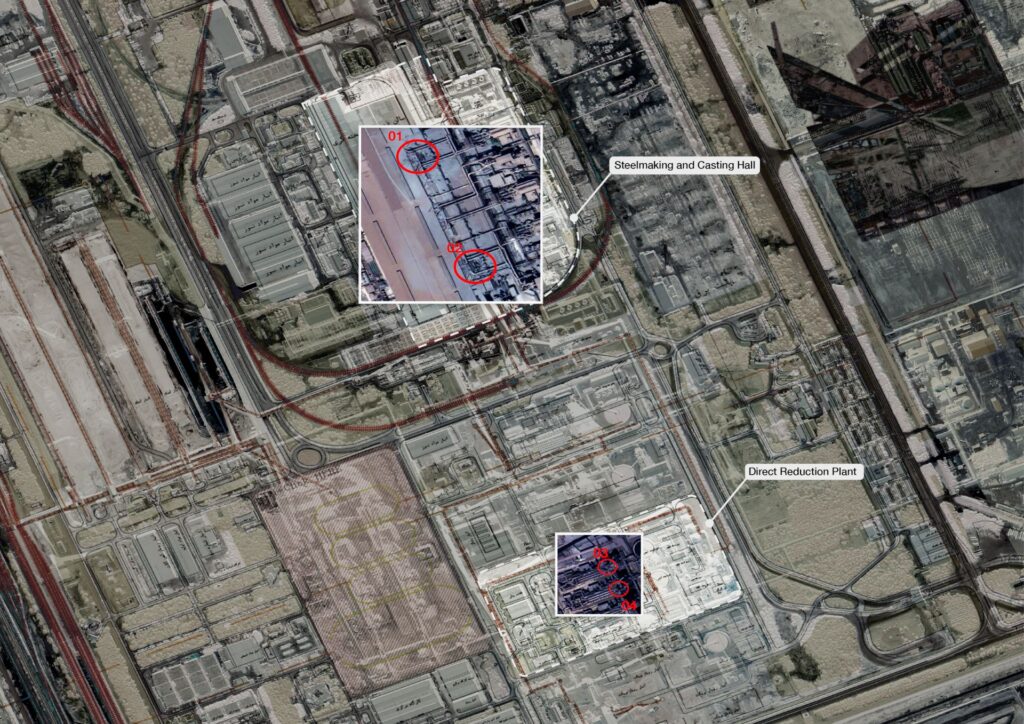
At Khuzestan Steel, a general site plan obtained by New Lines allowed the observed damage to be matched to specific industrial units, confirming that key production infrastructure has been impacted.
“The strikes on Mobarakeh and Khuzestan knocked out around 10 million tons of annual steel production, equivalent to about one-third of all the steel produced in Germany each year. Clearly, the targeted facilities are systemically important for the Iranian economy. But the impact on Iran’s conduct of the war will be limited,” said Esfandyar Batmanghelidj, chief executive of the Bourse & Bazaar Foundation, a research organization based in London.
“The diminished steel output could create some headaches for ballistic missile production, but you don’t need a lot of steel to produce Shahed drones. In the face of economic pressure, Iran’s leaders will do what they have done for the last two decades: pursue the development of cheap and rudimentary weapons platforms that can be churned out even if the country’s economy takes big hits.”
Whether Iran can rapidly restore production at these facilities remains unclear, particularly under sanctions that complicate insurance, international financial transactions, and the import of replacement equipment and industrial components.
The strikes on Iran’s steel sector did not occur in isolation. New Lines verified strikes affecting other parts of Iran’s industrial and economic infrastructure, including facilities linked to the South Pars gas field and petrochemical complex in Asaluyeh, the Payard flour and starch factory in West Azerbaijan province, and Tofigh Daru Research and Engineering Company, a producer of anaesthetic and cancer drugs.
The Israeli campaign was framed publicly as being aimed at the Iranian state, with the population positioned as beneficiary rather than target. At the beginning of the war in late February, Prime Minister Benjamin Netanyahu said the airstrikes campaign would “create the conditions” for Iranians to “liberate themselves” and called on them to “take to the streets.”
The findings in this investigation point to a different outcome: the disruption of steel production, a significant component of Iran’s industrial economy, has had immediate effects on workers, supply chains and civilian life. In this sense, the consequences of the strikes are borne not only by the state, but also by the population they were framed as supporting.
Methodology
While no official site plan for Mobarakeh Steel Company was publicly available, open-source mapping tools, together with reporting by the Iranian newspaper Shargh Daily, indicate that the strikes affected the steelmaking workshop area of the complex.
To further identify the affected sections at Mobarakeh, New Lines compared visible industrial infrastructure with the general layout of Khuzestan Steel Company, where a site plan was available. Matching the configuration of dedusting plants, cooling towers and off-gas ducts across both facilities allowed the impacted zone at Mobarakeh to be identified as the steelmaking workshop.
New Lines also reviewed publicly available footage filmed inside Mobarakeh Steel Company to gain insight into the interior layout of the steelmaking hall. By comparing distinctive ceiling patterns, skylight segmentation and structural elements visible inside the facility with satellite imagery from above, it became possible to spatially situate sections of the hall within the wider industrial layout of the complex.
Cross-referencing the matched layout, footage geolocation, and satellite damage imagery allowed observed impacts to be mapped onto specific functional zones of the plant rather than to building footprints alone. This enabled differentiation between damage to core production stages and damage to peripheral or auxiliary structures.
To further assess the scale and location of the damage, New Lines constructed a 3D model of Mobarakeh Steel Company using a combination of high-resolution satellite imagery, comparative industrial layouts and publicly available reference imagery of the facility.
The reconstruction served as a spatial framework that tied together evidence from disparate sources: top-down satellite imagery, site images, geolocated video footage and Persian-language site documentation. By placing each piece of evidence within the same reconstructed space, observed damage could be cross-checked against the functional layout of the plant.
At Khuzestan Steel Company, New Lines conducted a separate spatial mapping analysis using a general site plan obtained from the facility alongside high-resolution satellite imagery. This allowed observed damage to be matched to specific industrial units, including sections linked to steelmaking and direct reduction processes.
These spatial assessments suggest that the strikes targeted different operational bottlenecks within each facility’s production chain. They also allowed strike locations to be mapped to functional zones with reasonable confidence, because the precise extent of internal damage cannot be determined from satellite images alone.
Become a member today to receive access to all our paywalled essays and the best of New Lines delivered to your inbox through our newsletters.