


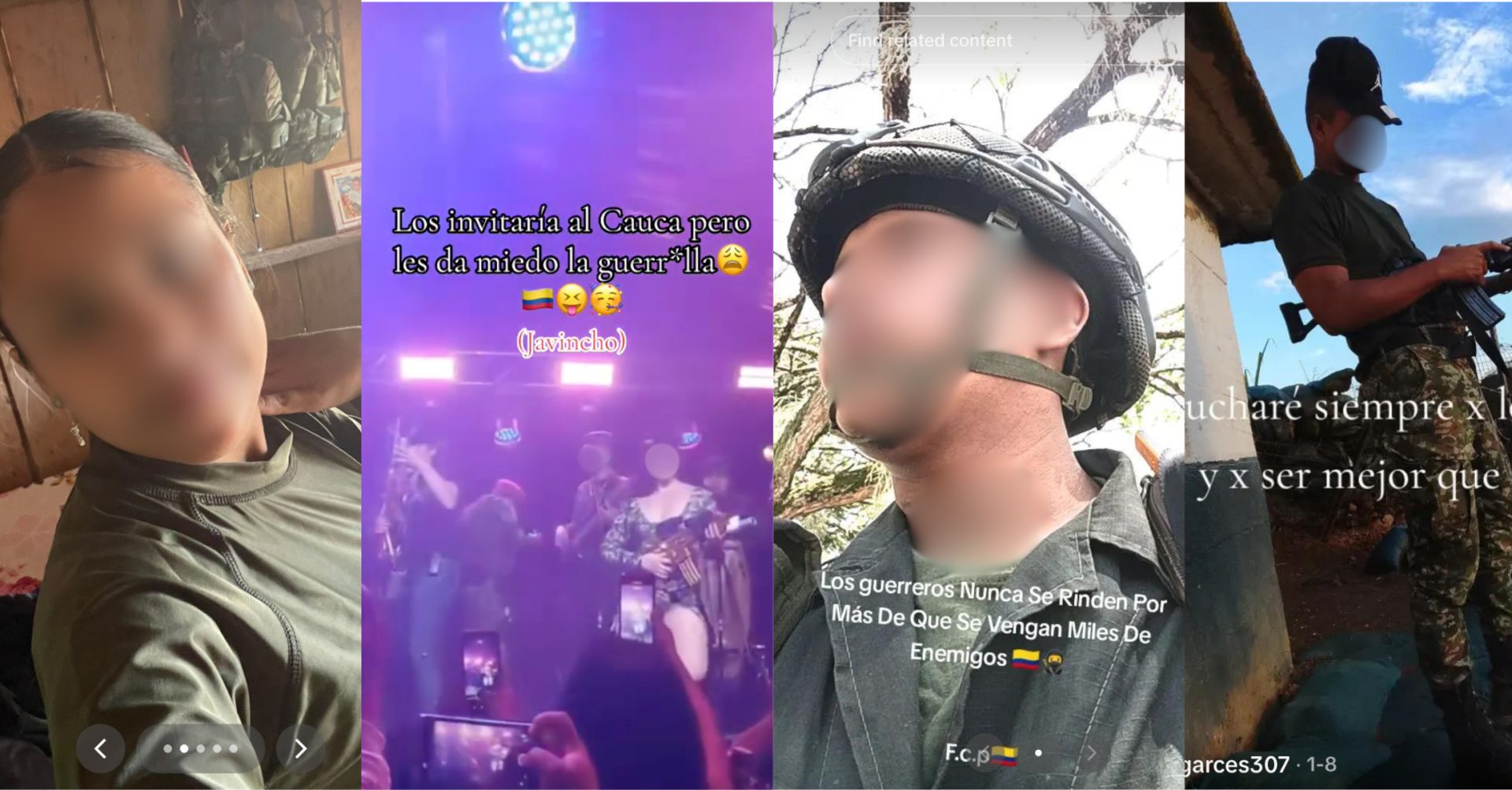
In one video, a man dives to the ground as gunfire cracks through the air. In another, a drone rises slowly upward, explosives dangling underneath. In a third, a young man stands amid dense jungle, dressed in camouflage and brandishing a rifle.
These clips are not battlefield leaks or wartime archives. They are part of a steady stream of social media content that repackages Colombia’s internal armed conflict — fought between left-wing guerrillas, right-wing paramilitaries, drug cartels and state forces — as something aspirational. “Come and join us,” they appear to say. “Become a warrior and fulfill your dreams.”
Over four months, New Lines has investigated the rise of these recruitment videos and the networks behind them, identifying dozens of TikTok accounts promoting Colombian armed groups fighting for political influence, territorial control and illicit profits. Many feature fighters flaunting a lifestyle built on cash, alcohol, designer clothes and cosmetic surgery, with some explicitly urging viewers to enlist. Many more contain footage of teenagers posing with military-grade weaponry. Even when recruitment is not their primary aim, these videos nonetheless remain consistent in their message: that a life of crime is a path to wealth and social status.
That messaging is coming at a moment of renewed violence. Across Colombia, illegal armed groups are vying for control of illicit sources of wealth like gold mining and key drug-trafficking regions and routes. With tensions escalating, teenagers are increasingly targeted — drawn in by a calculated vision of belonging, power and money — to fill the ranks. Social media has become the ideal vehicle to communicate this message; it is widely used among Colombia’s youth and, by its nature, rewards the display of status.
Figures from the Colombian ombudsperson’s office show a steady increase in child recruitment: 43 known cases in 2021, 68 in 2022, 384 in 2023 and 651 in 2024. These figures are believed to be significantly underreported, with families often too afraid to report cases for fear of reprisals, including the possibility that the armed group will return and take another child. The United Nations and Human Rights Watch both say their research indicates the trend is continuing or intensifying.
“Cases of child recruitment are rising year on year,” Scott Campbell, Colombia’s representative for the United Nations Office of the High Commissioner for Human Rights, told New Lines. “It is a devastating, grave issue. It leaves an indelible mark on the child, a shocking and indelible mark on their families and their communities.”
First contact increasingly takes place on social media, where armed groups flood users’ feeds with aspirational content: motorcycles, piles of cash, designer clothes, cosmetic procedures and parties. These images are interspersed with footage of teenagers posing with rifles, drones and grenades.
Last year, Colombia’s Special Jurisdiction for Peace (JEP), the country’s transitional justice mechanism, set up in the wake of the 2016 peace deal, warned that TikTok had become the platform most commonly used for broadcasting content that normalizes, romanticizes and promotes armed life among adolescents and young people. Many of these videos attract hundreds of thousands of views; JEP analysts found some clips with invitations to join the groups had been viewed more than 625,000 times.
“Illegal armed groups use social networks to build narratives that romanticize life in war and that seek to attract new generations of children and adolescents in highly vulnerable conditions,” the ombudsperson’s office said.
The videos identified by New Lines reveal a consistent set of narratives used to glorify life within Colombia’s armed groups. Across hundreds of clips, the same themes surface again and again: the idea that education is better provided by armed groups than by schools; the promise that recruits can fulfill lifelong dreams; the cultivation of a warrior identity; the normalization — even glorification — of death; and the mystique surrounding clandestine operations.
Many of the videos also present this armed life as one of power. Footage shows fighters loading guns, training with drone weaponry and stacking bags of money. Many of the clips also show men and women dressed in camouflage posing with guns. In others, individuals wear armbands identifying the group they have joined, while holding portable radios or moving through rural terrain.
A particularly striking theme is the portrayal of armed groups as a substitute for formal education. In one video, a young boy suggests his education came not from the classroom but from the group he had joined: “I learned from those very ones, they gave me school.” In another, footage plays of a boy throwing his schoolbag away, with a caption reading: “We weren’t good at studying.” It then flips to pictures of a hand-held radio, weapons and a training camp and reads: “but we’re fulfilling our dreams.”
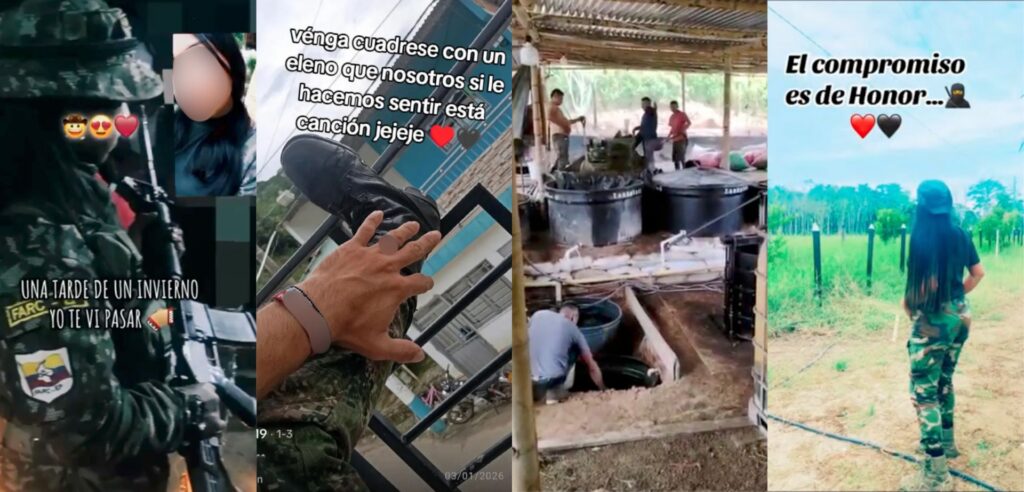
The language of social mobility is also constant. One post reads: “2026 I am ready. I’m ready to leave for a year and a half away from here,” accompanied first by a picture of a young schoolchild and then of an older figure standing in the jungle. Another declares: “We guerrillas have a ticket out, but only God knows when we’ll return. We are fulfilling our dreams.”
The identity of the “warrior” is central too. In one video, the caption reads: “Life of the guerrilla, it sounds like this: We die to save people from plagues. Here we never will surrender.” Another says: “The warriors never surrender, no matter how many thousands of enemies come at them.” Visuals reinforce this narrative; men standing with rifles in war-torn areas like Catatumbo, a strategic border region in northeastern Colombia, and others lying in the jungle in full camouflage. Memorial-style posts also circulate frequently, with captions such as “We will always remember you, you will be a warrior.”
Another recurring motif is covert action. Many videos speak about “secret missions,” often accompanied by footage of traveling by mopeds in the dark or cars driving through jungle roads at night. One post reads: “Long live the secret missions that take place after midnight!” Another says: “Everyone thought we were sleeping, but I was on a secret mission.” In practice, these “secret missions” refer to activities such as transporting drugs or weapons, carrying out attacks on rival groups or moving through territory undetected.
In one video, a child is taught how to operate a drone, practising dropping water bottles — an activity framed as training, but with clear parallels to weaponization. Another shows a drone operation and the letters “ELN” — the National Liberation Army, a guerrilla group. Experts say there are growing reports of children being recruited to operate drones to monitor communities and launch grenades, in part because they are more adept with the technology.
The videos span the country’s fragmented conflict: left-wing insurgents such as the ELN and dissident factions of the Revolutionary Armed Forces of Colombia (FARC), alongside right-wing paramilitary groups like the Gaitanist Army of Colombia (EGC). Across ideological lines, a similar message emerges — one tailored for the algorithm age, in which war is not only fought on the ground but marketed on the screen. As Elizabeth Dickinson, deputy director for Latin America at the International Crisis Group and an expert on Colombia’s child recruitment crisis, said: “This is not a practice that’s limited to one criminal or armed group. It is a generalized pattern across Colombia’s conflict. All of them are recruiting.”
Children who engage with the content are often contacted directly, experts say. The comment sections beneath videos offer a glimpse into their reach. In some, people ask how to join, or say they want to be guerrilla fighters. Responses frequently direct users to continue the conversation in private messages. Testimonies gathered by rights monitors suggest that local commanders usually follow up via Instagram or WhatsApp, using a mix of flattery, promises of quick money and, in some cases, intimidation.
Campbell said that recruiters are very well aware of platform moderation efforts and adjust their tactics accordingly. To avoid detection, armed groups now often rely on coded language, symbols and emojis. Researchers have found that the EGC, also known as the Gulf Clan, uses the Nigerian flag and green-letter acronyms, while the ELN often deploys red and black heart emojis or the Angolan flag. Other symbols — including the Armenian flag and ninja emojis — are used to signal they are part of a group, without being specific about which. The Colombian flag, four-leaf clover and wads of money are also used frequently.
New Lines’ investigation documented hundreds of instances in which these symbols and emojis appear in armed group content. One shows a man lying in the jungle in camouflage. “I am not ashamed of the path I have chosen,” he writes, posting a ninja emoji and the Colombian flag.
The aunt of a 15-year-old boy who was recruited in 2024 told New Lines that social media was a “fundamental factor” in his decision to leave home. “It was perhaps the most impactful in my nephew’s recruitment, especially TikTok and WhatsApp,” she said, her identity concealed for safety. “He saw videos that promoted violence and false ideas about belonging to a group.”
According to the aunt, contact quickly moved to private messaging platforms. On WhatsApp, the boy began receiving direct messages encouraging him to join, often framed around promises of protection. These offers soon included money, power and a position of authority, alongside assurances that he would be able to financially support his single mother and siblings.
“Through platforms like TikTok, WhatsApp and Facebook, they normalize violence, glamorize war, and offer false promises of money, power, belonging and protection,” she said. “Social media becomes the first point of contact, a form of grooming, which is later reinforced through people on the ground.”
One 15-year-old girl described how child recruitment gained a foothold in her community. She was living with her mother on a farm in the country’s north, where she described her childhood as “beautiful.” Then the armed groups arrived.
“It was both the guerrillas and the ELN. They have always been around, but more of them arrived. They started recruiting. They started taking boys and girls, classmates and friends from school,” she told New Lines. “Within months, they had taken many of my classmates.”
She said the recruiters began harassing her, telling her that she would be paid, have fun and “do new things.” “I was scared all of the time. I locked myself away,” she said.
Another girl, aged 16, said she was persuaded to join the ELN by her boyfriend and her best friend, both of whom had enlisted. She got as far as meeting the commanders. “When I arrived, they told me that everything was ready,” she said.
Before taking the final steps, the 16-year-old confessed to her mother. “I felt very ashamed,” she said. She then escaped. “I wrote to my boyfriend and said no, I don’t want to go anymore, I don’t want to die.”
She estimated that hundreds of children were recruited from her region. She said that most of the friends who joined have since been killed.
Juan Sebastián Campo works as a coordinator of programs and projects at Benposta, a home for children escaping forced recruitment in Bogota, where both girls currently live. He said that the organization is facing “one of the most critical situations we have experienced in all the years we have been working in Colombia.” New arrivals keep coming, he said, some as young as 10. “Every child has a different story,” he added.
Colombia has long been haunted by cycles of violence in which children are recruited, coerced and exploited by armed actors. Conflict between leftist guerrillas, right-wing paramilitaries and the state has raged for more than six decades, forcing millions from their homes and leaving hundreds of thousands dead.
It began with leftist insurgencies like the FARC and ELN vowing to fight for class equality in a country dominated by a small landowning elite. Over time, both turned to kidnappings, extortion and drug trafficking to finance their campaigns. In the 1980s, right-wing paramilitary groups emerged in response, encouraged at times by the government, unleashing massacres and mass displacements. Drug traffickers — from Pablo Escobar’s Medellin cartel to rival networks in Cali — deepened the bloodshed, waging campaigns of violent attacks that paralyzed the country. State forces, too, committed serious abuses. In this context, child recruitment became widespread.
“Child recruitment was the typical modus operandi of guerrillas in areas of the country where there was very little presence of the state,” said Juanita Goebertus, the Americas director at Human Rights Watch and a former Colombian member of Congress.
A 2016 peace agreement between the government and FARC, then the country’s largest guerrilla group, sharply reduced violence and drove down child recruitment. But those gains are now unraveling. Dissident factions, drug-trafficking networks and newly formed armed groups — many stepping into the vacuum left by the demobilized FARC — have reignited conflict across large parts of the country.
They are fighting for control of coca-growing regions, smuggling corridors, illegal mining operations and arms routes. In areas where the state remains weak or absent, these groups often act as de facto authorities; enforcing rules, extorting communities — a practice known in Colombia as “paying vaccine,” named because victims are forced to “pay” to be safe — and regulating local economies.
“There has been an atomization of the armed groups. They are splintering, and so almost all of them are turning to children to strengthen their hand,” Campbell said.
Dickinson said that, while the peace deal pushed the number of child recruits to its lowest in decades, pandemic-related school closures had fueled a resurgence. “The groups realized that they could very easily fill these children’s time and imagination,” she said.
This trend also raises broader questions about the impact of President Gustavo Petro’s “Total Peace” strategy. While the policy aims at negotiation with armed groups and a reduction in violence, critics argue that the easing of military pressure in some regions has allowed these groups to expand their territorial control and recruitment efforts.
Indigenous and Afro-Colombian communities have been disproportionately affected by the current crisis. Many of these communities live in remote regions where state services are scarce and armed groups exercise effective control. The U.N. has repeatedly warned that children from Indigenous communities are specifically targeted, not only because of their vulnerability but because of their deep knowledge of local terrain.
“Young people are increasingly being recruited by armed groups,” Ati Quiago, an Arhuacan Indigenous leader, told New Lines in the Sierra Nevada. “These groups are growing and using our territory as drug-trafficking corridors. Violence is increasing.”
The increase also reflects a broader transformation in how these groups operate. In the past, armed groups often forcibly took children from schools or rural communities, said Goebertus. Today, recruitment is more likely to rely on persuasion by professional recruiters — romanticizing life with a weapon, as seen in TikTok videos, and cultivating a sense of belonging.
“Many of these groups now resemble organized crime networks, and they are paying children — even dissident groups are paying,” Goebertus said.
For those on the receiving end, the offers can be difficult to refuse. The 15-year-old girl who fled recruitment told New Lines that armed groups preyed on hardship. “They would offer money. Some of my friends had problems at home, some did not have food, so they went with them. Others were offered cellphones and motorcycles,” she said.
While social media has become an increasingly important recruitment tool, it is not the only method. Recruiters also target children in schools and through community networks, using trusted spaces and relationships to identify and approach potential recruits.
Some recruiters operate within armed groups and are given quotas for how many children they need to bring in. But recruitment is also outsourced, with independent recruiters operating outside any one armed organization. These “freelancers” are dedicated to identifying vulnerable children, convincing them to run away, and then, in essence, selling the children to the highest bidders.
“When a child is recruited, there is a sale price. So whoever is recruiting, or the structure that is recruiting, will be paid for the child. Those payments make very clear that this is human trafficking,” Dickinson said. “You can find children from one single community ending up in five or six different armed groups. These criminal networks are selling children to the highest bidder.”
The payments vary based on the so-called “qualities” of the child, she added, for example, whether they are strong, whether the girl is pretty, or how old they are. “We were told roughly, in northern Cauca, that a regular male child would be about 500,000 pesos (roughly $135), while a pretty girl could get up to 2 million (about $540),” Dickinson said. In Catatumbo, community leaders told the International Crisis Group that recruited girls sell at a far higher price if they are virgins.
Once recruited, the children are drawn into the daily machinery of the armed group, quickly learning that this bears little resemblance to the curated, algorithm-driven world of TikTok.
“Because children are very inexpensive and easy to recruit, they’re often used as front-line combatants, which we can see from the number of children among the dead after a clash,” Campbell said. In January 2025, a fight between two rival armed groups in Guaviare, in the Amazon region, left nearly two dozen dead; a third of those who died were under the age of 18.
But their work extends far beyond the battlefield. In remote areas, children are often used as informants for the groups, tasked with monitoring roads, carrying messages or acting as lookouts. The 15-year-old girl said that the children recruited from her village would “disappear for a month of training” before returning. “They would come back as informants, and be told to report back on everything.”
In coca-growing regions, many join the production chain — harvesting leaves, processing paste or transporting materials — while younger recruits may be assigned domestic labor. “They are used to run intelligence, to pick coca, to wash and clean, to recruit other children, to intimidate communities,” Campbell said.
Girls are also sexually exploited. In Cucuta, women who escaped human trafficking by dissident groups told The Guardian that they had seen children as young as 13 held in camps, sometimes in wooden cages, to be raped by commanders. One 16-year-old escapee said she had shared her cell in the jungle camp with eight children aged between 10 and 13. “They were locked up all day. They threw leftover food at them like animals,” she said.
Beyond filling their ranks, the recruitment of children serves another purpose: control.
In communities where armed groups operate, fear quickly takes hold. Families who might otherwise resist or report recruitment are forced into silence, weighing the risk of speaking out against the safety of their children.
“Armed and criminal groups recruit children because they have realized that this is a very effective way to silence community resistance,” Dickinson said. “Because as soon as a community starts to lose children, people start to be afraid to speak out.”
The aunt of the 15-year-old boy who was recruited via TikTok described the atmosphere as one of pervasive fear. “They fear retaliation, stigmatization and further harm to their children or themselves,” she said.
The children who attempt to leave are also often killed.
Recalling telling her boyfriend she would not join the ELN, the 16-year-old girl said: “He couldn’t leave, he had no choice anymore. If he left, they would kill him. He told me not to come. He said it wasn’t a good place. Some of the boys we knew killed themselves.”
The aunt said the family tried to bring him home but were turned away. When his mother went to the camp, a commander told her he had already “signed a contract” and could no longer leave, dismissing her pleas by saying their ranks “were not a daycare.”
Months later, the family received reports that he had been executed for disobeying orders or attempting to desert. They have never been able to verify the claim, and said no body has been returned.
In his final messages to his mother, the boy said he wanted to escape. He was exhausted and discouraged, and said the reality of life inside the group was nothing like what he had been promised when he first saw the videos on social media. The family still clings to the possibility that the reports are wrong. “As a family, we still hold on to hope that this is only a rumor,” his aunt said.
The proliferation of this online content underscores a broader failure of accountability — one that spans armed groups, governments and the platforms hosting it.
Armed groups rarely admit outright to recruiting children. Instead, experts say that they tend to justify, redefine or minimize it.
But the evidence points not to ambiguity but intent. As Dickinson noted, these groups maintain detailed records of their members, often including birth certificates or identity documents, making it impossible to plausibly deny knowledge of children in their ranks. “They know that they’re recruiting individuals under 18. They have the documentation on it, which is proof of some sort of intention. These are not children who just happen to end up in the group by accident,” Dickinson said.
In some cases, that awareness has been made explicit. When the ombudsperson reported that at least 15 children had been killed in aerial bombardments targeting the EMC in late 2025, the group responded by releasing names, birth dates and even copies of documents — effectively confirming that minors were knowingly present within their ranks.
At the same time, experts say social media companies have yet to adequately confront their role in enabling recruitment. Platforms such as TikTok have become key vectors through which armed groups project power, status and belonging to vulnerable audiences. While monitoring such content is complex, it is not insurmountable. “One of our main recommendations is that TikTok and other social media companies put in the resources,” said Campbell, pointing to the need for sustained investment in detection, moderation and local expertise.
TikTok told New Lines that the content flagged from the investigation had been removed and the accounts permanently banned.
A spokesperson said it takes recruitment issues and the misuse of digital platforms by armed groups extremely seriously, but asserted that the issue is not unique to TikTok. “It’s a cross-platform problem that requires industry-wide cooperation with government and civil society partners,” the spokesperson said. They added that they had not identified patterns indicating that groups are targeting minors directly through TikTok, noting that the platform is for users aged 13 and above.
They also said they had been working closely with authorities, including the national police and national army in Colombia, and had geoblocked searches associated with this issue.
TikTok added that videos are initially reviewed by automated moderation technology, which aims to identify content that may violate its community guidelines. If a potential violation is found, the system will either pass it on to the safety team for further review or remove it automatically if there is a high degree of confidence that the content violates the guidelines.
Government efforts, meanwhile, have often lagged behind the scale and adaptability of the threat. Dickinson describes the state response as “haphazard,” with communities frequently left as the first — and sometimes only — line of defense. Authorities have acknowledged the challenge: A senior police officer told the International Crisis Group that Colombian authorities working to trace these networks say content creators are adept at changing accounts, hiding IP addresses, and speaking directly to children’s concerns and local cultural practices.
But for those living in affected regions, the gap between state presence and armed group control remains stark. “Where I am from, the armed groups have much more control than the government,” said a 14-year-old boy who escaped recruitment after seven of his friends were taken. “The police, the army don’t do anything.”
The consequences of that absence are borne by families and communities, many of whom remain too afraid to speak out. “Many families are afraid to speak, but this reality needs to be seen and addressed urgently,” said the aunt of the recruited boy. “Children’s lives cannot continue to be treated as expendable.”
Become a member today to receive access to all our paywalled essays and the best of New Lines delivered to your inbox through our newsletters.