


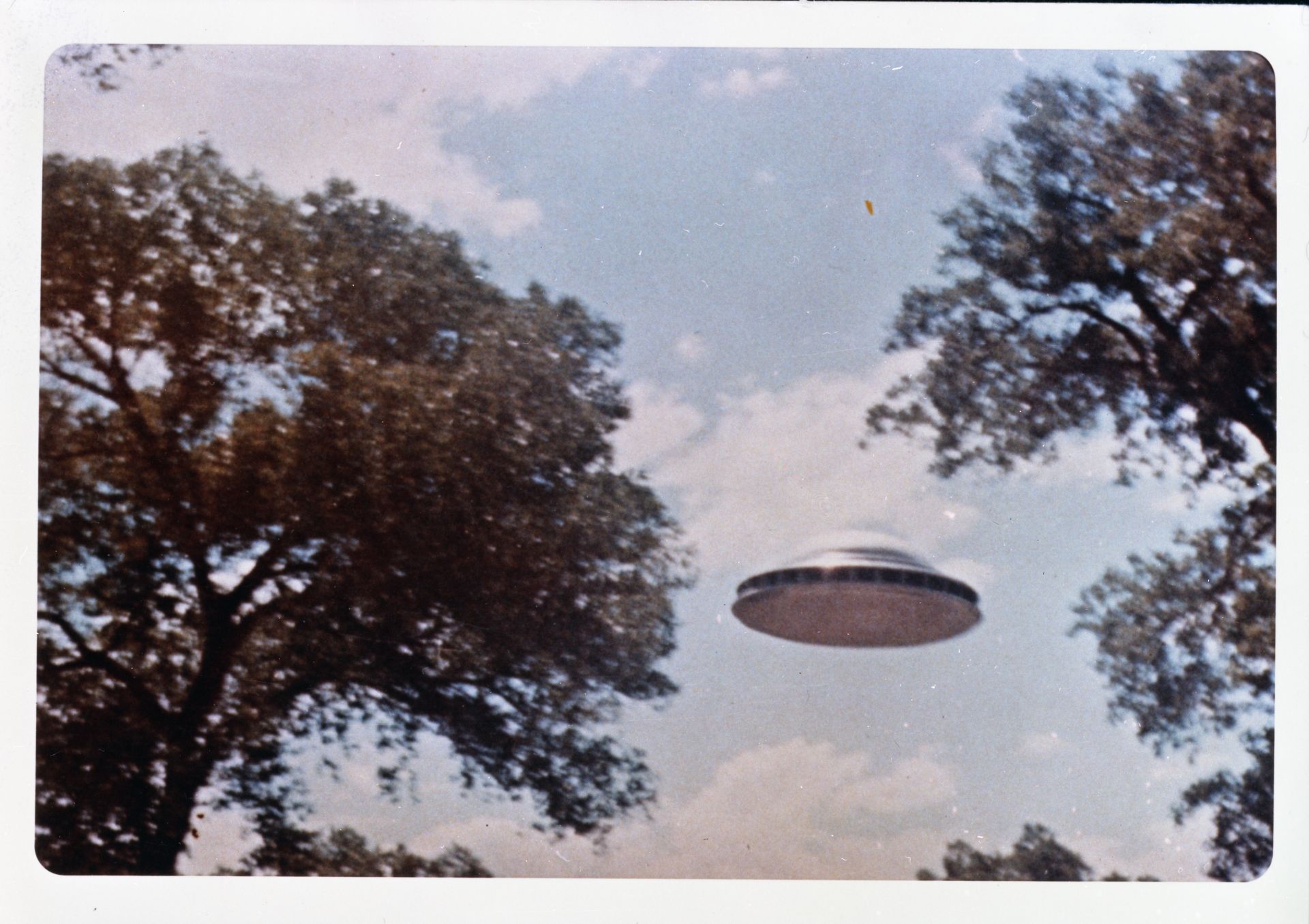
Last Friday, pursuant to an executive order, the Department of Defense began the release of UFO files in its possession. To anyone who’s been following this topic, which has been gaining slow but steady momentum in the United States Congress (as in other countries), the images released in this tranche so far appear unremarkable and more ambiguous than those already in the public domain, including what is in the National Archives and what was first revealed in a landmark New York Times report in 2017, though the Pentagon says that more releases are forthcoming.
Among the promised reports on the horizon “in the next 30 days or so” are ones titled “Syrian UAP Instant Acceleration” and “UFOs in Formation Over Persian Gulf,” according to Republican Rep. Anna Paulina Luna of Florida, who is part of a nonpartisan congressional push for more government transparency on this topic.
UFOs are now referred to under the umbrella terms “unidentified anomalous phenomena” (UAPs) or “unidentified submersible objects” (USOs), and sometimes lumped together as “the phenomena.” As the topic, which is potentially the strangest of our time, if not ever, moves into mainstream public conversation, nonpartisan pressure from elected U.S. officials has been mounting for full government disclosure. It might sound unusual to say that the government is pushing the government for more information, but that is indeed what has been unfolding in this space — something akin to the congressional push in 1992 for the release of records pertaining to the assassination of President John F. Kennedy — with whistleblowers and other credible witnesses attesting to cover-ups about encounters with nonhuman intelligence and even the existence of exotic hardware and “biologics” that apparently baffle the world’s most advanced military institutions.
“There are objects in our airspace and waterspace that we can’t explain, and they’re under intelligent control. … We don’t understand their nature or intentions. And that’s a reality,” said retired U.S. Navy Rear Adm. Tim Gallaudet over the weekend, during an interview on CNN.
Gallaudet has been an integral figure in bringing to light UAP accounts like those of the Nimitz incident, where U.S. Navy pilots encountered a white, “Tic Tac”-shaped object with no visible wings or propulsion, performing extreme maneuvers off the coast of California in 2004. He is also an adviser to the Sol Foundation, which is loosely affiliated with Stanford University. The foundation, whose stated mission is to advance the understanding of UAPs and encourage government transparency, held its second annual symposium on UAPs in October in Lake Maggiore, Italy, which I attended. The conference aimed to bypass the snail’s pace of governmental responses to UAPs and jump-start an international conversation across academia, industry and the media. During my time there, I was struck by the extent to which I felt constrained in covering the conference as a journalist due to the incredulity visited upon the subject by some of the U.S. government’s official denials. Addressing UAPs requires a paradigm shift in our worldview, and covering the subject can feel akin to talking about flying around the globe while official reports still claim the Earth is flat. Yet I was captivated by the attendees’ sober-minded curiosity about a subject that can otherwise garner ridicule and derision.
Presenters included scientists, legal scholars and venture capitalists, all there not so much to pontificate on whether or not UAPs are real, but to collaborate on ways to study them and, as the Durham Law School chair in global law and SETI (Search for Extraterrestrial Intelligence) policy, Michael Bohlander, put it, think about “how to grapple with the ethics and legal ramifications of contact” with nonhuman intelligence.
Also among the presenters was the astrophysicist Beatriz Villarroel of the Nordic Institute for Theoretical Physics, who showcased her discovery of anomalous, artificial reflective objects visible in archival images of space that were taken before the Russians even launched Sputnik in 1957, when there were no satellites or any man-made objects in Earth’s orbits. Her findings, which continue to withstand scrutiny in peer-reviewed publications, are especially interesting in light of the Pentagon’s new release. The Pentagon files include audio and transcripts from astronauts aboard the Gemini 7 space flight, and the Apollo 11, Apollo 12 and Apollo 17 moon landing missions in the 1960s and 1970s, making observations about lights and objects that they could not explain hovering in the vicinity around their craft. In one audio file, recorded on Dec. 5, 1965, aboard Gemini 7, the astronaut Frank Borman reports to ground control his observations of a “bogey,” military speak for an unidentified aircraft or radar contact not yet confirmed as friend or foe.
But leading up to this release, one of the most defining moments catapulting the current conversation into the public arena happened on July 26, 2023, when career Air Force Intelligence officer-turned-whistleblower David Grusch gave a riveting sworn testimony before Congress about his time as a national reconnaissance officer representative for the Pentagon’s Unidentified Anomalous Phenomena Task Force, which had been tasked by Congress in 2020 with detecting, analyzing and cataloging UAPs. To understand the incredible allegations that he made under oath, it is imperative to first look behind the curtain at the process that a member of the intelligence community must undergo before qualifying for legal protection to blow the whistle.
Grusch became a whistleblower in accordance with the Presidential Policy Directive-19 (PPD19) and The Intelligence Community Whistleblower Protection Act, passed in 2014, which aims to provide federal employees with the means to report to Congress complaints or information pertaining to “urgent concerns,” a category that includes problems and abuses in the running of intelligence activity relating to classified information, and the withholding of such information from Congress. A would-be whistleblower who seeks protection under this law must first submit their claims to the inspector general — an internal watchdog — overseeing their agency, who in Grusch’s case was Thomas Monheim.
For months, Monheim’s office investigated each of Grusch’s claims, interviewing witnesses and poring over documentation, until it was satisfied that the claims were indeed “credible” and “urgent,” thus meeting the legal threshold that qualified Grusch for whistleblower protection.
It was under this high level of scrutiny that Grusch alleged under oath, during his public testimony before Congress, the existence of an illegal, off-the-books government program of UAP crash retrieval and reverse engineering that continues to elude congressional oversight. He claimed that some of the retrieved material contained nonhuman “biologics,” and that the government has transferred custody of such exotic material to aerospace contractors, thus removing the material from legally mandated congressional oversight and Freedom of Information Act (FOIA) requests. He additionally asserted during his first public media interview, hosted by the Australian investigative journalist Ross Coulthart and aired on News Nation, that “there’s a sophisticated disinformation campaign [by U.S. intelligence agencies] targeting the U.S. populace” on the topic of UAPs. If true, this would be in violation of laws that prohibit the government from targeting the American people with disinformation campaigns.
Grusch’s testimony was a bombshell for those seeking greater government transparency on UAPs and congressional oversight. The language he introduced under oath would find its way into written law, which today defines the congressional push for UAP disclosure.
Last weekend, Grusch, who now works as a special adviser to lawmakers on how to navigate UAP records compartmentalization within intelligence agencies, reacted to the Pentagon’s release of records by alleging government “obfuscation.” He continues to assert that intelligence agencies are in possession of extraordinary reports on UAPs and a “legacy program” of crash retrieval and reverse engineering, purposely being withheld from congressional oversight, including from the “Gang of Eight,” the bipartisan congressional leaders who, by law, must be briefed on all matters of intelligence by the executive branch.
“There are some actors within certain intelligence agencies, to include DIA [Defense Intelligence Agency] and CIA specifically, that are actually blocking some of the presidentially appointed team in getting access,” he said during an interview on Fox News.
Grusch has reportedly received threats of violence against himself and his family, and his medical records from his time serving in the Air Force have been leaked to the media, in an apparent effort to embarrass and discredit him.
Nevertheless, his allegations, combined with other testimony, culminated that same year in the UAP Disclosure Act, one of the few bipartisan collaborative efforts in congressional history. The bill, co-sponsored that year by Senate Majority Leader Chuck Schumer, a member of the “Gang of Eight,” and Republican Sen. Mike Rounds, introduced strong language to push for government disclosure of all things related to UAPs, and to begin the release of documentation to the National Archives. It was passed as part of the National Defense Authorization Act for 2024, specifically mandating all governmental agencies to release to the National Archives any records they have on “nonhuman intelligence” and UAPs. (For details on the act, what it means and why the language was watered down, listen to the interview on New Lines’ The Lede with the iconic civil liberties lawyer Danny Sheehan, who founded the New Paradigm Institute dedicated to government transparency on UAPs. He also spearheaded writing the UAP Disclosure Act.)
Over time, as I’ve continued to closely watch developments on all things UAP, motivated by both personal curiosity and an attempt to cover it professionally, despite the shadow that the government casts on this topic (not an easy task), I must say that I have learned more about human behavior and the inner workings of government than I have about anything that is potentially extraterrestrial, starting with the domino effect of human drama that Grusch’s testimony put in motion.
Feeling heat from Congress, the All-domain Anomaly Resolution Office (AARO), established in 2022 within the Department of Defense and mandated by Congress to investigate UAPs (which would have included cooperating with the task force that Grusch headed), published a report that dismissed Grusch’s allegations. The report read more like an op-ed than the analytical paper it was supposed to be. It cherry-picked sensationalized information that was already in the public domain, and omitted incidents like the Nimitz “Tic Tac” from 2004 and the “Gimbal/Go-Fast” from 2014/2015, which were declassified by the DOD in 2020 (after their unauthorized release in the New York Times article in 2017); incidents that had led to the establishment of AARO in the first place. The report, which clearly aimed to make light of Grusch’s allegations, had links to sourcing that did not work, and cited as a reference a Fandom page, which is a fan-generated wiki for entertainment and gaming. It was swiftly dismissed by lawmakers.
“They’re lying,” Republican Rep. Tim Burchette of Tennessee said in numerous media interviews about the Pentagon. “They weren’t transparent to us in a SCIF setting,” said Missouri Rep. Eric Burlison, referring to classified testimony in a secured room.
Prior to leaving the agency amid controversy over the report, the former head of AARO, the physicist Sean Kirkpatrick, published a letter on his LinkedIn page decrying the whole thing, at times sounding personally dejected by the Grusch hearings. (It is highly unusual for a senior public servant to comment on their agency’s work in a personal capacity while still in office.)
He then proceeded to give media interviews with contradictory claims. He told Politico that the Pentagon, the official home to AARO, needed to be more transparent with the public, and that it shot down his requests for more media engagement, a claim that the Pentagon swiftly disputed.
In Scientific American, he referred to the phenomena as “fascinating, important, and stubborn mysteries,” but dismissed the entire UAP public discourse as a “self-licking ice cream cone,” something of a game of telephone gone bad. He has since returned to government work, this time at the Department of Energy, also on the receiving end of the bipartisan congressional push for UAP disclosure.
Undeterred by the Pentagon’s own pushback on the subject, last year more witnesses testified before Congress on the need for government transparency on UAPs, including Air Force and Navy veterans, though none provided as riveting a testimony as Grusch. During their hearing in September, the main issue was not whether UAPs were real, but rather how to facilitate reporting of UAP sightings by military personnel, and even commercial pilots, without the stigma or penalties that often accompany it.
The Pentagon’s latest release of files may offer no answers to any of Grusch’s allegations, but it does offer topical legitimacy to UAPs, giving journalists around the world a thread to pull on. It is a marked departure from the AARO report published under Kirkpatrick, which fed into the ridicule that already surrounded the subject.
Moving forward, it is difficult to predict how the subject of UAPs will unfold in the foreseeable future, or to make statements about what UAPs are. But as it gains traction in the mainstream, more governments are pushing ahead with their own disclosures. France, for example, has already set up a state-sponsored unit known as GEIPAN for investigating the phenomenon. Chile, Brazil and Peru openly investigate UAP incidents without the stigma found in other countries. And so far this week, in response to the Pentagon’s release of at least one UAP incident report that occurred over Japan, Japanese authorities said they, too, plan to initiate UAP disclosure within a national security framework.
What is certain is that the topic will retain its human aspect. President Donald Trump is already touting himself as the heroic “disclosure president,” while his detractors dismiss the release as a mere distraction from the Epstein files and the Iran war. Proponents of disclosure have already pooh-poohed the Pentagon’s release as a “nothing burger,” rightly pointing out that a good chunk of the 162 files released was already in the public domain through FOIA requests by dedicated sites such as The Black Vault. Debunkers have taken to social media with their own prosaic explanations. Perhaps most dramatically, America’s religious right and personalities such as Tucker Carlson are already peddling theories that UAPs are really “angels and demons.”
But no matter one’s inclinations, there comes a time when dismissing something incredible actually raises even more incredible questions. Ignoring or discounting the mounting evidence of the UAP phenomenon is just that, because if there is no “there” there, then logic dictates that one of the following must be true: The U.S. government (along with the other governments that have been forthcoming about UAPs) is hallucinating, losing its grip on reality, lying, or otherwise confusing something, like its own or Russian or Chinese technology, for a phenomenon it cannot explain using its own multibillion-dollar equipment.
Nor is it interesting to hear more of the usual trite and tired quips surrounding this topic, the half-nervous jokes about “little green men” or the shutting down of the discourse with declarative statements like “there is no evidence of aliens,” which is neither here nor there when it comes to the role of government in addressing a phenomenon observed and unexplained by its own military.
After all, it was not too long ago, in the late 19th century, that physicists believed that they knew practically everything about the universe, and that only the precision of measurements required further study. Then came the theory of relativity and quantum physics.
As Gallaudet says about UAPs: “What they are, we don’t know. That’s why the release of these initial videos is so historic, because if the Pentagon follows through … in releasing more, then we can actually open the subject up to independent research from universities, from think tanks and the government, actually.” And, he adds, specifically from organizations he formerly worked for that are still reluctant to research UAPs, like the offices of geographical intelligence and naval intelligence.
In grappling with all the high strangeness that surrounds this topic, perhaps it is best to find our humility and pool together our resources to study and understand what we don’t yet know.
Become a member today to receive access to all our paywalled essays and the best of New Lines delivered to your inbox through our newsletters.