


The pearl diver slips his feet through a loop of rope and straightens his legs so that the stone is straining toward the seabed. He nods to his hauler, who will pull him and the oysters back up to the surface in about one minute’s time, then takes a deep breath and loosens his grip on the “yida,” the rope connecting him to the boat, allowing it to run through his hands as he sinks to the bottom.
He is dislodging camouflaged shells from the bank, the currents churning in his ears, when his hauler notices dark shapes on the horizon and tugs prematurely at the yida. Surprised, the pearl diver looks up toward the melted sky and grabs hold of the rope. When he breaks through the surface, everyone in the pearling boat is looking out toward the incoming ships.
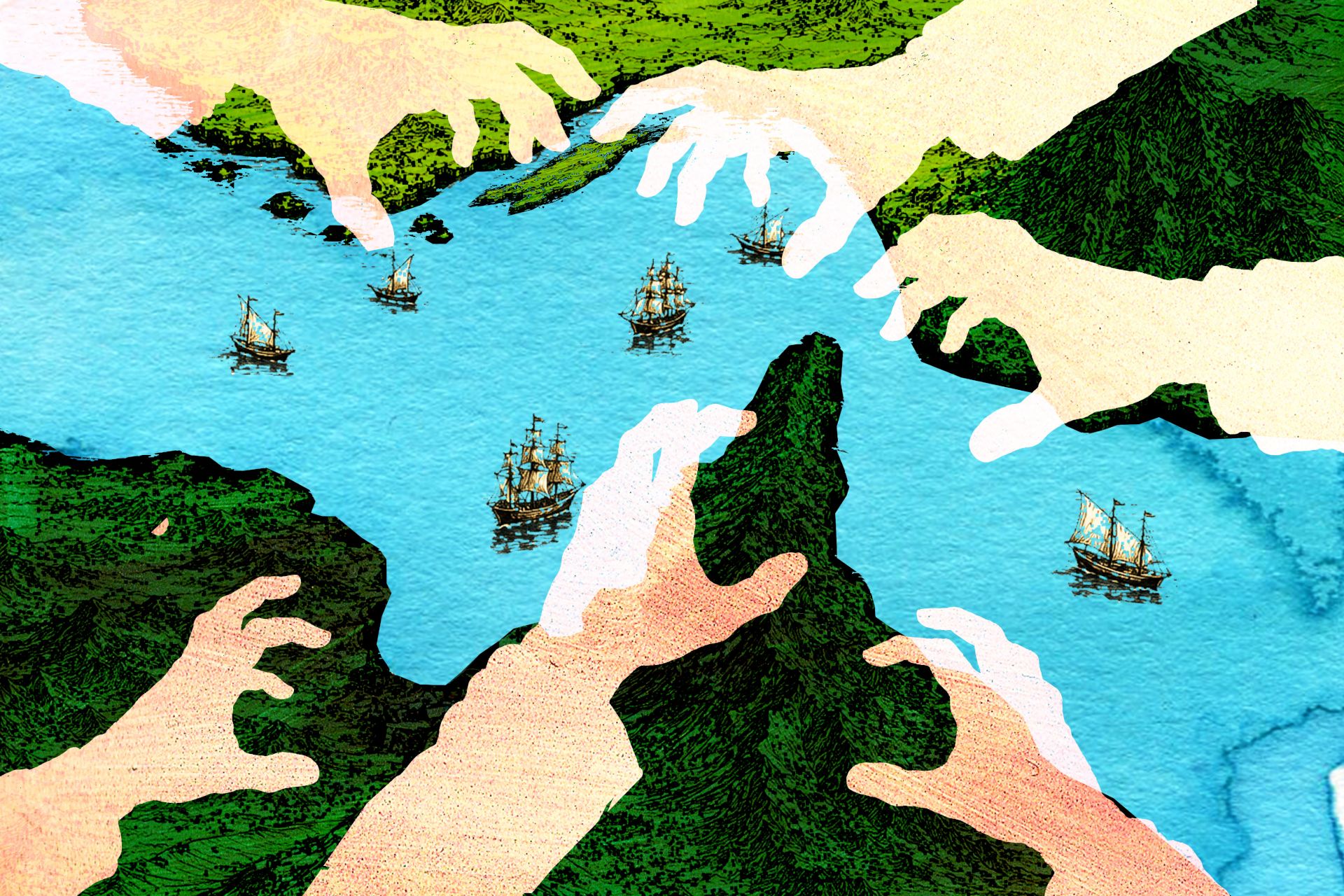
This might have been the scene on the sparkling salty waters of the Bahr Fars, the Persian Gulf, at the moment the people of the Kingdom of Hormuz first spotted the incoming Portuguese fleet on Sept. 25, 1507. The small but mighty kingdom was about to fall into the hands of the region’s first European conquerors, marking the beginning of a global battle that continues to this day, for control over the narrow channel known as the Strait of Hormuz.
The six weathered vessels and 500 Portuguese men, no doubt exhausted, were under the command of Afonso de Albuquerque — an authoritarian gunpowder-diplomat, as historian Dejanirah Couto describes him — who tended to inform his king of his plans after he’d already carried them out.
The Portuguese were outnumbered, but what they lacked in men they made up for in cannons; the Hormuzians, at the center of so much trade, preferred business deals over armed clashes. By Oct. 10, a victorious Albuquerque was disembarking at the port of Hormuz to meet with its leader and enshrine his surrender.
The island was barren — just hills of deeply hued sand and volcanic rock — but the kingdom that had built itself up there overflowed with everything a fertile land could offer. Anything worth buying and selling came through Hormuz, and the city’s elite accrued an enormous and renowned wealth through a complex tolling system, set up to tax shipping between the Gulf and the Indian Ocean.
Most Hormuzians worked at or in connection with the customs house, and the people of the island reflected the diversity of goods that passed through the strait. When Jesuit priests landed on Hormuz some years later, Couto explains, they were shocked to find people of different faiths — Muslim, Christian, Hindu, Jewish — mingling as if they all shared the same holy book. Navarrese missionary Francis Xavier is said to have described Hormuz as a “Babel for its confusion of tongues,” home to “all the most corrupted forms of every religion in the East,” and a place where “foreigners, soldiers and merchants threw off all restraint in the indulgence of their passions.”
The priests also weren’t keen on how scantily dressed the women were, but with the heat as ungodly as it was, extra clothing was a hard sell. Besides, for Hormuzian women, life was short. They gave birth young and died young. Couto says many women didn’t make it past their 20s. Drinking water was shipped in just like everything else that made life possible on the island, and that water didn’t always come clean.
But most chroniclers who visited the kingdom during this period described Persians, Arabs, Armenians and Indians living side by side and in relative comfort, ruled by royal families who’d made their fortunes in the same trade as the people they ruled over. The bazaars were lively and overflowing with dates, spices, silk, fruits, dyes, horses, pearls, sugar, wines, perfumes and porcelain. Carpets covered the earth, and fabrics hung overhead to protect bargainers from the relentless sun.
Maybe Albuquerque and his likely overdressed entourage passed through these prosperous bazaars on their way to the palace to meet with the kingdom’s de facto ruler, vizier Hwaga Ata (or Cogeatar), a Bengali former slave who had risen through the ranks over decades and proved himself a skilled dealmaker.
But on this day, the deal was not in his favour. Placed before him was a treaty transforming his kingdom into a vassal of Portugal, allowing Albuquerque to build a fortress in the town and agreeing to the yearly payment of a hefty sum of money. Hwaga Ata had no choice but to hand over the keys to the world’s most important trade route.
“If the world were a ring, Hormuz would be the jewel,” the contemporaneous historian João de Barros wrote — a jewel that comes with its fair share of curses. Perhaps John Milton knew this when he used “the wealth of Ormus” to describe Satan’s throne in “Paradise Lost.”
The strait that had given the Kingdom of Hormuz its precious quality would continue to bring far-reaching power to those who later controlled it. It was true in 1507, and it’s true in 2026: The Strait of Hormuz has acted as a negotiating table for more than 500 years.
By the early 17th century, Portugal’s reputation in the Gulf had sunk below the waves. Albuquerque died in 1515 after suffering from “a spasm which is a signal of my dissolution,” attributed in part to the notorious Hormuzian heat and in part to the overwhelming jealousy that gripped him when he heard the news that his rival had replaced him as governor of India while he was busy taking the strait.
Albuquerque’s fortress was an expensive liability, historian Ghoncheh Tazmini explains, and the system he had set up was hard to maintain. Each successive Portuguese administration ratcheted up tolls until Hormuz was wrung dry, local merchants were fed up and the powers that be were itching for a change.
Portugal’s grip on Hormuz was eventually prised loose, according to historian Daniel T. Potts, via Qeshm, the long and lush island next door. The crown had sent an armada of five vessels to Hormuz under a young and reckless, but not incompetent, commander named Rui Freire, with orders to “trace and destroy any foreign European ships that tried to establish trade connections with Persia.”
In June 1620, Freire caught wind of a fleet from the East India Company — at this point two decades old and already a formidable fighting force — bound for Jask, which juts out into the Gulf of Oman further down the Iranian coast. For more than a month, Freire cruised the shoreline, waiting for the English to arrive. When they did, they had no trouble averting the Portuguese, unloading and loading at Jask, then slipping back through the failed Portuguese blockade.
Back on Hormuz, Freire focused on fortifying what he had. In May 1621, he took 2,500 men with him to Qeshm, where they dismantled a small town, likely used by the king of Hormuz during hunting season, and set out to build a massive fort.
Meanwhile, in Isfahan, Shah Abbas the Great watched the European powers bumble and bristle their way through the early stages of regional competition. He’d inherited, at 16 years old, a deeply fractured population and set himself to building Safavid Iran into an empire. Now 49, Abbas, whom historian Rudi Matthee describes as a brutal warlord but also a visionary, set his eyes on the Strait of Hormuz, knowing that consolidating power meant controlling trade.
The Safavids were not people of the sea, Matthee points out. They originated from the fertile landlocked valleys of the southern Caucasus and preferred solid ground to lurching waves. The Portuguese were becoming a nuisance, but Abbas couldn’t fight them himself because there was no Safavid navy. But if he played his cards right, he wouldn’t have to.
The English and Dutch, through their respective East India Companies, sought silk, and Abbas made deals with both countries, playing them against each other, Matthee explains. The two European powers competed commercially for a foothold, squeezing their own trading posts in between Portugal’s existing ones.
In a letter sent from Jask to his bosses in London, East India Company merchant Edward Monox wrote, “For anything I see, the Portugall is better respected and more feared than we, and is because he keepeth them in more slavery than we do, which maketh us to be despised and the Portugall to be feared, all of which if you please may easily be remedied.”
Perhaps not as easily as Monox thought. In “The Asian Trade Revolution of the Seventeenth Century,” Niels Steensgaard describes an awkward early encounter between Abbas and the company. During a visit to the court in Isfahan in the early summer days of 1621, the English party brought with it an assortment of gifts, including a coach, which Abbas flat out rejected, protesting the vehicle on the grounds that he was not a stone and would not be dragged around from place to place in a cart. Nay, horseback would be his preferred method of transportation until the day he died!
The English at least still hoped to discuss business with Abbas the Great, who, having likely invited the Carmelite Catholic priests himself, insisted that it would be unsuitable to discuss business in their presence. Instead, he pursued what he must have considered more relevant topics: Exactly how many nails were used to crucify Jesus, and Protestant-Catholic divergences in biblical interpretation.
Not long after, in June 1621, word of Freire’s fort reached the shah, who was reportedly pleased to have an excuse to finally push the Portuguese out of Hormuz. He summoned the English again, this time for business, and offered them 50% of the revenue from the customs house in Bandar Abbas, which he planned to establish as a nearby mainland replacement to Hormuz for the running of Iranian-Indian trade. According to the English, Abbas may have also added the threat of cutting them off from the Isfahan silk trade route, just to spice up the deal.
And so, as is recorded in the ship logs of the Jonas, which included Monox in its crew, the East India Company sent its fleet out to the Strait of Hormuz to confront their “daringe yet dasterdly enymie” and invite them “to a banquit of fyer flyinge bullitts.”
The captain of the Jonas later drunkenly told Italian traveler and chronicler Pietro Della Valle that England planned to rebuild and colonize Hormuz, bringing “whole Families with Wives and Children” from England, and running the customs house from there. A soberer Della Valle, however, knew from his own studies of Abbas’ court that the shah had no intention of handing the strait over to foreigners. Della Valle’s interpretation of the deal turned out to be much closer to reality, Matthee explains, as the English received little of what may or may not have been promised to them.
After a few days of cannon fire, the Portuguese force at Qeshm surrendered, the English having lost only three men, one of them explorer William Baffin (whom some Canadians may know as the man who tried to find the Northwest Passage). After Qeshm, the Iranians, aided by the East India Company, swiftly took Hormuz.
“Hormuz perished as if it had been blasted away by a volcanic eruption,” Steensgaard writes in the opening line of Chapter 8, titled frankly, “The Losers.”
At the end of the day, Tazmini points out, Iran came out on top. The Portuguese were gone, the Strait of Hormuz was under Iranian control and the Safavid Empire was filling its coffers with customs revenues.
The handful of East India Company employees given posts in Bandar Abbas were generally miserable, sweaty and “bored out of their skulls,” Matthee says. The company complained several times about not getting half of the Bandar Abbas bounty, but there wasn’t much they could do about it. They were the superior naval power, but a land battle would have been a whole other story and not worth the risk of losing the trade route altogether.
As for the Dutch, they struggled to profit from their silk dealings with Iran. Frustrated after years of unfavorable contracts, they launched what Matthee says was likely the first ever naval blockade of the Strait of Hormuz in 1645. Faced with the potential loss of their southern trade route, Iran was quick to bow to Dutch demands. But when the Dutch envoy arrived in Isfahan, he was promptly informed that Shah Abbas II wouldn’t see him until the Dutch had lifted their blockade.
One hundred years after winning Hormuz, a hollowed-out Safavid Empire collapsed, followed by a revolving door of leaders and dynasties throughout the 18th century. Inland, Iran was in turmoil, but at sea, trade thrived via ships crewed by skilled Arab seafarers. The Persian Gulf was a wheel of prominent ports connected by shipping routes that criss-crossed the pearl-rich waters.
In 1758, a man named Carsten Niebuhr was asked if he’d like to go to “Arabia.” Born to farmers in the marshlands of northern Germany, Niebuhr spent his early 20s chasing down teachers in Hamburg from whom to learn mathematics, geometry and astronomy. One of those teachers ended up nominating this particularly bright pupil to the king of Denmark’s scientific expedition. “Why not,” Neibuhr said. “If the expenses are paid.”
By the time he made it to the Persian Gulf in 1765, he was the only traveler left. Along the way, his five companions succumbed to diseases that he had managed to survive, it is said, due to his reverence for local customs, and his tough peasant blood. From the Strait of Hormuz, he wrote of the most powerful navy in all the Gulf: that of the Al Qasimi (plural, Qawasim), a confederacy of Arab tribes and masters of the sea.
With the exception of the prestigious Sharjah and Ras al-Khaimah ports, Al Qasimi dwellings on land, which extended along both sides of the strait and on Qeshm, were mostly modest mud houses, Niebuhr observed. But the huts meant little to the Qawasim when compared to their real homes: their impressively light and dextrous pear-shaped ships. “These people have nothing to lose upon the continent,” Niebuhr wrote. Life was at sea.
But they did not appear to exercise complete control over the waters of the Strait of Hormuz. Rather, a balance (or instability, depending on who’s speaking) prevented, at this time, a total monopoly by any one power.
In his 1997 book “The Blood-Red Arab Flag,” historian Charles E. Davies argued that the Gulf’s “fluid society” resulted from “the flexibility it gained from being an organism that ultimately broke down into family units which could combine or act independently as circumstances required.” Each Al Qasimi town, for example, had its own sheikh, Niebuhr noted, but “if the principal inhabitants happen to be dissatisfied with the reigning sheikh, they depose him, and choose another out of the same family.”
The ships themselves also gave the tribes a “mobility and independence” that preserved the political system’s fluidity, Davies wrote. It was an era of both vitality and volatility that Britain would eventually choke out with the enforcement of its “Pax Britannica.”
The Europeans, surrounded by successful free-sailing Arabs they were seemingly unable to coexist with, eventually abandoned their trading posts in the Gulf. The British watched as the Al Qasimi allied with the new Wahhabi movement, becoming, as historian Rosmarie Said Zahlan describes it, the Wahhabis’ “naval extension,” and intensifying the rivalry with Oman.
It was Oman that endeavored to bring the British back into the picture, says historian Simon Layton. In a bid to secure support from the British navy in combating the Qawasim, the Omanis pushed the image of their enemies as “pirates,” a narrative that the British took up with fervor, labeling the entire coastline between Bahrain and the Strait of Hormuz “the Pirate Coast.”
The Omani-British alliance was initially lackluster, Layton says, but a confluence of factors eventually convinced the East India Company to lend its fighting forces to the Omani cause. One such factor was the “public voice” of smaller, independent British trading companies frustrated at the less-than-positive effect of flying the British flag on their ships and the lack of protection granted to them by the company’s pass system.
One of these merchants, James Silk Buckingham, had come face to face with the Gulf’s most notorious “pirate,” Rahmah ibn Jabir. Described as an astute politician and even a poet, Jabir was also the closest of the Arab naval leaders to an actual pirate, in that he attacked and made alliances with whomever he liked, answering only to himself. The only constant was his blood feud with Bahrain’s ruling Al Khalifa family, who had won the island with the help of Jabir’s Al Jalahma tribe, only to freeze them out of the rewards: extremely lucrative pearl banks.
In 1816, Buckingham was in Muscat when the resident British diplomat hosted Rahmah ibn Jabir and some of his followers for tea, an encounter noteworthy not only for its image of a battle-worn man in a “large black goat’s-hair cloak” lifting a cup of English breakfast to his lips, but also considering that the British had been complaining for several years of attacks by Jabir.
Buckingham, sounding a bit out of his depth, described Jabir’s face as “naturally ferocious,” his arms and legs as “cut and hacked and pierced with wounds of sabres, spears and bullets,” and his apparent insistence not to distinguish himself in dress from his followers as “disgusting.” Jabir is also often given the prestigious title of the first pirate recorded as wearing an eye patch.
Jabir had just recovered from a badly damaged arm that left him boneless from elbow to shoulder. Asked by one of the English party how he would confront his enemies with such an arm, Jabir unsheathed his dagger and used his good arm to “twirl” his limp arm, dagger in hand, around and around, declaring that he looked forward to the cutting of further throats. The burst of laughter that arose from Jabir’s admiring audience disturbed the poor, flustered Buckingham.
Three years later, the British used Jabir’s “piracy” as justification to attack the Qawasim once again, their first attempt in 1809 having failed to do much to change the scene. This time, however, the East India Company set everything on fire, and the Qawasim were forced into a treaty that put Britain in de facto control of the Strait of Hormuz. The agreement included an article declaring that all “pacified tribes” would henceforth fly a new flag, white with a red rectangle in the middle, signifying their “peace with the British government.”
The only “piratical chief of consequence” who refused to sign the treaty was Rahmah ibn Jabir, who, some years later, died “like, three times,” Layton says.
The record of Jabir’s death is just as contemptuous of authority as he himself was in life. In the prevailing account, Jabir died in 1826, nearly blind but determined, as always, to assail his ultimate foe, the Al Khalifa, head-on in a confrontation at sea. Perhaps judging the battle to be a loss, or perhaps simply sensing impending retirement, Jabir retreated into the ship’s cabins with his argileh (water pipe) and lit the gunpowder stores with one of its coals.
Jabir’s fire-and-water finale and the Qawasim’s surrender together ushered in an era of British policing of the Persian Gulf that lasted until 1971, by which time the pearls of Hormuz had been replaced by cargoes of black gold.
It’s finally time for the pearl divers to come home. It’s been four months at sea. The women they left behind gather on the shore to entreat the sea to release their loved ones back to them. At first, they are encouraging and gentle. The elders whip up a wind meant to blow the seafarers home, and new mothers pour fresh milk into the waves as thanks. But then they become agitated. The women throw stones and burning branches into the water, cursing the sea for taking their men from them for so long. They dip cats into the sea foam, the hissing and meowing an expression of their anger at the sea.
And then they sing sea shanties until the boats appear. “Enough is enough, oh sea. Aren’t you afraid of God, oh sea? You took my son, oh sea!”
Become a member today to receive access to all our paywalled essays and the best of New Lines delivered to your inbox through our newsletters.