


In 2007, at the Damascus Gate restaurant on the outskirts of the Syrian capital, two men met regularly with a senior Yemeni official. The restaurant was one of many places in Damascus where Yemeni business leaders, intermediaries and political figures passed through with relative ease. Syria’s visa regime made the city both accessible and discreet. What was discussed there, however, was not routine.
One of the men, known as Abu Hadi, an Iranian operative linked to the Islamic Revolutionary Guard Corps (IRGC), was working closely with Lebanon’s Hezbollah. The other was Khalil Harb, also known as Abu Mustafa, a senior Hezbollah commander who would later oversee its dealings in Yemen. At the time, they were mapping Yemen’s political terrain. Hezbollah operatives were using these meetings to think about taking on a larger role at the strategic southern tip of the Arabian Peninsula.
By this point, Hezbollah had already established contact with Yemen’s Houthi movement and had begun providing limited support. What was taking shape in Damascus was something more deliberate, as these operatives considered how to build beyond that initial relationship and how they might reshape a local group that had emerged over a thousand miles from Hezbollah’s home, on behalf of its sponsor — the Islamic Republic of Iran.
Yemenis who attended these meetings later described how Abu Hadi spoke openly about Yemen’s strategic value for Iran, particularly its position on the Red Sea and its proximity to Saudi Arabia. Abu Mustafa, by contrast, was more methodical. He focused on people: tribal structures, political factions and who could be approached. It was less about intervention and more about positioning.
They began through intermediaries such as Sultan al-Samai, a Socialist Party parliamentarian from Taiz with both political and tribal clout. Through figures like him — and others operating across party and tribal lines — Hezbollah expanded its network, building relationships that did not depend solely on the Houthis.
By 2009, Hezbollah’s efforts moved from planning to practice. It began dispatching trainers and advisers to northern Yemen. According to Yemeni security sources, they assisted in laying mines, building defensive positions and adapting tactics to the terrain. Locally, they were referred to as “zuwwar ala tariq al-jihad” — “visitors on the path of jihad,” a phrase that framed their presence as both temporary and ideological, even as it became increasingly entrenched.
Some operatives remained in advisory roles, mediating disputes within the Houthi movement and helping shape leadership decisions. Others embedded more deeply. In at least one documented case, a Hezbollah operative entered Yemen with a Syrian passport under an assumed identity, lived there for years and married into a local family. Eventually, he was arrested in 2012 by the National Security Bureau under President Abed Rabbu Mansour Hadi’s government while trying to depart from Sanaa Airport. These were not short deployments. They reflected a longer-term investment in the movement’s internal development.
At the same time, Hezbollah’s involvement surfaced in other ways, including outside Yemen. Fundraising campaigns in Beirut openly collected money for the Houthis, even as the organization denied direct involvement. In one instance, a gas station in southern Beirut was renamed after the movement’s founder, Hussein al-Houthi, complete with a donation box. The box was removed and the name was changed after the Yemeni Embassy in Beirut intervened, but only after the relationship had become difficult to ignore.
Not all of Hezbollah’s activities aligned with Houthi priorities. In Yemen’s al-Jawf, particularly during the later rounds of fighting between 2007 and 2010, operatives worked with tribal actors to provoke clashes along the Saudi border, at times without coordination with Houthi leadership. The relationship was close, though it was not yet fully controlled from one side.
By the early 2010s, Hezbollah was no longer simply engaging an armed movement at the margins of Yemen. It was shaping networks, guiding decisions and rooting itself within political structures through which the Houthis would later consolidate power.
Connections between Yemen and Lebanon existed long before the Houthis, but they were limited in scope and did not extend beyond state-level interactions. In the 1970s, South Yemen’s socialist leadership supported leftist factions during Lebanon’s civil war, including figures such as Kamal Jumblatt, a prominent Druze leader and founder of the Progressive Socialist Party. These ties remained transactional and did not develop into sustained political or social relationships.
This began to change in the early 2000s, as Hezbollah’s profile in the region shifted. Following Israel’s withdrawal from southern Lebanon in 2000, Hezbollah’s standing grew across parts of the Arab world, particularly among publics disillusioned with both Western intervention and the failures of their own governments. Its confrontation with Israel, and its ability to withstand it, resonated widely.
In Yemen, this coincided with mounting domestic tensions. Power was increasingly consolidated under President Ali Abdullah Saleh, while grievances deepened in peripheral regions such as Saada in the north. For some Yemenis, Hezbollah offered a different model; one that was disciplined, effective and rooted in both religious authority and political organization.
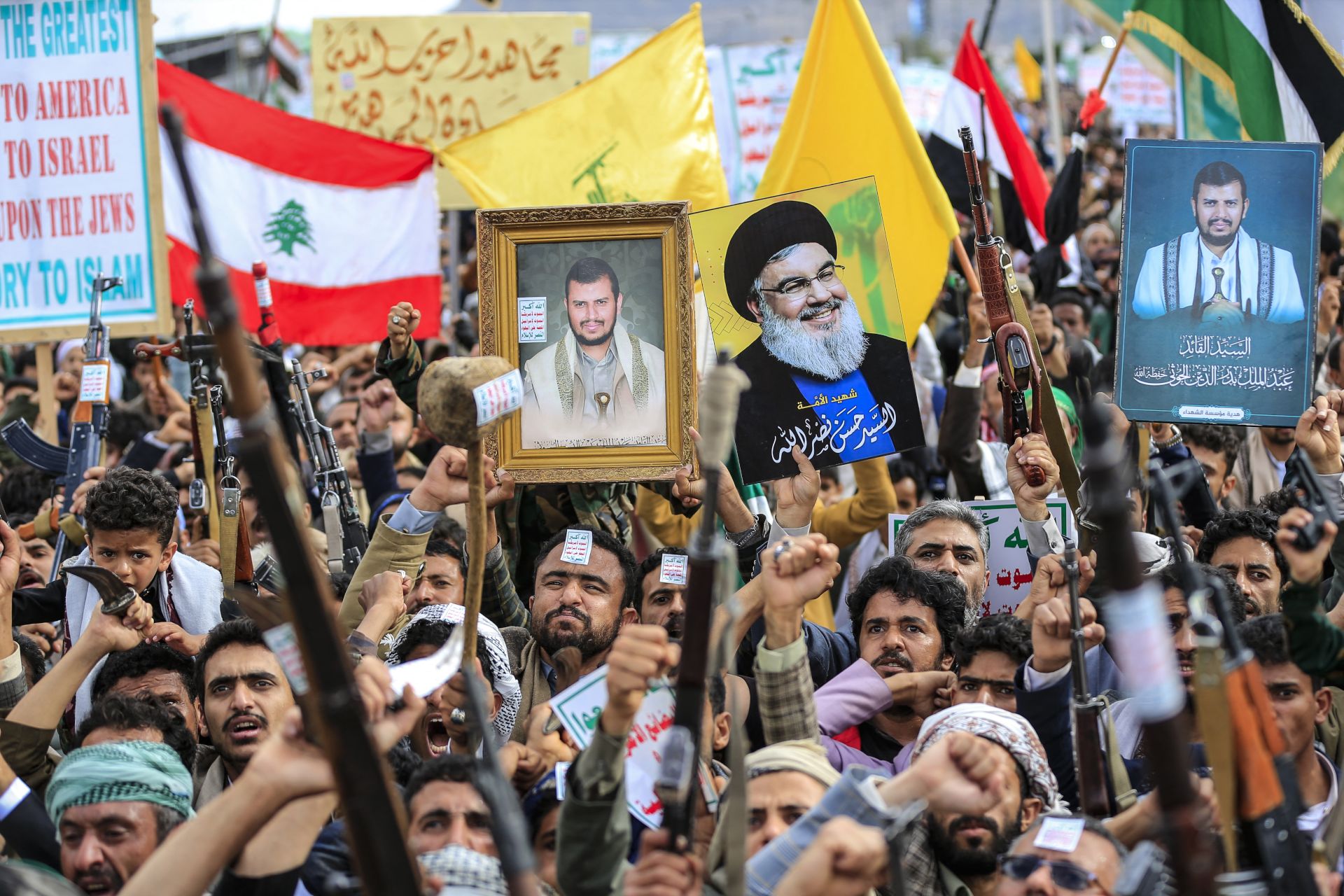
By the mid-2000s, that appeal had moved beyond abstraction. During the 2006 war with Israel, Hassan Nasrallah, Hezbollah’s secretary-general, became a widely recognized figure. His speeches circulated across Yemen, playing in shops and public spaces, and his image became associated with defiance. The appeal extended beyond ideological alignment.
As conflict between the Yemeni government and the Houthi movement escalated in Saada after 2004, the movement, which was still in its early stages, was seeking structure as much as survival. For its leadership, particularly Abdul-Malik al-Houthi, Nasrallah offered more than symbolic inspiration. He represented a model: a leader who combined religious legitimacy, military resistance and political authority. Over time, this shifted from admiration to emulation, shaping both his leadership style and the movement’s organizational structure.
While Iran facilitated this relationship, much of it was handled through Hezbollah, whose leadership operated in Arabic and was better positioned to engage local actors. In practice, Yemeni intermediaries attempting to reach the Houthis through Iranian channels were often told to go through Hezbollah instead, a practical division of labor that reflected both trust and strategy.
By the end of the decade, the Houthis were no longer simply drawing from Hezbollah as an example. They were adopting elements of its model in practice. Hezbollah contributed to training fighters, structuring chains of command and shaping political messaging. This also influenced how the Houthis framed their struggle; not simply as a local conflict, but as part of a broader regional confrontation.
The uprisings of 2011 expanded Hezbollah’s role from working through the Houthis to engaging directly with a wider range of Yemeni actors. As the state weakened and authority fragmented, the constraints on external involvement receded.
After 2011, Hezbollah’s projects in Yemen were consolidated under Khalil Harb (aka Abu Mustafa), working in coordination with Iran’s IRGC. Hezbollah also moved to formalize its role in the media sphere by helping to establish Al-Masirah, the Houthis’ primary television channel, headquartered in Beirut’s southern suburbs, in 2012. Hezbollah trained its staff, shaped its editorial direction and, in its early years, operated it directly.
Hezbollah intensified its support for the Houthis, but was now working with a wider range of Yemeni actors.
Movement between Yemen, Beirut, Damascus and Tehran increased. Politicians, tribal figures, journalists and activists were brought into this orbit. Travel was tightly managed. Passports were often left unstamped, and flights were coordinated through informal channels. Some Yemenis traveling through Beirut at the time complained that seats were increasingly difficult to access, as they were quietly reserved for these coordinated movements.
The process was not entirely opaque. In one case, a participant filmed members of Hezbollah and the IRGC on a return flight. He was detained upon arrival in Damascus, and his recordings were confiscated.
Hezbollah’s efforts extended beyond media and the Houthis. In Beirut, it hosted conferences bringing together Yemeni figures from across the political spectrum. Such gatherings were common during the period before Yemen’s transition away from autocracy collapsed into civil war (2011 to 2014), but Hezbollah’s objective was more specific. A 2012 conference titled “The Yemen We Want” brought together parliamentarians, party leaders and activists, many with no prior connection to the Houthis. Participants were encouraged to form Tanzim al-Ahrar, or the Organization of the Free, designed along a familiar model: a political environment in which multiple actors operate, but one armed group retains decisive influence.
Some participants were subsequently flown to Tehran via Damascus, often without passport stamps, reinforcing the controlled nature of these networks and drawing these participants into the axis.
Hezbollah also extended its reach into southern Yemen. Through figures such as Hassan Ba’oum, a leading southern separatist who called for the restoration of an independent South, and his son Fadi, it established links with Yemeni secessionists. Before switching to the United Arab Emirates’ camp and, more recently, to the Saudi camp, Fadi Ba’oum spent extended periods in Beirut, where he functioned as a liaison, coordinating political activity and facilitating the movement of southern youths for training as well as political activities against the government in South Yemen.
This outreach carried contradictions. Until 2015, Hezbollah maintained relationships with actors whose interests did not fully align, including factions, like the southern separatists led by Aideroos al-Zubaidi, that would later oppose the Houthis militarily. In some cases, troops who had received training were later involved in pushing Houthi forces out of southern areas such as al-Dhalea in 2015.
For a period, this approach offered Hezbollah influence. It was strengthening the Houthis while cultivating political networks and shaping the information environment. But the model proved difficult to sustain.
As Yemen’s transition collapsed and conflict deepened, relationships across factions began to fragment. Some remained tactical. Others broke down entirely.
By 2014-2015, as the Houthis advanced on Sanaa and consolidated control in the north, Hezbollah’s broader approach narrowed. What had begun as an effort to build a network of aligned actors ultimately converged back toward a single partner.
The Houthi takeover of Sanaa in 2014-2015 marked the high point of Hezbollah’s trajectory in Yemen.
By then, years of training, political engagement and institutional support had contributed to the emergence of a movement capable of seizing and holding the capital. For Hezbollah, this appeared to validate its approach. Its role shifted from building to sustaining.
Involvement continued across military, political and media domains. The Houthis’ growing use of missiles and drones reflected capabilities developed over years of external support.
As the war escalated after 2015, this relationship became more visible. Missile launches into Saudi territory drew increased scrutiny, and Hezbollah’s role became harder to obscure. And that visibility carried costs.
In 2017, following a missile launch attributed to the Houthis, Saudi Arabia detained Lebanese Prime Minister Saad al-Hariri and escalated political and economic pressure on Lebanon.
The fallout extended beyond the immediate crisis, contributing to wider Gulf actions against Lebanon, including trade restrictions and financial constraints, widely understood as targeting Hezbollah. Yemen had become both an asset and a liability.
At the same time, the Houthis were consolidating internally. Despite setbacks in the south, they retained control over northern Yemen and key population centers. Over time, they strengthened administrative structures and developed more advanced military capabilities.
By the early 2020s, they had become the most powerful domestic actor in Yemen. This consolidation reduced their dependence on external support and altered the terms of the relationship. Hezbollah remained important, but it no longer defined the Houthis’ trajectory.
By 2023, the shift was clear. The Houthis expanded beyond the Yemeni conflict, targeting commercial shipping in the Red Sea and launching drones and missiles toward Israeli territory. These operations drew on capabilities developed over the previous decade, but reflected the Houthis’ own strategic calculations.
At the same time, Hezbollah’s position was changing. Sustained Israeli operations degraded its leadership and operational capacity. The killing of Hassan Nasrallah in 2024 marked a significant rupture. Additional operations exposed vulnerabilities within Hezbollah’s internal systems, including intelligence breaches that allowed for precise targeting of senior commanders across multiple fronts
These pressures constrained Hezbollah’s ability to operate externally at the same scale. Its presence in Yemen became more limited, with operatives recalled and exposure reduced.
The regional environment also shifted. The collapse of the Bashar al-Assad regime in Syria removed a central pillar of Hezbollah’s network.
Within this context, the Houthis assumed a more prominent role. They maintained territorial control, expanded their reach and continued to develop military capabilities, and by now needed Hezbollah much less than they had in the past. They became, and remain, a problem with and without Hezbollah. Hezbollah had helped build a partner that was now operating with its own momentum.
The relationship between Hezbollah and the Houthis is not simply a case of proxy support. It reflects a sustained process of construction — militarily, politically and institutionally — that produced an actor with its own strategic direction.
Over time, that process altered the relationship itself. What began as mentorship created the conditions for autonomy. The Houthis remain aligned within a broader regional framework, but they are no longer defined by their allies.
While the Houthis today are much stronger regionally and domestically thanks to Hezbollah (and, by extension, Iran), they are local and international actors, regardless of what happens to their allies. Their attacks on the Red Sea in 2023 were an example: Iran, which was more cautious about escalation, advised and asked them not to launch attacks on international shipments. But regardless, and using the capacity they gained from Iran and Hezbollah, the Houthis acted according to their own priorities.
The implications extend beyond Yemen and Houthis. When nonstate actors invest in building other movements, they do not simply extend influence forever. They help create forces that operate on their own timelines and according to their own calculations.
The Houthis are no exception. They are an early example of how these relationships evolve, and how control, once diffused, is difficult to maintain.
Become a member today to receive access to all our paywalled essays and the best of New Lines delivered to your inbox through our newsletters.