


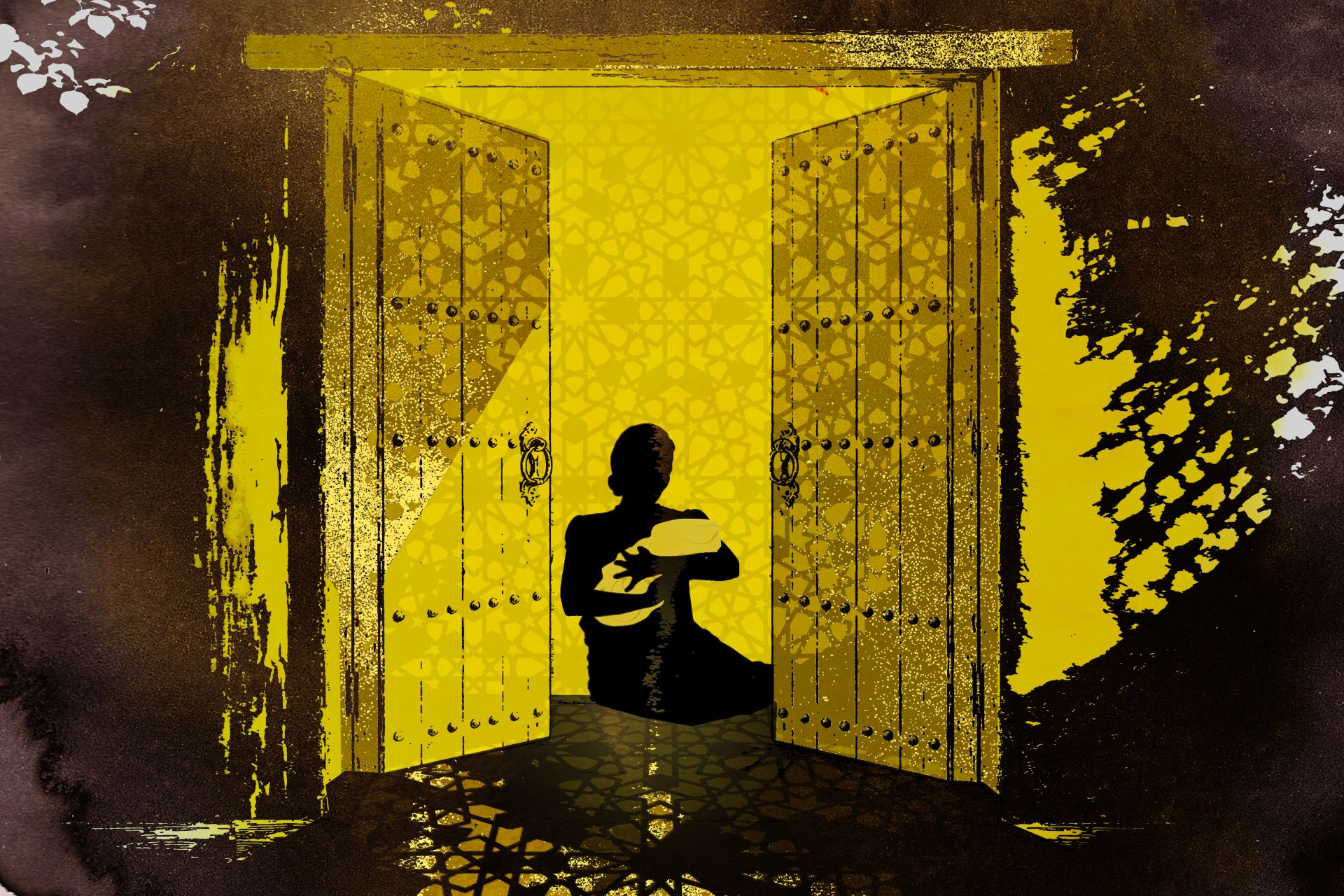
In Cordoba, certain families practice a unique ritual to bless their newborns. The women of the household cradle the baby behind the front door, away from prying eyes, and delicately clip the infant’s first nails while singing soft flamenco tunes. The nails are then carried to loved ones in a small wooden box, which relatives fill with money to bless the newborn.
On its own, the ritual could be dismissed as a local eccentricity, yet some see it as much more. Antonio Manuel, a 56-year-old poet, writer and law professor, first described the tradition to me. He has dedicated his life to studying the untold imprint that centuries of Muslim rule left on his birthplace. Crowds of Andalusians of all ages and backgrounds, curious about their own history, gather in long queues outside his conferences, which are always sold out. According to him, countless Andalusian traditions are an inheritance of al-Andalus, the name given to the 800 years of Muslim rule over the Iberian peninsula, and have accomplished the near-impossible feat of resisting 500 years of erasure.
A proud Cordobese, he knew the nail-cutting ritual would sound familiar to a North African like me. In my region of central Algeria, it is not the babies’ nails that are cut but their hair. It still is a common tradition, often performed alongside the sacrifice of a sheep, as part of a ceremony to bless newborns known as “aqiqah” across the Muslim world. Manuel did not see this as a coincidence. To him, this could be an example of survival, an echo of al-Andalus. He posits that the practice likely originated during that time and endured across centuries, with little twists that guaranteed it would escape the harsh scrutiny on offer in a country with a long history of suppression of anything outside Castilian-Christian norms. To him, such resemblances are an invitation to wonder how much history has survived beyond the threshold of documentation.
Cutting nails was more discreet than cutting hair: It would not raise any suspicion. He finds continuity also in the music: flamenco tunes would have replaced prayers. While highly contested, to him the “larilele” of these melodies are not meaningless syllables but the lingering trace of the long-forgotten invocation, “La ilaha illa Allah” (“There is no god but God”). Back home in Algeria, my family still celebrates with the front door practically open, to make sure neighbors join in. Cordobese families keep the front door closed to this day, as if they were protecting a clandestine ritual from the ghosts of the inquisitors.
Could intimate, almost unnoticed gestures be unknown relics of al-Andalus? Could family rituals rewrite Spanish narratives of history? A growing movement in Andalusia seems to think so. The Spanish far right has been reviving the mythology surrounding the “Reconquista” — the “Reconquest,” a much-debated term for the series of medieval military campaigns by northern Iberian Christian states against the Muslim-ruled south. Yet there has been a pushback against their presentation of Spain as removed from its Andalusi past and the xenophobic policies that accompany it. Writers, activists, nongovernmental organizations and academics have proposed that Andalusian, and by extension Spanish, identity was not something that began in 1492 with the fall of Granada and the end of al-Andalus, but part of an uninterrupted continuum. In this vision, Andalusia, as the rightful heir of al-Andalus, needs to honor its history of openness and its world-famous, if perhaps overstated, coexistence between religious groups.
For this movement, everyday gestures and stories form an oral archive that connects present-day Andalusians with their past. It emphasizes family memory, though notoriously murky when used as historical evidence, as part of history itself. It helps us rethink and enrich our view of the past, even if informal and contested. Al-Andalus, in this narrative, did not leave the Iberian peninsula with the last Nasrid ruler; it is linked to the land and remains a living part of today’s culture, the proof of a multilayered past.
Antonio Manuel, who told us about nail-cutting in Cordoba, is a leading voice in this movement connecting the threads to al-Andalus. For him, it all started with questioning what he saw as family traditions whose meaning had been lost. “It all began because I wanted to know who I am,” he recalls, “When I was a child and Christmas came, my grandmother Rosario would prepare a batch of special sweets and place them outside our open front door. When I would try to sneak one, she’d tap on my hand to stop me, ‘No, do not eat these. You have to eat those I made for our home.’” She had learned that habit from her mother, who learned it from her mother before that.
Years later, Manuel noticed a crucial difference between the sweets: Those for his family were made with olive oil, while those left out in front of the door were made with pork lard. “Did my grandmother know why she had to keep the front door open? No. Did she know why sweets for the house had to be made with olive oil and those for the outside with pork? No, but she did it. As if there was an unconscious memory she was perpetuating.” When Manuel studied the history of Andalusia, the practice started to make sense to him. Publicly signaling that one eats pork while consuming a substitute in private is typical of crypto-Jewish and crypto-Muslim traditions, and many culinary habits in the region are a result of these practices.
For Manuel, recalling his grandmother’s gestures is a way to signal that his family history, and that of Andalusia, is more complex than the common orthodoxy allows. Rather than a monolithic Christian-Castilian belonging, they have plural origins, including Muslim and Jewish elements. He situates Andalusia within a Mediterranean context, as a region inherently connected to the other shore. “When you use that lens that takes into account Andalusi and ‘converso’ heritage [that of Jews who converted to Catholicism], suddenly you see the words, the gestures, the melodies, the flavors, the traditions are all full of both, and then you start understanding yourself.”
Though his work attracts numbers, he is also heavily criticized. Most criticism comes from right-wing groups, who outwardly reject the idea that Spain has any meaningful link to al-Andalus. Some often invoke a 2019 study by the University of Granada, which concluded that al-Andalus left little to no genetic imprint on the region. These arguments, however, unknowingly support Manuel’s position. To him, al-Andalus was an Iberian endeavor; most of its inhabitants were indigenous to the Peninsula, while those from North Africa or the Arab world remained within the elites. He dismisses these critiques as coming from those uncomfortable with a complex identity that challenges the national myth they were told. “Why would you be ready to accept that ‘azucar’ [sugar] and ‘almohada’ [pillow] come from Arabic, or that there is an old mosque over there, but anything more, no? Because anything more might destroy the story you have told yourself about who you are.”
These debates are far from new, and academics view them with more caution. “Since the 19th century, al-Andalus has been at the heart of debates about what it means to be Spanish,” explains Eric Calderwood, associate professor of comparative literature at the University of Illinois. “It has often been used as a helpful narrative to counterfoil a ‘Reconquista’ mode of understanding Spanish identity that would posit it as a monolith.”
Calderwood has been investigating the many narratives that have emerged around al-Andalus all over the world in his book “On Earth or In Poems.” According to him, the current revival of “Andalucista” identity is twofold. In post-Franco Spain, al-Andalus became a counternarrative to a nation-building effort that promoted a monolingual and monoethnic vision of Spain. More recently, it has responded to unresolved questions about Spanish identity and to broader discussions about European identity and the rise of the global right.
This revival, because it rests on family stories, has posed methodological issues for academics. While the intimacy of these family stories gives them power, it is also what complicates their use as historical evidence. Spanish historians have been reluctant to integrate oral history into their methodology, and a lot of these stories have not yet been formally examined. Even if sympathetic to this idea of a multicultural society, medievalists caution that memory is fragile and often context-dependent. It is almost impossible to conclusively trace these stories back to al-Andalus. How can we be sure that nails came to replace hair in a new converso version of aqiqah? What if Cordobese grandmothers perpetuated a habit of saving money from a time when olive oil was a luxury?
The difficulty of tracing these practices is not accidental. It is the result of deliberate historical conditions that started with the fall of Granada. These rites, whether Andalusi traditions subtly modified to survive or customs that emerged out of the ingenuity of conversos, would have needed to escape centuries of policies designed to ensure their erasure. Any tradition that survived did so through the veil of centuries of secrecy, often losing its meaning and origin along the way.
When Granada, the last stronghold of al-Andalus, fell in 1492, the new sovereigns imagined a kingdom unified by a single religion, Catholicism, and a single language, Castilian. What followed was a hunt for anyone and anything that was neither of the two. Jews were immediately expelled, and Islam was formally banned as early as 1502. Muslims had to choose: convert or leave. Revolts, most notably during the rebellion of the Alpujarras, a mountain range outside Granada, were brutally crushed, and the survivors sold into slavery. Those former Muslim communities that stayed on their land, the Moriscos, “little Moors” or “Moor-ish,” were seen with a suspicion reserved for potential enemies. So they were treated as such.
On Fridays, for Jumuah, and Saturdays, for Shabbat, Moriscos and conversos had to leave their door open to ensure they were not praying. Later, Arabic, henna and Moorish names were banned, followed by their music and dances. The Inquisition scrutinized the Moriscos for any sign that they retained their past identity. More than a century of suspicion culminated in King Philip III ordering the expulsion of all Moriscos from the kingdom in 1609. Some 350,000 men, women and children were removed from their homes and forced into exile.
Yet these extreme measures did not manage to fully erase the Morisco presence. The Inquisition continued to give out localized sentences against crypto-Jews and crypto-Muslims until the 18th century. In some remote villages, Morisco culture appears to have survived until the 20th century. The village of Riopar, nestled away between the hills of Sierra del Segura, just north of Andalusia’s border, is an uncanny example.
Joaquin Muñoz Garcia, recently retired, lives in Riopar, where he runs a bed-and-breakfast in his father-in-law’s home. Juan López González, who died in 1986, was a significant figure in the village, the last of his generation to practice peculiar traditions that were passed down from his family, who came from Granada in a distant past that he could not quite pinpoint. “My wife, Venerada, knew about these. I had no idea,” Joaquin recalls. “She told me because she realized that there was something different about them”.
González would kneel down outside with other elders, repeatedly putting his forehead to the ground. His daughter would hear him and her uncle quietly chanting from an ancient book that he would keep hidden in a beam, the word “Ala” coming back repeatedly in his prayers. He would also refer to the sun as “Muhama,” and punctuate the everyday with phrases in a language no one could quite understand, while always instructing his daughter not to repeat them outside.
He also officiated weddings. “He performed mine!” Joaquin says. “He’d make us kneel down and get up with the right foot to ensure blessings.” These practices were apparently common all over the region at the time of González’s parents. Venerada only started making sense of her father’s customs after noticing that a Moroccan colleague would use the same phrases as him. Yet when I asked Joaquin whether he thought his father-in-law’s traditions had anything to do with a Morisco past, he responded, puzzled, “What do you mean Morisco ways?” To him, they were this man’s family traditions, some kind of idiosyncratic faith, nothing else.
Riopar may seem like an enigma, yet in my three years in Andalusia, I have heard variations of this story everywhere: from older ladies at bus stops, lonely storytellers in the bars of mountain villages and youngsters at parties and coffee shops, in car shares to the beach and at mosques and churches. Some did not understand what their grandparents were doing, but for others the connection to al-Andalus was irrefutable, and often justified by an observation they had of someone of North African origin.
It seems that such stories have even crossed the Atlantic Ocean with the Moriscos. Medina Tenour Whiteman, a writer based in the Alpujarras mountains, the famous Morisco rebel stronghold outside Granada, collected similar accounts for her book “The Invisible Muslim.” She found examples as far afield as Latin America. This is not surprising, because Moriscos were sent to the continent as galley slaves. Some went on to become rich and powerful merchants, yet that status could not protect them from the wrath of the Inquisition. Many were burnt at the stake all over the continent on suspicion of “Judaizing,” often for rituals that had nothing to do with Judaism. These were often politically motivated executions.
Whiteman describes how Moriscos formed unique pockets of mestizo culture. “In Argentina, they were exempt from the laws around blood purity that prevented old Christians from marrying indigenous women.” This left a considerable imprint on the local food culture, but also family anecdotes, just like in Andalusia.
Whiteman recounts meeting a Chilean woman who started to learn more about Arabic and Islam in preparation for a job search in Dubai. “She noticed that some things were actually familiar to her. For example, her mother and particularly her maternal grandmother made her wash her hands and feet in the morning before eating and before going to bed,” Whiteman explained. “Before eating, she’d say ‘nombrado sea Dios,’ ‘may God be named’ which is not un-Christian to say, but that particular formulation is not common amongst Christians. You don’t hear people typically saying that; it sounds like a Hispanized version of ‘bismillah.’” That woman later found out that her grandmother had a Morisco name.
Back in Spain, local sites are making space for this history of persecution. In Hornachos, Extremadura, the “desbautizadero,” where Moriscos would wash off the Christian sacrament by immersing themselves in an isolated spring, is growing in popularity with visitors. The thin corridor carved into the mountain would fill with rainwater, its thick walls protecting the secrecy of the ritual. The site owes its fame not only to its cinematic setting but also to the sensational story of its Morisco community. Moriscos from the area fled to Morocco following their expulsion and founded the Republic of Sale. In a twist of vengeance the likes of which history rarely delivers, they became famous corsairs who terrorized Spanish ships laden with the riches of South America.
Memories of al-Andalus seem to punctuate life at a family or village level, yet public memory and official narratives have been far less generous in their acknowledgement. In the official memory, the grandiose monuments al-Andalus left behind are applauded. These were initially preserved as trophies of conquest, reminders of victory over a once-powerful civilization. Today, the Alhambra in Granada, with its heavenly gardens, and the Great Mosque of Cordoba, with its sea of arches, are a source of pride and considerable income with their millions of visitors.
But there is a reluctance to imagine that al-Andalus left much more than stones. In history textbooks across the country, al-Andalus is barely a couple of paragraphs and the expulsion of Moriscos just a line. For the average Spaniard, al-Andalus is something foreign, a long occupation that ended in 1492 with the “invaders” and their descendants leaving the peninsula.
Some elements are readily accepted. Roughly 8% of the total Spanish dictionary comes from Arabic, according to some estimates. This includes some expressions that hilariously carried their initial connotations through the centuries. In Andalusia, “cafre,” from “kafir” (the Arabic for “unbeliever”), is used for someone uncouth, while “mindundi,” from “min dun deen” (the Arabic for “without religion”), refers to a person of little significance or power. Culinary contributions, from most sweet recipes to serving customs, are also viewed, uncontroversially, as an inheritance of al-Andalus. The cocido, a stew that is a home staple in Spain, is a Sephardic dish in essence, with pork being a later addition.
There is still intense debate over the origin of folk traditions that are considered central to Andalusian identity. Anthropologists considered flamenco to come from Holland for years, even though the scales it uses are identical to those of Arabic music. The fervor and flamboyance of Andalusia’s religiosity, like the impressive parades of Semana Santa, the week leading up to Easter Sunday, are also dismissed as the result of a passionate “southern temperament.” In reality, they evolved as part of the Counter-Reformation and the Church’s efforts to embed its position within a majority population that came to Christianity by force.
Reclaiming al-Andalus was long a powerful anti-fascist stance. Blas Infante, father of Andalusian nationalism, and Federico García Lorca, one of Spain’s most important poets, were both fervent defenders of the living legacy of al-Andalus. Both were murdered in the same week by Franco’s forces.
“Except … it’s way messier than that,” Calderwood says, “Franco had an aggressive outreach to the Arab world that heavily mobilized the legacy of al-Andalus. … The practices that we imagine as leftist and resistant often have a fascist backstory as well.” To show that Spain, and more particularly his regime, were historic allies to the Muslim and Arab World, Franco developed an array of policies we would typically associate with a celebration of al-Andalus. He sponsored the pilgrimage of Moroccan Muslims to Mecca in the 1930s and invited Arab and Muslim dignitaries to Spain on guided tours that included praying in the mosque of Cordoba.
Invoking al-Andalus as a means to connect both sides of the Mediterranean is viewed as progressive today, and even as a way to fight the rise of the far right, yet it has a history of serving colonial purposes. “It’s very hard for me as a scholar to hear someone say that in the streets of Granada they feel like in Fes or Tetouan without hearing colonial discourse,” explains Calderwood. “Intellectuals of the Franco regime were interested in projecting the idea that Morocco was an Andalusi country and hence Spanish colonialism in Morocco was not colonialism at all but the celebration of Andalusi heritage.”
Celebrating al-Andalus is an inescapably messy endeavor and will remain so. Al-Andalus has been a favorite location for poets from Mahmoud Darwish to Nizar Qabbani. It has been central to Moroccan identity, the Syrian national project and is often invoked in ways that raise the eyebrows of medievalists. Calderwood encourages us to understand what al-Andalus means to those who invoke it. When someone speaks of al-Andalus, listen, because they are talking about themselves.
Become a member today to receive access to all our paywalled essays and the best of New Lines delivered to your inbox through our newsletters.