


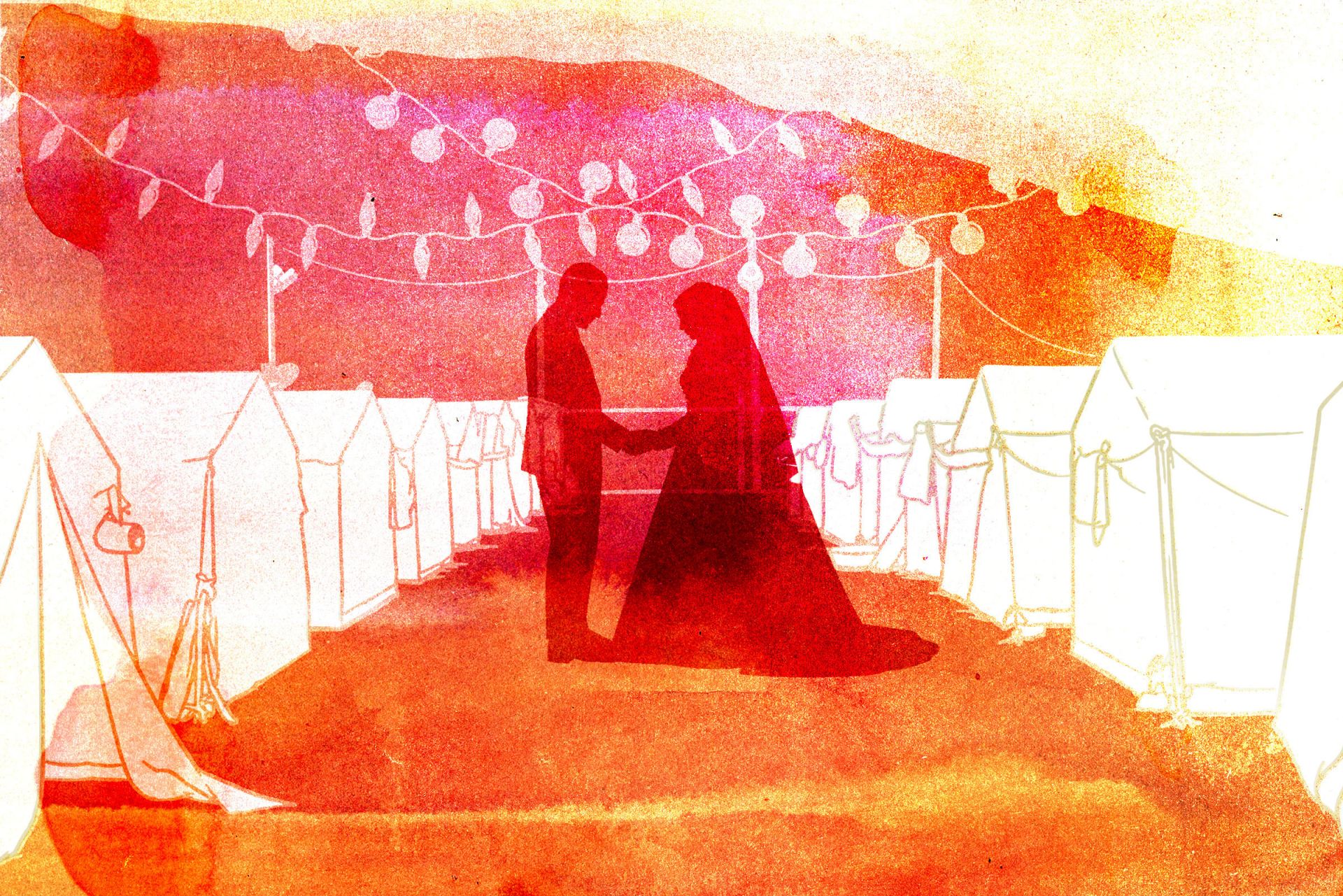
When I arrived at the wedding, the bride was not the first thing that caught my eye. It was the portrait of a young man killed in the war, hanging behind the spot where the bride and groom would stand just minutes later. No one had taken it down or tried to conceal it behind the white fabric draped as a simple backdrop for the ceremony. It remained in place, framed by a few artificial flowers, as guests settled into plastic chairs and children darted between the tents nearby.
In Gaza, joy no longer comes after mourning has ended. The two now exist side by side.
A few minutes later, the bride entered to the sound of ululations. There was no long procession of cars, no brightly lit wedding hall like those that once hosted celebrations across Gaza. Instead, the family had carved out a small space inside a displacement camp, trying, if only for a few hours, to make it feel different from the rows of tents surrounding it.
Halfway through the music, the speakers suddenly fell silent. It was not a power cut — Gaza has had virtually no electricity since the war began — but a drained battery powering the sound system. The celebration paused. For a brief moment, several guests instinctively looked up as the familiar buzz of an Israeli surveillance drone passed overhead. A few minutes later, one of the young men returned with another battery. The music resumed, and so did the ululations, as though these interruptions had become just another part of a Gaza wedding, no less familiar than the constant sound of drones.
Watching the scene unfold, I realized this wedding was unlike any I had known before the war. It was not only the setting that had changed. The meaning of celebration itself had been transformed.
Before the war, weddings in Gaza were planned months in advance. Families booked lavish wedding halls, prepared long guest lists and celebrated late into the night. If a close relative died, weddings were almost always postponed for months — sometimes for an entire year — in keeping with long-standing traditions of mourning passed down through generations.
Today, after nearly three years of war, those customs belong to a life that can no longer be afforded. Over the past several months, as I moved between displacement camps and devastated neighborhoods across Gaza, I kept encountering the same scene: weddings taking place despite relentless bombardment, despite repeated displacement, despite the fact that many of those celebrating had lost their homes — or the people they loved most.
At first, it felt almost contradictory. Why would people choose to marry while the war is still raging? How could a family celebrate the wedding of a son or daughter only months after burying someone they loved? But the more weddings I attended, and the more conversations I had with newlyweds, their parents and people working in Gaza’s wedding industry, the more I realized that the real question was no longer why people choose to marry during a war. It was why they would wait, when no one knows when the war — or their lives — might end.
Basel told me the war had taken everything he once believed was worth waiting for. Within months, he had lost all of his sisters. The family home was destroyed, and his mother, worn down by repeated displacement and loss, fell ill. The house he returned to no longer resembled the one he had grown up in, and the future he had imagined for himself had disappeared with it.
“I kept telling myself I’d wait until the war was over,” he told me. “Then I’d think about getting married. But the war kept going, and every day I felt like I was losing another piece of my life.” What weighed on him most, he said, was not only the destruction but the loneliness. “I missed the simplest things — coming home at the end of the day to find someone waiting for me, sitting with my family the way we used to before the war. After I lost my sisters, the silence inside the house became harder than anything else.” After months of living with that silence, he decided to get married.
His mother opposed the idea at first — not because the war was still raging, but because she had always imagined celebrating her son’s wedding the way mothers in Gaza traditionally did: in a home full of relatives, with a wedding hall, a henna night for the bride and the women, and all the rituals and traditions she had dreamed of sharing with him. Over time, however, she came to realize that waiting for that day might mean it would never come, and so she agreed, and the wedding went ahead with little of what she had once envisioned. Yet it gave her something she feared she might never have: the chance to see her son begin a new chapter of his life while she was still alive to witness it.
Basel’s story is far from unique. Nearly every person I interviewed described the same shift, even if they expressed it differently. No one spoke anymore about waiting for the “right time,” because the right time no longer seemed to exist. For many young Palestinians in Gaza, postponing marriage had become another way of postponing life itself — for a future no one could promise. “We always used to say we’d get married when the war was over,” one groom told me. “Then we realized we had no idea when that would be — or whether we’d still be alive to see it.”
Maryam’s story echoed the same reality. Her wedding had been scheduled just one week before the war began. She had nearly finished preparing everything. She had bought her wedding dress, furnished her future home and carefully planned a day she had imagined for years. Then the war started. Her family was displaced. Their home was destroyed, along with everything inside it — her clothes, furniture, gifts and even her wedding dress. “It wasn’t just the things I lost,” she told me. “It felt like the future I had been building collapsed overnight.”
For months, marriage was the last thing on her mind. She was simply trying to survive displacement, fear and the loss of any sense of stability. But as the war dragged on, she began to see things differently. “I kept telling myself that if I waited for life to return to what it used to be, I might never get married at all.”
Eventually, she and her fiance decided to go ahead with the wedding. The ceremony took place inside a displacement camp, in a modest space between rows of tents. There was no home waiting for her, no furniture she had spent months choosing before the war, no wedding dress she had once dreamed of wearing. But by then, she no longer measured a successful wedding by how perfect it was. What mattered was that it happened at all. Maryam was not trying to reclaim the life she had lost. She was trying to keep the war from deciding what the rest of her life would look like.
As I worked on this story, I came to understand that the war has not only transformed weddings in Gaza. It has transformed people’s relationship with time itself. Before the war, marriage followed a familiar sequence. People finished their education, found work, built or rented a home, saved enough money and only then began planning a wedding. Families often postponed marriages until those expectations had been met. But now no one has that luxury — the luxury of time.
I spoke with one mother who had lost several of her children during the war, yet hurried to arrange the marriage of her youngest son. She told me she had always dreamed, like any mother, of watching all of her children grow up, get married, and fill her home with grandchildren. The war had taken much of that dream away, but she was determined not to lose what remained.
“I want to celebrate his wedding while he’s still with me,” she said. “And, God willing, I’d like to live long enough to see his children.” Her words echoed what I heard from many parents. Marriage was no longer simply a social milestone; it had become a way of holding on to whatever future remained.
For some, like Basel, it was also a way of pushing back against the loneliness the war had left behind. After losing relatives, being separated from extended family or enduring years of displacement, building a new family came to mean something far greater than the union of two people. It became an attempt to reclaim a sense of ordinary life — to create a home again, even if that home was nothing more than a tent or a single rented room surrounded by destruction.
One mother laughed when I asked why she was so eager to marry off her son, who was still in his early 20s. “So I can register him for the gas distribution list,” she joked, referring to international aid available to families. Then, still smiling, she added something that revealed a harsher reality. “And once he has his own family, maybe he’ll qualify for more aid. What we’re receiving now simply isn’t enough.” She wasn’t entirely joking, it turned out.
As the war has dragged on and resources have become increasingly scarce, survival has begun to shape decisions that were once driven by very different considerations. For some families, marriage now also means establishing an independent household that may qualify for certain humanitarian assistance or public services available only to families — a reminder of how profoundly the war has reshaped even the meaning of starting a family.
And just as survival has become part of the calculation, the extreme need in Gaza has transformed celebrations. The grand wedding halls that once hosted hundreds of guests have largely disappeared, destroyed in the bombardment or rendered inaccessible. In their place are small celebrations held between rows of tents, in the courtyards of damaged homes, or in makeshift corners of displacement camps. Weddings no longer stretch late into the night, and the long wedding motorcades that once wound through Gaza’s streets have vanished. Weddings today are shorter, quieter and far less expensive. But they have not disappeared.
At one ceremony I attended, children ran between nearby tents while a group of young men fastened a white sheet to mark off the wedding space. Women sat shoulder to shoulder on plastic chairs as one carefully adjusted the bride’s veil. Nearby, a photographer carrying an aging camera searched for an angle that would hide as much of the surrounding destruction as possible. No one was trying to pretend the war wasn’t there. They were simply trying to give the bride at least one photograph she would want to remember.
Preparations that once took months are now compressed into days, sometimes even hours. Dowries for the bride have fallen dramatically. Many brides have abandoned altogether the traditional expectation of being gifted gold jewelry, often settling for a few modest pieces. Household furnishings have been reduced to the bare essentials — just enough to begin a life together.
Yet what struck me most was not how modest these weddings had become. It was the way entire communities came together to make them possible.
Sanaa was convinced her wedding would never happen. Her family had lost its source of income, and with each passing day, buying even the most basic wedding necessities seemed further out of reach. Little by little, the future she had imagined began to feel impossible.
Her neighbors had other plans. One woman brought her a pair of shoes. Another lent her makeup. A photographer volunteered to document the ceremony free of charge. Others helped prepare the venue, while relatives contributed whatever they could spare. Piece by piece, the wedding came together — not through the efforts of one family, but through the generosity of many. “No one had much,” Sanaa told me. “But everyone gave me something. It didn’t feel like it was only my wedding. It felt like everyone was celebrating with me.” In a war that has torn so many families apart, it has also forged new forms of solidarity among those who remain.
Weddings are no longer occasions to display wealth or social status. They have become moments in which communities demonstrate something else entirely: their determination to protect a small pocket of joy from the weight of war, if only for a few hours.
Perhaps the war’s deepest transformation, however, is not found in the weddings themselves, but in the way it has reshaped people’s understanding of mourning. Before the war, it was almost unthinkable for a wedding to take place shortly after the death of a close family member. Weddings were commonly postponed for months, sometimes even a full year, out of respect for mourning traditions that had long been woven into Gaza’s social fabric.
Today, that has become almost impossible. After nearly three years of war, few families have been spared loss. Almost everyone has buried a relative, a friend or a neighbor. If people waited for mourning to end before celebrating, life itself would remain suspended indefinitely.
One researcher I spoke with believes Palestinians in Gaza have not abandoned respect for the dead. Rather, they have been forced to redefine what it means to live alongside grief. The war, he said, has fundamentally changed people’s relationship with time. The future is no longer something that can be carefully planned for; it has become deeply uncertain. Under those conditions, postponing marriage, parenthood or any major life decision can feel like surrendering even more of one’s life to the war.
A religious scholar offered a similar perspective. Marriage, he argued, is no longer viewed as conflicting with mourning, but as an affirmation of life itself — particularly when death has become part of everyday existence. That is why it is no longer unusual to see photographs of those killed in the war displayed beside wedding decorations, or to hear ululations in a home that buried a son only months before.
One story, more than any other, has stayed with me. Ali was the sole survivor of his family after losing his parents and siblings in the war. For a long time, he lived alone, until he decided, as he put it, that he wanted to begin again. He became engaged to a young woman named Dana, and together they planned a modest wedding. It was nothing like the celebration they had imagined before the war, but it was enough to make them believe that life could still continue.
Dana bought her wedding dress. A few days before the ceremony, she left home to buy the last few things they needed. She never came back. She was killed in an Israeli airstrike before she ever had the chance to wear the dress. The dress remained, but the wedding never took place.
Ali’s story made me think not only about a wedding that never happened, but about thousands of young people in Gaza who continue to make plans for the future while knowing that the war could take it away at any moment.
Perhaps that is why marriage in Gaza is no longer simply a celebration marking the beginning of a new life. It has become a declaration that life, however diminished, is still worth living.
As I left the wedding where this story began, I looked one last time at the portrait behind the couple. No one had tried to hide the loss. No one had tried to ignore the joy. Both occupied the same space, as though Gaza had found, in the midst of an endless war, its own way of living with the impossible.
In a place where weddings were once postponed until mourning had passed, many families now celebrate because they no longer feel they can afford to wait. The war has not erased joy from Gaza, but it has redefined it.
Marriage is no longer simply a promise of a stable future. It has become a quiet act of defiance against uncertainty — a way of insisting that, however long the war lasts, it will not be the only force deciding how people live, or when they allow themselves to celebrate.
Become a member today to receive access to all our paywalled essays and the best of New Lines delivered to your inbox through our newsletters.