


“Till between the waters and the wind, came the marked-down derelicts with the dollar signs for eyes,” Nelson Algren wrote in his 1951 prose poem “Chicago: City on the Make.” “Looking for any prairie portage at all that hadn’t yet built a jail. Beside any old secondhand sea.”
As Algren signaled, the story of Chicago is the pursuit of profit at the portage — the convergence of land, waterway and human anchorage: a site of collisions between landscapes, governments and people from all over the globe. This history raises crucial questions: What do we retain from the breathtaking transformation of a prairie into an embodiment of industry, architecture, urban modernism and public landscaping? What great human and environmental ruptures occurred amid the astonishing material and economic convulsions that forged this city in a garden?
These questions are at the center of Ann Durkin Keating’s “Rising Up From Indian Country: The Battle of Fort Dearborn and the Birth of Chicago,” William Cronon’s “Nature’s Metropolis: Chicago and the Great West” and James Green’s “Death in the Haymarket: A Story of Chicago, the First Labor Movement and the Bombing That Divided Gilded Age America.” These historical studies help us make sense of Chicago today, as it stands at the threshold of artificial intelligence and under the boot of Immigration and Customs Enforcement (ICE). They tell a story of dramatic industrial upheaval, political realignments, labor conflict and environmental metamorphosis.
Like many stories in American history, this one begins with the expulsion of Native people.
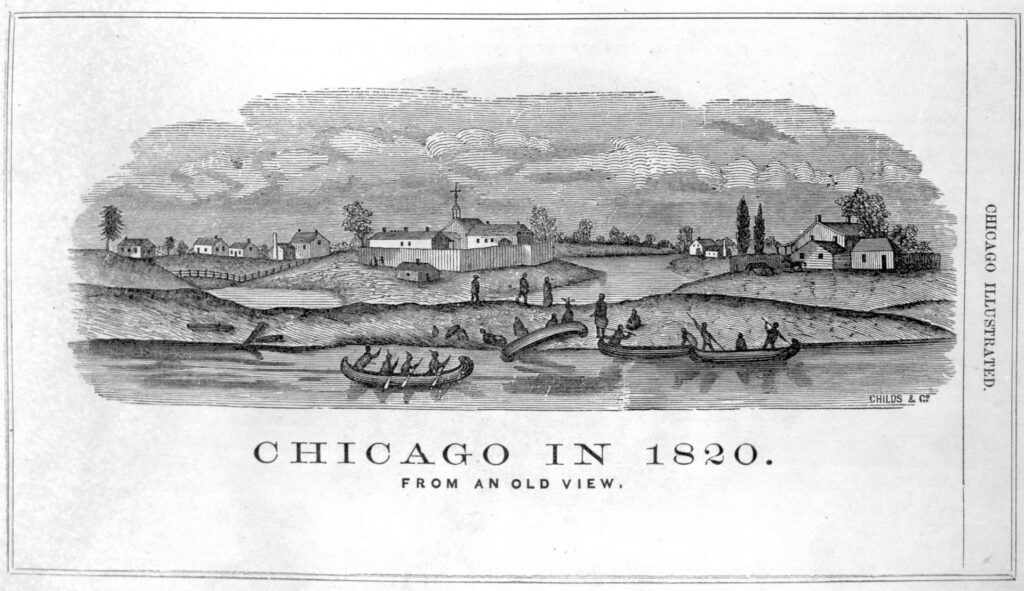
At the center of Keating’s 2012 book is “the transfer of the western Great Lakes from Indian to American control through a combination of treaties and military conquest.” Chicago as we know it today, she writes, “would not exist without this conquest and the end of the Indian Country in the western Great Lakes.” Her book examines how an outpost for hunting and trading on open land dominated by populous Indian nations, fur traders of European descent and their dual-heritage offspring turned into Chicago, the city that had become a juggernaut of global capitalism by the time it hosted the World’s Columbian Exposition in 1893.
The fur trader John Kinzie has been lionized as the white man whose family created a beachhead of civilization out of which an American city could develop. Keating’s reconsideration of Kinzie helps correct the “booster narrative of manifest destiny” — the idea that the United States is divinely destined to expand its dominion westward to the Pacific — attached to this man, who actually “hoped for a permanent Indian Country around Chicago where he could trade.” The study begins in 1763, using Kinzie’s life to structure a narrative of Great Lakes Native dominion that leads up to a violent confrontation just south of the city’s founding village, on through to the treaty of 1833 that yielded Chicago as an American town inside a more sharply demarcated United States. Keating uses this structure to great dramatic effect as tension builds up to a bloody ambush and then lessens as reprisals and conquest follow.
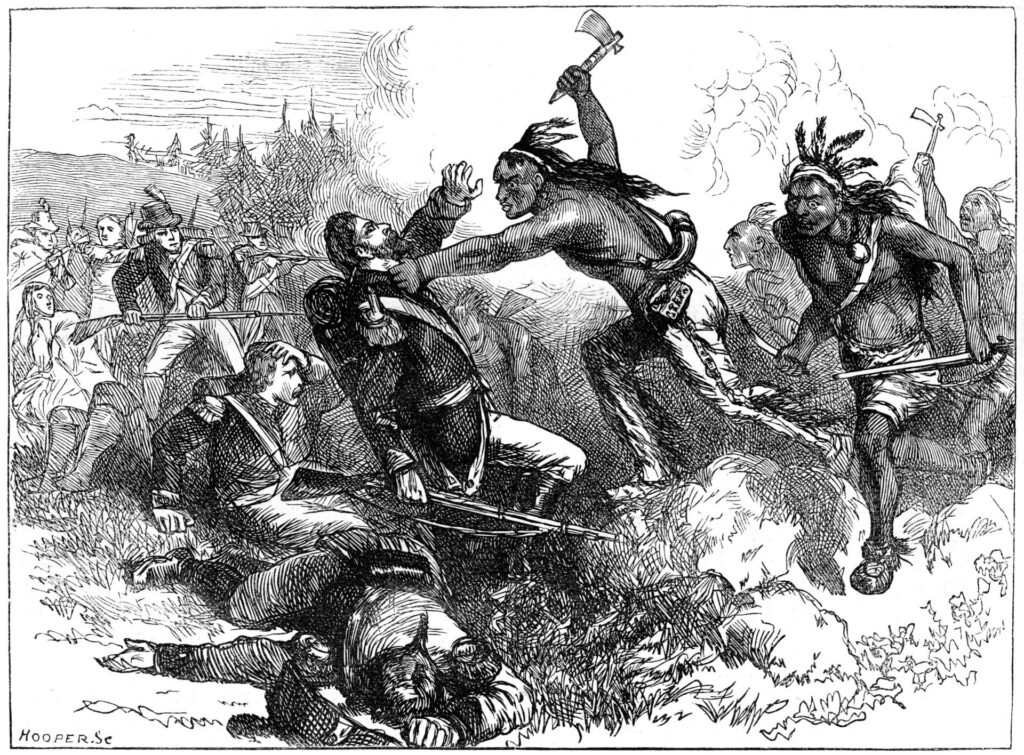
On Aug. 15, 1812, along Lake Michigan, just south of the city’s present-day center, Kinzie’s hopes were quashed when Potawatomi Indians ambushed a retreating detachment of 56 soldiers and settlers (including women and children) from Fort Dearborn, a remote federal fortification established in 1803 at today’s Michigan Avenue and Wacker Drive. Less than half of the retreating group survived, and prisoners were taken, touching off more confrontations that would end with Native expulsion. The War of 1812 furthered competition and conflict in the Great Lakes, eventually upsetting a transitory peace for Native, European and “metis” (mixed-race) people who populated the region, forcing imperial lines to be drawn across the relatively free and open country. If not for global rivalry between Spain, Britain, France and the U.S. over the continent and its resources, Kinzie could have lived in peace near the mouth of the Chicago River among the multilingual mixed-race peoples of the prairie, the different groups subsisting off the land and each other.
But the events at Fort Dearborn were cast as a “massacre” that became “a rallying cry for raising support for the War of 1812, especially for recruiting volunteers for western militia units,” per Keating. In the aftermath, from 1815 to 1833, the Potawatomis would give up 5 million acres of their land to the U.S., agreeing to move west of the Mississippi.
Keating describes Kinzie as a “reluctant American”: born in Quebec City and automatically assigned U.S. citizenship per the treaty between the U.S. and Britain on territorial dominion. This provides a way of thinking about Chicago even now, as global developments beyond the city and harsh federal enforcement of immigration law force its inhabitants closer together, with this boisterously diverse place as a unifying, rallying point of identity that now feels fiercely local, more neighborhood “us” than national “them.” Central to Keating’s argument and to this moment, we can reimagine a founding of Chicago that isn’t just a simple story of manifest destiny and expropriation. “Chicago’s foundation rests in this era of multi-racial, multi-ethnic communities buffeted by international rivalries and competing visions for the future,” she writes.
The very personal relationships among Native Americans and European traders and settlers are the linchpin of this story, which is also broader — continental and global — with conflicting loyalties and motivations permeating fluid cultures that adapted and evolved together. The founding village at the mouth of the Chicago River was populated not only by the French-Haitian pioneer trader Jean Baptiste Point du Sable — Chicago’s first permanent settler — but also by “metis” and Europeans. Connected to the various nations in the Great Lakes through similar relationships, they formed a coherent community. This is still the stuff of Chicago today.
Was the story of Indian Country Chicago one of displacement on the march toward a striving metropolis? In contrast to Keating, the environmental historian William Cronon decenters people in favor of a focus on the natural environment, material resources, market forces and economic feedback loops between the established East, Western lands and an upstart city called Chicago.
“Frontier and metropolis turn out to be two sides of the same coin,” Cronon writes in his landmark “Nature’s Metropolis.” Put simply, capital back East helped create remote hinterlands in a loop of production and consumption, and Chicago became a gateway city, superseding St. Louis and fueling the transformation of the continental Great West as it became a source of raw materials, labor and customers. The 19th century, Cronon clarifies, “saw the creation of an integrated economy that bound city and country into a powerful national and international market that forever altered human relationships to the American land.” In this view, it is natural resources and economic exchange, not the intensely interpersonal relationships chronicled by Keating, that drive history.
Cronon’s story begins with a prologue set under a foul, toxic veil of late 19th-century factory smoke, mixed with the stockyard stench of animal slaughter, cloaking a “Dark City.” To the casual observer, the polluted air is also indicative of moral rot, like a “black halo.” It’s a story told in many other literary and historical contexts — for example, in “Constructing Chicago,” the historian Daniel Bluestone notes that visions of Chicago in the 19th century “depended in part on where one stood among the economic classes but also upon where one stood and traveled in the city itself. … Thus, descriptive literature on Chicago revealed alternately one of the most beautiful American cities and one of the most ugly.”
This is still true today. But Cronon questions and challenges this dichotomy and others — city versus country, the natural versus human worlds — on the way to his larger argument. Truly, says Cronon, this imagined divide speaks more to cultural notions about the transit from innocence to experience, among other literary tropes and touchstones that have been used to contrast rural with urban. He poses the related question: “At what moment, exactly, did the city of Chicago cease to be part of nature?”
Focused on the second half of the 19th century, Cronon sees Chicago as a place blessed with great natural riches, evidenced by the massively profitable extraction of distribution routes, products and technological advancements from the earth. Understanding the city as its ecology begins with recognizing Chicago’s geographical gifts: fertile land and a strategic location at a nexus of rivers and a lake (a very large one, itself part of an interconnected system of lakes). Cronon traces “the path between an urban market and the natural systems that supply it”; these narratives of grain, lumber and meat are meant to be “parables for our own lives as well,” referencing the tight coils of material resources, market forces, consumption and labor that pull Chicago together and link it to the rest of the world.
Cronon describes Chicago’s original natural riches and rapid development after 1833 as based first on speculative land sales and the wager that people would want to come and live, work and buy stuff in a cold wetland of unpaved streets, rope-drawn ferries and roaming wolves. In this case, frontier growth began with betting that a city would happen (contrary to historian Frederick Jackson Turner’s influential “frontier thesis,” which held that America’s westward expansion across a rugged continent forged the individualism, self-reliance and restless energy that would come to define the country’s “national character.”) Chicago was not the end of the frontier but a beginning, and eventually the betting sure did pay off, but not without a lot of imaginative sales boosting that the prairie would yield payload and reach the heights of the great cities of antiquity.
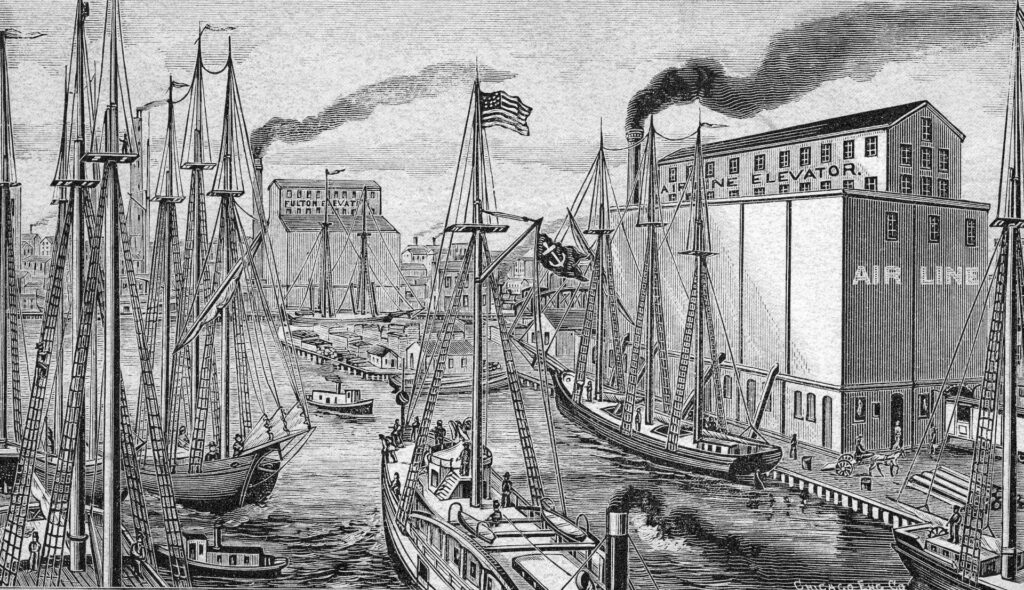
Cronon explores the forging of portages, train roads, canals, and the links to raw materials and routes to market. He chronicles the shipping of grain, the creation of mechanical harvester and elevator technology, the establishment of the Chicago Board of Trade in 1848, and the selling of grain futures that led to the city becoming a vital center in global commodities pricing. He goes on to examine lumber and meat production, shipping, storage and subsequent technologies that expanded these markets. Cronon makes great use of railroad archives, sales receipts, shipping and packing records and reports of bankruptcies that illuminate the vast network of forces and interests powering Chicago’s rise.
He concludes with the World’s Columbian Exposition (also known as the Chicago World’s Fair) of 1893 and the apotheosis of Chicago as the “White City” (in contrast to the dark place where the book starts). Despite its depersonalized account of markets, in this book we do come back around to extensive human connections and debts — to the nonhuman and natural worlds as well as to each other. The annihilation of space in modernity means that we are more directly connected than we might think to the land and to those who do the work of extracting its riches.
But, as Cronon puts it, “What now most strikes me about my urban home is how easily it obscures from me the very systems that enable me to survive.” Doing “justice” to both city and country, Cronon says, requires accepting “our moral responsibility for the ways they shape each other’s landscapes and alter the lives of people and organisms within their bounds.” Ultimately, he suggests that this disconnection has led to deforestation, species extinction, unsustainable resource extraction and habitat destruction — ongoing consequences of economic development to create more of what is wanted out of Chicago, by its inhabitants and the world.
James Green’s “Death in the Haymarket” also takes us back to the late 19th century and a time when laborers in the sprawling lumberyards and mills could still see prairie grass off in the distance, a vantage point from which we can observe the emergence of a toxic industrial hellscape out of the lake lands. Like Keating, Green introduces us to an intricate web of human relationships focused largely on the laborers, bosses, organizers, factory magnates, monied classes, socialist and anarchist activists, public and private police, worker militias, journalists and general street populace that experienced “the biggest news story since Lincoln’s assassination twenty-one years earlier.”
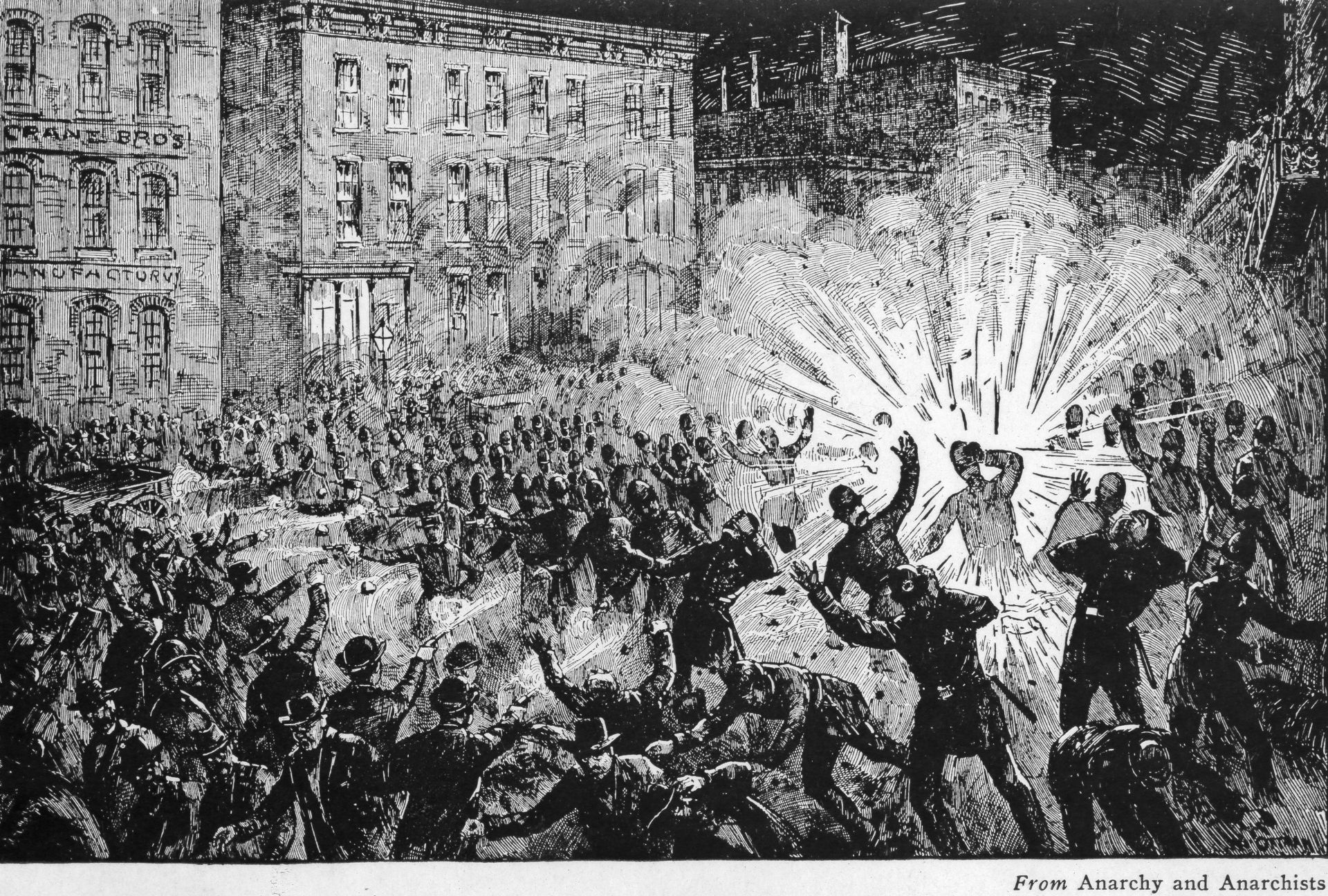
Green likewise builds his story around escalating action, in this case the development of unions and major labor uprisings after the Civil War (largely focused on the fight for an eight-hour workday) through to the citywide strikes of May Day and clashes on the evening of May 4, 1886: a “night of terror” at Haymarket Square on the near West Side, when police moved to disperse a labor rally at which a bomb was thrown, initiating a shootout and the death of seven officers. The aftermath consisted of the investigation, prosecution and execution of the alleged perpetrators (convicted with no proof or identification of the actual bomber), as well as the event’s legacy for the city of Chicago. The events of May 4 — the “Haymarket Affair,” as it came to be known — inspired a national backlash against the labor movement, discrediting and defeating many worker and ethnic groups as well as their alternative visions of how to structure society and its political economy fairly for all.
One could say that Kinzie and his mixed-race people of the late 18th- and early 19th-century Indian Country wanted the same thing as the anarchist elements of 1886: freedom from nation-state capitalism and a life outside the grinding logic of markets, factories and the overarching, never-ending power of a global capitalist agenda. Green makes us aware of the competing concerns, political philosophies and powerful interests behind various groups of actors, largely through the nascent public opinion to be found not only in diverse city newspapers of the day but also in ethnic and labor publications, given workers’ roots in Germany, Hungary and throughout Central and Eastern Europe. This marketplace of ideas shaped perceptions of the Haymarket incident and its aftermath, with Joseph Medill’s Chicago Daily Tribune creating “a governing narrative for the city’s propertied classes and for the state’s attorney who would prosecute the alleged perpetrators.” Emergent mass communication helped inform and shape reactions, posit competing narratives and foment debates — as well as fuel “fantastic rumors” and “wild exaggerations.” Green sorts through daily newspapers of record as well as worker and ethnic screeds, in addition to court proceedings and secondary sources.
Green argues that the Haymarket event “marked a juncture in our history” when radicals and reformers were painted as violent, and that the consequences eventually included the federal government expanding its power to deport undesirable foreigners and restrict organizing, specifically targeting immigrants and labor activists. By 1920, “nearly every repressive measure called for during the post-Haymarket red scare had become federal law,” and Green sums up by saying that the bombing inaugurated “fifty years of recurrent industrial violence, a period when workers, especially immigrants, often found themselves at war with their employers, the courts, the police and the armed forces of their own government.” He calls it nothing less than a “catastrophe” for subsequent mainstream labor organizers trying to move forward.
It’s the kind of catastrophe one can imagine emerging from our recent street skirmishes between protesters and ICE agents dispatched to Chicago purposely to provoke exactly the kind of response that invites a violent display of authority. This is the continuing legacy of a city powered by immigrant labor still fighting for a better day. Per Green, the Haymarket violence fed “a long-lasting popular impression of the immigrant as a dangerous figure, somehow more menacing than even the most violent American.” Yesterday’s backlash against ethnic Europeans remains a lesson for today’s flash points around a labor force now largely from the Global South.
And yet the pursuit of “profitable portage” continues, with designs to refurbish what has become abandoned postindustrial detritus. As the news outlet Block Club Chicago reported in December, “Where the mouth of the Calumet River meets Lake Michigan on Chicago’s Southeast Side is an abandoned lakefront parcel where one of the world’s largest steel mills [U.S. Steel South Works] once operated.” If all goes as planned, “a leap forward” will see the land “transformed into the first industrial park in the country to focus on developing quantum computing, a much more powerful technology than conventional computing.”
Using language that parallels the original boosters of Chicago, who wagered on the birth of a rich metropolis before a city even existed, reporters also quote one stakeholder: “‘The steel that was used there helped build this country, and now we’re looking at a sector that will help change humanity and answer the most difficult problems that life has to offer,’ said Peter Chico, the city’s 10th Ward alderman.” Nevertheless, activists and neighbors have questions about likely environmental impacts, specifically the allocation and possible pollution of water, echoing concerns from across the ages that urban development not come at the cost of the natural world in which we must live, breathe and thrive.
Cronon reminds us that, from the beginning of Chicago, “Boosters sought to make their visions come true by conveying just this certainty to investors and merchants … that climate, soils, vegetation, transportation routes, and other features of the landscape all pointed toward key locations that nature had designated for urban greatness.” That certainty persists, as do the challenges and questions we continue to face at a moment of electoral realignment and political strife, of tipping points in the environment, technology and the economy. Keating, Cronon and Green have much to say about parallel moments in our history that are worth considering now, as we seek a better tomorrow.
Become a member today to receive access to all our paywalled essays and the best of New Lines delivered to your inbox through our newsletters.