


In Paris, the history of France’s resistance to the Nazi occupation is omnipresent — the heroics and horrors of World War II are folded into street names, plaques, school curricula and a certain moral comfort that comes from believing the worst has already happened.
Before becoming a journalist, I trained here as a historian of the Resistance. I studied the German invasion of France in the summer of 1940, the collaborationist zeal of the puppet French government set up in the central town of Vichy, and the part French citizens played in deporting their neighbors, as well as those who resisted such efforts. Early on, I learned to distrust stories that cast the French Resistance as unified, heroic or inevitable. Resistance, I was taught, was not an identity or a personality trait but a set of choices made under pressure, often by ordinary people who did not think of themselves as brave and who rarely knew, in the moment, whether what they were doing would matter.
I never expected to have to think about those lessons again so urgently and so personally — not as history, but as method.
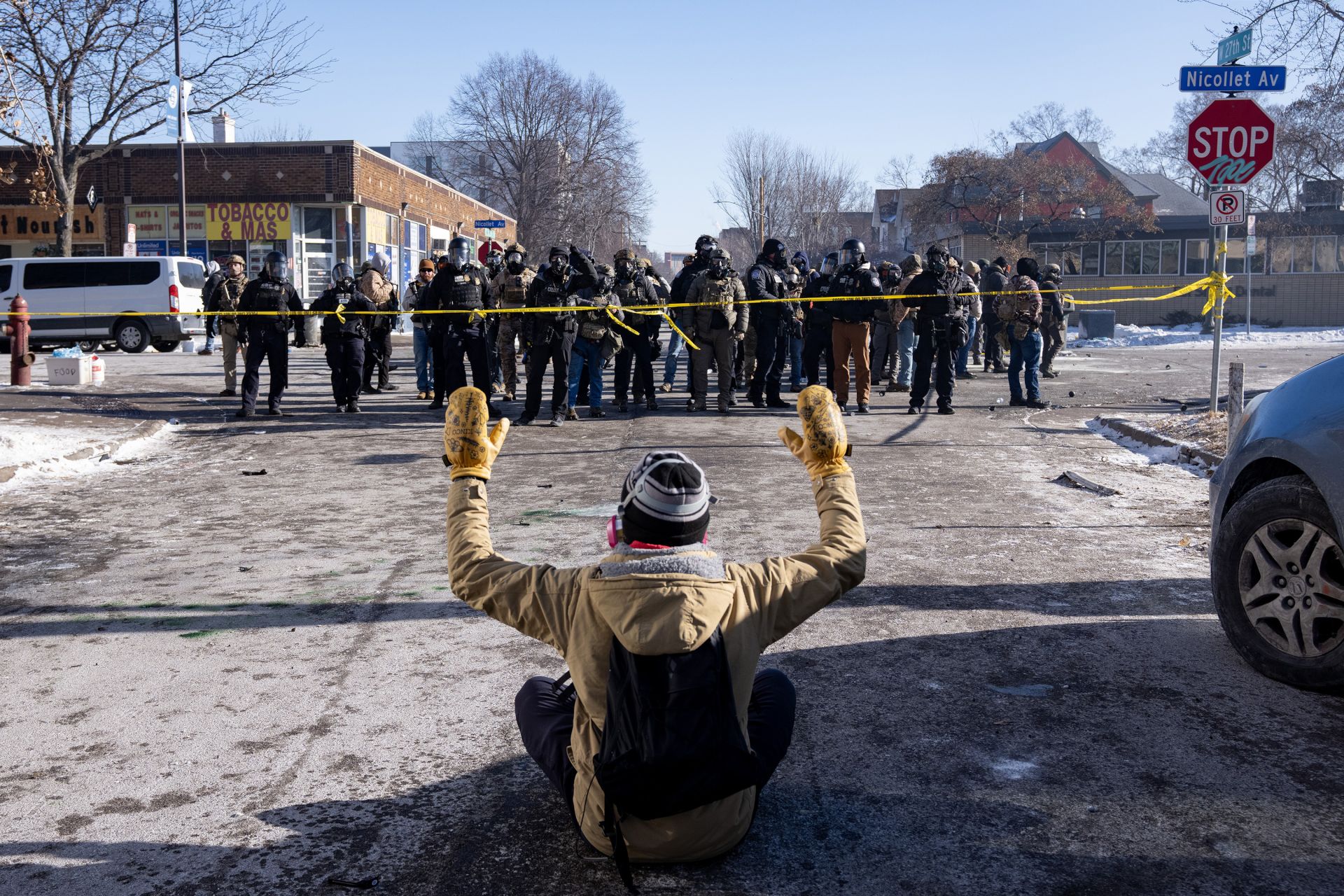
Though New York is the place in the United States that I called home for 10 years, I have many loved ones in Minnesota’s Twin Cities: My partner’s family emigrated there from Sweden four generations ago. And said partner — fellow New Lines contributor Phineas Rueckert — is currently reporting on the ground in Minneapolis, where, since December 2025, the Trump administration has sent a surge of 2,000 Immigration and Customs Enforcement (ICE) agents and some 1,000 Customs and Border Protection (CBP) officers, with the stated purpose of apprehending and deporting “the worst of the worst” undocumented immigrants. This week, Minnesota Attorney General Keith Ellison likened the surge to a “federal invasion.”
In a text message from New York, a few days before he left for Minneapolis, Phineas confided: “For weeks, the first thing I see before going to bed and after waking up is videos of snow. The Minnesota snow I’ve known all my life. But these videos are all of Renée Good being shot in the head, and that snow is covered in blood.”
Alone in our Paris apartment, I scroll through endless filmed accounts of federal occupation and civilian resistance in my loved ones’ hometown. I read about immigrant families going into hiding, about neighbors putting themselves at risk to defend strangers, but also volunteering to walk their dogs, take their clothes to the laundromat or shuttle their kids to school. I see Americans putting together a protest that is massive, even by French standards, and organizing the first general strike in the United States in 80 years, which had thousands statewide walking out of work and into the streets in subzero temperatures, with hundreds of businesses across Minnesota closed in solidarity. I watch U.S. citizens die, watch videos of what many have described as executions circulate the way I imagine clandestine newspapers once passed from hand to hand.
Historians don’t like to make such comparisons. Because I speak to them for a living, I would never ask them to compare Minneapolis to WWII France. But I know I can ask them to draw some parallels and share some lessons from that chapter, when Vichy’s militia of French citizens was sent to quell Resistance activity and help deport “undesirable elements” — French Jews who’d lost their citizenship, foreign Jews, communists — first to camps across France, then to Germany or to Poland. They, too, had quotas.
As I spend several days speaking with an array of historians who have devoted their careers to understanding what made resistance efforts successful, I don’t ask them whether we are living through another 1940. Rather, I ask them what resistance looked like when it worked best — and what it might teach us about the current moment in the United States.
They tell me how networks formed, how trust was built, how truth survived under censorship, how people decided what risks to take — and what risks not to take. What emerges from these conversations is not a ready-made script for the present but, rather, a set of hard-earned lessons about resistance, not as myth but as a lived, organized practice that several of them believe could be applied to Minneapolis.
Historian Géraud Létang, who teaches at the Army War College in Paris, is initially reluctant to draw parallels between the current moment and the period he studies. In the present-day United States, he says, unlike in occupied France, authoritarianism does not stem from military defeat.
“Nonetheless,” Létang concedes, “the lesson of the Resistance was that the fight for freedom is inseparable from the defense of truth.” The war waged by Trump against truth, he warns, is the primary threat to liberty.
The Trump administration’s loose relationship with the truth has taken a dark turn during the ICE operation in Minnesota. In the wake of their deaths at the hands of federal agents, Renée Good and Alex Pretti alike were labeled “domestic terrorists” by the Department of Homeland Security and said to have endangered federal officers. Much of the narrative has attempted to turn victims into villains and to blame them for their own deaths. The Minnesota Reformer documented an ICE agent telling observers: “You guys gotta stop obstructing us — that’s why that lesbian bitch is dead,” referring to Good. After blocking the investigation into her killing by ICE agent Jonathan E. Ross, the federal government instead launched an investigation into Good’s widow.
In WWII France, the collaborationist Vichy regime consistently denounced Resistance fighters as terrorists, threatened their families and attempted to turn the population against them through reprisals on civilian hostages. Throughout the war, truth was consistently warped by censorship, propaganda and the constant rewriting of reality. The victims of deportation raids, much like undocumented immigrants in Trump’s America, were systematically dehumanized and said to be at odds with the safety and well-being of French citizens.
For political action to function under occupation, Létang explains, the first step is refusing to let these lies go unchallenged.
Robert Pike, a Welsh doctoral student at the University of Cardiff and author of the book “Defying Vichy: Blood, Fear and French Resistance,” stresses that the most hard-hitting, most effective way of resisting was to “get real information out.” At the time, the French syndicated press was so biased that a jeer soon spread across the country: “Radio Paris lies, Radio Paris is German!” Many French households chose to tune into the BBC and Radio Londres instead, where French men and women exiled in London told a version closer to the truth. Pike, whose focus is rural resistance in southwest France, tells me: “Listening to the BBC was illegal, but having a clandestine press was key: It meant that even the chaps in remote villages found out that, despite what Vichy was printing and broadcasting, the Germans weren’t actually winning the war.”
In the 1940s, the underground press anchored communities in a shared reality. In Minneapolis, that anchor is the smartphone. We know that Good and Pretti were by no means the first to die at the hands of the federal government, that they were but two of at least eight deaths related to federal immigration law enforcement in the U.S. since September 2025 — not counting the 32 others who died in detention. But unlike these other deaths, Good and Pretti happened to be white U.S. citizens, and their deaths happened to be filmed. The videos of their deaths created a shared reality which, despite the administration’s attempts to distort it, seems to have spread resistance efforts well beyond the initial ICE Watch groups that sprang into action when the surge began.
In Minneapolis, Phineas reports that Signal chats pump out real-time information about raids and ICE patrolling activity. A flood of national and international media has descended upon the Twin Cities, livestreaming, posting and reporting not just Good and Pretti’s deaths, but the everyday violence of enforcement actions and immigration court. Small, scrappy Minnesota newsrooms like that of the Minnesota Reformer and the Sahan Journal, a nonprofit newsroom dedicated to covering immigrants and communities of color, work shifts to cover the news for their communities and have suddenly become vital to readers far beyond their reporting backyards.
A common myth about the French Resistance is that it was a mass phenomenon. In reality, as historian Robert Gildea reminds me, resistance networks were small and fragmented, and often began among people who were “marginal or dissatisfied or rebellious or already on the run.”
Gildea, an emeritus professor at the University of Oxford and author of the book “Fighters in the Shadows: A New History of the French Resistance,” tells me that many of those who got involved in resistance activity in the early days could do so because they had preexisting networks and underground expertise that the rest of the population did not.
By way of example, he points me to his colleague Julian Jackson’s research on homosexuals in the Resistance. “It may be,” Jackson wrote, “that the experience of living a double life could have been easier for homosexuals; that homosexuals might have been especially subjected to alienation by Vichy’s moralism … that having already broken with a convention, they might have found it easier to break with another.”
This is a reality very much at play in the Minneapolis queer community, which is particularly implanted in south Minneapolis, where much of the ICE activity has taken place and where Good was killed. A friend of Good’s widow told NBC News that the couple had recently moved to Minneapolis from Canada, after having left Missouri in the wake of Trump’s 2024 election. In Minneapolis, they and their son finally found peace and safe harbor, her widow, Becca Good, said in a statement to Minnesota Public Radio. They found a vibrant and welcoming community and a “strong shared sense here in Minneapolis that we were looking out for each other.” This is what compelled the Goods to stop during an ICE operation in south Minneapolis on Jan. 7. “We had whistles,” Becca Good said. “They had guns.”
Minneapolis’ rapid mobilization owes much to groundwork laid years before the current escalation. Many of the networks now mobilizing against ICE raids were first forged in the aftermath of George Floyd’s murder in 2020. Mutual aid kitchens, jail support teams, street medics, legal observers — structures built for an earlier crisis — never fully disappeared. They merely adapted once new threats arrived.
If anything, the solidarity networks have been too successful, one source told Phineas over lunch at the Modern Times Cafe in South Minneapolis this week. Rechristened “(Post) Modern Times” until the end of the occupation, the restaurant has been giving away food for free and accepting payment on a donation basis, with some proceeds going to neighborhood solidarity funds. He said another cafe he goes to has had trouble giving away food donations fast enough.
Pike, at Cardiff University, speaks of “kernels of resistance.” His research focuses on villages in the Dordogne region of France, where he says resistance efforts began earlier than in larger towns — not because villagers were braver, he tells me, but because they already knew one another and could rely on the local “village structures.” Pike found that such preexisting structures — labor unions, networks of friends, municipal councils — meant that people who were already meeting before the war, when suddenly linked by a shared goal, could more easily organize.
Minneapolis is not a Dordogne village — but it is a much smaller city than Chicago or Los Angeles, recently targets of similar ICE raids, and neighbors know each other much better. Indeed, as Adam Serwer writes in The Atlantic, “If the Minnesota resistance has an overarching ideology, you could call it ‘neighborism.’”
In The New Republic, Ana Marie Cox explains that “this decency is mirrored in a dozen other Minnesota mutual-aid traditions: Lutheran churches seeded what has become the largest refugee population per capita in the United States. Minnesota has had a labor organizing movement since before it became a state. Minnesota created the first high-risk pool in the country to insure ‘the uninsurable’ in 1976.”
On the ground, Phineas tells me that, across the city, groups that were once just ways for people to connect to their communities — book clubs, playdate groups, school Facebook chats — have also evolved into networks of solidarity, even if they have little or no organizing experience. “The fact that these groups existed before Operation Metro Surge began in December and that they’re so horizontal means that they’re harder for federal authorities to infiltrate,” he explains.
Despite Minnesotans’ long tradition of mutual aid, Phineas feels that the recent ICE surge has forced them to “close ranks” a bit. The vetting process to join new groups, he says, is pretty thorough: “In other cities, vetting questions have more to do with ideology and politics, but in Minneapolis, what they’re looking for is proof you’re embedded in the community.” Sign-up forms ask neighborhood-specific questions whose answers cannot be found online. Some even require proof of address. As a result, mobilization cuts across class and racial lines to an even greater extent than in the summer of 2020.
In the small and tight-knit communities of Dordogne, Pike explains, politics mattered less than what he calls “knowing your people.” This was particularly important when dealing with the Special Operations Executive (SOE) — the British-led organization that sent agents to occupied France and Europe to carry out espionage, sabotage and reconnaissance, as well as to aid local resistance movements. In Siorac, one of the villages he looks at, Pike says that local Resistance leader Robert Brouillet, who took on the code name “Charles Le Bolshevik,” told them: “I am a Bolshevik, if you can work with me, I can work with you.” Local politics may have mattered before the occupation, but when France fell, rejecting the occupier became the driving force.
In the last two decades, historians of the French Resistance have been particularly interested in what they call “unrecognized” or “invisible” resistance.
“Most resistance,” Pike tells me, “was administrative, relational and deliberately unspectacular.” He points to secretaries in town halls who altered paperwork so that Jewish families could be registered under different names or placed on school rolls without attracting attention, or to local politicians who refused to hand over information on their constituents. “They weren’t trying to overthrow the regime,” Pike says. “They were trying to make the machine malfunction.”
The overwhelming form of resistance in occupied France was not resistance that announced itself, but resistance that hid inside normality — because visibility, in most cases, meant arrest. The same logic is quietly at work in Minneapolis. As Francesca Donner beautifully put it in the online magazine The Persistent, “You don’t have to be the confrontation type to make a point. … Some will make sure there are sandwiches and water. Someone has to remember to bring the hand-warmers.”
Knowing the terrain better than the invader is central to successful resistance. Hand warmers and an ability to withstand the cold, forged across the generations, give Minnesotans an edge, especially when they use their harsh environment as a weapon — pouring water in front of ICE vehicles to freeze their path, throwing icy snowballs at them or, in a moment that traveled across the world, jeering at an agent who slipped and fell on an icy sidewalk loud enough that he retreated back to his car. As my mother-in-law (the epitome of “Minnesota nice”) put it, “Do you have any idea how evil you have to be to get a Minnesotan to make fun of you for slipping on ice?”
On the phone from Minneapolis, Phineas tells me many of the efforts he’s seen so far happen in the background, inside kitchens and cars, not at rallies. Some drive children to school when parents are afraid to leave their homes; they walk dogs for neighbors stuck inside; they keep spare phones charged for filming; they deliver groceries. Not everyone joins street demonstrations or ICE Watch patrols. He tells me about a toy store in Saint Paul where, on the coldest day of the year, people stood in line for hours not for children’s toys, but for “ICE out” lawn signs. Phineas met a 50-year-old man from the suburbs in line there, who told him that he and his wife had never “been involved in anything before,” and that this lawn sign was their very first act of protest.
Watching events unfold in Minneapolis, I’m struck by the centrality of women — of mothers in particular: organizing their neighbors, acting as observers, interrupting arrests and forcing agents to come back with warrants. From Paris, I read, for instance, about a group of women in Cedar-Riverside, a Minneapolis neighborhood home to the city’s largest Somali-American community, and among the first to be targeted. Known locally as the “Mamas of Cedar,” they have taken it upon themselves to make sure that fellow mothers and neighbors know what’s happening around them, and that no one is left without food, child care or support.
There’s a concept in Resistance history that Gildea — my former research supervisor — often brought up during my studies and that I’ve been thinking of a lot in the past few days: the “woman at the door.” It refers to the women sheltering prisoners of war, resisters or young men hiding from forced enlistment and deportation to work in Germany. Their role was to stand in doorways and try to assuage inquiries from Vichy and the Germans, or, if their network was discovered, to buy precious seconds for their charges to escape through back windows, absorbing risk so the rest of the group could survive.
Members of the invisible Resistance didn’t get medals or military pensions after France’s liberation. They went largely unrecognized until recently. But that division of labor made much of the Resistance’s underground work possible.
Toward the end of my interview with Pike, he mentions that, in the little villages of Dordogne his research focuses on, resistance sympathizers used to ring church bells and call ahead to post offices to warn the neighboring town of the Nazis’ approach. As he says this aloud, we are both immediately reminded of the sounds of the ICE Watch whistles we’ve all heard in videos from Minneapolis, Chicago, New York or LA. The emotion in Pike’s lilting Welsh accent as he takes in the parallel is unmistakable.
This calculus of survival was central to thwarting deportation efforts in wartime France. Laura Hobson Faure, a professor of modern history at Paris’ Pantheon-Sorbonne University, studies the rescue of Jewish children during that time. Her latest book, “Who Will Rescue Us?,” is the first study of the French branch of the Kindertransport — a rescue program to get Jewish children out of Germany and Austria. Through Kindertransport, 10,000 children were sent to the U.K. and another 1,000 to the U.S. She says fewer than 500 were sent to France.
When I ask her about the current deportation surge in her native United States — Hobson Faure is originally from Michigan — she says she doesn’t want to make a “facile comparison.” Deported immigrants in the United States are being sent to what many consider modern-day concentration camps, yes, but these are not the death camps of World War II. The questions she wants to ask instead are: “What can I learn from my research? What can I do?”
“If my book can give ideas,” she says, “I hope that it could help.” She goes on to tell me what she thinks people in her country could learn from the rescue of children in World War II.
“Up until the summer of 1942, when the deportations of Jewish children began in France,” Hobson Faure explains, “everyone assumed that these children were not in particular danger. But the Kindertransport initiative started years earlier, after the November 1938 pogrom known as Kristallnacht,” when Nazi leadership organized a coordinated series of violent, nationwide attacks against Jewish communities. So what her book is really looking at, she explains, is “the perception of danger, and how it differs according to the viewer.”
For rescue to occur, Hobson Faure argues, we need to perceive danger.
I ask her if she’s been reading the same stories I have about undocumented parents in Minneapolis and across the country getting paperwork ready to grant custody of their children to U.S. citizens if they get deported. She says she has. “I think the big fear that many people have right now,” she tells me, “is that when families are separated in the deportation process, parents will lose track of their children, who might be deported to different countries. So if granting custody to a U.S. citizen of a foreign child is something that could help keep that child from getting deported and keep that child in a safe place and on record where the parents could find them, I absolutely think that we should consider that.”
Hobson Faure then goes on to say that we should also start thinking about asylum programs outside the U.S. for targeted families, sooner rather than later. She adds that Americans abroad could also start thinking about how to help these families.
“We need to perceive the danger now, not later,” she concludes.
Every one of these lessons — about spreading information, building networks and securing early rescue — runs up against a reality that historians of the 1940s could scarcely have imagined 20 years ago.
Rescue in wartime France depended on opacity, on the ability to disappear into paper archives, remote villages and human memory. Files could be altered because they were physical. Network members communicated in person or by leaving coded messages between the pages of books in bookstores.
Today, by contrast, resistance unfolds in a world built to record it. Phones film the truth — but they also store it. Visibility helps galvanize outrage in Minneapolis — but it also puts protesters at risk. Group chats mobilize neighbors — but they are vulnerable to interception, and leave trails when the platforms’ owners sell user data to the government. Visibility is also what allows the state to observe, catalog and preempt resistance at scale.
“The people who were most able to help were often the least visible,” Hobson Faure told me. In her research, she encountered figures like the journalist Louise Weiss — brilliant, outspoken, politically fearless — who were deemed unsuitable for clandestine work precisely because they were too loud. This lesson from the French Resistance sits uneasily with the present moment. Visibility is not always a virtue.
Hobson Faure worries about what it means to build resistance infrastructures on technologies that record everything. “You have to ask,” she says, “who is watching, and what traces are you leaving behind?”
In Minneapolis, Phineas tells me that those who are organizing and acting have turned to encrypted messaging apps like Signal and change their aliases every day. He says one of the biggest challenges he’s encountered in his reporting so far is that “meetings have to happen in person to be secure, but you still have to communicate ahead of time to decide where and when you’re meeting.” Many are understandably cagey, especially after reporting revealed that at least some ICE Watch groups had been infiltrated, screenshotted and posted online. On Monday, FBI Director Kash Patel announced that he was launching a criminal investigation into Signal group chats used by Minneapolis protesters, based on a social media post by the far-right personality Cam Higby, who says he infiltrated such groups.
This does not mean Minneapolis should abandon digital tools. But historians are clear that movements collapse when visibility becomes confused with effectiveness. Gildea cautions against the temptation to perform resistance for an audience. “The most effective resistance,” he tells me, “is often the least legible from the outside.”
Yet the balance between local legitimacy and external reinforcement proved decisive to the French Resistance. Outside help was key. The Resistance could not have succeeded without London and the SOE providing “that structure, that support, that funding,” Pike tells me. He adds that rural villages only became “hotspots” of resistance when “the dots were joined” by outside forces.
At Oxford, Gildea has spent decades dismantling the idea of an entirely homegrown resistance. In “Fighters in the Shadows,” he shows how crucial external support was — not only materially, but symbolically. The SOE did not invent resistance networks in France. But it connected them, supplied them, trained them and — perhaps most importantly — convinced many resisters that they were not isolated.
For New Lines, Phineas and I wrote about the instrumental role of French exiles in Argentina in shaping the rhetoric of the French Resistance — and in funding it. We’ve also looked into how Argentine exiles in Paris took center stage to protest the dictatorship in their home country, shedding light on the plight of those disappeared by Jorge Rafael Videla’s regime.
Rescue efforts, too, depend on outside help. Hobson Faure’s work on the Kindertransport underscores how transnational those efforts were. The rescue of Jewish children from Germany, Austria and, later, occupied Europe depended on Jewish organizations in the U.S., immigration policies of host countries, international fundraising and diplomatic pressure. Money and paperwork crossed borders so children could, too.
Minneapolis does not stand alone. Protests against ICE raids have spread far beyond Minnesota, with demonstrations reported in hundreds of towns and cities across the U.S. — and across Europe, as well. In Paris, Marseille, Berlin, Edinburgh, Dublin, London, Geneva and Bern, American immigrants and local protesters have stood in solidarity in front of U.S. embassies and their country’s foreign ministries, holding signs bearing the names of those killed. These actions might not stop deportations in Minneapolis, but they do something else that historians recognize as vital: tell those resisting on the ground that they are seen.
Financial support has followed. Mutual aid funds in Minnesota report donations arriving from abroad. Online fundraisers circulate among diaspora communities. In one unexpected echo of wartime Europe, some of my favorite knitting influencers have even begun selling red Norwegian “lusekofte” hats — modeled on those worn by Norwegian resistance fighters during World War II, when red caps became a subtle symbol of defiance under Nazi occupation — with proceeds from the hats or knitting pattern going to immigrant bail and legal defense funds.
It would be easy to dismiss such gestures as merely symbolic. Historians caution against that reflex. Symbols matter when they sustain morale. Money matters when it pays for lawyers. Outside attention matters when it raises the geopolitical cost of repression.
From Paris, it is tempting to read the events unfolding in Minneapolis as history repeating itself. That temptation should be resisted. This is not occupied France. The stakes, the structures and the outcomes are different. But history does not need to repeat itself to remain instructive.
The French Resistance offers not a ready-made analogy but a way of thinking. The Resistance failed repeatedly. Networks were infiltrated. Leaders were arrested. Entire groups disappeared. But, sometimes, it worked.
It worked when people defended truth against systematic lies, when networks grew out of existing relationships and when the calculus of survival led to a division of labor. It worked when danger was perceived early, when visibility was used strategically — and when resistance made itself known to the outside world.
Become a member today to receive access to all our paywalled essays and the best of New Lines delivered to your inbox through our newsletters.