


You’ve likely heard Alan Shearer’s voice ring through a TikTok edit of one of England’s Euro 2024 penalty shootouts. The legendary English forward uttered a line so cold it feels scripted for cinema, as he belted out the names of the team’s stars: “Palmer. Bellingham. Saka. Toney. Trent. Pressure? What pressure? Pressure is for tires!”
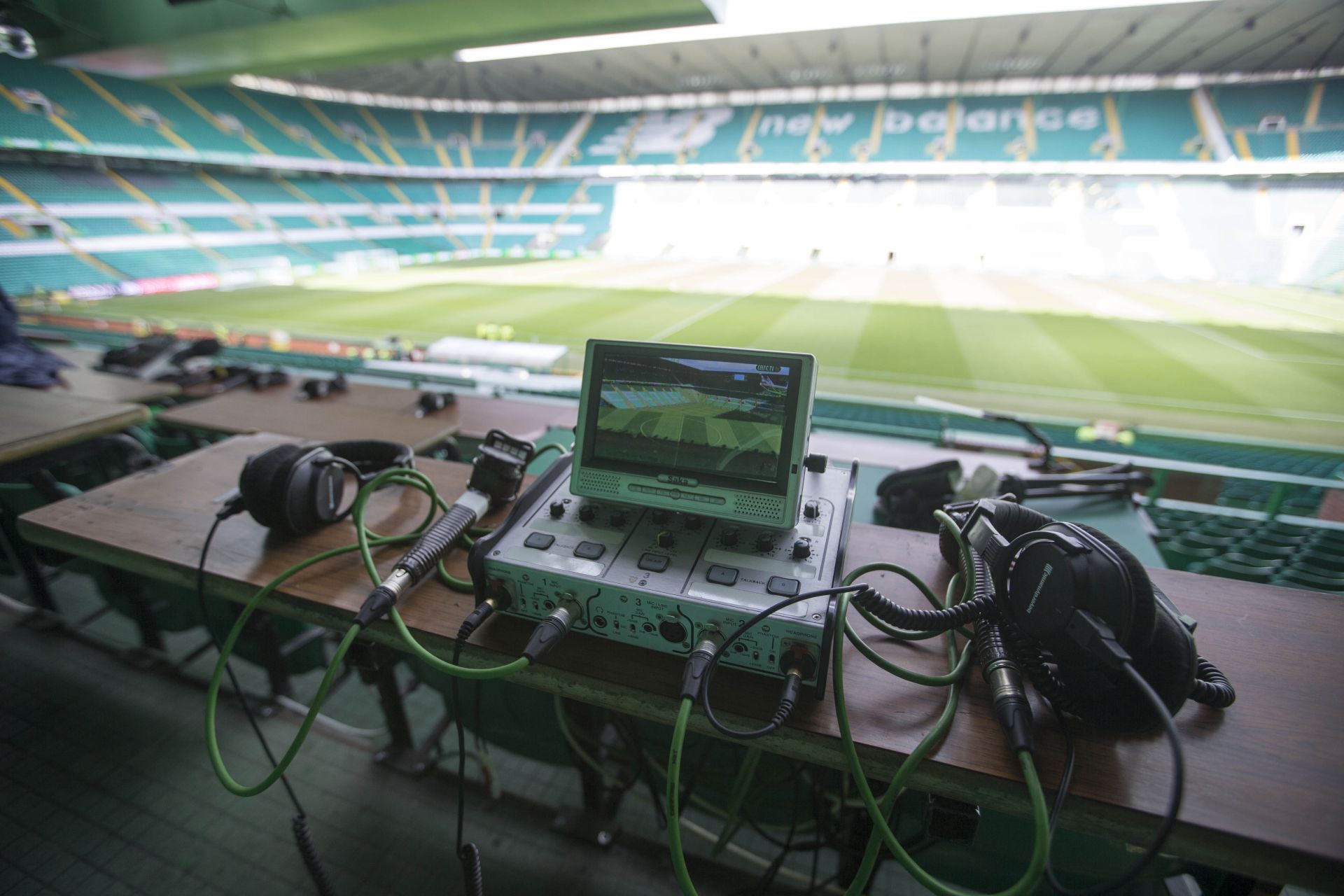
But while we consume these snippets in 15-second loops, they represent something deeper than a viral audio trend. In soccer, we often call the crowd the 12th man, but the commentator is the invisible 12th player. Without them, the game is a silent screen; they are the ones you end up screaming with at 2 a.m. during a 90th-minute corner.
While commentary might feel like a natural part of the game today, it began as something far more functional. In 1927, when the BBC aired one of the first live radio broadcasts of a match between Arsenal and Sheffield United, listeners had no visuals to rely on. The challenge was spatial: How do you describe a fluid, chaotic game to someone miles away? The solution was geometric. The BBC published a numbered grid of the pitch in newspapers, allowing audiences to track the ball in real time: “Ball now in square 3… moving into square 6.” It is often cited as the origin of the phrase “back to square one.”
As television entered living rooms, this system became obsolete. Audiences could see the pitch for themselves. Commentary had to evolve from description into interpretation. A goal no longer arrived alone; it became inseparable from the voice that carried it.
When Peter Drury famously bellowed, “Roma have risen from their ruins!” during a 2018 Champions League comeback, he distilled 30 years of Roman agony, giving language to the trauma of a fanbase still scarred by the 1984 European Cup final, when their team lost to Liverpool on penalties at the Stadio Olimpico in the Italian capital.
This same instinct — the need to find language for the impossible — spans cultures. It can be heard in Joaquim Maria Puyal’s hypnotic repetition of “Encara Messi” (“Still Messi”), as a teenage Lionel Messi dribbled past defender after defender in 2007.
It echoes in Andrés Cantor’s cry as Argentina finally lifted the World Cup trophy in 2022, his voice cracking under the weight of a 36-year dream finally realized.
But nowhere are these emotions more vivid than in the Arabic broadcast booth, where a game turns into high theater. Arabic commentary embraces a deep and poetic language. We feel it when we hear Faris Awad’s “Madness … madness … oh Lord!” or in the celebration of lineage in his catchphrase, “It’s impossible, O son of Argentina!”
We hear it in Tunisian commentator Raouf Khelif’s famous trademark catchphrase, “Yuwazza!” (“Distribute!”), meaning the player crosses the ball to distribute it into the penalty area. It became an instant signature phrase for Khelif.
And we felt it in Khalil Al Balushi’s shock during Saudi Arabia’s victory over Argentina at the 2022 World Cup: “The impossible is not Saudi.”
Perhaps the ultimate master of this dramatic prose is Issam Chaouali. When confronted with the sheer impossibility of Lionel Messi’s peak Barcelona years, the Tunisian linguistic master bypassed modern analysis entirely to summon the titans of soccer history, commanding them to bear witness: “Witness him, Pelé! Confirm it, Maradona! Talk about him, Cruyff! Admit the truth, Platini! Tell the truth, Zizou! Isn’t he the greatest?”
More recently, Algerian commentator Hafid Derradji’s account of a Manchester United attack in a Premier League match this season — a rhythmic repetition of “Bruno, Cunha, Luke Shaw!” — went viral.
Stripped of context, international fans remixed the musicality of his voice into songs and loops. In the hands of these broadcasters, the beautiful game is never just a sport. Commentary does not stay confined to the broadcast booth. It travels into memory and conversation, and into the way soccer is remembered long after the final whistle.
For Kamali, 33, a Manchester United fan who grew up in Iraq on stories of Ahmad Radhi scoring the country’s only World Cup goal in 1986, the voice of legendary Tunisian commentator Issam Chaouali became inseparable from the sport itself. “He turned Arabic commentary from just a side thing into an iconic part of any match or goal I remember,” he says.
Mahmoud Hassouneh, 31, a Palestinian Barcelona supporter, feels much the same. Barcelona’s famous 5-0 demolition of Real Madrid in 2010 remains tied to the sound of Chaouali’s commentary.
“It is forever engraved in my head,” he says. “Now whenever I think about that game, I hear his voice. When a commentator like Chaouali shouts with that level of unfiltered passion, it validates our own madness. It makes us feel like our joy is the most important thing happening on earth right now.”
In soccer, devotion is rarely dictated by geography. Khider, 29, who is Sudanese, points to a familiar quirk of fandom: supporters speaking as though they are part of the team itself. A fan sitting in a cafe thousands of miles from Spain will still say, “We’re playing tonight,” or “We’re winning the league.” The language says it all. There is no “them” — only “us.”
For Aqib Anwar, 36, an Indian who grew up in Dubai, the obsession began with “Bend It Like Beckham” and late-night Champions League games. He was raised on the larger-than-life style of commentators such as Andy Gray, whose famous call — “Oh, you beauty! What a hit, son!” — defined an era of Premier League soccer.
But for Aqib, Peter Drury remains unmatched. “I still go back to the moment Cristiano Ronaldo returned to Manchester United,” he says. “It gives me goosebumps even as I talk about it now.”
“When Ronaldo walked out of that Old Trafford tunnel in 2021, Drury didn’t look at the tactical lineup,” Anwar explains. “He spoke about nostalgia, the return of the prodigal son, and the passage of time. He said exactly what our hearts felt.”
Whether it is a title race, a clasico between Real Madrid and Barcelona, or a dramatic homecoming, the effect of commentary on the fan is identical. Soccer is a game tracked by numbers, but nobody tells stories in percentages. We don’t remember possession statistics; we remember where we were when the ball hit the net, who we were with and the voice that filled the room. At the end of the day, a great commentator is just a fan with a microphone and a better vocabulary, someone who finds the words when the rest of us are too stunned to speak. The final whistle blows and the scoreboard resets, but the right call outlives both. Years later, a few familiar words are enough to take you right back to where you were when it happened.
“Spotlight” is a newsletter about underreported cultural trends and news from around the world, emailed to subscribers twice a week. Sign up here.