


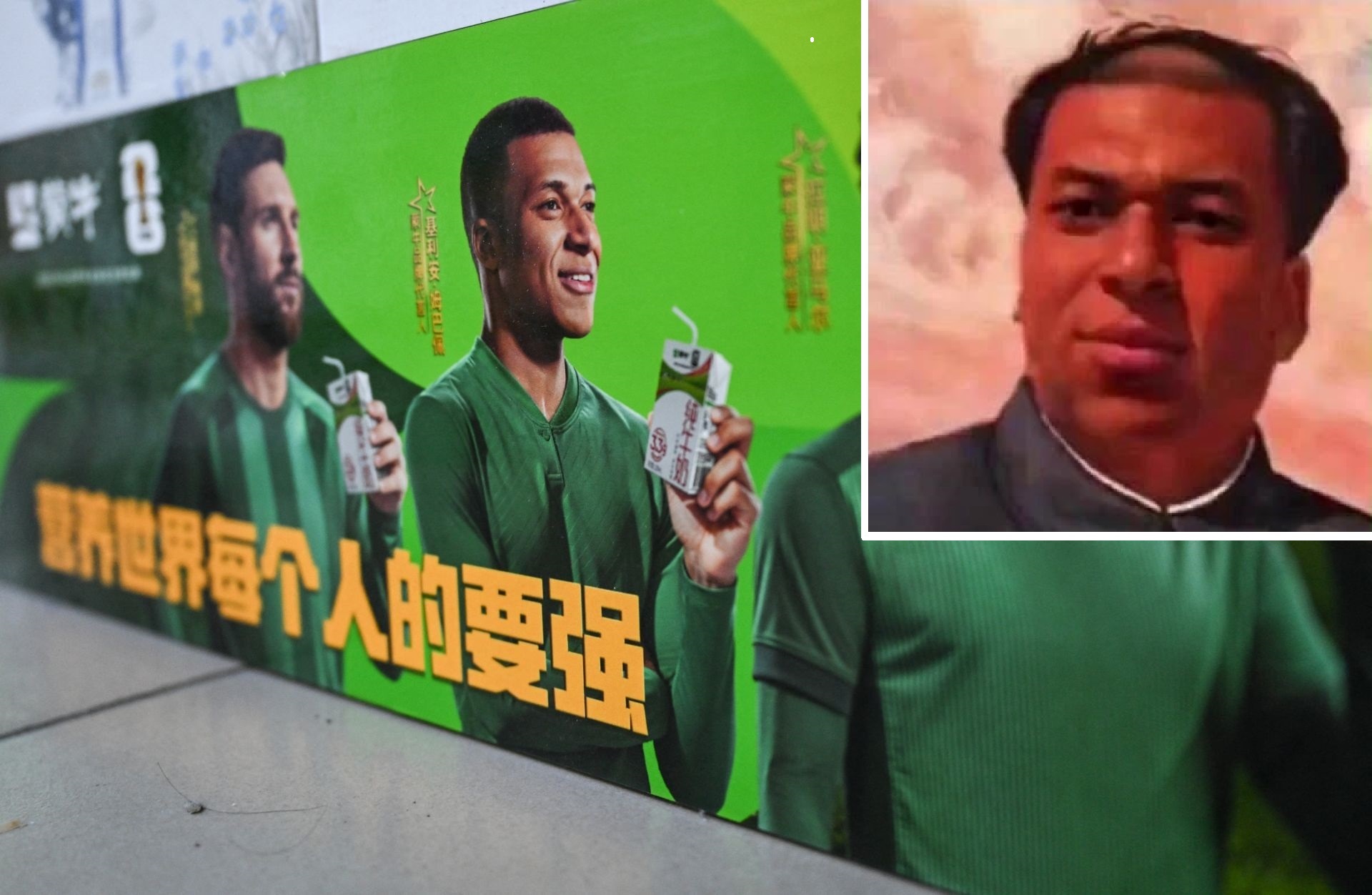
Kylian Mbappé now knows that life comes at you fast, especially when the sensibilities of Chinese netizens are concerned. Last weekend, the French superstar scored both goals for Real Madrid in a celebrated win over bitter rival Barcelona in the biggest game in club soccer. The world, including millions of Chinese fans, watched.
Monday, however, was not quite so good. The 27-year-old finished runner-up to England’s captain Harry Kane in the prestigious Ballon d’Or award, the prize given to the best player in the world over the soccer season, which he has never won. That was disappointing, but what was simultaneously brewing in Beijing would present a greater challenge to the forward, along with many more people, organizations and companies with which he is associated.
Now that the era of Cristiano Ronaldo and Lionel Messi is ending, the 2018 World Cup winner is perhaps the biggest name in soccer. He is certainly hugely popular in China, with his face on billboards, websites and television screens almost everywhere you look in the country of 1.4 billion. Yet it took only hours for him to start losing sponsorship deals, and now his club Real Madrid, widely regarded as the biggest in the world, and Spain’s La Liga are caught in the fallout of his appearance on a French talk show.
The star was asked which of the many memes in which he features is his favorite. He replied that it was the one in which his face is photoshopped onto the body of “some guy — I think he’s a Chinese dictator.” Though he did not mention the name, he was talking about Mao Zedong. Chairman Mao, the founder of the People’s Republic of China, ruled the country from 1949, when the Communist Party took power, until his death in 1976. That was the image shown on the video. Mbappé’s comment during the interview was soon picked up on a soccer forum in China and then spread from there.
The use of the word “dictator” went down badly in a country where Mao’s legacy and character are still not questioned, even half a century after his death. Any satire involving the former leader is taboo. That may be seen as overly sensitive, but then again, comparing President Xi Jinping to Winnie the Pooh, due to a perceived similarity between the two, is also a national no-no.
The reaction was swift, as sponsors rushed to show their patriotism. The dairy giant Mengniu, also a FIFA sponsor, dropped Mbappé, as did the cheese company Milkground. Dongpeng Beverage, which had unveiled the player in April as the ambassador for its new sports drink Bushuila, did the same.
Reports suggest that each contract with his three Chinese partners is worth between $3 million and $6 million a year. That could just be the start. In September alone, Mbappé left Nike to join Swiss-based ON in a deal seen as a major coup for the sportswear company. China is ON’s second biggest market, and it is looking to expand further, but the addition of Mbappé has brought risk as well as reward. No comment has yet been made, but the company has removed promotional content featuring the player in China. According to Chinese media, Dior and Hublot have done the same.
Real Madrid is also going to suffer. China accounts for around 10%-15% of Real Madrid’s merchandise sales, with Mbappé’s shirt being the bestselling item — though now, reportedly, it can’t be found in sports stores around the country. The Spanish league will suffer too. State broadcaster China Central Television (CCTV) is removing all content featuring the player, including La Liga broadcasts.
Perhaps, then, it was not a surprise when Mbappé apologized almost immediately. “During a recent interview, I reacted to an image of myself,” he said. “My comment was ill-judged, and I now understand that it hurt many people in China and in Chinese communities around the world. I apologize to everyone my words have upset. This was absolutely not my intention.”
Real Madrid also apologized, and La Liga was quick to prepare a statement telling its Chinese fans how important they are. “I wish to personally apologize to Chinese fans for the offense caused,” said Javier Tebas, the league’s president. “I have deep respect for China, its institutions and its people, and I value the trust with which, for so many years, they have supported our football.” He promised that clubs and players would work on strengthening awareness of different cultures and that this would not happen again.
“What did he say? Many Chinese would rather not repeat it,” the state-backed Global Times wrote. “The message from Chinese consumers is clear: Respect is not optional; one doesn’t get to profit from China while disrespecting it. Not a chance.”
That is another issue — what Mbappé actually said. One Chinese soccer official told me that his sentence, just one sentence, contained three mistakes — talking about Mao in the first place, calling him a dictator and treating the comparison as funny.
Yet those in China who do not use a virtual private network to access the global internet and rely instead on the heavily censored domestic version may not actually know what the French captain has done. Much of the reporting has been about the reaction — the sponsors, the media and the online outrage — but the comments themselves are not widely reported.
Mao’s public image is that of the father of the nation, even if his legacy is a complex one, with the so-called Great Leap Forward and the Cultural Revolution having resulted in the deaths of tens of millions. The Chinese authorities would rather that Mao not become an issue of debate. At present, it is safe to say that Beijing is sensitive to slights, perceived or otherwise, from high-profile foreigners — though nobody knows what the people themselves really think, because social media is strictly controlled and hardly an accurate reflection of public opinion in any case.
In such an environment, there is no room for any nuance. Mbappé’s off-the-cuff remark was likely referring to himself and the fact that he is known as a “dictator” due to the influence he is thought to have had at his former club, Paris Saint-Germain, in terms of transfers and coaching appointments. There have been viral memes with the player photoshopped not just as Mao, but as Kim Jong Un, Josef Stalin and Moammar Gadhafi, and his French teammates reportedly call him “Mobut,” alluding to the former Congolese leader Mobutu Sese Seko. Didier Deschamps, the former French national team coach, felt moved to address the issue during the World Cup when talking to reporters.
“You guys make Kylian Mbappé seem like a dictator. … The reality is the opposite,” Deschamps said. “His public image does not reflect reality at all. Kylian has always been mature, and the whole team follows him.”
There is something else, though, a point that seems to have escaped the debate outside China. The People’s Daily talked about this in a commentary that ran online, in which it called the matter one of basic decency, which is especially important for celebrities who rely on public support. “If they do not understand respect, sooner or later they will turn their popularity into a bad reputation and damage the brand they have worked hard to build over many years. In any country, it is unacceptable to enjoy the rich rewards of the local market while simultaneously showing contempt for—or even offending—the local history, culture, social customs, and national feelings that people hold dear. This is ‘biting the hand that feeds you.’”
Whether the outrage is organic or organized, it seems clear that Mbappé makes a lot of money from China but, from the video, equally clear that he does not really know who Mao was. This is a figure central to life in China, whose face is on the national bank notes, yet this foreign superstar seems to lack a basic awareness of the culture, society and history of the country that is making him millions.
Mbappé is certainly aware of Mao now, but that is not going to stop him losing money, at least in the short term. And not just him. Spain’s top league lags behind England’s Premier League in terms of popularity and, crucially, international broadcasting revenue. It has worked hard to build a brand and audiences in China and receives $160 million annually for broadcasting rights. Now, though, it may have to turn to its English rival for some advice.
Mbappé may wonder what he did wrong, compared to Mesut Özil. In December 2019, the German international posted on social media about China’s treatment of the Uyghur population in the northwestern region of Xinjiang. Arsenal, his club, moved quickly to distance itself. “The content published is Özil’s personal opinion,” went their statement. “As a football club, Arsenal has always adhered to the principle of not involving itself in politics.”
Arsenal games were not shown in China for a few weeks, at least. According to one survey, the London club fell from being the seventh most popular European team in China in 2019 to 13th in the following year. Some speculated that Özil’s comments, and his refraining from recanting or apologizing for them, played a part in the fact that he never played for Arsenal after March, before leaving in early 2021.
By 2019, Özil was a fading force on the field, and fans were already divided as to whether he was worth his massive salary. His departure seemed to solve the problem for the club. The Premier League, which had stayed silent throughout, must also have been relieved. Mbappé is on a different level to Özil, both on and off the pitch, and neither Real Madrid nor La Liga have the option of letting their biggest star leave. Maybe, then, it is time for officials to study the case of the NBA.
In 2019, Daryl Morey, the general manager of the Houston Rockets, expressed support for the pro-democracy protests in Hong Kong on social media. CCTV pulled games involving the team. After being criticized for an initial statement that was seen as weak, NBA Commissioner Adam Silver said that the competition would not censor players or team officials.
“The NBA will not put itself in a position of regulating what players, employees and team owners say or will not say,” Silver said in a statement. “We simply could not operate that way. I do know there are consequences from freedom of speech; we will have to live with those consequences. For those who question our motivation, this is about far more than growing our business.”
In response, CCTV pulled all NBA games, which was a big deal, as it had reported 600 million viewers in the previous season, with digital partner Tencent boasting 500 million. All 11 of the official partners in the country severed ties, and the league’s reported target to double its revenue share from 10% to 20% by 2030 looked to be in tatters. The standoff continued, and in 2022, Silver said that it had cost hundreds of millions in lost revenue (Morey was not fired over the tweet). Still, what followed was a thaw in relations. That year, games started to be broadcast once more and, in 2025, the NBA played preseason matches in Macau, a Special Administrative Region of China instead of a mainland city. It had taken six years.
The league could argue that it had maintained its principles, and while it took a severe financial hit, now CCTV and Tencent are both back on board, as are a growing number of sponsors. “We’re the number one sport right now in China,” a bullish Silver said in October. “There is tremendous social media presence here as well as media presence, with Tencent as our partner here. The time zone is also appropriate, with people used to watching games in the morning here because obviously they’re on.” Figures have not been released, but it has been speculated that annual revenue from China is back at around $500 million. In the meantime, the NBA has been active in trying to tap into other markets around the world in Africa, the Middle East and Asia. For the basketball tournament, China is still a big deal, but not quite as central as it was.
It is easier for the NBA, since it does not have any international competition for basketball hearts and minds around the world. The same is not true in soccer, with leagues elsewhere always looking to attract more fans. The initial signs are that Mbappé, Real Madrid and La Liga are not going down the NBA route. It is a reminder that, if you choose to operate in China, there are certain conditions you have to accept.
As one ex-Premier League official said: “China is a hugely important market, and one that you have to tread very carefully in as the situation can blow up at any time. That is just part of the deal — you tread as carefully as you can, hope nobody says anything controversial.” And when things do blow up? “Then you have a choice to make, but most decide that China is too important for obvious reasons and so bow down. The initial incident will soon get forgotten anyway, so you just try to move on as quickly as possible and hope that the damage is minimal.”
There are promising signs for Mbappé now that he has said sorry. On Wednesday, China’s Foreign Ministry spokesperson Guo Jiakun, who had said a day earlier that any words or actions which offended the Chinese people would be rejected by society, remarked, “We take seriously the apology the individual concerned has made.”
That China may possibly be open to moving on at some point may be the one bright spot of a dismal week for Kylian Mbappé, and a reminder that, while European soccer chases a global audience, that audience has certain expectations and can pull the plug at any time, regardless of whether you understand the reasons.
“Spotlight” is a newsletter about underreported cultural trends and news from around the world, emailed to subscribers twice a week. Sign up here.