


In the last few years, the term “South Asian” has taken on a new charge in the United States. For the longest time, when media narratives described South Asians, they often meant Indians, particularly those working in tech or business, often with access to influence, capital and power. Sundar Pichai was described as South Asian when he became the CEO of Google, one of the most formidable companies in the world, in 2015. The same description was applied to Satya Nadella a year before, when he took over as chair of Microsoft. The term was used when Kamala Harris became the first female vice president of the United States (and later the Democratic presidential nominee), and when Mindy Kaling — who started as a writer with a recurring role on “The Office” — went on to become one of the most influential female producers and directors in Hollywood.
Indian Americans — the highest earning minority in the U.S. (according to the Pew Research Center, Indian-headed households have a median income of $151,200, more than double the American average of $75,500) — have often been evoked as stand-ins for the much larger category of South Asians, which also includes Pakistani, Bangladeshi, Sri Lankan and Nepalese Americans, as well as others. Yet the convenient narrative of Indian Americans as a “model minority” has often overshadowed the more complicated and nuanced representation of other South Asian communities, which rarely receive proportional attention or interest. It has also led to Indian Americans becoming the de facto voices of all South Asian communities in the U.S., flattening the realities of the rest and collapsing the entire category into one of its subgroups. India’s role as the largest country in the subcontinent and one of the fastest-growing economies in the world also plays into this narrative.
Since the late 2000s, Indian Americans have emerged as an influential political bloc, often influencing politicians to foreground their interests. In 2023, for instance, a group of Indian-American voters pressured California’s Gov. Gavin Newsom to veto a landmark law designed to protect Dalits and other oppressed caste communities from South Asia. They also became highly visible in diversity initiatives in media and entertainment, at a time when corporations and advertisers were paying closer attention to Indian Americans’ growing economic influence and were eager to seek affluent audiences.
It wasn’t long before Indian Americans — prominently represented in the second Trump administration — emerged as spokespeople for South Asians more broadly, a position that not only glossed over variations in the issues faced by different groups, but also marginalized the experiences of some of them.
By 2025, however, Indian Americans were confronting the limits of their political influence and some of the implications of having been a highly celebrated minority and one swiftly assimilating into the American mainstream. Unlike the early 2020s, with Harris in the White House and regular splashy announcements of Indians taking over American corporations, last year saw the comeback of rampant and virulent anti-Indian racism, both online and in person. Vivek Ramaswamy initially rose to prominence in the Trump administration as co-founder of the Department of Government Efficiency (DOGE), but later faced significant backlash from Trump’s right-wing base after he suggested that Indian Americans’ success in tech and business stemmed from a “culture” that prioritizes excellence over mediocrity, compared to “native” Americans.
This retaliation against Ramaswamy did not end with his ouster from DOGE and has followed him on his recent gubernatorial run in Ohio, which has been marked by a similar anti-Indian backlash. Elon Musk’s takeover of Twitter from Indian-American CEO Parag Agrawal in 2022 also sparked a wave of online criticism targeting Indian tech and business leaders in the U.S., spilling over onto the Musk-owned platform from other alt-right corners of the web like 4chan. The Trump administration’s ongoing attacks against immigration have also weighed heavily against H1-B visa holders, a majority of whom happen to be Indians.
But nowhere was the waning influence of the archetypal Indian American — likely Hindu, dominant-caste, working in tech or business — more evident than in New York City in 2025, when Zohran Mamdani, the son of an Indian-origin filmmaker-academic duo, won a hard-fought election (without their explicit support). Mamdani’s parents, the Oscar-nominated director Mira Nair and Columbia University professor Mahmood Mamdani, belong to an Indian-American creative class that is well-respected in India but doesn’t often get to occupy a place in the mainstream imagination of the South Asian community in America.
Compared with the majority of Indian Americans who work in tech and business (data from the Migration Policy Institute suggests that close to 78% of Indian immigrants and 44% of American-born Indians work in management, business, tech and the arts), Indians like Mamdani don’t fit into neat definitions. Even as a plurality of Indians in the U.S. (47% according to 2024 data from the Carnegie Foundation) approve of the policies of the Hindu right-wing government of Prime Minister Narendra Modi, Mamdani represents a growing percentage of Indian Americans who disagree.
Mamdani protested against Modi’s policies as a New York state assemblymember, described him as a “war criminal” during his mayoral campaign, and said that he would not host a joint press conference with the prime minister if he were to visit New York. These statements drew swift ire from the Hindu community in New York and New Jersey, many of whom either came out in support of his opponent Andrew Cuomo or reasserted their allegiance to former New York Mayor Eric Adams. A few weeks before the nail-biting primary against Cuomo, a group that described itself as “Indian Americans for Cuomo” (with most of its members registered as residents in New Jersey) flew banners on the Hudson River in New York, attacking Mamdani’s Muslim heritage and linking him to a so-called “global intifada.”
Mamdani’s comments on Modi, which stemmed from his ongoing opposition to the Indian prime minister’s policies of targeting Muslims and other minorities in India, seemed like a well-calibrated move on his part to challenge the Hindu right narratives that have recently come to dominate Indian-American and, by extension, South Asian discourse in the past several years.
Indian tech and business leaders have not only sought to influence American politics through aggressive lobbying — as in the case of the California caste bill or, earlier in 2019, when a group of Hindu organizations successfully defeated a resolution introduced by progressive Indian-American Rep. Pramila Jayapal to urge the Indian government to end mass detentions in Kashmir — but have also been key players in navigating the relationship between India and the U.S. over the last several decades. After Modi was denied a U.S. visa for his role in the 2002 Gujarat riots, Indian-American tech and business leaders pushed to get that ban revoked. “There is an Indian lobby, and they do not want to hear any criticism of India, whether it be on the Delhi rape case or on the Modi issue. They just want to hear good things about India,” read a New York Times piece from 2013, a few months before Modi had won the election to become the Indian prime minister.
Mamdani’s staggering win in New York City, despite vehement and forceful opposition from many of Modi’s supporters, who lobbied against him through coordinated political action committees and appeals to the Indian Embassy, shows that there are limits to the ability of one segment of the Indian-American diaspora to define not only Indian identity in the U.S., but what it means to be South Asian in the country.
In 2026, a year when American foreign policy — including Trump’s high tariffs on India — looks remarkably different from past years, the U.S. government’s previous relationships with the Indian-American business and tech communities seem poised for a restructure. This reshuffle of the political and diplomatic order may have already paved the way for a new generation of South Asian power brokers, ones who don’t share the established proclivities of the Indian-American elite and, in fact, might not even be Indian. They might be Pakistani, Bangladeshi, Nepalese, Sri Lankan or Indian, and they would embrace a broader regional worldview rather than advancing an India-centric vision.
They could disrupt the carefully calibrated political and cultural ecosystems that have defined the diaspora. And they could defy the familiar American image of the apolitical immigrant tech worker or business owner: reluctant to take a stand on American politics as on global issues like Palestine, and seeking influence not through assimilation but through a distinct cultural prism.
For instance, Bangladeshis — one of the fastest-growing minority populations in New York City, tripling in the last decade — have grown their political influence in city government. Shahana Hanif, from the Bangladeshi-majority neighborhood of Kensington, was elected to New York’s City Council in 2021, the first Muslim woman to hold the seat. Despite being widely viewed as vulnerable because of her outspoken support for Gaza, she went on to win her reelection against Maya Kornberg, a Democratic candidate supported by the Wall Street and real estate lobbies who spent close to $400,000 to unseat her — a victory that was powered largely by grassroots canvassing from the highly engaged Bangladeshi community she grew up in.
During the general election campaign, when Mamdani’s 2020 comments about “defunding the NYPD” were revived after the shooting of a police officer in midtown Manhattan last summer, he turned to Bangladeshi New Yorkers as a bulwark against the backlash. The officer, Didarul Islam, was a Bangladeshi immigrant and a member of the Bangladeshi American Police Association (BAPA). After Islam’s death, Mamdani, who was on vacation in Uganda, flew back to New York and went straight to the Bronx, where Islam had lived with his family. Multiple meetings with Islam’s relatives and neighbors, along with support from BAPA, helped stem the criticism that came at a vulnerable point in Mamdani’s campaign, signaling the burgeoning influence of the Bangladeshi community in New York’s political landscape. Mamdani himself acknowledged this influence — even before Islam’s death — when, after winning the Democratic nomination last June, he credited his primary victory in part to “the Bangladeshi auntie who knocked on door after door until her feet throbbed and her knuckles ached.”
Pakistani New Yorker Asad Dandia, a public historian and City University of New York (CUNY) lecturer who was a part of Mamdani’s informal “kitchen cabinet” compared the rising political power of South Asians — particularly Bangladeshis — to those of the “Irish at the turn of the last century,” who went from being outsiders to dominating “the Catholic Church, politics and labor unions” in the city. “Among South Asians in the diaspora, the one community that is most connected to this kind of working-class labor power is Bangladeshi,” he told New Lines. That shift is also felt culturally. “As someone born and raised in Queens, I spent my entire life explaining that I was from Bangladesh — ‘Oh, that little country next to India,’” said Bangladeshi-American journalist Jennifer Chowdhury on a Bangladeshi news channel panel, referencing Mamdani’s “Bangladeshi auntie” moment in his June speech. “I don’t need to say that anymore.”
Bangladeshis are not the only South Asian community to flex their political influence in New York’s mayoral election. Pakistani New Yorkers — who have faced extensive harassment and targeted surveillance in the decades since 9/11 — have also been deeply influential in helping Mamdani secure his win. Ali Najmi, who has roots in Pakistan, was among Mamdani’s closest advisers on his campaign and served as his election attorney. He has since been appointed chair of the Mayor’s Advisory Committee on the Judiciary. As a leader within the Muslim Democratic Club of New York, he also advised Mamdani during his earlier assembly runs and closely guided him as he navigated the turbulence that inevitably hit his general election campaign.
In the Pakistani-plurality neighborhood of Midwood in Brooklyn, members of DRUM Beats — an affiliate of DRUM (Desis Rising Up and Moving), a working-class South Asian organization — canvassed to register new voters and encourage residents to support Mamdani. Pakistani neighborhood organizations also hosted him regularly at local mosques, deepening his ties to the community, where his Indian heritage could have posed challenges given the fraught political history between the two countries. But the grassroots campaign ultimately broke barriers not just for the now-mayor, but also for the community itself, which witnessed unprecedented participation from Pakistani New Yorkers — especially older women — who rarely engaged in formal political spaces, often out of fear of inviting further harassment and targeting. According to data released by DRUM Beats after the election, turnout among Pakistani New Yorkers increased from 15% to 46% in the general election, while Bangladeshi engagement similarly jumped from 15% to 49%.
Mamdani’s astute recognition that he needed to build a coalition outside the Indian-American power center of the Hindu right — and tech and business interests — was perhaps the most crucial factor that led to his mayoral win. Anticipating the pushback he would face for his criticism of the Indian government, Mamdani, with the help of working-class South Asian organizations like DRUM Beats, built an early base among Pakistani, Bangladeshi and Nepalese New Yorkers, who were more or less neutral, if not opposed, to his stance on Modi’s politics. This coalition also included Sikh New Yorkers at a time when their relations with the Indian government had grown tense following U.S. allegations that an Indian official was linked to a murder-for-hire plot targeting a U.S. citizen on American soil. That citizen is an activist advocating for Khalistan, an independent Sikh state in India’s Punjab region.
It was only after his primary victory over Cuomo that backlash from some Hindu New Yorkers — whose politics around India diverged sharply from his own — began to seriously undermine Mamdani’s campaign. As the media narrative about his lack of Indian-American support began to build, amplified by conservative outlets like the New York Post, groups like “Hindus for Zohran,” made up of Hindu New Yorkers who either shared his opposition to Modi or did not see it as central to his candidacy, stepped in to blunt the attacks. At the same time, groups like “Pakistanis for Zohran,” “Bangladeshis for Zohran” and “South Asians for Zohran” — alongside DRUM Beats and CAAAV Voice, an Asian-American working-class organization — did much of the heavy lifting in reshaping the narrative in Mamdani’s favor.
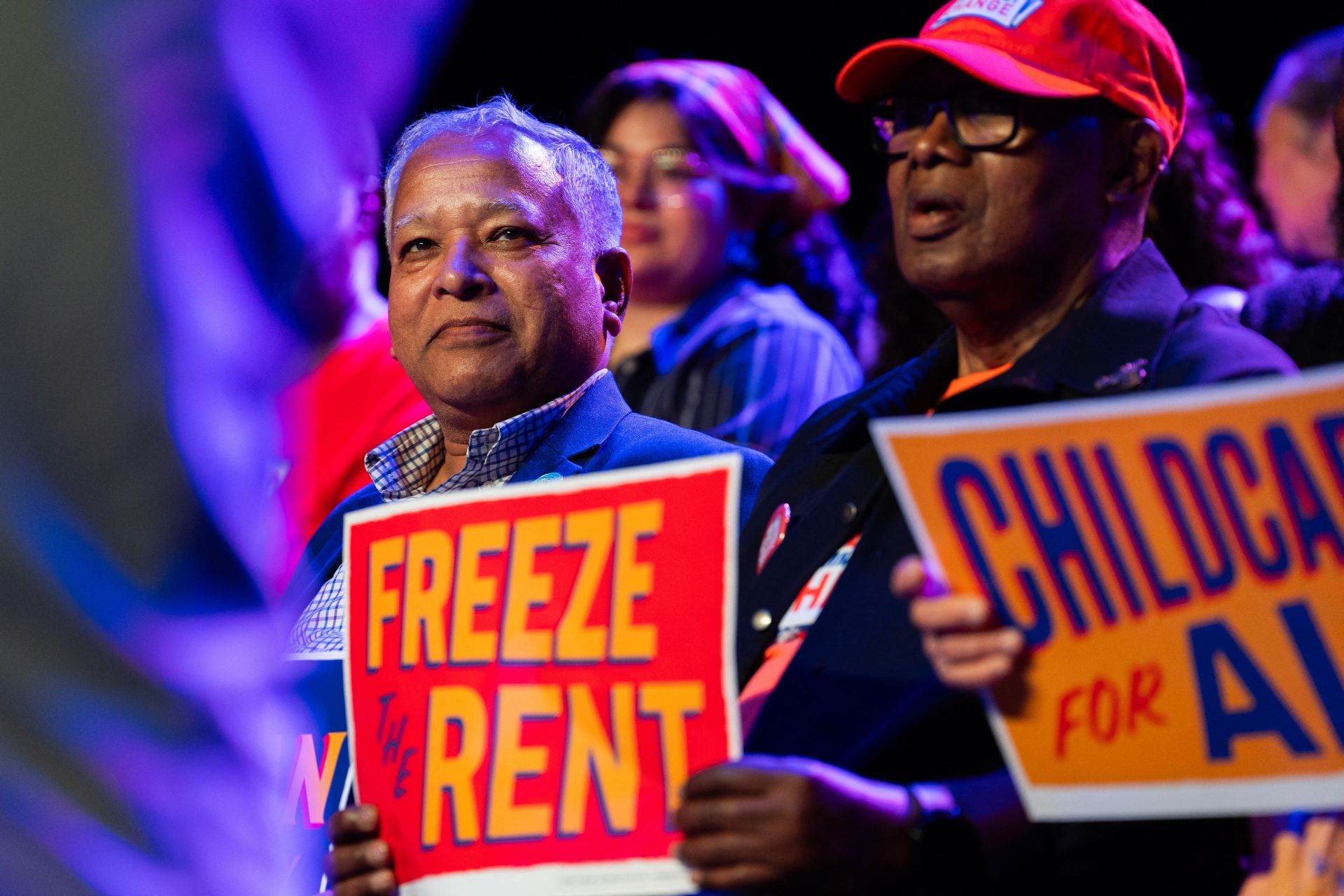
“We definitely encountered working-class Indian people who may have different sort of ideological leanings, given politics back home, but here they are more impacted by how much rent they have to pay, the schools that their kids go to, how much child care costs,” Fahd Ahmed, the executive director of DRUM told New Lines. “The most dominant narrative of our communities has tended to emphasize Indians, but I would say more so has tended to actually emphasize professionals and a more privileged class of people,” he added.
“We get these very limited and distorted portrayals of gas station workers or taxi drivers, but people that you know do this kind of work make up very large portions of our communities across the country. … It is their stories, their experiences, that are often minimized or at best tokenized,” Ahmed said. He also pointed to another section of Indian New Yorkers, many of whom lived in parts of Brooklyn and Manhattan outside of traditional desi enclaves, who “were more aligned with a progressive and a transformative vision of society” and both volunteered and voted for Mamdani.
Even before Mamdani was inaugurated as New York’s mayor, the ascendant political power of South Asian New Yorkers had begun to acutely register within political circles in the city. In December, New York’s Lt. Gov. Antonio Delgado, who was mounting a challenge to unseat his current boss, Gov. Kathy Hochul, in an election this year (he has since suspended his campaign), was among the first major political players in the state to reach out to South Asian New Yorkers. He attended an exclusive town hall with South Asian and Indo-Caribbean New Yorkers, organized by a group created directly in the aftermath of Mamdani’s win, and appealed to them by comparing his policies to those of Mamdani. And a few weeks later, when Vickie Paladino, a Republican member of the New York City Council, posted on social media in support of the “expulsion of Muslims from western nations” in the wake of the Sydney attack, several elected hopefuls joined a protest rally organized by South Asian and Indo-Caribbean organizations outside her office in Queens.
Mamdani’s win also saw South Asian and Indo-Caribbean communities, which have always shared historical and geopolitical similarities in the city, emerge as a stronger, cohesive political unit, in part due to efforts by groups like DRUM and other related political organizations in the city, further upsetting the India-centric equation of this demographic. “It is going to be difficult, if not outright impossible, to win a citywide election without the support of South Asian communities,” Dandia said. “It’s not just that South Asians are building power. They’re building progressive power. They’re building socialist power,” he added.
Based on the composition of Mamdani’s administration, which includes Pakistani American antitrust lawyer and former Federal Trade Commission chair Lina Khan, as well as several other desi members, it is abundantly clear that this broader South Asian coalition will continue to hold, at least in New York. Given that Mamdani already has a clear line to Trump (after Mamdani’s shockingly pleasant reception at the White House in November, reports have revealed that they text on a regular basis), it is possible that Indian-American tech and business leaders, even those who oppose Mamdani’s politics, might soon have to approach him to get through to Trump. That’s not the direct line to the president that they are used to.
Mamdani represents something that, until recently, was considered impossible: an Indian American rising to one of the most influential elected offices in the country, without the backing of the pro-Modi lobby. The new South Asian power broker has finally arrived.
Become a member today to receive access to all our paywalled essays and the best of New Lines delivered to your inbox through our newsletters.