


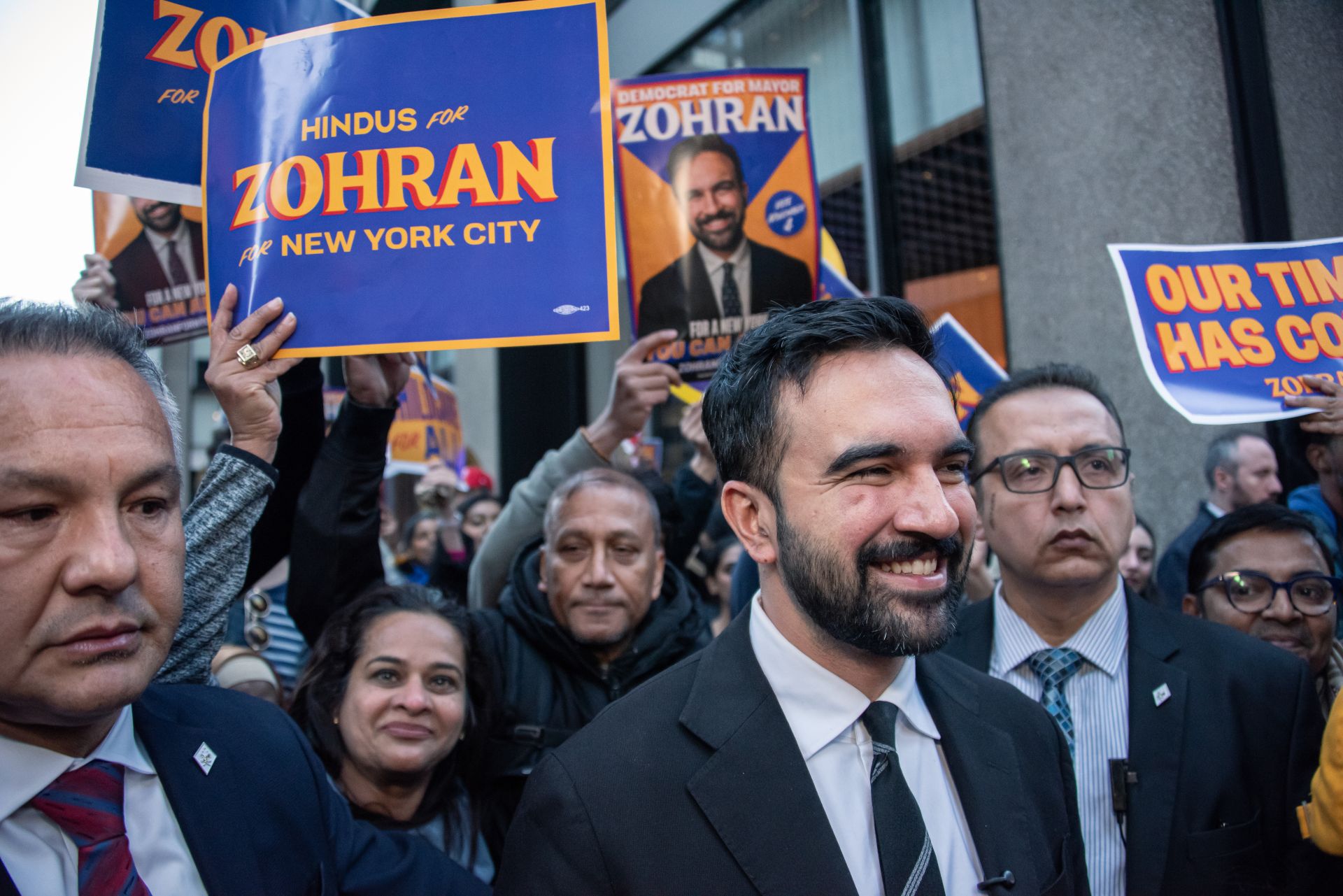
On Diwali, the most important festival in the Hindu calendar, also celebrated by Sikhs and Jains, Democratic nominee Zohran Mamdani hosted one of the most unusual events of the New York City mayoral elections so far. In a race that has already seen him host a scavenger hunt around New York’s political landmarks, walk the length of Manhattan in an evening and, most recently, organize a soccer tournament in Coney Island to promote his affordability platform, unusual was a high bar to cross.
Yet the event — where Mamdani, along with his filmmaker mother Mira Nair and actor and former Obama staffer Kal Penn, distributed traditional desi sweets out of a small Indian store in Queens — was one of the first times that South Asian politics were so overtly mirrored in the city’s local elections. Similar to politicians in India who often distribute sweets on Diwali, particularly ahead of an election, Mamdani signaled to his South Asian voter base that he was one of them. And for the rest, it was proof that his team seemingly had an endless array of creative ways to engage with New Yorkers.
Earlier that day, Mamdani had visited four more temples in Queens, adding to the two he had visited earlier in October. At one of them, while addressing previous comments in which he called Indian Prime Minister Narendra Modi a “war criminal,” Mamdani talked about a pluralistic vision of India that he grew up with, “where everyone belonged no matter their religion.” He compared it to that of the Modi government, which only has room for “certain kinds of Indians.”
Maintaining his reconciliatory streak, Mamdani also added that he is running to be the mayor of a city where many might feel “differently” about Modi, but he promised to represent them equally and ensure they are safe and can “afford this city.” The video, which was taken by this reporter, has since gone viral in India and has forced many, including some of Mamdani’s critics, to acknowledge his measured response.
Mamdani, as New Lines reported recently, was far from the only mayoral candidate to have taken advantage of Diwali to get close to South Asian New Yorkers. Former New York Gov. Andrew Cuomo launched “South Asians for Cuomo” on the eve of Diwali (and was mocked thoroughly for confusing South Asians with Southeast Asians). Republican Curtis Sliwa also dropped by some of the same temples that day. If, until now, the influence and visibility of South Asian New Yorkers were simmering under the surface, Diwali marked a turning point when, in a fitting metaphor, it finally exploded onto New York’s political scene.
Between their multiple temple visits and each candidate’s attempts to court Hindu, Muslim and Sikh voters — since the primary, both Cuomo and Mamdani have also visited several gurdwaras and mosques as part of their campaigns — the absence of a political group that until recently was fairly prominent in mainstream American discourse stood out. Dalits, a term of self-description for members of formerly “untouchable” castes in India, Nepal, and parts of Bangladesh, Pakistan and Sri Lanka, were missing from the conversation.
As the Democratic nominee for mayor, Mamdani has recently been focused on consolidating Hindu votes and has so far not addressed caste in his campaign. Although he was set to visit the Shri Guru Ravidass Temple in Queens (the Ravidass Gurdwara, as it is commonly known), he had to cancel because of scheduling conflicts during his string of temple appearances on Diwali.
The only Dalit place of worship in the city, established in 1987 when members of the Dalit Sikh community encountered discrimination while entering other Sikh gurudwaras, the temple is among the few South Asian places of worship that none of the current mayoral candidates has visited so far. And it is unclear if Mamdani, Cuomo or Sliwa plan to visit it before the election on Nov. 4.
Mamdani has, however, visited certain temples where advocacy around caste is met with hostility, like the BAPS Shri Swaminarayan Temple in Queens. In 2021, Bochasanwasi Shri Akshar Purushottam Swaminarayan Sanstha (BAPS), an influential Hindu sect from the state of Gujarat, came under federal investigation for allegedly bringing Dalit and marginalized caste workers to the U.S. on religious visas and employing them to build the Akshardham temple in Robbinsville, New Jersey, in exploitative conditions. This included allegedly forcing them to work more than 12 hours a day for $1.20 an hour and confining them to the temple premises. Although BAPS North America has claimed that the Department of Justice closed the case in September, a wage theft civil lawsuit is still pending.
While Mamdani is not the only candidate to visit the BAPS outpost in Queens (Cuomo visited the temple in early September), his visit has generated mixed reactions among Dalit as well as other dominant caste Hindu New Yorkers, many of whom believe that Mamdani could have avoided visiting, given the organization’s checkered past on alleged caste-based exploitation.
Sunita Viswanath, who helped organize the “Hindus for Zohran” group to showcase support from the community, is one of them. “I wish Zohran’s campaign had consulted with the Dalit community and ‘Hindus for Zohran’ volunteers before visiting the BAPS mandir [temple] in Queens,” she told New Lines. Viswanath added that while she was happy about the positive reception Mamdani received at New York’s various temples, it was important to acknowledge “this harm, especially given the recent dismissal of the case by Trump’s DOJ.”
Many Dalit Americans interviewed by New Lines felt similarly to Viswanath. However, a Dalit resident from Queens, who has also canvassed for Mamdani’s campaign, offered a different interpretation of the temple visit. “I don’t think [Mamdani] supports [BAPS’] policies. It’s just part of his campaign,” he told New Lines on the condition of anonymity. While the Mamdani campaign did not get back to New Lines despite repeated requests for comment, many Hindu New Yorkers, as well as supporters in India, have celebrated Mamdani’s appearance at temples, including at the BAPS Queens outpost.
As an assemblymember, Mamdani, who comes from a mixed dominant-caste background (his mother, Mira Nair, is from a dominant Khatri caste, and his father, Mahmood Mamdani, comes from a Khoja merchant caste background), has been vocal about his support for the anti-caste movement. In 2021, Mamdani appeared on a panel with anti-caste activist Prachi Patankar and emphasized the need for leadership from Dalit and marginalized caste communities to counter the rise of Hindu nationalism. In March, he co-sponsored a caste protection bill in New York state, which has been put on hold until next year.
The question of caste would ordinarily not come up in a local election in the United States. But given the prominence of South Asian New Yorkers in this election, animated by Mamdani’s efforts to canvass in communities he shares a background with, caste has become a valid talking point, especially because Hindu temples, where Dalits, like this reporter, often don’t feel welcome, have emerged as fertile ground for canvassing by New York’s mayoral candidates.
Conversations around caste aren’t novel for City Hall either. On April 14 this year, Mayor Eric Adams signed a proclamation designating the date as Ambedkar Day in honor of Dr. Bhimrao Ramji Ambedkar, the pioneering Dalit civil rights leader. In 2023, a street in Queens was renamed Dr. B.R. Ambedkar Way to commemorate his legacy.
Over the past few years, Dalits have emerged as a formidable political group in the United States, advocating for protections around caste and calling out discrimination that oppressed-caste South Asians encounter in community spaces, whether at festival celebrations or the workplace.
While Dalit advocacy groups have been active in the country for decades, American media outlets began actively paying attention to them in 2020, when, in a highly publicized case, a Dalit engineer sued his employer, Silicon Valley giant Cisco, for failing to protect him from caste-based discrimination from his dominant-caste Brahmin managers. Breaking through in the “Black Lives Matter” moment, when the killing of George Floyd by Minneapolis police officer Derek Chauvin sparked a wave of racial justice protests across the country, the Cisco case led to widespread awareness and advocacy around Dalit rights and caste discrimination in the U.S.
Companies like Apple and universities like Brandeis, California State University, Columbia and Brown, added caste protections to their official policies. In February 2023, Seattle became the first city in the U.S. to include caste as a protected category in its local constitution. Later that year, California, the state with the highest population of South Asians in the country, introduced a landmark bill to outlaw caste discrimination, which passed through several rungs of its legislature with a sizable majority.
However, after months of protests and lobbying from Hindu right-wing groups, who form an influential political force in the state and had threatened to withdraw their support, Gov. Gavin Newsom succumbed and vetoed the bill. While many of these groups have been around for a few decades, some, like the Coalition of Hindus of North America (CoHNA), became more prominent in 2020 in direct response to the rising visibility of the anti-caste movement in the United States.
Most Hindu right-wing groups echo a familiar idea from India, that after a few decades of affirmative action policies, caste is perceived as irrelevant, even though systemic discrimination and violence against Dalits in India is at an all-time high (data indicates that a crime takes place against a Dalit person in India every 18 minutes). Conversations around caste, especially in places like the U.S. and the U.K., are deemed harmful to the “model minority” image of the Indian diaspora. In fact, some Hindu right-wing organizations have opposed even mentioning of caste in American textbooks, arguing that learning about the discrimination Dalits and oppressed-caste individuals experience in India will lead to the bullying of Indian-American students at school in the U.S.
In the aftermath of the Hamas attacks in Israel and the subsequent genocide of Palestinians in Gaza, mainstream American discourse pivoted sharply to the right. As the Overton window — a concept used to identify the broad public tolerance for a range of social and political issues — in the U.S. shifted away from support for issues around racial justice and equity toward a more insular outlook, the inclination and space to discuss Dalit rights in mainstream American institutions disappeared seemingly overnight.
The effects of this evaporating support were visible in the stymying of caste protection throughout the country. Caste protection bills, similar to the one proposed in California, which had been under consideration in Oregon and Texas, were shelved or killed, and the proposals for protections against caste discrimination across campuses in the U.S. were quietly rejected.
The swift disappearance of caste from public discourse was perhaps most visible during the 2024 presidential election, when the Democratic nominee Kamala Harris, who has Black and South Asian heritage, campaigned around being the “daughter of a brown woman” and sought massive support from South Asian Americans. Harris’ Brahmin caste identity failed to become a flash point, unlike in 2020, when American media outlets devoted extended coverage to her caste background during her vice presidential campaign. The lack of political pundits discussing this aspect of Harris’ Indian background in 2024 — although The New York Times raised similar points regarding Harris’ father, who came from a family of wealthy landowners in Jamaica — indicated how far the discourse around caste had shifted.
Even though President Donald Trump’s goodwill with Hindu Americans has recently waned, thanks to policies like high tariffs on Indian imported goods and $100,000 application fees for new H1-B visas, just days before the presidential election he had assured Hindu Americans that he would protect them from the “anti-religion agenda of the radical left,” in what was clearly a dog whistle against breakthroughs around caste protections from progressive allies and Dalit organizations, who have often traced the roots of caste to Hinduism. The subsequent spotlight on conservative South Asian figures in Trump’s orbit, like FBI Director Kash Patel and Vivek Ramaswamy, and celebration over the presence of Hindu Americans in the new administration, also distracted from the caste issue.
In fact, the gains from the veto of the caste bill in California as well as the Cisco case, where the state voluntarily dismissed the charges against the Brahmin managers who were accused of perpetuating caste discrimination (the case against the company still continues), have emboldened Hindu right-wing organizations to introduce legislations that could potentially penalize advocacy around caste as well as criticism of the Indian government.
In 2024, Democratic Rep. Shri Thanedar introduced a novel resolution to get Congress to recognize “Hinduphobia,” which is described as “anti-Hindu bigotry, hate, and intolerance.” This year, in April, which is celebrated as Dalit History Month, Georgia introduced a similar bill in its Senate to formally recognize the term. (The local chapter of BAPS was among the supporters of the Georgia bill.)
“Hinduphobia” and “anti-Hindu hate” are often invoked by Hindu right-wing organizations to fend off legitimate criticism of the caste hierarchy in Hinduism and Hindu nationalist politics in India. Earlier in July, Indian journalist and lawyer Mukta Joshi reported in Jewish Currents, a progressive American magazine, that 75% of the incidents that the Hindu American Foundation (HAF) condemned as “Hinduphobia” in the United States did not meet its own definition of the term and were used to vilify caste advocates and critics of Hindu nationalism.
In 2021, an academic conference in the U.S. titled “Dismantling Global Hindutva” that was co-sponsored by over 50 universities, including Harvard, Columbia and Stanford, was described as “anti-Hindu” solely due to its focus on Hindu nationalism. The backlash around the conference was so severe that it resulted in significant digital violence against the participants, including many receiving death threats as well as potential bans on visiting India, and even the possibility of arrests of their families back home.
Despite these shifts, awareness around caste has increased across the country, as noted in a recent survey by the Carnegie Endowment for International Peace, which showed that an overwhelming majority of Indian Americans support measures to outlaw caste discrimination. Yet there has hardly been any mention of caste in an election that has become so heavily centered around South Asians.
Despite its absence, Dalit New Yorkers with Indo-Caribbean as well as South Asian backgrounds have been active in the mayoral election. During Mamdani’s first major rally in Brooklyn this May, New Lines spoke with Tej Bughram, a 19-year-old volunteer for his campaign who comes from a Dalit background and had traveled from Queens for the rally. He was excited about Mamdani’s fast and free buses program, noting that his father drives a bus for the city, but also expressed concern about whether caste would feature prominently in the election.
“[Caste] is definitely a big issue in the city. Here is a South Asian candidate, but how does that relate to caste?” he said. “Jati and Varna [classifications of the caste system] still play a very big part in the brown [community] politics in New York. There is a difference between what you get in this country if you’re [from] a different caste,” Bughram told New Lines, referring to the discrimination that Dalits experience. Many assume that caste does not influence social or professional settings in America, but as highlighted by the Cisco case, Dalits in the U.S. often experience exclusion at work and feel compelled to hide their caste identity to avoid discrimination within South Asian communities.
Although Mamdani’s concerted effort to reach out to Hindu New Yorkers, aided by volunteer-led organizations like Hindus for Zohran, seems to have worked out in his favor, his multiple temple visits have upset some Hindu right-wing organizations in the U.S. On Oct. 25, a letter signed by 20 Hindu organizations (including CoHNA and Gujarati Samaj of New York, which had earlier endorsed Eric Adams and recently hosted an event for Cuomo) emerged online condemning Mamdani’s “Hinduphobic” statements.
Dated Oct. 10, a few days after Mamdani’s first temple visits, it lists his previous comments about New York State Assemblymember Jenifer Rajkumar, whom he described as a “puppet of Hindu fascists,” his criticism of India’s controversial Citizenship Amendment Act and his co-sponsorship of the caste protection bill in New York among the examples of his “Hinduphobia.” It also described the proposed protective legislation as a violation of Hindus’ “civil rights.”
This is the second letter of its kind — the first, released in August and listing similar concerns, was addressed to Mamdani’s mother, Mira Nair. If, up until now, caste had remained in the shadows in the mayoral race, this new public letter has propelled it into the spotlight.
Given the rightward shift in American politics and sustained attacks on civil rights and diversity, equity and inclusion initiatives by the Trump administration, it is evident that, in 2025, the road to City Hall no longer runs on principled stances alone. As the first Muslim South Asian to run for mayor, Mamdani’s identity has not only been scrutinized but has also led him to face shockingly racist attacks from his opponents. As recently as Oct. 23, Cuomo appeared on a radio show and seemingly agreed with the host’s suggestion that Mamdani would celebrate another “9/11-like incident” in New York because he was Muslim, a day after he was linked to “Jihad on NYC” in an ad released by the Cuomo-supporting political action committee “For Our City.”
Even though critics have portrayed Mamdani’s democratic socialism as a liability for governing a city like New York, the New York City Democratic Socialists of America, of which he is a member, has been focusing on getting more socialists elected to office instead of critiquing Mamdani’s moderate turn. So it would not be unreasonable to assume that, in this election, Dalit voices might be sidelined in the broader calculations around South Asian votes.
Since the veto of the California bill, the visibility of caste has all but disappeared in the United States. If Mamdani, as mayor, takes Dalits’ voices into account for his vision for the city, it could offer the movement around caste a necessary bulwark to resist the ongoing attacks from the Hindu right, especially now that they have openly attacked Mamdani over his support of the caste protection bill. But will it happen? That remains to be seen.
Become a member today to receive access to all our paywalled essays and the best of New Lines delivered to your inbox through our newsletters.