


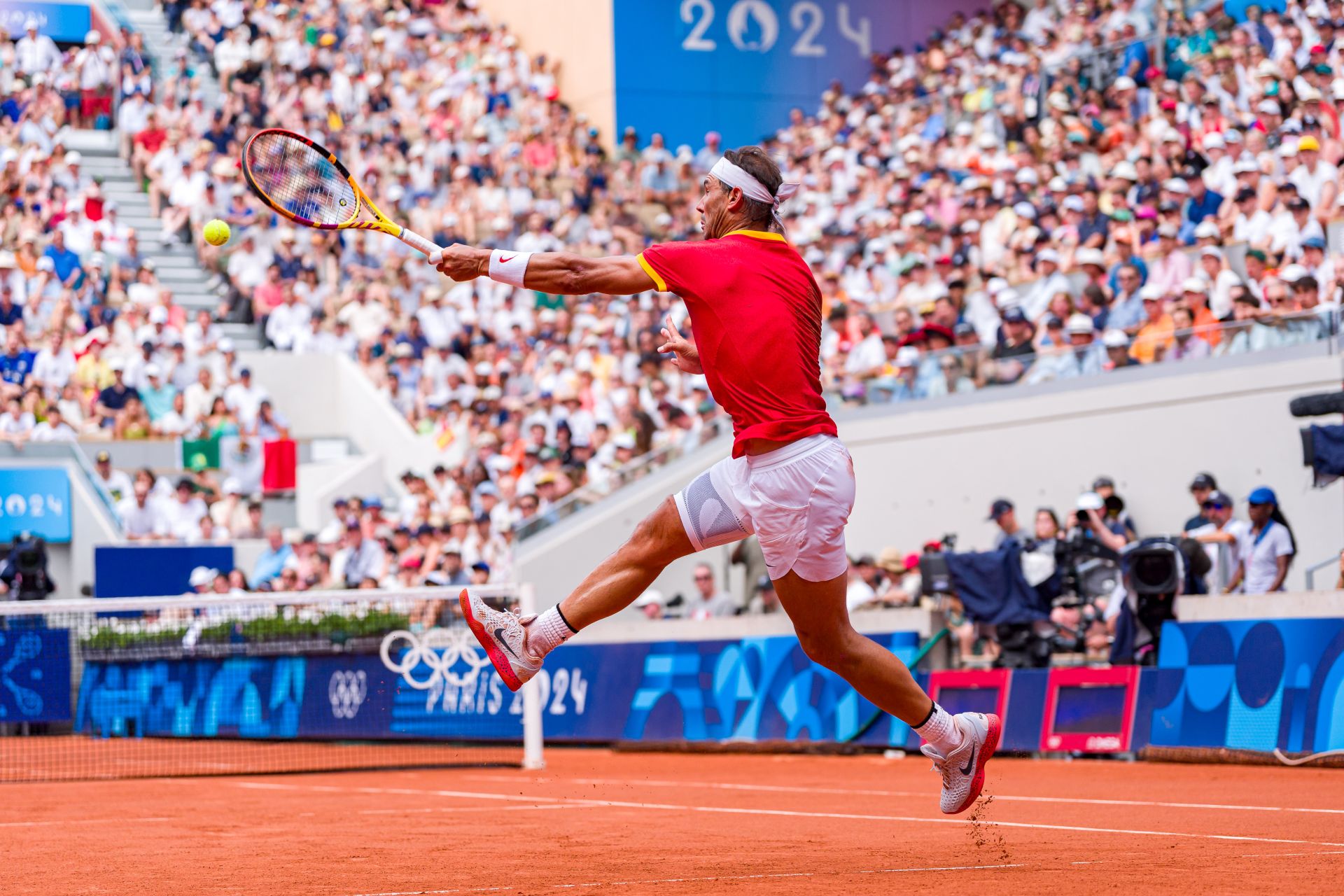
Because Rafael Nadal has been a beloved and respected icon of tennis for so many years now, part of the pantheon of the sport, it’s easy to forget that he wasn’t universally embraced at first. When he burst onto the scene in the mid-2000s, tennis traditionalists — especially fans of the Swiss champion Roger Federer, who was then at the apex of his powers — were aghast at the sight of the young Nadal with his sleeveless shirts and capri pants or “clamdiggers.” The Spanish term “piratas” (pirate pants) drives the point home: Nadal looked quite the opposite of the gentlemen playing “tennis in an English garden,” as the Wimbledon motto has it. The sport’s gatekeepers regarded him as a serpent in that garden, a leopard in the temple of tennis.
The most enthralling aspect of “Rafa,” the just-released four-part Netflix documentary, is the archival footage of those early years of the Nadal juggernaut. There’s an illuminating reconstruction of Nadal’s breakthrough moment when he defeated the American star Andy Roddick in the 2004 Davis Cup final in Seville, Spain. Nadal was then 18 and ranked a mere 51st in the world. Roddick, four years Nadal’s senior, was then ranked second. That victory turned a lot of heads on the professional tour. Within a few months, he was winning one tournament after another, culminating with the French Open in June 2005. That would be the first of 14 French Open titles and 22 major titles in a career that endured through 2024.
David Foster Wallace, the late novelist and arguably the most interesting tennis writer ever, was an early skeptic of Nadal. In his celebrated 2006 essay “Roger Federer as Religious Experience,” Wallace described Nadal as “mesomorphic and totally martial” and referred to him as “he of the unsleeved biceps and Kabuki self-exhortations.” By “Kabuki self-exhortations,” Wallace was alluding to Nadal’s habit of celebrating after winning a point by pumping his fist, raising his left knee in the air and giving a thunderous roar of “Vamos!” (“Let’s go!”). Nadal might have done more than anyone to popularize and globalize the Spanish phrase. Indeed, “Vamos Rafa!” became a rallying cry for his legions of fans across the planet, and even a brand slogan emblazoned on T-shirts and sundry tennis merch.
Rafa’s “sculptural” physique, as Christopher Clarey calls it in his 2025 book “The Warrior: Rafael Nadal and His Kingdom of Clay,” was especially unusual in professional tennis, a sport in which the typical build is on the slender side: Think Federer, Novak Djokovic, Alexander Zverev and Jannik Sinner, the current world number one — all extraordinary physical specimens, but a completely different build from Rafa. My son describes the Djokovic body as “skinny ripped.” That’s more or less the prototype for an elite tennis player.
Nadal, in contrast, “is built as if he could have had a career as an NFL halfback — if not a UFC cage fighter — had this tennis pursuit not panned out so magnificently,” Jon Wertheim wrote in his 2010 book “Strokes Of Genius: Federer, Nadal, and the Greatest Match Ever Played” (the subtitle being a reference to the 2008 Wimbledon final in which the Spaniard dethroned the reigning champion in a truly epic battle). Behold this photo from one of Nadal’s practice sessions, which were legendarily grueling:
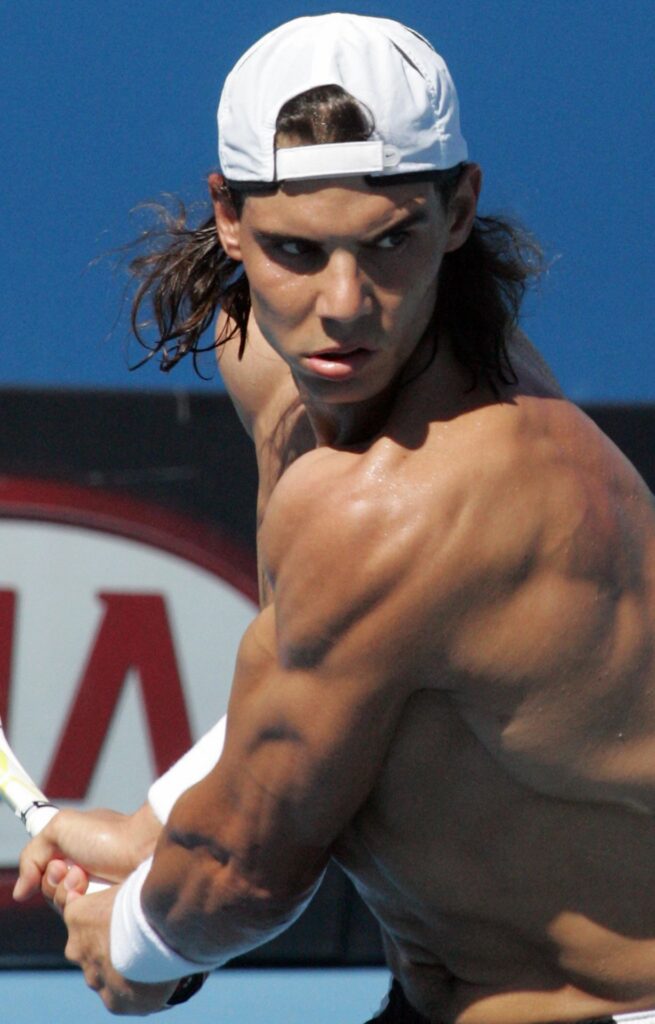
Rafa’s defining qualities are on full display here. The matador expression, the snarl on his lips — they emanate laserlike focus and lethal intent. He isn’t just preparing to hit a backhand, but to pulverize the ball. The energy is primal, bordering on the libidinal. You can almost hear the grunt that will accompany the shot he’s about to hit.
You can’t fully appreciate this aspect of Nadal’s style of play without hearing him grunt when he strikes the ball. If you’ve watched him play enough times, the Rafa grunt is almost ambient noise — you’re focused on the frantic footwork, the trajectory of the ball, the exchange of shots; the grunt is part of the equation, but it somehow just blends into the background. It really hits you what a raw and animalistic release his grunting is, though, if you listen to it without watching.
Contrast Federer’s silence with Nadal’s ferocity. “Feline light versus taurine heavy. Middle European restraint and quiet meticulousness versus Iberian bravado and passion. Dignified power versus an unapologetic, whoomphing brutality. Zeus versus Hercules,” as Wertheim put it in “Strokes of Genius.”
But it was more than his physicality or sound effects. Nadal played with an intensity that his compatriot and contemporary Fernando Verdasco once described as “brutal.” One thing that every player who faced Nadal says about him is that he never took a point off. His focus was unrelenting. “Rafa is always at 200%,” Verdasco said. He was like “a tiger in a cage,” Federer once remarked. “Rafa’s got that intensity and that energy that’s so debilitating to opponents,” the commentator and retired champion John McEnroe said. “It’s so intimidating — it tires you out mentally.” Beast mode was Nadal’s default mode.
There’s a statistic that brings this quality of Nadal’s into sharp focus. Rafa was the king of what’s called the “break back,” which is when a player breaks their opponent’s serve (wins their opponent’s service game) immediately after having their own serve broken. Nadal did this at the highest rate on the professional tour. It’s not just that he broke his opponents’ serve frequently, which he did — he broke right away, as if to immediately settle the score (literally as well as figuratively).
There’s a wonderfully revealing anecdote early on in Clarey’s book “The Warrior.” “When Nadal walks on a clay court for the first time after arriving at an event,” Clarey reports, “he likes to bend down and rub the clay with his hands to get a feel for its properties, to sense the level of humidity and whether it is more coarse than fine.”
This image speaks so palpably to the sensual nature of Nadal’s relationship with clay, on which he was more dominant than any player in the history of tennis (grass and hard courts being the other surfaces on which the sport is played). Another Spanish tennis star, Feliciano López, calls Nadal’s 14 French Open titles “the most amazing record in the history of individual sports.” (For perspective: In the “pre-Rafaelite era,” as Clarey calls it, Pete Sampras held the men’s record for most singles titles at a given “major” or “Grand Slam” tournament, having won Wimbledon seven times.) Add to this that Nadal never lost a final at the French Open — he was a perfect 14-0.
Which is not to say that Nadal was a “clay court specialist,” as players who could only win on that surface are known. Far from it: He won the U.S. Open (played on hard courts) four times, the Australian Open (also on hard courts) twice and Wimbledon (played on grass) twice — for a total of 22 major titles (the second most ever, after the Serb Djokovic’s 24). But it was on clay that “Rafa,” as he is known to his legions of fans, simply towered above everyone. “Clay is to Nadal what water is to Michael Phelps or midair is to Simone Biles: a natural habitat suited to serial success,” Clarey writes.
In French, clay courts are called “terre battue,” meaning “beaten earth.” They consist of a top layer of crushed red brick or tile over an 8-centimeter-thick layer of crushed white limestone. Unlike hard courts, which are impervious to weather, clay courts “play” very differently in hot versus cool temperatures and in dry versus humid conditions. Clay requires players to slide on the court, and it takes longer to pivot and change direction than it does on hard courts. The ball also bounces differently: The gritty texture sort of grips the ball and slows it down slightly. Balls hit with topspin bounce higher on clay than on hard courts or grass. Topspin existed before Nadal, but no one hit with more of it — or inflicted more damage using it — than he did.
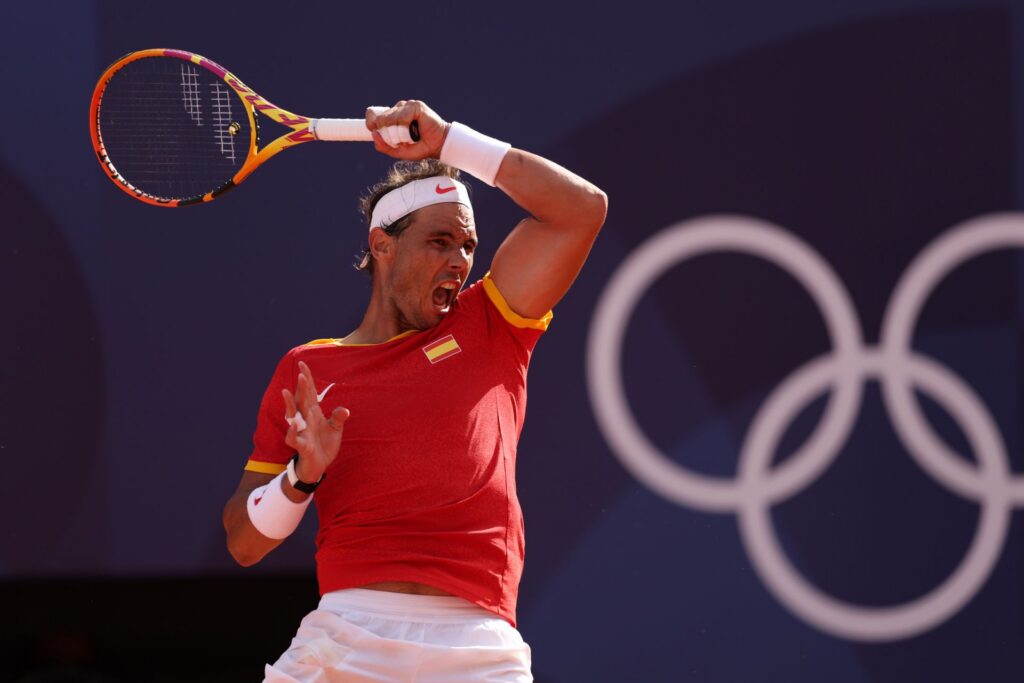
It’s been called the shot that broke tennis. Stylistically, Nadal’s forehand was an extraordinary spectacle to behold. Its flashy finish — alternatively described as a “buggy whip,” “wraparound,” “lasso” and “bolo” — quickly became iconic, captured in countless Rafa posters, T-shirts and memes.
The Nadal forehand was “a weapon the likes of which have never been seen in tennis,” as one commentator put it. It produced upward of 3,300 revolutions per minute on average and was clocked as high as 5,000 rpm. That kind of spin makes the ball rise high over the net and take a nose dive, giving it a “heaviness” that is more than figurative. For an opponent, it’s “like trying to hit a bowling ball,” the tennis coach and commentator Paul Annacone has observed.
Nadal’s left-handedness made his topspin particularly deadly when he hit it to the backhand of his right-handed opponents, because it jumped up over shoulder height, well above their comfort zone — especially for players with a one-handed backhand (like Nadal’s great rival Federer). Nadal’s forehand jumped off the court, not just up but away, often out of their reach. It left his opponents flummoxed, with a look of disbelief as his ball seemed to defy the laws of physics.
The commentator and former player Chris Eubanks recently pointed out how difficult it is to appreciate this while watching on television, with its default high camera angles. With a court-level camera angle, in contrast, you really see the dramatic height that Nadal’s topspin created and how difficult it was to have a ball doing that kind of dance as it comes at you.
Add to this Nadal’s exceptional footwork, which allowed him to run around his backhand and hit forehands from virtually anywhere on the court. From that position, Nadal could hit what’s called an “inside-out” forehand at a wicked cross angle or an “inside-in” forehand that went down the line. (If you want to know how difficult this is and you’re a casual tennis player, try doing it the next time you play: Commit to hitting only forehands, on every shot, no matter what. You’ll be winded very quickly.) This created a geometric nightmare for his opponents, “a style of tennis that no one up to that point had ever faced,” as Mats Wilander, a retired Swedish champion, put it.
It was this extreme physicality and relentless intensity that led Andre Agassi to wonder out loud, very early in Nadal’s career, if the young Spaniard was “writing checks that his body might not be able to cash.”
This was both prescient and partly negated by Nadal’s shocking longevity. Throughout his career, Nadal was plagued by injuries, several requiring surgery: tendinitis in both knees, injuries to both wrists, hip flexor and labrum injury, a fractured rib, abdominal tears, osteoarthritis in his thumb and severe back pain. Most devastating of all, in 2005 — the year he won the first of his 14 French Open titles at age 19 — he was diagnosed with Mueller-Weiss syndrome, a rare degenerative condition, in his foot. Nadal essentially played with a broken bone in his foot his entire professional career. He simply learned to play through the pain.
And yet he was the only male player to be ranked first in the world in three different decades (having first surged to the top in 2008 and doing it for the last time in 2020). He won 22 majors and continued to rack them up as late as 2022, when he won both the Australian Open (at age 35) and the French Open (at 36). So did he prove Agassi wrong? Yes and no. Injuries prevented Nadal from playing in 15 Grand Slam tournaments. Djokovic missed only one through 2024. It’s hard not to believe that Rafa would have won more major titles than Djokovic (rather than two fewer) had injuries not short-circuited him so frequently.
There’s a small category of athletes — very small, I think — who excite people with no interest in the athlete’s sport, or in sports at all. From the mid 1980s through the late 1990s, people all over my city of Chicago were enraptured by Michael Jordan. People who had never watched a basketball game on TV, let alone attended one in person, were all of a sudden gathering with friends at bars and people’s homes to behold this man who twisted and contorted his body while flying through the air, ball in one hand or cradled against his forearm — while somehow evading also-airborne opponents in the process — and ending this sublime sequence with a jaw-dropping dunk.
He was doing things never seen before, and that didn’t even seem physically possible. You didn’t need to know a thing about basketball or its rules to understand that you were witnessing something exquisite. It spoke its own language, one of beauty and awe. The looks on people’s faces, the screams they let out, the near-disbelief that they just saw what they saw: “Michael,” as he quickly became known, had tapped into some primordial substrate that transcended basketball and turned all manner of unsuspecting people into die-hard fans. More than a few went from never having so much as seen a basketball game to attending (in some cases even hosting) watch parties.
Nadal possessed this kind of appeal. All kinds of people who don’t follow tennis responded on a visceral level to the energy he exuded, the uncanny intensity he played with and the unrelenting warrior spirit he brought to every point, indeed every shot. That made watching him play an ecstatic experience. You don’t need to understand the various lines crisscrossing the court or the game’s elaborate scoring system to “get” Rafa and his aura.
Federer inspired profound admiration, even awe, with the artistry of his game and the balletic elegance of his movement on the court. And it was the stark contrast between the two that made their rivalry so compelling — without question one of the greatest in the history of sports. But while Federer was the tennis player’s tennis player, the embodiment of everything the game is supposed to be, Nadal’s appeal was more instinctive and accessible to the uninitiated.
Jordi Díez Fernández, the sculptor behind the life-sized steel statue of Nadal that stands at the entrance of Roland-Garros (the French Open venue), speaks to this transcendent quality. “The vast majority of people who follow Rafa in Spain and elsewhere don’t play tennis,” he told Clarey. “And that makes you wonder why Rafa is so closely followed and why he generates so much emotion in so many people who don’t play the game he plays.”
Similarly, the Netflix series “Rafa” requires zero prior knowledge of tennis or familiarity with Nadal’s career. This is partly, I suspect, because the previous films by the director, Zach Heinzerling, have nothing to do with tennis, or with sports at all. They focus, respectively, on art, music and a cult that destroyed the lives of a group of college students. “Rafa” is as accessible and compelling as its subject. But there are new discoveries and delights for longtime Nadal watchers as well.
For example, Nadal went through a bad slump and a crisis of confidence in 2015. He discussed it in interviews at the time, but the Netflix documentary reveals the true depth of the crisis and that Nadal turned to a psychiatrist for help. He was struggling with controlling his emotions and had panic attacks during matches that caused distortions in his vision. He had to have a water bottle in his hand almost constantly, out of fear that he would choke on his own saliva.
It’s hard not to link this with something we learn earlier in the documentary. When Rafa was a kid, his uncle Toni, who coached him, didn’t let him drink water for the first hour of practice, as a way of conditioning his young charge to endure suffering and “toughen” him up. Uncle Toni pushed his nephew hard over the years, and the results speak for themselves. But it also caused some tension within the Nadal family, and after the struggles in 2015, Rafa decided to take on a new coach, his fellow Mallorcan and former tennis champion Carlos Moyá. Rafa didn’t fire his uncle; Toni and Moyá were co-coaches. But that arrangement didn’t last for long: Toni felt squeezed out and left the team in 2017.
That Uncle Toni was indispensable to Rafa’s stratospheric success is beyond doubt, and the intimacy of their relationship looms large in the documentary. But this darker side of the story might be the film’s biggest surprise, a haunting note in a mostly celebratory portrait.
In one of my favorite scenes, Nadal, sitting in the back of a moving car, ruminates that his 14 titles at a single major arguably represent a greater achievement than Djokovic’s 24 overall major titles. He would even be willing to wager, he says, that his record will prove harder to break than his rival’s. I like this moment because Nadal has long taken the high road in the never-ending GOAT debate. “I think that with respect to titles, Djokovic is the best in history and there is nothing to discuss about that,” Rafa said in 2023. “I believe that numbers are numbers and statistics are statistics. In that sense, I think he has better numbers than mine, and that is indisputable.” Such humility has been characteristic of the Spaniard throughout his career.
It’s one of his most endearing qualities, and I think it’s authentic. But his confessional remark in the Netflix documentary brings Nadal down to earth, revealing a bit of pride and ego. It also complicates Nadal’s insistence that his competition is purely internal. “I don’t train thinking of beating Djokovic or Federer or Murray. I train thinking of surpassing myself and my own limits and being the best I can be,” he told Clarey. Again, I believe that, but the car ride comment reveals that he does think about Djokovic and does care about their respective legacies. Both things can be true.
I especially appreciate the Spaniard’s assertion as someone who regards him as a vastly more exciting and compelling player to watch than Djokovic.
And not only Djokovic. With the single exception of Carlos Alcaraz, whose style of play is truly thrilling, I think the men’s game in the “post-Rafaelite” era is, despite its abundance of undeniable talent, largely monotonous and monochrome. Sinner might be playing the most impressive tennis ever played from a technical standpoint — hitting the ball harder from both wings and with fewer unforced errors than anyone before him — but it’s boring. The former player Andy Roddick captured it perfectly on his popular tennis podcast Served. “Sinner is an algorithm; it’s like input-output. It’s incredible. He’s like AI.”
Most of the top male players feel like only slight variations on this theme. Rafa’s wild innovations and primal intensity stand in marked contrast to this disconcerting trend. His departure from the game leaves a yawning void.
Watch: New Lines‘ Danny Postel on Rafael Nadal’s primal charisma:
Become a member today to receive access to all our paywalled essays and the best of New Lines delivered to your inbox through our newsletters.