

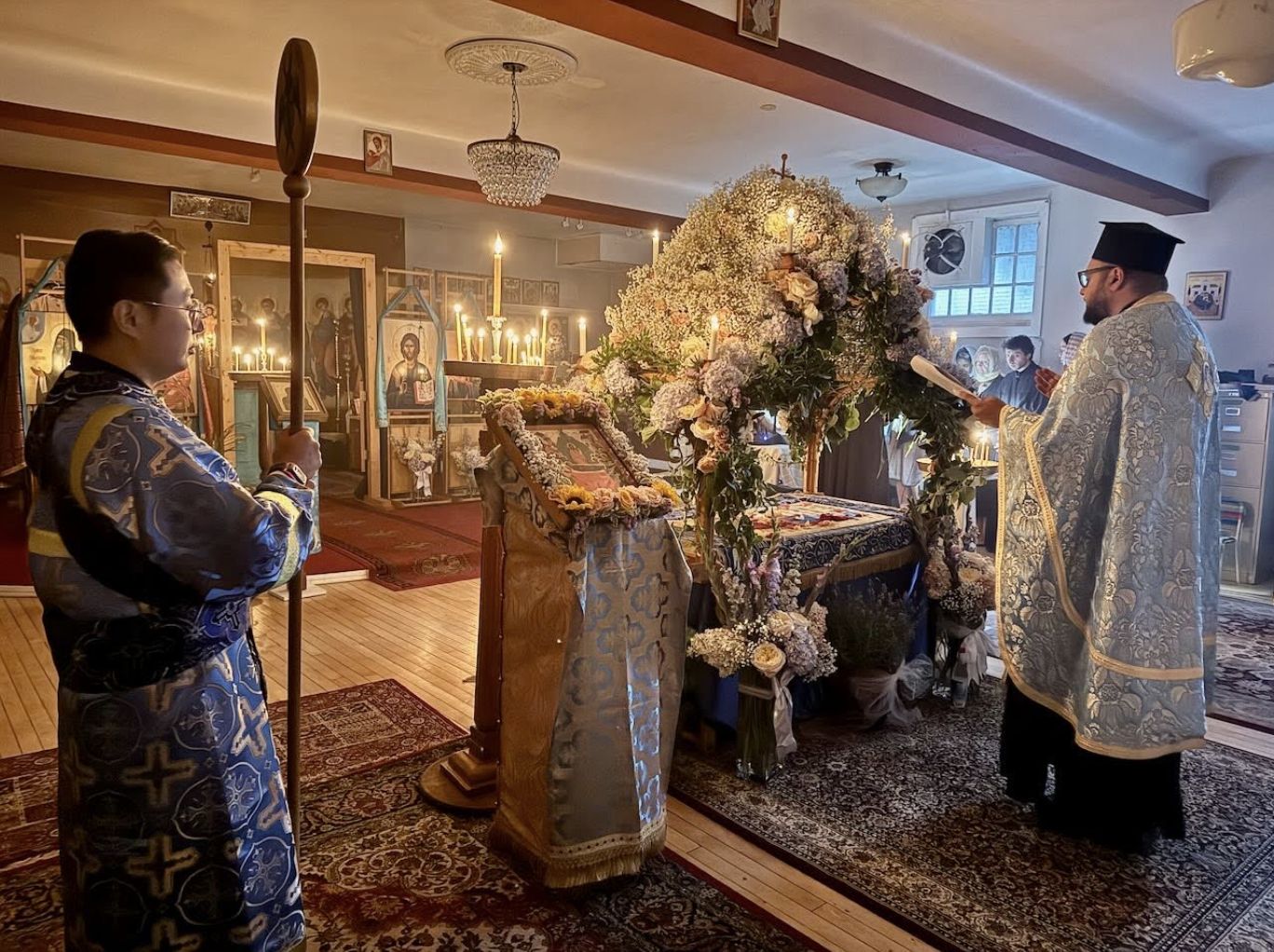
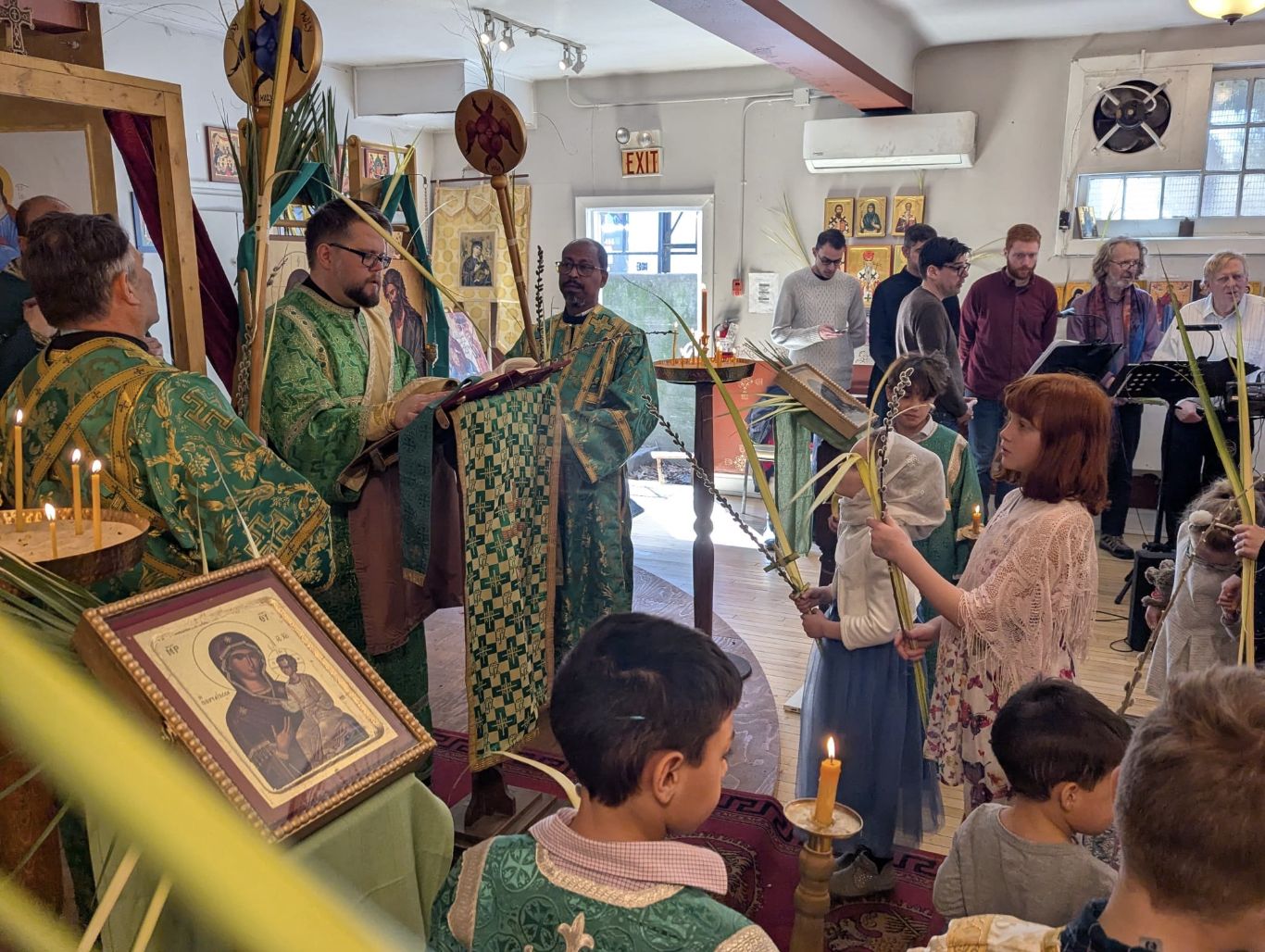
Three people hold keys to St. Silouan the Athonite Orthodox Church in Toronto. One is the priest, one a deacon and the third is Anthony, who has been homeless for three years, lives with schizophrenia and serves as church warden. He opens up at 8 a.m. on Sundays and lights the candles before anyone arrives.
“Technically, on the payroll, there’s me,” said the Rev. Paul Tadros, the rector. “And there’s a man who lives with schizophrenia,” referring to Anthony, who receives $200 a month.
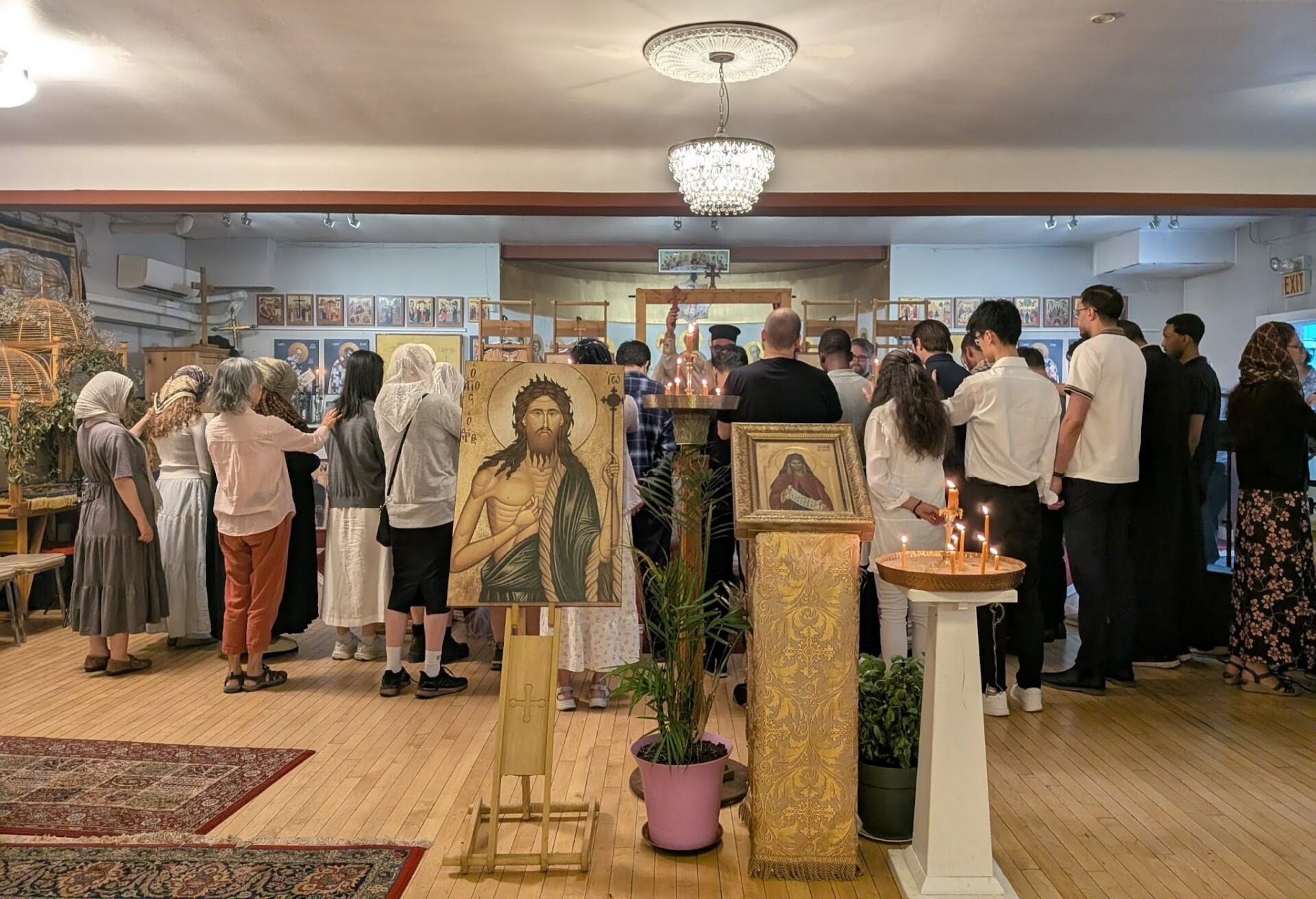
St. Silouan’s parish rents a basement from a Bulgarian Orthodox church in Regent Park, one of Canada’s most diverse neighborhoods. Around 80 people come on an average Sunday, including Greek, Romanian, Serbian, Ukrainian, Arab, Russian and Egyptian families, alongside Canadian-born converts.
At 10 a.m., the lights come up on the hymn “Glory to Thee Who Has Shown Us The Light” and Samir Hatem, a Lebanese Maronite who grew up in an Oriental-rite church and never felt at home in Toronto’s Latin parishes, says that is the moment. “You feel that you entered into the light.” Hatem found St. Silouan’s on his own, by searching “Orthodox church Toronto,” and kept coming back once his wife, Roxana Aras, an anthropologist who studies Orthodox communities, started coming too.
Then comes the Lord’s Prayer. Tadros switches his delivery from English into Greek, Slavonic, Romanian, Arabic, Coptic, Persian, Mandarin, Finnish, Cantonese and Hebrew.
In total, it amounts to at least 16 languages. Only recently has anyone begun to think that it runs too long.
“The many become one,” he said. “When I hear Mandarin or Farsi, these are not native languages to traditional Orthodox lands, but they are now.”
There are few rooms on Earth where the same prayer is said in Arabic and Hebrew by people standing shoulder to shoulder. The languages spoken there predate most of today’s borders.
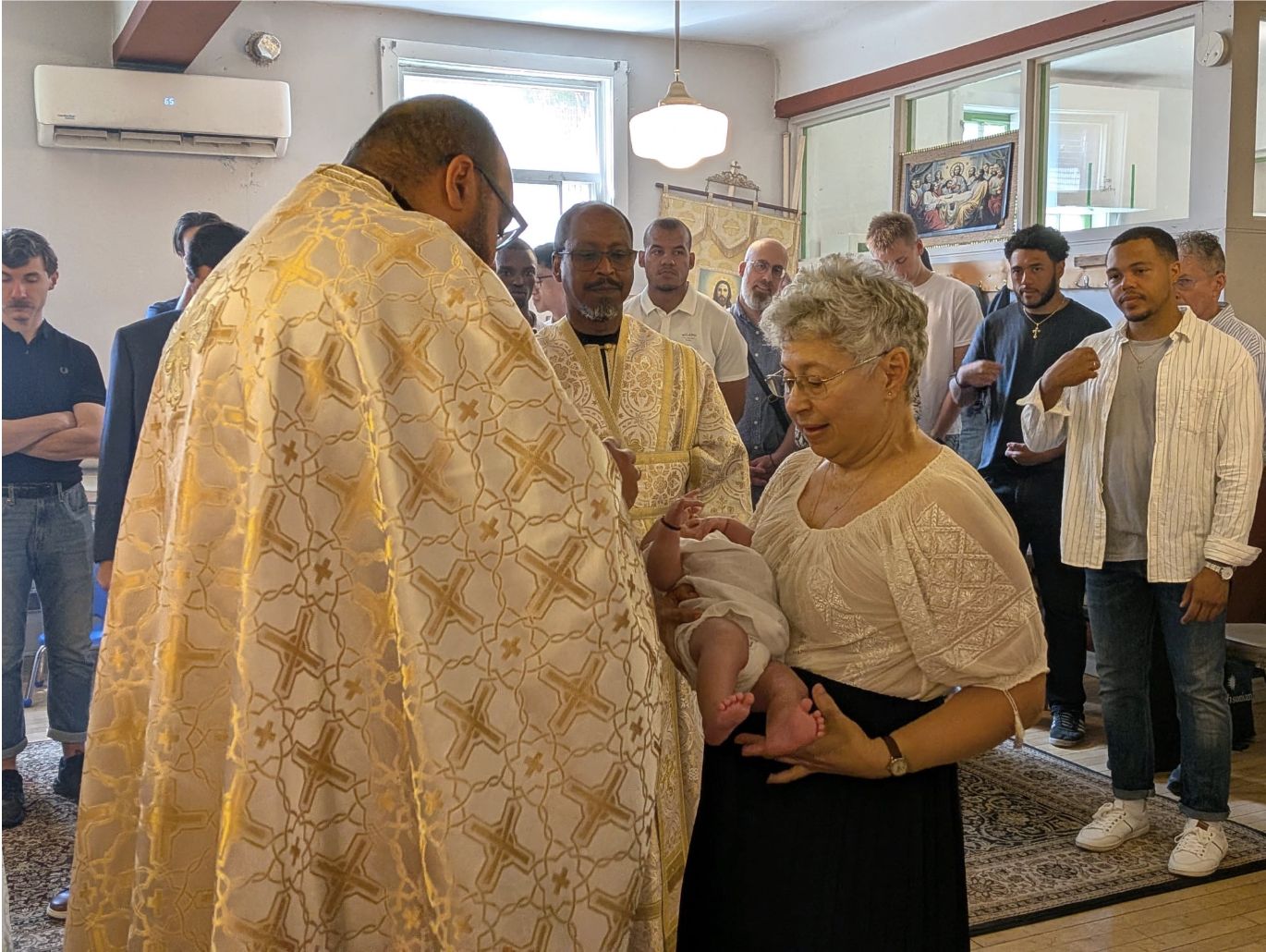
Polina Sanfilippo, the choir director, was born in Moscow to a secular Russian Jewish family, moved to Israel at 7 and Canada at 16. She and her husband are godparents to a boy in the parish whose family is Egyptian.
“Here I am, a Russian Jew, and my godson is Egyptian,” she said. “Where would that happen anywhere else?”
What’s happening in that basement is happening, unevenly, everywhere Orthodoxy has landed across North America: The old model of one ethnicity, one language, one parish is buckling under the same pressures in different cities, and each community is answering differently.
But the historic and liturgical differences in that basement began long before any of the worshippers at St. Silouan reached Canada.
In Christianity’s earliest centuries, there was no Greek, Coptic or Russian church. There were bishops in Alexandria, Antioch and Rome, known by their cities rather than nations, and congregations were mixed.
Tadros refers to Pentecost, the day the Holy Spirit is believed to have descended on the apostles, and a crowd of people with many different native languages heard them speaking in their own tongues.
He insists his parish is not an experiment. “We’re as old stock Orthodox as it comes,” he says. “And I dare say we’re probably acting older than the oldest stock.”
The division came later. In 431, bishops gathered at the ancient Greco-Roman city of Ephesus, now in western Turkey, over a dispute about Christ and what to call the Virgin Mary: Was she the mother of his humanity alone, or Theotokos, the one who gave birth to God?
The council upheld Theotokos. If Christ was one person, fully God and fully human, then Mary bore that one person, not a separate human figure joined to God.
Twenty years later, bishops met at the ancient maritime town of Chalcedon, now in Istanbul’s Kadikoy district, and defined that relationship more precisely. Christ is one person “in two natures,” they said, divine and human, without confusion or separation.
Many Christians in Egypt and Syria rejected the formula; the Armenian and Ethiopian churches ultimately stood with them. They feared that speaking of two natures could pull apart what Ephesus had joined, and preferred Cyril of Alexandria’s language of one united divine-human nature. For them, Ephesus had already settled the essential point: Christ was one.
“The non-Chalcedonians would say Ephesus was clear, and the Chalcedonians would say Ephesus needed to be explained through Chalcedon,” Tadros said.
The churches on either side formed two Orthodox families. Those who rejected Chalcedon became the Oriental Orthodox churches: Coptic, Armenian, Syriac, Ethiopian and Eritrean. Rome and the eastern churches that accepted Chalcedon remained in communion for centuries, although divisions grew between them. Their separation is conventionally dated to the Great Schism of 1054, though it unfolded over a much longer period. The eastern churches became the Eastern Orthodox Church.
The two strands of Orthodoxy remain formally out of full communion after 1,500 years, although modern theological dialogue has concluded that both profess the same Christological faith: Christ is fully divine and fully human, one person, though they describe that union differently.
Tadros grew up Coptic and credits the Coptic priests who raised him with teaching him pastoral care. He was received into Eastern Orthodoxy in 2012 and says “the Coptic Church, in my opinion, begins in earnest in 451,” because before Chalcedon it was not yet a separate church. In Cairo, that is a provocative claim. Copts trace their church to St. Mark in first-century Alexandria, so dating its beginning to 451 makes the schism, rather than its apostolic foundation, the starting point.
Candace Lukasik, an anthropologist of the Coptic diaspora who converted to Coptic Orthodoxy herself, sees another history behind the way Copts argue about what counts as authentic Orthodoxy. Missionaries had long described Coptic Christianity as backward, especially as Catholic and Protestant missions grew in the 19th century. Habib Girgis, who became dean of the Coptic seminary in 1918, pushed back in part by adopting one of their tools: Sunday school, with doctrine taught systematically in a classroom. It eventually enrolled tens of thousands of Coptic children.
Practices passed down through families, like fasting, kissing icons and keeping saints’ days, could increasingly be dismissed as culture if people could not explain the doctrine behind them.
Yet in North America, people born into traditions that spent centuries apart are now ending up praying in the same room. That has left Orthodox churches with an old question in a new place: What travels with the faith, and what belongs to the country it came from?
The Rev. John Jillions, a former chancellor of the Orthodox Church in America, had confronted the problem of language and national identity decades earlier. In 1984, he was sent from New York to an Orthodox parish in Brisbane to explore celebrating services in English.
Two years later, he led its parish council in making it an English-language mission, the first Orthodox parish in Australia to make English its primary liturgical language. Some parishioners left; Orthodox Christians from other backgrounds and a small number of converts began attending.
Jillions points to an older precedent in 19th-century Alaska, where Russian missionaries translated services into Yupik, Tlingit and Athabaskan. Some 90 villages there remain Orthodox today, communities that, in his words, “don’t see Orthodoxy as an immigrant faith.”
Elsewhere, Orthodoxy arrived divided by the countries people had left behind, with more than a dozen overlapping jurisdictions still answering to churches abroad. But “a kind of natural pan-Orthodoxy has emerged,” Jillions said.
George Demacopoulos, who directs Fordham’s Orthodox Christian Studies Center, sees that happening most clearly where geography leaves churches little choice.
“They’re going to draw the Serbs, they’re going to draw the Romanians. They’re likely to even draw the Copts and the Armenians. And then functionally they’re going to operate almost entirely in English.”
Parishes organized around one nationality face another risk. Aras, the anthropologist married to Samir, watched Romanian Pentecostal children in Michigan drift toward English-speaking churches when they could no longer follow the language.
Orthodoxy can delay that loss because “the faith comes through the doing,” she said: standing, crossing yourself, kissing an icon. Parents can assume understanding will come later, sometimes without noticing their children are already drifting away. That same quality can draw outsiders in.
Jillions remembers a reporter describing a Russian service she could not understand: “Everything I do is so rational. I love being in a place where it’s not rational.”
The Coptic Church has been working through the same tension from the other side of Chalcedon.
The Rev. Michael Sorial once posed a question to Pope Shenouda III before an assembly of priests from across the northeast: Why were Coptic churches in Egypt, sub-Saharan Africa and Asia largely indigenous, while those in North America remained overwhelmingly immigrant? Shenouda’s answer stayed with him.
Coptic priests in America, he said, were good at teaching their own communities but less practiced at reaching beyond them. They needed to give people the faith, not the culture.
That answer found its use when Sorial left a thousand-person parish in Queens to plant St. Anianus in central New Jersey with three families, his own and two others. Within three months, both families he had recruited were gone: One father was ordained to a parish on Staten Island, while the other was transferred for a job.
“So I felt God was telling me, ‘You’re not building this church, I am,’” Sorial said. “And I was like, ‘OK, I’m fine with that.’”
Sunday attendance settled around 25, a changing mix of newcomers, and Sorial began serving whoever showed up, Egyptian or not. When a parishioner accused him of abandoning Egyptian children to serve outsiders, he bristled. “I can walk right by someone who potentially is perishing, and I’m like, they’re not my people? That’s so tribal. It’s tragic.”
After Egypt’s 2011 revolution brought a new wave of Coptic immigration to North America, much of it from rural Upper Egypt, the tension sharpened. At one Jersey City parish studied by Lukasik, three Sunday liturgies emerged: one in English, one mixed, and one dominated by newer Upper Egyptian families.
The Rev. Lazarus Yassa, a former journalist ordained in 2008, leads a Coptic parish in California that is mostly English-speaking and roughly half converts. It grew out of a ministry serving homeless people, and more than half the congregation now serves the poor. In his diocese, women now serve in what is formally called the ecclesiastical choir, vested and standing near the front, though not among the male deacons.
“It is kind of to establish a role that has been part of the faith in the past,” he says, a practice his diocese’s bishop, Metropolitan Serapion, who leads the Coptic diocese of Los Angeles and Southern California, initiated roughly 15 to 20 years ago. Similar customs exist among the Syriac and Armenian churches, sister traditions in communion with the Copts.
In Montreal, the Rev. Gabriel Wissa co-founded Coptic Orthodox Answers because, as he put it, “we have a treasure, and this treasure is hidden, and it shouldn’t be hidden.” The YouTube channel now has more than 60,000 subscribers and over 700 videos, with more than 7 million views in its lifetime.
Across the old Chalcedonian divide, Eastern Orthodox parishes have been asking the same question. How much of an immigrant church’s identity belongs to the faith, and how much to the culture that carried it here?
When the Rev. Anthony Baba arrived at an Antiochian parish north of Houston, Texas, in 2010, 25 families were worshipping in a trailer. Five hundred people now come on Sundays: Lebanese and Syrians alongside Eastern Europeans, Mexican families “coming in droves,” a handful from Cameroon and some African American converts.
The parish’s own sign reads only “St. Anthony Orthodox Christian Church,” with the word Antiochian, the jurisdiction’s name, left out. A label meant to welcome one group can read, to everyone else, as a closed door.
The growth is striking partly because the national numbers point the other way.
Pew’s latest Religious Landscape Study puts the Christian share of American adults at 62%, down from 78% in 2007, while Orthodox Christians are about 1% of the population. From 2010 to 2020, per the U.S. Census of Orthodox Christian Churches, Eastern Orthodox adherents fell from 816,653 to 675,765, a 17% drop. Oriental Orthodox churches, the Coptic church among them, grew over the same decade.
Yet some parishes are expanding quickly. Alexei Krindatch, who coordinates the U.S. Census of Orthodox Christian Churches, also found in 2022 that about 1 in 8 Eastern Orthodox parishes had surged since the COVID-19 pandemic, especially those with more converts. This was part of a longer trend: The Assembly of Canonical Orthodox Bishops of the United States reported in 2015 that nearly half the country’s roughly 1 million Orthodox Christians were converts.
Demacopoulos says the wave is real, though nobody yet knows how much of it will hold. “How long are these people sticking around? What they are going to find in a parish is going to be really, really different from some of the stuff that passes itself off as authentic online.”
Sarah Riccardi-Swartz, an anthropologist at Northeastern University who converted to Orthodoxy in 2011 and was a parishioner at Baba’s church in Texas from 2020 to 2022, watched the demographics shift. During COVID-19, she said, many arrivals were muscular, chronically online, manosphere-adjacent white men. Since then, the mix has widened and varies sharply by place.
Much of the media coverage of Orthodoxy’s growth in America has remained fixed on that first group, describing the church as a draw for young men seeking a harder, more masculine Christianity. Converts in some regions do skew male, and Orthodoxy is the only Christian tradition in America that is not majority-female.
But Demacopoulos says the picture has been exaggerated: The overall split is about 53% male to 47% female, and church authorities have repudiated the masculine framing. He also argues that recent converts are too often allowed to speak for whole parishes. Meanwhile, young women elsewhere in the Coptic Church were being given new roles at the altar rail.
The people actually arriving at these churches tell a broader story. Tameka Nicole, 51, grew up Pentecostal in New Jersey. A pastor’s request that the congregation observe Advent sent her into a year of study that eventually led her to ask why Ethiopian and Eritrean churches were rarely mentioned alongside the Greeks and Russians.
Nicole, who is Black American, screened nearby parishes with two questions: “Do I see someone who looks like me? Are there services in English?” At a Coptic church, what stayed with her from the first liturgy was simple: “I’ll always remember walking into the sanctuary and feeling comfortable, and being met by warm gazes.”
After she was baptized in 2024, she found a point of connection in the persecution that shapes Coptic memory. “I don’t feel like it’s the same thing, and I never want to feel like I get it,” she said. “But there is a point of connection. Faith in God is what sustained enslaved Africans in America for generations.”
Polina came from the opposite direction. Her family treated religion as something the weak did, and the icons in her aunt’s house in Saskatoon struck her as absurd. “There’s pictures of people all over the place,” she remembered thinking, “and you kiss them?” She arrived at St. Silouan’s in 2007, when it drew 10 people, and fainted a couple of times during her early fasts.
Tadros thinks the draw is simpler than the commentary allows. “A lot of people, especially post-COVID, are looking for authenticity,” he said. “Everybody inherently is looking to come home. And it feels like this world, if it’s becoming good at anything, is making it seem like there’s no home.”
His own parish almost did not survive to see any of it. In 2019, St. Silouan’s was splitting and hemorrhaging members, and the bishop moved the congregation out of its building.
Tadros, until then a deacon, was ordained in the middle of the crisis. A friendly church lent them a basement for no more than two months. “In 2019, we had $0, and we had no idea where we would go.” The parish register counted about 60 people when Tadros took over; it has roughly 120 now, in a space they have already outgrown.
They stream the liturgy and do almost nothing else online, which Tadros defends on the grounds that an audience changes what a church is willing to be. “You could begin to smile harder for the photo, because of its marketability.” What nobody at St. Silouan’s or anywhere else can tell you is how many of the newcomers will still be there in 10 years.
Lucia Keeler was baptized into a Coptic parish in New Jersey in 2022, five years after her first liturgy there. She had spent those years visiting Armenian, Syriac, Ethiopian, Macedonian and Orthodox Church in America churches. It took her five months just to enter the Coptic one: Wikipedia called Copts an ethno-religious group, so she assumed she might be turned away and waited for the church’s Egyptian festival. “They want people to come and spend money,” she thought. “So I’ll just go then when they’re not going to kick me out.”
After baptism, the community she expected did not materialize.
When her family moved to Minnesota, she stayed in New Jersey. Her priest helped her find work, but during the seven weeks before her apartment became available to her, she stayed first in a hotel and then in a Pentecostal halfway house, which also hired her to teach fifth grade and run its after-school program. She spent two Thanksgivings alone. When she told her priest she was struggling, she was encouraged to focus on the positive. Later, she was told that people had noticed she no longer smiled.
What she wanted was simpler. Nobody had taught her how to fast. She imagined parish families bringing new converts into their kitchens, showing them how to make the meals and sending them home with leftovers.
“Don’t tell them, teach them,” she said. “And teach them within the context of community.”
She no longer attends that parish regularly, though her faith has not changed. “That does not have any bearing on the historical accuracy of Orthodoxy, the theological accuracy of Orthodoxy. Not to me.”
Converts are not the only ones who leave quietly. Priests often describe the church as a hospital for the sick, a place for slow spiritual healing. Riccardi-Swartz says that this language can mean women who report mistreatment are counseled toward patience and humility, while the person causing harm is treated as someone still healing. “I understand the narrative of the church as a hospital, but there’s only so much you can do if a person refuses treatment,” she said. More often, the women she hears from simply stop coming.
Demacopoulos also sees young women leaving, in part because they have come to expect leadership elsewhere in their lives and often do not find it in Orthodox churches. Meanwhile, another force is shaping those who stay and those who arrive: the internet. It has brought new converts into Orthodoxy, but it can also deepen older divisions.
Yassa began podcasting after an Eastern Orthodox priest called Copts heretics online, drawing Protestants, Catholics and atheists into conversations his parish could never have started.
Riccardi-Swartz worries that online personalities can now carry more influence than bishops. “My concern is that people with these outsized voices will become the dominant voices, even if they’re not the dominant population converting,” she said.
Tadros hears Chalcedon returning through new channels. “It entrenches things, ossifies narratives,” he said, “as opposed to allowing for greater understanding.”
What holds St. Silouan’s together is what happens after the service ends. On Monday nights, the basement that serves as St. Silouan’s church becomes a dining hall, with volunteers cooking for about a hundred people while a doctor sees patients, and children gather nearby. The ministry is called Noble Joseph, though Tadros resists calling it a program.
“Your prayer life informs the way that you engage your brother who is naked, who is hungry, who is lonely, who is mentally ill, who is rejected,” he said. “I cannot be comfortable with my God and neglect the world that he created.”
The first adult he baptized, in 2019, was an Ojibwe woman named Jolene, among the poorest people in the parish, who bakes cakes for the community every Monday night and has become one of its mothers. He said that while people sometimes imagined that Christianity and Indigenous communities were at odds, “I would say, come to St. Silouan’s.”
Polina is careful about how she describes those evenings, because she has seen soup kitchens and this is not that. “There is no feeling of division between them and us.” One woman who first came for dinner now comes to liturgy and, though she cannot read and is often unwell, she has become one of the steadiest believers there.
Tadros insists the charity does not run in the direction people assume. “When you actually disable a person from being able to give, you take away their humanity,” he said. “It’s not a breadline. It’s a house of hospitality.”
Samir, who cannot receive communion there because he is Catholic, needed eight words for the difference. “Less intellectual, more lived. Less theoretical, more applied.”
Michael Taylor used to take out the garbage at the old church and sit by the door. Adopted young into what Tadros described as an unkind family, he never knew his birth family. He loved Elvis and the Maple Leafs and rarely traveled beyond Toronto.
The parish lost him in the shuffle of 2019, the year it lost its building, and found him again during COVID-19, by which point diabetic neuropathy had taken his legs and he could not get out of bed. So they organized a visitation rotation, and people went to sit with him.
Tadros had asked him years earlier whether he had ever thought about being Orthodox. Michael said he was OK, thanks. In his last two weeks, Tadros asked again, and Michael nodded. With no font, he carried water from the tap in his hands and baptized him in bed. Soon after, an ambulance took Michael away, and he waved goodbye.
He died on a Friday morning in January. Polina arrived first and sang “Christ Is Risen” over him. Joanna, an older woman from the parish, came next and held his hand.
Michael had told Tadros nobody would claim him, and nobody did. After two months without finding next of kin, the coroner released his body to the church. Ten people were allowed inside, and they buried him.
Become a member today to receive access to all our paywalled essays and the best of New Lines delivered to your inbox through our newsletters.