

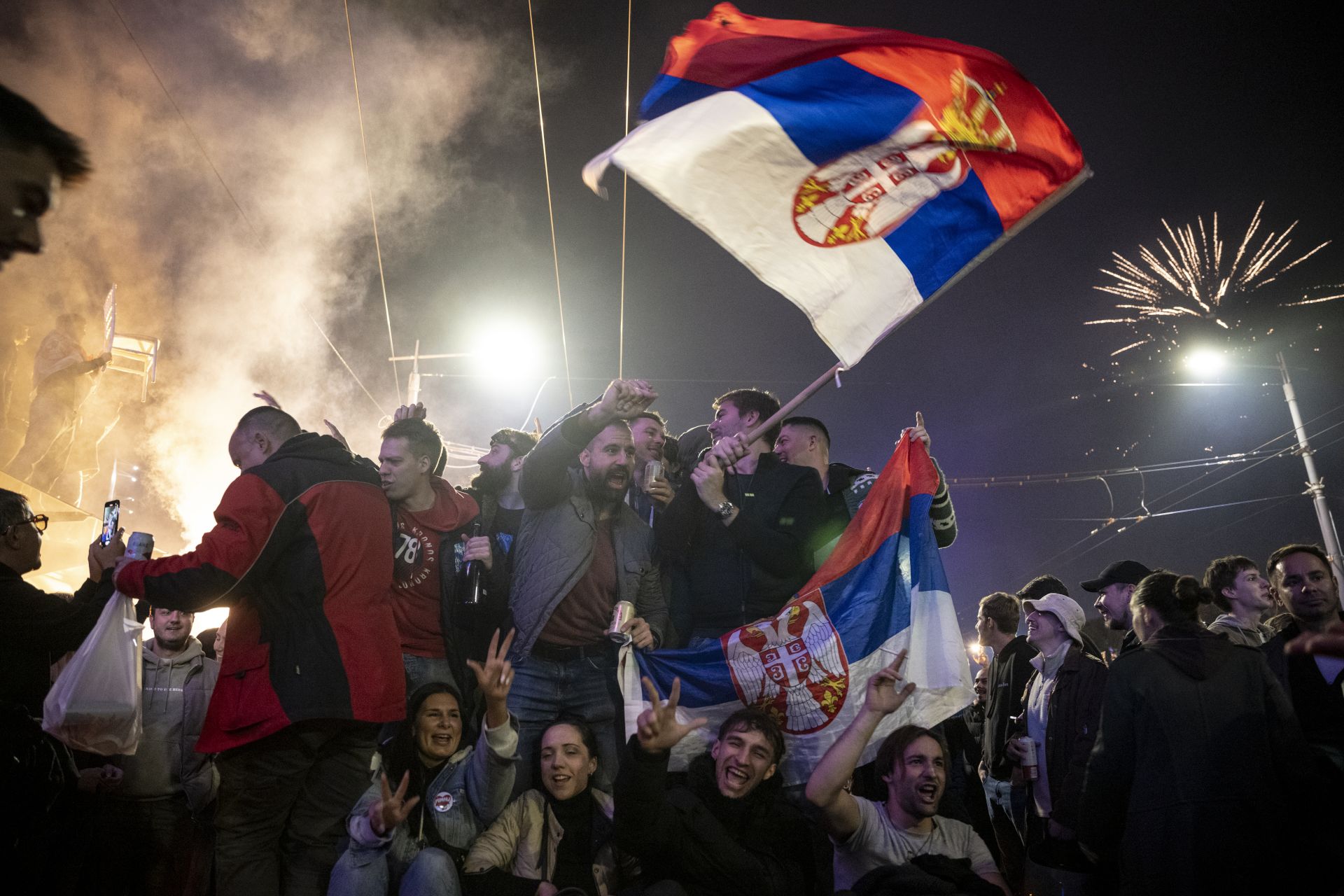
For the second time in just over a quarter-century, Serbia has seemingly thrown off the yoke of one-man rule.
In October 2000, Serbians mobilized — first at the ballot box, then in the streets — to oust the genocidal regime of Slobodan Milošević. In October 2026, it was sufficient for them merely to vote in overwhelming numbers to force the concession of the strongman at the helm. This time Serbians ousted Milošević’s protege, Aleksandar Vučić, and his ruling Serbian Progressive Party (SNS) after their nearly 14-year tenure in government.
The vote capped two years of protest that began in November 2024, when a newly renovated canopy at Novi Sad’s railway station collapsed, killing 16 people. An insurgent student movement blamed the deaths on government corruption, which they saw as a hallmark of Vučić’s rule, and their ensuing blockades of universities grew into the largest protest movement in Serbia since 2000. The movement eventually coalesced into the so-called Student List parliamentary coalition. On Sunday, this bloc won 53% of the popular vote and secured around 140 seats in the country’s 250-seat National Assembly, providing it with a comfortable, stable governing majority.
Domestically, the Student List ran on a sweeping anti-corruption platform. Its foreign policy agenda, however, is virtually indistinguishable from that of the SNS — at least on paper. Why? Because Serbian nationalism remains, arguably, the most potent political force in the country. The vote that propelled the Serbian List into power is a heterodox amalgam of the country’s moderate, liberal public and the antiregime far right (voters who believe Vučić has been insufficiently hard-line, for instance, in opposing Kosovo’s sovereignty, and would like the country to pursue still deeper ties with Moscow). The same curious combination was evident throughout the two-year protest movement preceding the vote. A very similar coalition toppled Milošević in 2000.
This is the bind in which Serbia’s would-be democrats find themselves. Their aspirations to remake the country’s political order depend, in part, on the support of some of the region’s most reactionary elements. Yet the past 40 years suggest that, much as in Russia, Serbia’s regional ambitions and democratization at home are at odds. The reason is institutional.
Pressing Belgrade’s expansionist claims against Kosovo, Montenegro, and Bosnia and Herzegovina has required security services that have waged clandestine wars, paramilitary and criminal proxies controlled by the regime, and a captured media to propagandize such efforts to the Serbian public. Those instruments for external violence have, in every instance, also been turned on Serbia’s own citizens. Between 1991 and 1995, for example, Serbia’s state security special forces were deployed in Croatia and Bosnia. In 2003, some of its most senior operatives directed the assassination of Prime Minister Zoran Đinđić. Under Vučić, the same confederation of security sector operatives and organized crime figures that orchestrated the deadly paramilitary attacks in Kosovo in September 2023 were repeatedly deployed to violently break up peaceful anti-government protests in Belgrade and Novi Sad.
Does that mean genuine normalization in regional affairs is doomed, before the new government has even been seated? No. But it means that for the foreseeable future, the most transformative changes may need to be piecemeal.
For instance, Dejan Šoškić, the former head of Serbia’s central bank, is one of the more serious candidates to be the country’s new prime minister. He has suggested that lustration (a full, public accounting of the wrongdoing of past governments) of Vučić’s expansive network of regime-aligned oligarchs, and their respective commercial holdings, will be a priority for the new government.
Lustration is precisely what was missing after Milošević’s fall. The country’s security archives were never opened, the regime’s apparatchik class was never stripped of power, and the intelligence, military and police apparatus was never reformed. The result was the return of the Milošević B-team, with Vučić at its fore, barely 11 years later.
Šoškić is speaking of lustration in the sense of economic reform, but his government could easily expand the effort to the state’s broader institutional regime. The new government could declassify the security archives, allowing researchers and survivors to finally learn the whole truth about the Serbian state’s direct involvement in the wars of the 1990s. It could also permit the Serbian public to definitively learn whom the state surveilled, harassed and assassinated, both between 1987 (when Milošević first came to power) and 2000, and thereafter.
The precise facts of the assassination of the country’s first reformist prime minister, Zoran Đinđić, in 2003 would be especially important to establish. And with respect to the slew of far-right American and European influencers Vučić’s government evidently imported into the country in the closing days of the election campaign, substantive lustration would also finally expose the true extent of the government’s political and media influence networks — in Serbia, in the region and beyond.
No one in the region expects Serbia’s new government to transform the country overnight. That will be, optimistically, the work of decades to come. But a government that recognizes that Serbia’s democracy depends on the rejection of its imperial machinations can begin to chart that course today, and take the critical first steps toward a Serbia that is truly at peace with itself and its neighbors.