

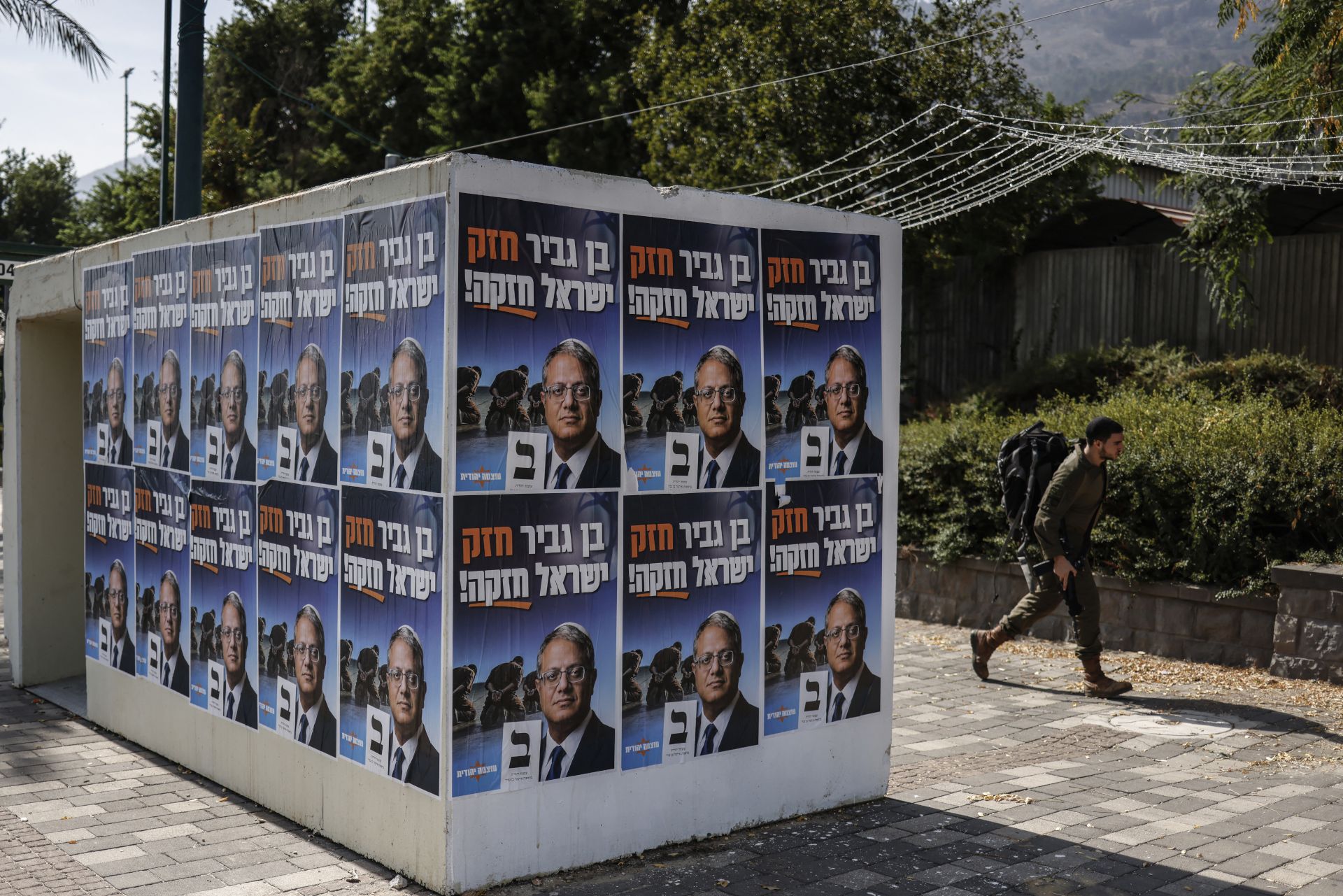
The Israeli 18-year-olds who will vote for the first time today were babies when Benjamin Netanyahu was elected prime minister in 2009. With the exception of a short-lived “government of change” in 2021-22, which was led by another right-wing politician, Naftali Bennett, and followed by the brief caretaker premiership of Yair Lapid, they have not known another national leader. Three-quarters of 18- to 22-year-olds identify as right-wing or far-right, according to a poll conducted recently by Channel 12 News, Israel’s most watched mainstream commercial television broadcaster.
Political attitudes among Jewish Israelis have been moving steadily to the right over the last 25 years, since the Second Intifada. For the last decade, polls have consistently shown that just over half of Israeli Jews overall identify as right-wing. For years, calling someone a “leftist” has been an insult. One of my secular, liberal Israeli friends, who lives in a normal suburb of Tel Aviv, told me recently that her teenage daughter burst into tears and said she was afraid to bring her school friends home, lest they gain the impression from my friend’s lifestyle that they were leftists.
The spike in far-right views among young adults speaks to a confluence of circumstances that include the COVID-19 pandemic, the Oct. 7 Hamas-led attack, the ensuing war in Gaza — and, most significantly, the normalization of the extreme, antidemocratic right. Now, after three years of war, in addition to 17 years of Netanyahu’s methodical suppression and manipulation of the media, far-right ideas have permeated mainstream Israeli society.
When Netanyahu brought Itamar Ben-Gvir and Bezalel Smotrich into his coalition government in 2022, the response from more than half the country, including people who identify as right-wing, was horror. Both men are extremist, antidemocratic, violent settlers. Smotrich was arrested and detained for three weeks in 2005 on suspicion of planning to blow up a main arterial road, while the army rejected Ben-Gvir because it considered him too radical for conscription.
Secular liberals of greater Tel Aviv might do their army service in the occupied West Bank, but they saw people like Ben-Gvir and Smotrich as alien and a bit repulsive. Both men espouse racist, murderous views toward Palestinians, specifically, and Arabs in general. Both reject the basic principles of liberal democracy. Now they are, respectively, the minister of finance and the minister of security. After four years in power, they have become normalized — particularly for first-time voters who were just 14 years old when the current government came to power.
This year Lior Schleien, a popular television host and comedian, launched a one-man civil society initiative to rescue Israeli youth from the fog of incipient fascism. He set out to convince them that democracy was the best system of government. It’s fair to say that a lot of them were unconvinced. Accompanied by a camera crew, Schleien met with groups of high school students all over the country, in locations ranging from radical hilltop settlements to the liberal, prosperous green suburbs of Tel Aviv.
In the videos that he posted online, he holds town hall-style meetings with the teens, demonstrating a remarkable ability to engage with them with both intellectual rigor and respect. They seem to be flattered by his peer-to-peer debating style and impressed by his celebrity. They assure him that they are open to changing their minds, but few seem to be convinced by his arguments. If anything, Schleien’s passionate attempts to convey the benefits of democracy to the stone-faced youths serve to show the extent to which the values he represents have become fringe.
“So you’re saying that it’s better for Israel to be a democratic state than a Jewish one?” asks one boy in an angry tone. Neither he nor any of his peers in the audience are wearing any marker of religious observance, so it’s not clear what they mean by “Jewish.” It sounds more like an ethnic or national identity than a religious faith. Another young man, in a video that Schleien later removed at his parents’ request, said that he wanted to kill or expel “all the Arabs” living under Israeli sovereignty. In most of the groups, the young people express fear and resentment. They feel they are vulnerable to external enemies, those who want to kill them and those who want to marginalize them. They seem to have fully bought into the idea that their survival depends on living forever in a highly militarized state — or, as Netanyahu has said, in “Sparta.”
Schleien stands in front of his young audiences as a secular Israeli who believes passionately in democracy, but he doesn’t try to explain the contradiction between arguing for the democratic rights of Israel’s Palestinian citizens, who make up 20% of the population, and his commitment to preserving Israel as a Jewish state. Nor does he explain his vision of a secular Jewish state, and how it differs from a Jewish state governed by religious law. What is a secular Jewish democracy? And how are Palestinian citizens meant to realize their full rights as equal citizens of a state that defines itself as Jewish, whether secular or not?
Schleien and his democracy project have gained him international coverage in prestigious publications like The New Yorker, which notes that he is “often referred to as the Jon Stewart of Israel.” The impression from these profiles is that the writers are holding Schleien up to American readers as a cri de coeur, a plea for outsiders to recognize the humanity of ordinary Israelis, to see them through the eyes of Schleien rather than through the lens of Yuval Abraham and Rachel Szor’s camera in “NAZA.”
Soon we will see how the youthful attitudes expressed in Schleien’s videos affect the results of Tuesday’s election.