

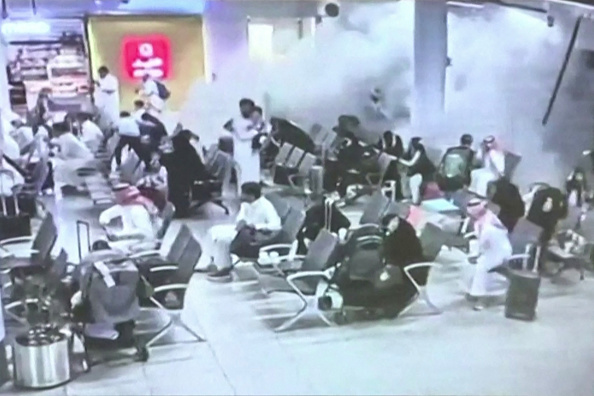
Amid the latest Houthi escalation against Saudi Arabia, drones and missiles have not been limited to southern cities and airports such as Abha and Najran, near the Yemeni border. They have also reached King Khalid International Airport in Riyadh and King Fahd International Airport in Dammam, causing widespread fear at home, alongside flight suspensions and temporary school closures.
Yet this fear has more of a silent nature, one that leaves little trace on social media or in public discussions of any kind. We Saudis find ourselves in a unique position, different from that of the other parties involved. We have no voice that represents us under these circumstances, despite being directly affected by the war.
I spoke with families, academics and others in the kingdom in recent days to inquire about what was happening on the ground and how it was being received by the population at large. Some responded merely with hints, signaling with their eyes and lips that I should not speak about the subject.
One person I spoke to compared Crown Prince Mohammed bin Salman with previous Saudi monarchs — like King Abdullah, King Fahd, King Khalid and King Faisal — under whose reign Saudis, despite general dissatisfaction, trusted their leaders and did not experience economic uncertainty. But that sense of stability has now faded, and concerns over domestic issues have intensified with the war, despite the crown prince’s reforms.
Another told me that “we’ve gotten used to hearing Houthi missiles.” Perhaps those were not missiles but the sounds of drones. I don’t know, and I don’t think the person I spoke to cares about the difference. The young children in this person’s family are excited because school has been suspended, but that does not change the fact that there is a war going on, and that hearing drones and explosions has become normalized for many Saudis.
What is even more troubling is that excessive nationalism has taken hold. Although Saudi Arabia is home to a large population of foreign workers and residents, whose numbers are close to those of Saudi citizens, the current crisis has also brought unfair treatment toward some foreigners. Many Saudis are demanding that foreigners, most of whom are in the country simply to earn a living, publicly express their opinions and show support for the kingdom.
One academic I know said that, during the latest Houthi attacks on Dammam’s airport, he saw a formation of around 10 aircraft taking off from the airport toward an unknown destination, suggesting that they might have been moved to protect them from possible damage. The person described the scene sarcastically, using harsh and vulgar language that reflected the deep lack of trust between what Saudi media outlets were reporting and what he believed about whether the Houthis had actually hit their targets.
It genuinely saddens me that we have reached this point, where the public’s trust in government policies has deteriorated under the pressures facing the kingdom. The academic sent a message mocking Saudi policies, suggesting that, in the end, they do not align with public declarations. Saudi Arabia says it supports Palestine, and the Houthis also say they support Palestine. So where does Saudi Arabia stand on this? He then added sarcastically, “Pass me a bowl of lentils” — a reference to food served in prison, as though he expected to end up there because of his comment.
Users of social media tools now generally assume everything, including encrypted messaging platforms, is monitored, though this does not always inhibit their critiques.
One Saudi doctor pointed out that the authorities had announced the arrest of a foreign teacher working at a school, an arrest that appears to feed into the sense of excessive nationalism and the lack of respect for foreign residents, even as they are continually expected to demonstrate sympathy, whether they want to or not.
One female friend in Riyadh, who espouses liberal views, noted how the religious hegemony of the past has been replaced by what she described as “staunch state-mandated nationalism” that “is felt everywhere in daily life.”
“This shift fundamentally transformed how society is policed today, moving from neighborhood mosques surveilling patrons to keep count of daily attendance to digital surveillance targeting anyone who expresses doubt in state policies and immediately accusing them of treason,” she said. “Today, banal nationalism permeates every aspect of daily life in Saudi, turning overt patriotism into an expected baseline for both citizens and foreign nationals alike. The old religious weapon of declaring someone as infidel (‘takfir’) has been replaced by declaring someone as a traitor to the state (‘takhween’).”
She said that a sense of deep anxiety to conform is palpable among foreign resident communities who are adopting a “with us or against us” mindset to survive by proving they belong.
“In tandem, the state successfully fostered a police state run by citizens under the guise of nationalism,” she said, adding that “young Saudis painstakingly spend hours going through foreign nationals’ accounts and launching digital witch hunts that call for their dismissal from the country or worse.”
Whatever the cause of this situation, I find myself thinking back to other crises that faced the kingdom. We lived through the Kuwait war, the 1996 Khobar Towers bombing, 9/11, the invasion of Iraq and the 2011 uprisings. Yet the uncertainty feels more tangible now, and perhaps that explains the increasingly harsh tone that has come to dominate our discourse toward those around us. And it is not a tone we want our country to be known for.