

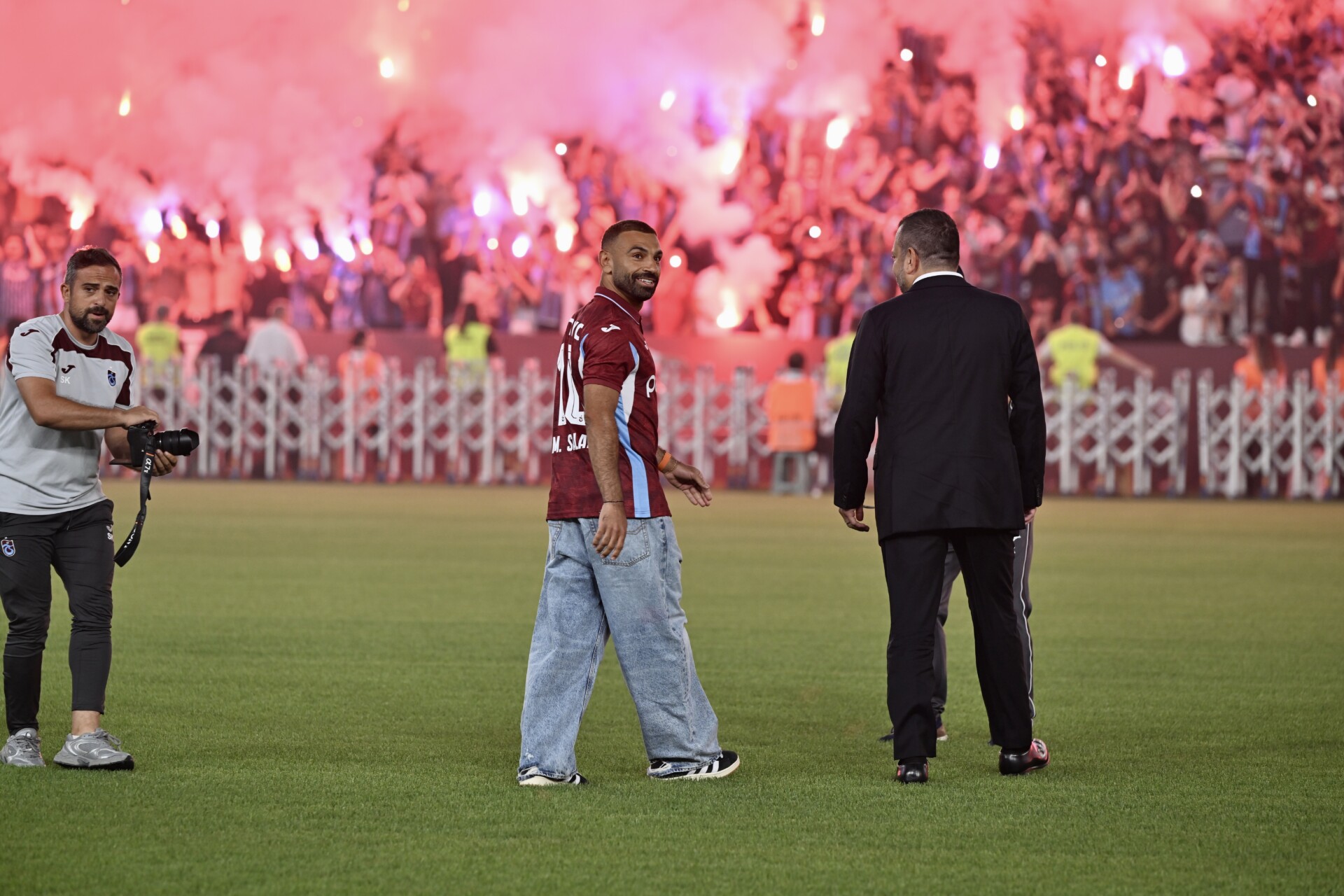
As Egyptian soccer player Mohamed Salah arrived in the Turkish city of Trabzon this week, thousands of supporters of its Trabzonspor sports club flooded the airport in the team’s colors, chanting his name as they celebrated the arrival of the star, who had cemented his name as one of Liverpool’s legends after 10 years in the English Premier League. Later, they packed the club’s stadium, setting off flares and fireworks and holding up giant banners as Salah smiled back and led the crowd in chants, even unveiling what fans are already speculating could become his new trademark goal celebration.
It was a reception befitting a legend who transcends soccer. For a player who has spent nearly 15 years abroad playing for Basel, Chelsea, Rome and, most recently, Liverpool, his move to the Turkish club makes him the marquee star in a Muslim-majority country for the first time since leaving his native Egypt in 2012. A decade ago, the story of an Egyptian soccer icon moving to Turkey would have unfolded against one of the Middle East’s most bitter of political feuds. Today, things look different.
For much of the past decade, Egypt and Turkey stood on opposite sides of nearly every regional fault line. Turkish President Recep Tayyip Erdoğan fiercely condemned Abdel Fattah el-Sisi’s overthrow of Mohamed Morsi, while Egypt viewed Turkey as the chief patron of the Muslim Brotherhood. Their rivalry spilled into Libya and the eastern Mediterranean, resurfacing at nearly every regional summit and appearing at times to threaten confrontation between the two countries. But that has changed remarkably quickly.
Since 2024, Erdoğan has visited Cairo, and Sisi has traveled to Ankara, as the two governments have signed more than a dozen cooperation agreements, expanding trade and investment and even security coordination. Though they still disagree over several issues, including some related to Libya, Sudan and Syria, the relationship has shifted from ideological rivalry to pragmatic management. In this context, Salah’s transfer appears to be one of the clearest cultural manifestations of a wider geopolitical realignment already underway.
That shift was visible online almost immediately. The announcement unleashed a wave of mutual celebration that would have been difficult to imagine only a few years ago. Turkish accounts welcomed Salah in Arabic while Egyptians responded with Turkish phrases. One viral montage showed Trabzonspor supporters dancing to “Boshret Kheir,” pop star Hussain al-Jassmi’s song forever associated with Sisi’s first presidential campaign. One user joked in response that “Egypt’s dominance is terrifying,” marveling that a song once synonymous with Egyptian politics was now echoing through a country that had spent years locked in a regional confrontation with it.
Even the jokes reflected the relationship’s new stage. Versions of the same meme spread across platforms, with users wondering how long the honeymoon would last before Salah inevitably stumbled into one of the countries’ historical sensitivities. One popular post read: “Waiting for the uproar that’ll break out when Mohamed Salah writes a tweet on Mustafa Kemal Atatürk’s birthday.”
Even the mayor of Araklı, a municipality within Trabzon, joined in the festivities, appearing alongside Salah in a playful video joking that climate change would eventually make Egypt unlivable and offering the star a plot of land for his children and grandchildren.
To say soccer alone repaired Egyptian-Turkish relations would certainly be an overstatement. Nor should Salah’s arrival be mistaken for the end of a regional competition between the two nations. Cairo and Ankara remain competitors, and their normalization is perhaps less about becoming allies than about accepting that perpetual confrontation doesn’t serve either side. But soccer has always had a way of making diplomatic shifts feel tangible. Millions of Egyptians and Turks who paid little attention to presidential visits or trade agreements are now watching the same player, wearing the same colors and united under the same goals (pun intended). It would not be the first time Salah has embodied a political moment. During his years at Liverpool, he became a symbol of Muslim inclusion in Britain, illustrating how a soccer player’s influence can sometimes extend well beyond the pitch.
As one of the few public figures to command the affection he does across both societies, Salah is uniquely positioned to keep open the door that diplomacy has only recently unlocked.