

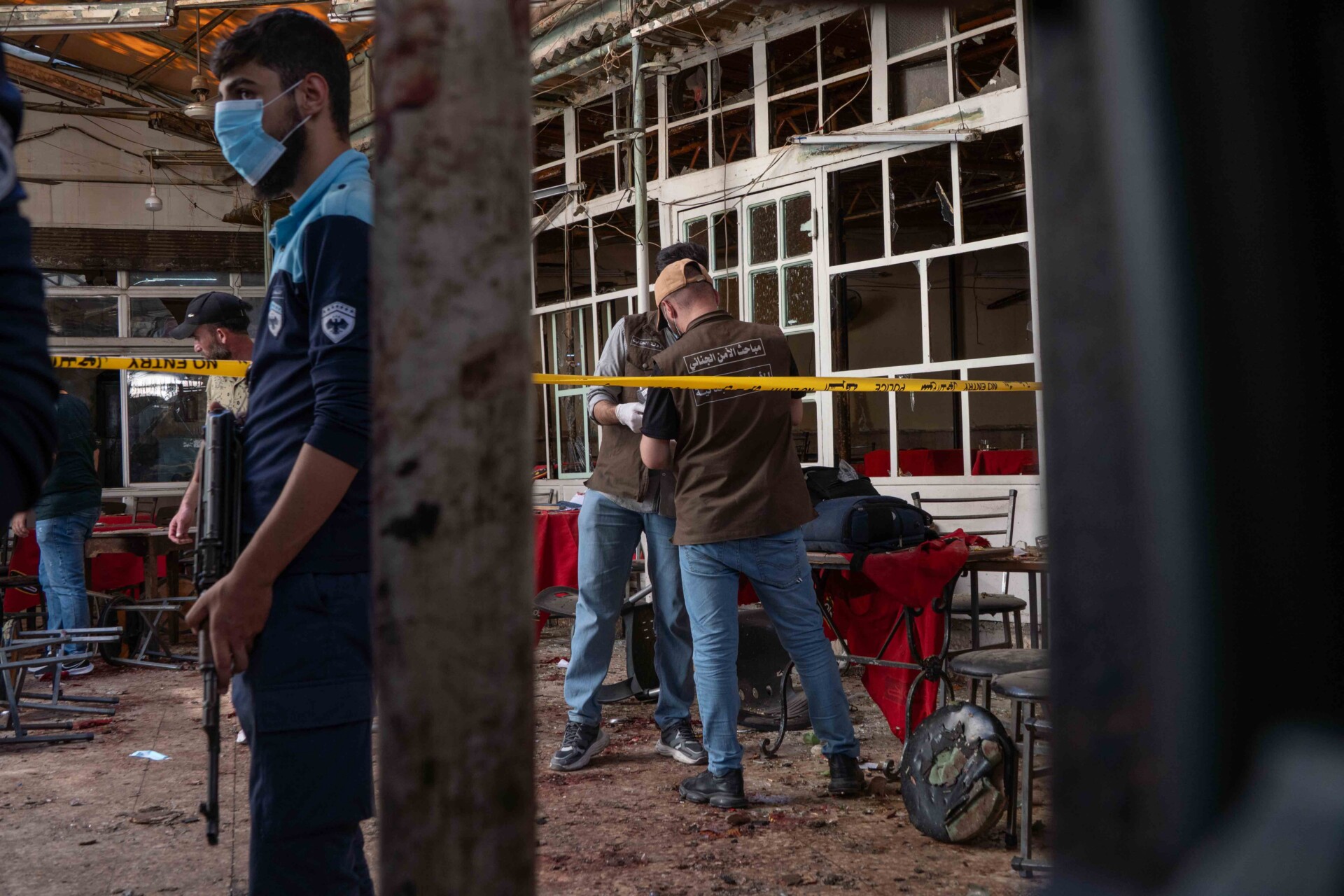
On July 2, central Damascus was rocked by an explosion in the Hijaz district, at a cafe frequented by lawyers and clerks working in the adjacent Palace of Justice government building.
Soon after the blast, members of internal security cordoned off the area and established a security presence beginning at the bustling Hamidiyeh market. The cafe’s bright red tablecloths stood out against the scene of carnage, with hookahs still visible amid darkening pools of blood. Investigators pored over scattered documents, looking for evidence and for the identities of those harmed.
At least nine people are believed to have been killed and 22 others injured. Among the dead are Eid Mohamed, a lawyer from the southern governorate of Quneitra. According to social media posts, other victims include lawyers from Deir ez-Zor and Daraa.
The victims were taken to the emergency department of Damascus Hospital, located a little over a mile from the bomb site. Families crowded at the gates, begging security forces for information about their relatives. One officer tearfully told a sobbing woman that he was not allowed to let her inside. Another woman arrived later, screaming, “Where is my father? We have no one except him!” She repeatedly fell to the ground in anguish as those in the vicinity tried to restrain her with teary eyes.
Lawyers were waiting outside, too, hoping to find out about injured colleagues. The Syrian Lawyers Syndicate put out a statement condemning the bombing near a judicial institution and an area frequented by civilians.
No one has yet claimed responsibility for the attack, though there is speculation about the perpetrators. A similar attack on the Mar Elias Church in Dweila in June 2025 was claimed by Saraya Ansar al-Sunna, a Sunni Islamist group created after the fall of the Assad regime. In its latest newsletter, the Islamic State group criticized the Syrian government and condemned its plans to cede legislative authority to a parliament, which the group considers un-Islamic.
With the large number of transitional justice trials ongoing against Assad-era officers and alleged perpetrators of violence, many point to the potential role of actors loyal to the ousted regime or other groups hostile to the new state. Just two days ago, Hussein al-Salama, Syria’s intelligence chief, spoke at a United Nations counterterrorism summit in New York about the various threats facing post-Assad Syria, including the Islamic State, regime “remnants,” Hezbollah-linked groups and Israel.
A couple of weeks ago, Salah Ahmad al-Saleh, head of the Palace of Justice in Babila, east of Damascus, was severely injured in a car bombing claimed by the Islamic State. In May, a car bombing outside the Defense Ministry in the capital’s Bab Sharqi district killed one soldier and wounded many others. These attacks vary in scope and style, but they contain throughlines that highlight the immense security challenges facing Syria.
Though the perpetrators of the latest attack are yet to be identified, it is clear that there is a palpable anger among groups hostile to the state, which seek to undermine the Syrian government’s efforts to strengthen its military, security and judicial institutions. Curbing their attempts to destabilize the country remains a key challenge for Syria’s government as it pursues security and stability in this time of transition.