

I’m breaking up with France.
Well, not France the country, France the national soccer team: the two France Football Federation (FFF) jackets, the rooster, the framed poster of Zinedine Zidane and, yes, even my prized 2006 Zidane jersey.
Of course, I, as the initiator, want to assure the FFF that it’s not them, it’s me.
I only ever loved the FFF because my true love, the Egyptian Football Association, has always rewarded my life’s longest-running loyalty with disappointment.
My family is Egyptian. My dad and I were kicking balls around the backyard at around the same time I started walking. It was through our satellite dish that I was privileged enough to peek through the window of Egyptian soccer at a young age.
But throughout my lifetime, Arab teams have failed to make a consistent, impressive appearance at the World Cup. People across the region or in the diaspora could only offer tacit support for countries like Morocco and Tunisia; they never made it very far, so we had to adopt other teams.
I landed on France in 2006. I was 20 years old and mesmerized by Zidane, this Algerian legend coming out of retirement to lead Les Bleus on an unlikely comeback run to the World Cup final. My North African pride for Zidane spread to the entire FFF and remained there for years.
But underneath the blue, I was loyal to the Pharaohs. By 2018, Egypt’s nearly 30-year drought at the World Cup more or less corresponded with my lifetime. We were barely a footnote in international soccer. Commentators could care less about our record as seven-time winners of the Africa Cup of Nations, and they certainly didn’t know our players’ names. My time throughout the 2000s and 2010s in my Egypt jersey, watching Africa Cup of Nations finals and World Cup qualification matches on sketchy streaming websites on my laptop, was mostly spent in disappointed solitude.
When Egypt finally qualified for the World Cup in 2018, I went all the way to Russia to see them. I had all my Egypt gear with me, but I brought my Zidane jersey along, too, a sort of insurance policy in case I left disappointed. And when we exited early following a dismal performance, I donned my French jersey for the remainder of the tournament, ultimately celebrating the team’s win in full FFF garb.
But something had cracked in 2018, and it split all the way open in 2022 when Morocco reached the semifinal. Morocco had beaten Spain and then Portugal, and it was clear for many of us that these victories, far from flukes, had been accomplished on behalf of the entire Arab world. Children scurried around my neighborhood in the national team’s jerseys, oblivious to the foreign concept of adopting a different side.
Four years later, eight Arab countries qualified for the tournament, and fans have finally ditched the big names to fuse their love for soccer with that of their heritage. I live in the New York City neighborhood of Astoria, Queens, which is home to a stretch of concrete on Steinway Street known as “Little Egypt.” Since last month, it’s been lined with knockoff jerseys from across the region sold by the tightly packed Arab delis and markets that call it home. The Yemeni coffee shop blasts watch parties in Arabic for fans who see themselves on the field. Stellar performances by Egypt and Morocco are followed by impromptu block parties: teens on top of trucks, shawarma spices wafting into the air as we dance to Egyptian songs in the middle of a street that’s been cordoned off by the New York Police Department.
It is almost bizarre to see the soccer stars I so closely followed throughout the 1990s, 2000s and 2010s learn the names of Egypt’s players and speak so highly of their talent, sportsmanship and work ethic. To watch Thierry Henry, a prominent French player who was on that 2006 World Cup side, a player whose knockoff jersey I owned as a preteen, praise the Egyptian squad for their “courage, organization and belief” is beautiful. Attending the Egypt-Iran match in Seattle and seeing hundreds of white American fans don the Egyptian jersey the way I did the French one is also beautiful.
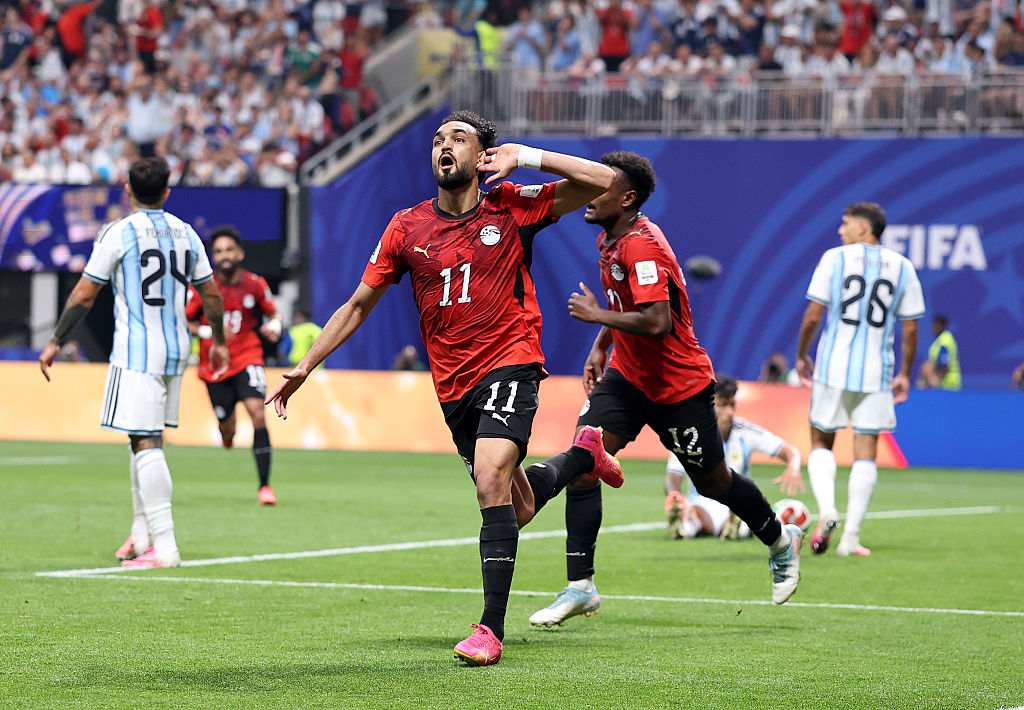
And to share the heartbreak of Egypt’s controversial loss to Argentina with thousands of non-Egyptians around the world is bizarre in the most dizzying, euphoric and redemptive way.
Today, Morocco will play France in a quarterfinal match. With all my condolences to France, I will not be wearing my Zidane jersey. The truth is that I haven’t touched it the whole tournament.
We are out of the shadows now. Just ask those kids in the Salah and Azzedine jerseys the next time we’re all dancing on Steinway Street. Or better yet, you could ask Zidane’s son, Luca, who brought the family name back to Algeria this year as their starting goalkeeper.
Sorry, France, but I just think it’s time I focus on me for a bit.