

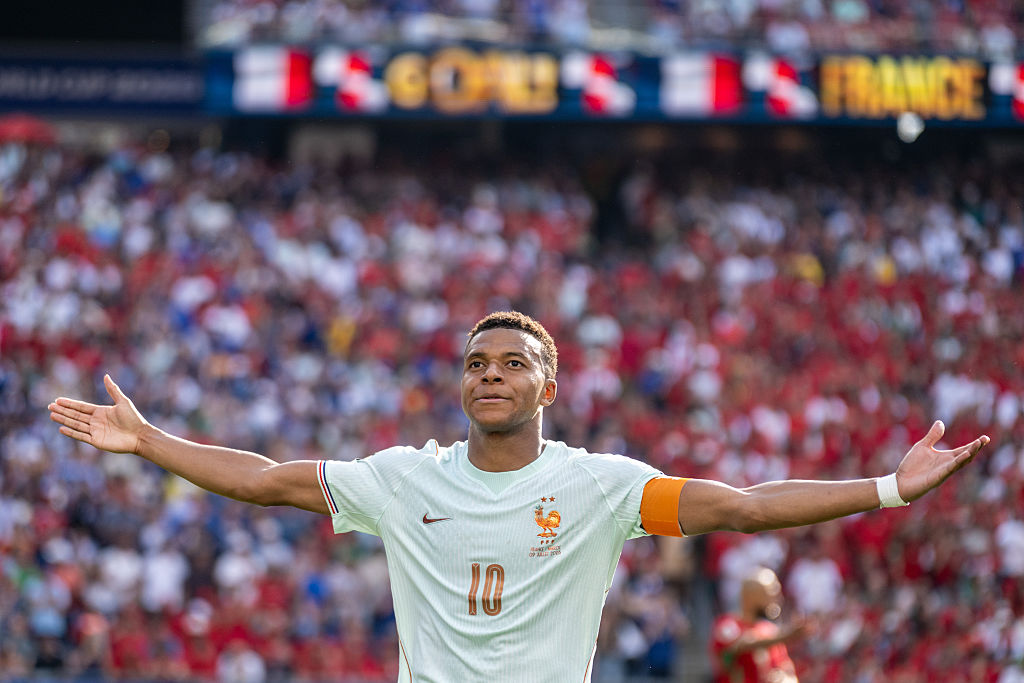
A cheer and a sigh of relief erupted from the front of a tearoom in Belleville, a majority Algerian and Tunisian enclave in northeastern Paris. French star Kylian Mbappé had just missed a penalty kick, leaving France and Morocco tied at nil.
The tension in the cafe, decorated with tile wallpaper and an elegant glass chandelier, was palpable. Drinking Hamoud sparkling water, espressos and mint tea, most of the spectators here supported Morocco, despite sometimes complicated relations between the various North African countries represented in this mixed area and the night’s soccer protagonist.
“Even though Algeria and Morocco don’t get along well, I’m rooting for Morocco,” said Samir, from Algeria. “We’re neighbors and brothers.” His friend, Moustapha, was wearing a Morocco jersey. He came to France as a student 26 years ago but, despite settling down here, still supports his national team. “You never know,” he said by way of prediction. “Small teams have fought back against big teams.” A few minutes later, a young Algerian woman sitting on her own admitted quietly: “I’m for France.”
In this part of Paris, who to support in the World Cup match pitting France against Morocco was a loaded question. The football rivalry between France and Morocco dates back to 1988. That year, the French team beat Morocco in the Tournoi de France. But the semifinals match in the 2022 World Cup upped the ante. On its way to becoming the first African team to make it to the tournament’s penultimate round, Morocco found the magic touch, beating the Netherlands and Canada to set up the highly anticipated rematch.
For many, like 27-year-old Janet Yasmeen — born in Italy to a Dutch father and a Moroccan mother — it was the unexpected semifinals run that inspired her to support the team. Despite her father raising her on Dutch matches, “my heart beats for Morocco,” she told me during a cigarette break.
Like Yasmeen’s own background, the composition of the Moroccan team highlights the country’s history of emigration, including to France. Nineteen of 26 members of the Atlas Lions were born outside the country. Although they remain the minority in Belleville, Morocco fans were nonetheless out in large numbers, proudly sporting their red and green jerseys.
Despite their complicated history, Morocco and Algeria have sometimes ended up on the same side of the pitch. In 1958, two years after Moroccan independence from France, Algerian players mutinied from the French team to form a splinter club set up by the country’s national liberation front, known as the FLN. Despite pressure from the French not to play the team, Morocco engaged it in a friendly match — leading FIFA to ban the Moroccan team from the World Cup for two years.
Tonight, Morocco’s supporters and their North African brothers-in-arms believed in their chances at the end of the first half. When the whistle sounded, the Atlas Lions had held France to a tie.
Like the match itself, some still hadn’t decided which team should pull ahead. Standing in front of a packed bar wearing a red Morocco jersey in a sea of French blue, Mohss, who grew up in Belleville, had tied a striped French jersey around his neck. “It’s difficult for me to choose,” he said. “I’m of Moroccan origin, but I was born in France, so I have that joint culture.”
“No matter what happens, I’m in the semifinals,” he said, laughing, minutes after Mbappé scored a goal for France via a curved shot to the top of the goal. “It’s a beautiful story. Our parents, our grandparents had to migrate when times were tough, and today here we are. … I’m proud of them.”
In the end, the French side took over. Six minutes after Mbappé, Ousmane Dembélé found the back of the net, putting France up 2-0. The game ended with fireworks and celebrations across France.
For their part, Moroccan fans will have to wait another four years for their team to try and advance into the final rounds. They were disappointed, not just at the score but also at their team’s performance and meager attempts to find the goal. It didn’t help that their star player, Ismael Saibari, had to sit out the game after suffering a hamstring injury. If he had been there, could they have won?