

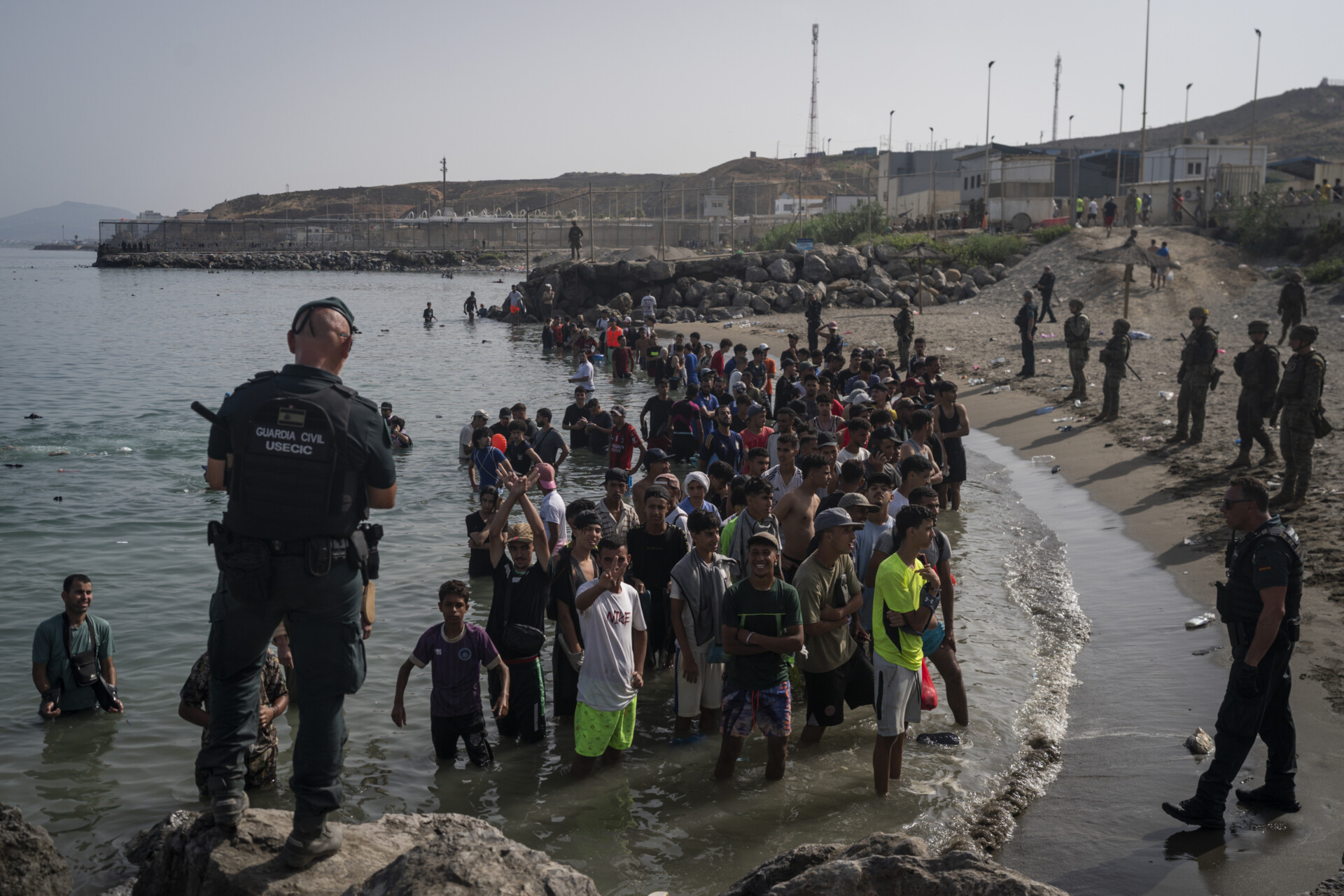
Since tens of thousands of people crossed into Ceuta last week, the political battle over the small, Spanish-administered North African enclave has eclipsed the crossings themselves.
Within hours, right-wing and anti-immigration factions were presenting Ceuta as proof of Europe’s border collapse. Israeli ministers used the episode to attack Spain over its increasingly confrontational stance toward both Israel and the Trump administration. Underneath it all were the migrants themselves, at least 72 of whom died.
Since the Abraham Accords, Morocco has become one of Israel’s closest Arab security partners while receiving unprecedented American support for its claim over the Western Sahara. Just two weeks ago, the House Appropriations Committee recommended at least $40 million in assistance for Morocco while describing both Ceuta and Melilla as “located in Moroccan territory.” Last week, the U.S. president claimed that Morocco had named part of the Tiznit-Dakhla highway through Western Sahara after him, a claim later reinforced by a letter from the king.
Meanwhile, Spain has moved in the opposite direction. In addition to recognizing a Palestinian state, Prime Minister Pedro Sánchez has become one of Europe’s most outspoken critics of Israel’s war in Gaza and has restricted military cooperation with Israel. Relations with the Trump administration have also deteriorated since Spain refused American access to military bases during the U.S. and Israel’s strikes on Iran and resisted Washington’s demands for increased NATO spending.
In recent months, Sánchez’s government introduced one of Europe’s most ambitious migrant regularization programs, and moved forward with legislation granting Spanish citizenship to Sahrawis born when the African territory was still a Spanish colony, along with their descendants — another source of friction with Rabat. The prime minister also recently visited Algeria for the first time in four years, restoring ties with Morocco’s main regional rival. Moroccan investigative journalist and political scientist Abdellatif El Hamamouchi told New Lines that many Moroccan observers viewed the timing of these decisions as politically significant.
Against this backdrop, Ceuta became a flash point. Far-right, anti-immigrant groups and influencers seized the opportunity to stir up migration panic. Itamar Ben-Gvir, Israel’s far-right minister of national security, sarcastically congratulated Sánchez on his commitment to “human diversity” and suggested Spain welcome migrants from Gaza. Israel’s Ambassador to the United Nations Danny Danon mocked Spain’s “crisis over its immigration policy” while asking why it still maintained “colonial enclaves in Africa.” Spain’s Transport Minister Óscar Puente responded with an insinuating observation: “Well, things are starting to get pretty clear.”
Within days, nearly everyone who entered had returned to Morocco. Speaking on July 31, Prime Minister Sánchez condemned the crossings as “an attack on Spain’s territorial integrity,” pledging that the government would use “all the resources of the state” to guarantee security. His foreign minister stressed that movement to mainland Spain remained subject to police controls and urged an end to the “deliberate confusion.” Still, the rhetoric continued to spill offline. By the weekend, groups of far-right extremists, including neo-Nazis, had traveled to Ceuta, claiming they intended to “defend” the city, with reports that some were hunting Moroccan residents and migrants.
A Spanish territory on the North African coast, Ceuta has long been a colonial anomaly. Morocco has never really accepted it as permanently Spanish, making it uniquely susceptible to being a diplomatic pressure point. Migration, too, has increasingly become an instrument of statecraft. In 2021, after Spain admitted Polisario Front leader Brahim Ghali for medical treatment, Morocco relaxed border controls, triggering the arrival of around 10,000 migrants in Ceuta over two days in what Spain viewed as retaliation.
Among those questioning the spontaneity of last week’s crossings was journalist and historian Vijay Prashad, who has reported extensively on migration across North Africa. He noted that many of those filmed entering Ceuta appeared to carry no luggage, drawing comparisons to the 2021 crisis. The New York Times reported that several Moroccan migrants said they had been encouraged by authorities to head toward Ceuta, claims that were echoed in videos that allegedly showed Moroccan authorities transporting young men toward the crossing by the truckload. El Hamamouchi said the absence of the usual social media build-up made the crossings appear “unnatural.” A report published by Spanish newspaper El País found that many of the social media accounts that had initially spread claims that the border was open have “disappeared.”
Viral posts claimed the operation had been jointly engineered by Morocco, Israel and Washington. Others, including from former Human Rights Watch executive director Kenneth Roth, publicly speculated about whether Israel had broader strategic interests in the dispute over Ceuta, suggesting that Moroccan control of the enclave could weaken Spain’s influence over the strategically important Strait of Gibraltar.
“In my opinion this was mass-orchestrated,” El Hamamouchi told New Lines, while emphasizing that there is no evidence yet linking the United States or Israel directly. While the facts surrounding them remain unverified, the speed with which these competing narratives emerged illustrates how combustible global migration issues have become. U.N. High Commissioner for Refugees Filippo Grandi lamented what he called a “failure” by Europe, accusing governments of allowing migrants to be “manipulated to create political pressure on Spain” while reacting according to domestic political interests. “Not a word of compassion for the victims,” he wrote on X.
El Hamamouchi argues that, regardless of who facilitated the crossings, the biggest political beneficiary was the transnational, anti-immigration right, which quickly reframed the episode as evidence of a broader “European invasion.”
Whatever their motives, the people who crossed into Ceuta became symbols in a debate that stretches far beyond Spain or Morocco, positioning the small enclave at the crossroads of a new geopolitical order.