


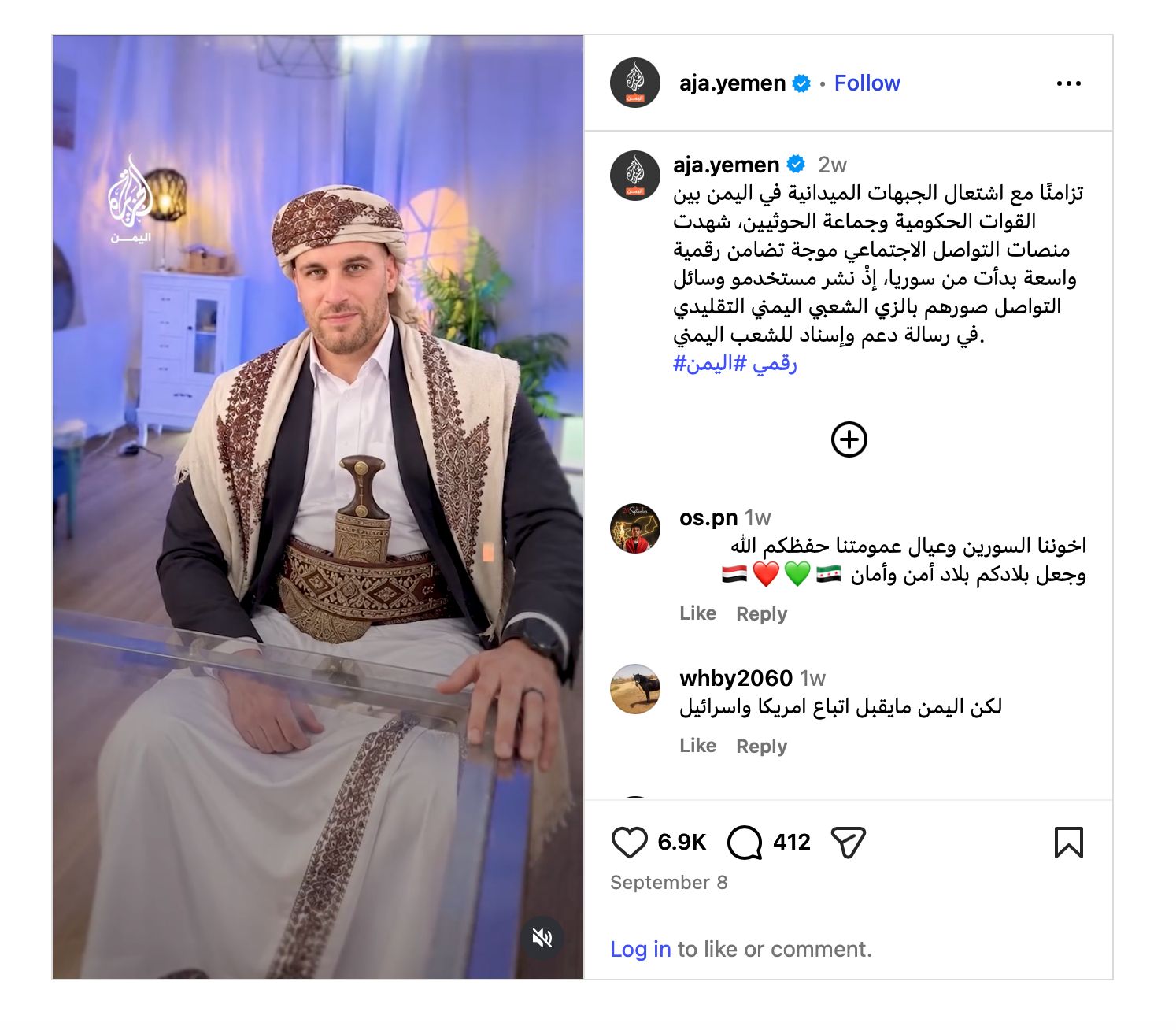
In early September, Arabic-language social media was saturated with AI-generated images of Syrians in Yemeni garb, young men clothed in white robes and embroidered shawls, their jambiyas (curved daggers) gleaming at their waists. The images appeared to be part of a targeted social media campaign.
Then came a video that seemed to present Syria’s president, Ahmad al-Sharaa, making a statement urging Yemenis to fight. On Sept. 7, Sidq, the Yemeni fact-checking organization, identified the splice as footage from al-Sharaa’s address to Syrians in May 2025, laid over audio from 2015, when he was known as Abu Mohammed al-Jolani. The audio was a eulogy for Nasir al-Wuhayshi, the leader of al Qaeda in the Arabian Peninsula (AQAP).
The fake borrowed its credibility from what Syria seemed to prove: that even a ruler propped up by Iran can be toppled, that warring factions can unite and that the world can eventually welcome a once-unthinkable victor. The latter seemed impossible until May 2025, when Donald Trump shook hands with al-Sharaa in Riyadh.
After more than five decades under the Assad family, Syrians finally have cause to celebrate. Yemenis, trapped in their own war for more than a decade, yearn for that same release. This September, Yemen’s government tried to borrow Syria’s ending.
On Aug. 7, Information Minister Moammar Al-Eryani likened Houthi escalation to the last shows of force by Iran’s allies before Assad fell and described the restoration of the state as only “a matter of time.” According to Mohammed al-Qadhi’s reporting in New Lines, the Yemeni government and Riyadh mobilized on social media, suggesting the battle would end Houthi influence for good. The Houthis cited those preparations as their reason to strike first. On Sept. 7, Assistant Defense Minister Samir al-Sabri announced that the decision to liberate Sanaa had been taken.
By then, the Houthis were already on the move; their west coast offensive had begun on Sept. 4. On Sept. 6, as solidarity posts surged, al-Kadaha in western Taiz fell, severing the road between Taiz and Mokha. At dawn on Sept. 10, government forces slipped out of Mokha, and within a week the Houthis held the coast of Bab al-Mandab. By Sept. 22, the U.N. refugee agency reported that more than 130,000 people had been forced from their homes that month.
The solidarity campaign had tried to claim that Syria’s victory could be reproduced without explaining how divided forces in Yemen could make that happen. Territorial strongholds had not produced a unified command, and foreign backing did not guarantee united support for an advance on Sanaa. Yet officials presented victory as imminent, asking Yemenis to place their hopes in a military result without a plan to achieve it.
The September solidarity campaign drew on a shared grievance: Iran’s support for Assad and the Houthis. Iran did not make decisions on behalf of its allies, but it prolonged the wars they were involved in. The sympathy between Syrians and Yemenis was genuine, and Al-Eryani openly embraced the wave, explicitly linking the suffering of the two countries to Iran’s proxies. His endorsement gave official weight to messages that drew on that sympathy to sell the prospect of another victory over an Iranian ally.
Yemenis followed Assad’s fall intently, and so did their government’s information minister. Between Dec. 7 and Dec. 24, 2024, as Damascus fell, a coordinated campaign against the Houthis took shape on X. The Arab Facts Hub later counted more than 135,000 posts from 30,849 accounts during that period, viewed more than 30 million times.
The posts carried hashtags such as “The Houthi After Bashar,” “The Fall of the Persian Crescent,” and “Liberating Sanaa Is a National Demand.” The researchers found ready-made content, fake accounts and prominent voices from those loyal to Saudi-backed factions, Saudi influencers and government officials. On Dec. 15, Al-Eryani called for a “major media campaign” to show that Houthi crimes matched those witnessed in Syria.
The December campaign established three core messages to gain support for a new offensive. First, it equated the Houthis with Assad, comparing their secret prisons with Sednaya, which had become the symbol of the Assad regime’s brutality. Then, it presented their downfall as destiny, amplifying the voices of commanders, including Tareq Saleh, who promised victory. Finally, it made the offensive look underway, with videos of troops supposedly moving toward Hodeidah, some of which turned out to be of Iraqi forces heading to the Syrian border. Over time, the call for justice for the Houthis’ victims became a countdown to a larger war.
The analogy outlived the December campaign. On Aug. 11, Rashad al-Alimi, head of the Presidential Leadership Council, gathered Al-Eryani and top media figures in Riyadh and urged them to mould public debate, alongside Saudi media. Less than a month later, the Syrian analogy was circulating again, this time alongside renewed fighting.
Most of the solidarity posts reviewed for this article, drawn from public Instagram accounts and illustrative rather than comprehensive, appeared on Sept. 6 or 7. The solidarity also ran along a new regional axis: Assad and the Houthis had both been Tehran’s allies, while al-Sharaa made Riyadh his first foreign stop. For many Syrians, the war in Yemen continued their own fight against Tehran.
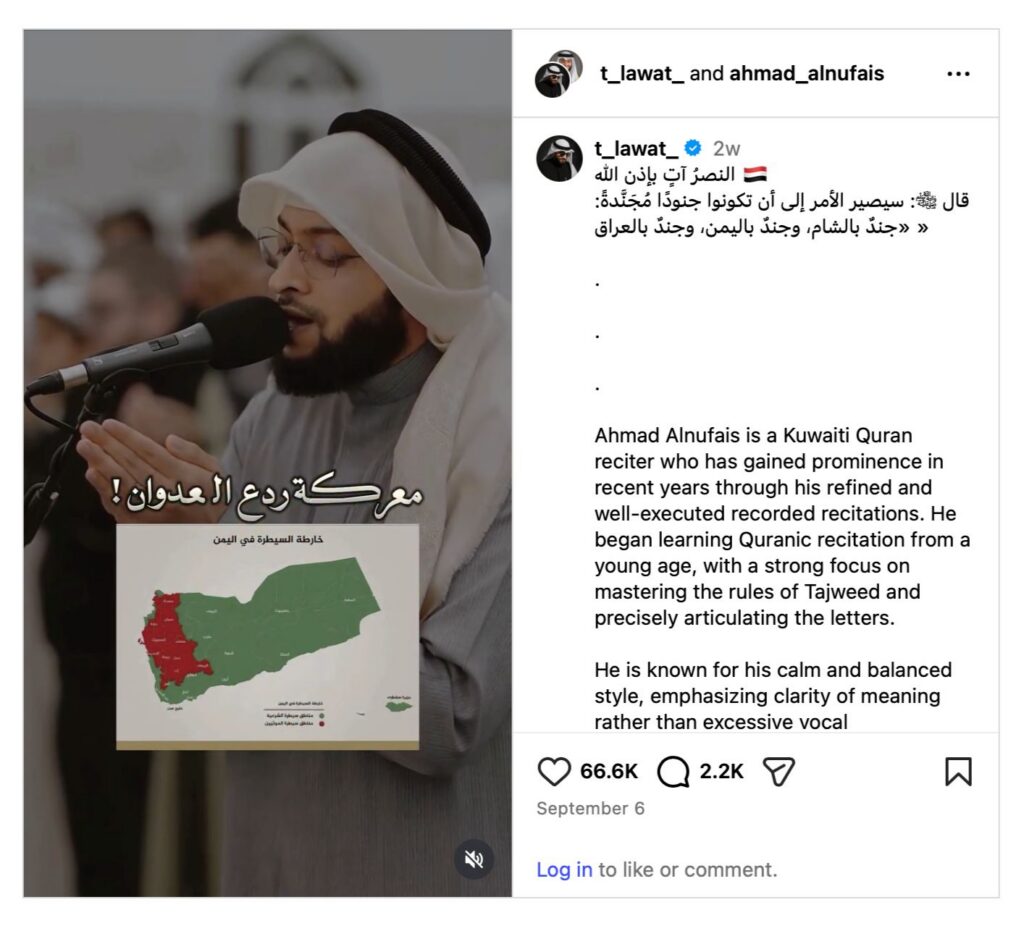
Some posts drew on older traditions of Arab solidarity. A Syrian video captioned “From al-Sham, here is Yemen” drew more than 60,000 likes. The phrase recalls Nov. 2, 1956, when an air raid during the Suez Crisis knocked Egyptian radio off the air, and Syrian radio opened with “From Damascus, here is Cairo.” Other posts turned solidarity into supplication. A collaboration with the Kuwaiti Quran reciter Ahmad al-Nufais placed a map of Yemen’s front lines over a prayer video under the banner “The Battle of Deterring Aggression!” and quoted a hadith foretelling armies in al-Sham (the Levant), Yemen and Iraq.
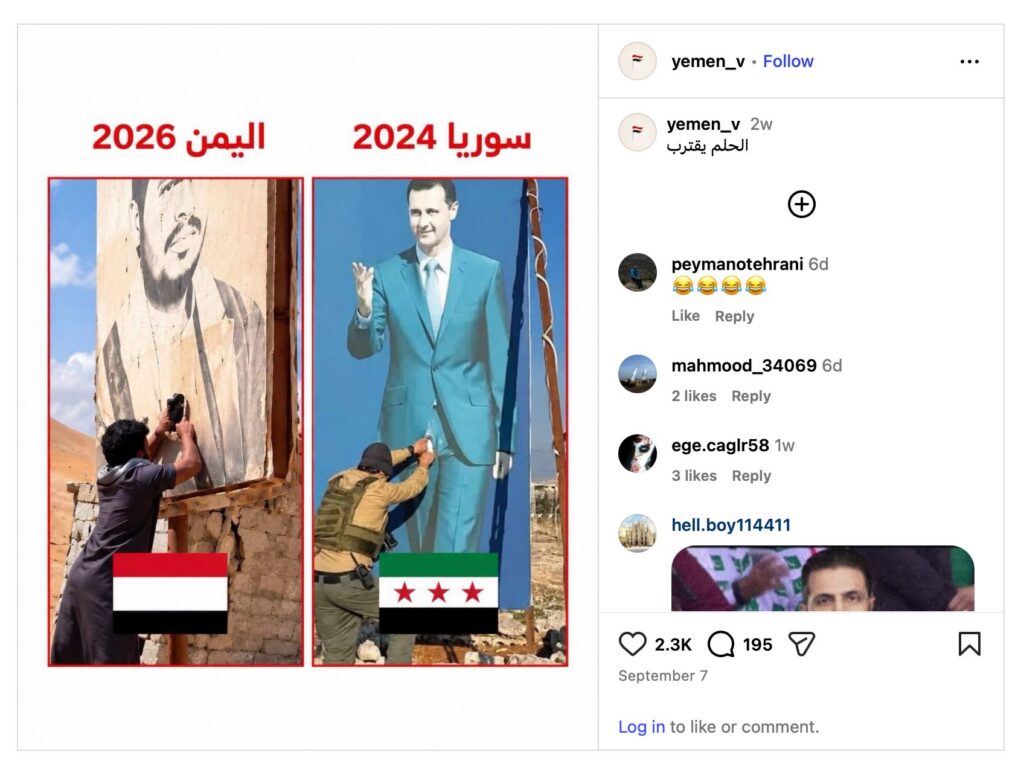
On Sept. 7, a Yemeni account juxtaposed an image of a fighter tearing down Assad’s portrait, labeled 2024, beside a man scraping at a portrait, labeled 2026, of the Houthi leader, Abdulmalik al-Houthi, with the comment, “The dream draws near.” That evening, al-Sabri made his announcement. Whether orchestrated or spontaneous, the posts echoed one another, sharing a hadith, a map and a slogan and appearing within hours of each other.
Even the vocabulary was borrowed. “Deterring Aggression” was the name given to the offensive that carried Syrian rebels to Damascus, though Yemen’s government never formally adopted it. In Yemen, the word has its own history. Since the Saudi-led coalition started bombing in March 2015, “the aggression” has been the Houthis’ name for the coalition, and soon after for the Yemeni government, too, which they call the “internal aggression.” The word once treated as proof of Houthi sympathy became a banner for those urging an offensive against the Houthis.
The grievance was selective, too. Many Yemenis mostly blame the Saudi-led coalition’s airstrikes and blockade for their ruin. Syrians who lived through barrel bombs had every reason to sympathize with Yemenis bombed from the air, whoever did the bombing. The solidarity campaign narrowed that sympathy to one culprit. It also cast Yemen’s government in the role of Syria’s rebels, even though its own backers had done much of the bombing.
The posts and official statements offered little explanation of what would follow victory: who would rule Sanaa, whether rival forces would unite or clash, and who would protect the civilians caught between them. Instead, the conversation turned to who might become Yemen’s al-Sharaa.
The first contender is resistance veteran Hamoud al-Mikhlafi, whose followers hail him as a sheikh. He led the anti-Houthi fight in Taiz during the war’s early years, and his backers there have eagerly drawn flattering parallels with al-Sharaa. Those close to him say that since 2024 he has studied al-Sharaa’s journey, aspired to the same American approval, and even begun English lessons. Their account suggests he is building the foundation for international recognition before there is any victory to recognize.
Abu Omar al-Nahdi, a former AQAP commander, is sometimes called the “al-Sharaa of Yemen,” mostly by enemies who want to tie him to his past. He reportedly fought alongside al-Sharaa in Iraq, but the movement he launched in Hadramawt in 2025 remains small. A more serious claimant is Tareq Saleh, nephew of Ali Abdullah Saleh, who ruled Yemen for 33 years and was killed by the Houthis in 2017.
With mostly Emirati backing, Tareq Saleh built the National Resistance on the Red Sea coast, and he has long promised to take back Sanaa. After Mokha fell on Sept. 10, he left for Riyadh by way of Aden. The same month, French prosecutors asked a Paris court to jail his cousins Ahmed and Khaled, the late president’s sons, on charges of laundering embezzled public money, much of it through luxury Paris properties. The brothers deny the charges. Whatever the verdict, the Saleh family’s hold on Yemen’s future is slipping.
The third is the southern commander Abdulrahman al-Mahrami, known as Abu Zaraa, who built the Giants Brigades, the Emirati-backed Salafist force, and sits on the Presidential Leadership Council. His career has followed his patrons: On Dec. 30, 2025, he opposed al-Alimi’s order expelling the UAE, and eight days later, Saudi-backed forces put him in charge of security in Aden.
When al-Mahrami pledged on Aug. 31 to build southern armed forces, Ali al-Bukhaiti, a former Houthi figure turned critic, replied that he would rather see al-Mahrami rule Sanaa as “the Yemeni Ahmad al-Sharaa.”
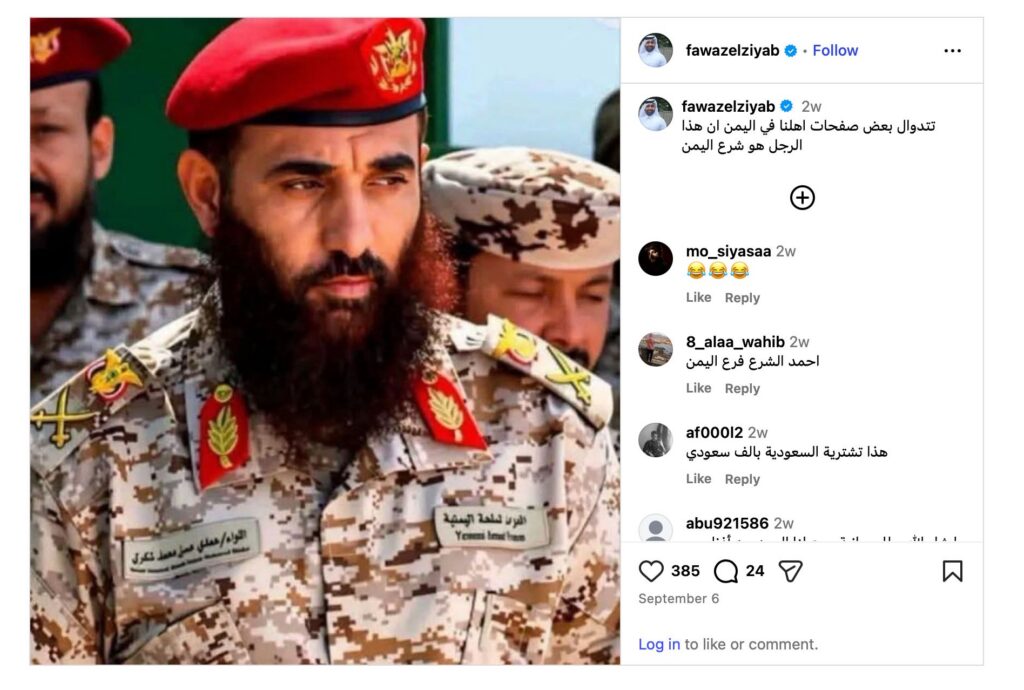
The fourth contender, Hamdi Shukri al-Subaihi, emerges from al-Mahrami’s own ranks: He commands the Giants’ 2nd Division. On Sept. 6, the Syrian commentator Fawaz al-Ziyab noted that Yemeni pages were calling al-Subaihi “the al-Sharaa of Yemen.” The same day, Al Jazeera’s Yemen service carried a recording in which al-Subaihi vowed to keep fighting until Yemen was purged of the Houthis, and al-Bukhaiti soon saluted him, too. For a few days, al-Subaihi seemed to be the man the solidarity campaign had been waiting for. His recording went out the day al-Kadaha fell, four days before the Houthis took Mokha.
Al-Mahrami and al-Subaihi both studied at Dammaj, a town in the Houthis’ home province of Saada, whose fate still resonates among Yemen’s Salafist fighters. There, Muqbil al-Wadi’i founded Dar al-Hadith after years of study in Saudi Arabia, building a center of religious learning that attracted students from across the Muslim world. Houthi sieges began in 2011; in January 2014, the students and their families were forced to leave. Many later joined Salafist formations fighting the Houthis. Their expulsion became a grievance that outlasted the school’s presence in the town. On Aug. 27, a Yemeni religious influencer revived that history in a video titled “Have You Heard the Story of Dammaj?” It drew more than 24,000 likes.
None of the four is a fit for al-Sharaa’s role today. People close to al-Mikhlafi say he is preparing for it, though he has no recent victory to point to. Tareq Saleh has lost his base. Al-Mahrami has fighters, but his focus is the south. In July, preparing a Saudi-sponsored dialogue among southern factions, he said southerners have the right to “determine their fate and choose their political future.” As for al-Subaihi, his moment lasted a few days until Mokha fell.
Publicity, backed with money, can move men within the anti-Houthi camp. Can it move the front line? September’s fighting suggests not. It can also make one man look like the world’s choice, before anyone has chosen him, for Yemenis hoping to escape Houthi rule.
The posts did not stop at promoting commanders. Anger at Iran’s role is political, and much of it is earned, but some September posts gave it a sectarian edge.
One widely shared post promised that after Syria and Yemen, Iraq’s turn would come. Al-Ziyab hailed the chief of staff of the Saudi-backed Nation’s Shield forces, arriving in Mokha, as one of “the lions of the Sunna.” After the city fell, the deputy head of the Yemen Ulema Authority called fighting the Houthis “jihad in the cause of God.”
Religious calls to arms matter because they recruit through existing channels. Researcher Hussam Radman, who distinguishes government-aligned Salafist groups from al Qaeda, has shown that Yemen’s armed groups recruit through religious institutions, welfare and steady pay. The Syrian example may ease a young man’s doubts, but a salary or a personal connection are more likely to decide whether he enlists.
On Sept. 7, the solidarity campaign also got its photograph: Syria’s foreign minister, Asaad al-Shaibani, and his Yemeni counterpart, Afrah al-Zouba, in matching red armchairs in Cairo, flags side by side, turned toward each other with mirrored poses and matching smiles.
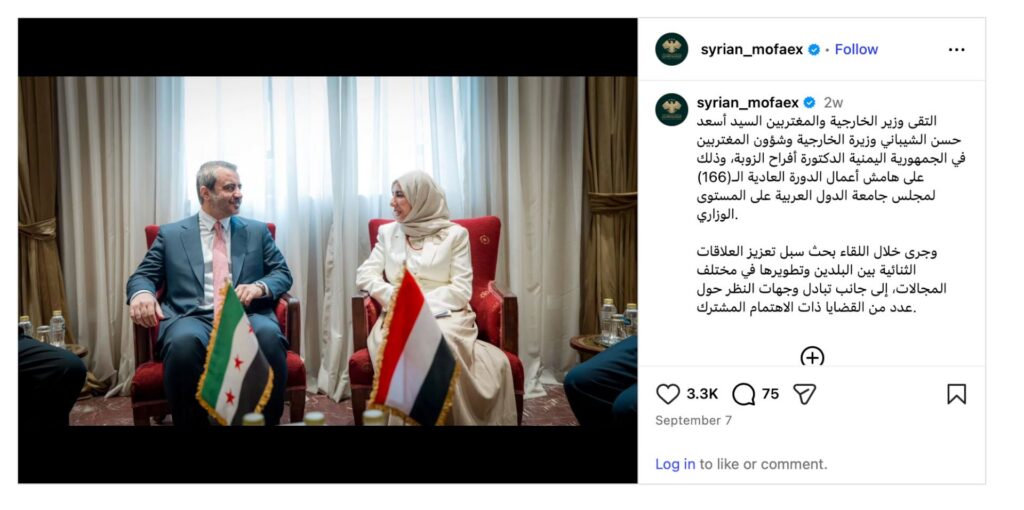
This photograph matters more to Yemen’s government than to Syria’s. The Presidential Leadership Council was formed in Riyadh in 2022, in a process Yemenis had little say in, and it still depends heavily on Saudi money. It has spent years trying to govern from Aden with little to show for it, and many of its officials still work from Riyadh. Yemen’s government has international recognition but little power at home, and a photo beside Syria’s foreign minister let the government of Yemen borrow some of its local standing.
According to Syrian sources quoted by Turkiye Today, Saudi Arabia had asked Damascus for fighters months earlier. In September, fabricated videos claimed Syrian fighters were already in Yemen. Together, these raise a question the solidarity campaign never answered: whether the hype was also meant to make Syrian fighters in Yemen seem natural before any arrived.
Damascus gave no sign it would send them. Neither readout of the Cairo meeting mentioned fighters, and on Sept. 14, Syria’s interior minister discussed controls on prisoners’ information and citizens’ travel. Four days later, Turkiye Today reported that Damascus had turned down the Saudi request, though it would not block individuals from going. If true, the nation Yemenis were urged to follow had quietly declined to join the fight.
Houthi supporters also responded on social media. For instance, on Sept. 8, an Instagram video with more than 30,000 likes dared Syrians to “expel the blue one” if they wanted to be counted as men. Other commentators told Syrians to free their own land from Israel before offering to free Yemen.
Riyadh’s other allies were slow to commit. In August, Saudi Arabia signed a defense pact with Pakistan and Turkey. On Sept. 10, as Mokha fell, Pakistan said no military response had been discussed, and Turkey later offered support while pressing for diplomacy. The tone shifted after the Houthis fired missiles at Taif and Yanbu on Sept. 24. That day, the three foreign ministers met in New York and discussed an emergency meeting of their military chiefs. As of today, neither Pakistan nor Turkey has offered troops.
Riyadh’s appeals to Washington brought only intelligence support. On Sept. 17, as U.S. officials ruled out a direct role, U.S. media reported a secret understanding: The Houthis would leave American shipping alone, and Washington would stay out of the Saudi-led war. The same day, the State Department approved a $24.3 billion sale of F-35s to Riyadh. Washington would sell Saudi Arabia weapons, but it would not fight beside it.
By then, Riyadh was itself looking for a way out. On Sept. 17, the Lebanese daily Al-Akhbar, which is close to Hezbollah, reported that Saudi Arabia had asked Oman to broker a two-week truce and direct talks with the Houthis. Riyadh has not confirmed the report. If it is accurate, then 10 days after the government promised to liberate Sanaa, its patron was seeking terms with the Houthis.
Al-Sharaa’s personality alone didn’t bring down the Syrian regime. Assad fell when his opponents pushed forward at a moment when his main backers were distracted or weakened: Russia by the war in Ukraine, Hezbollah by its war with Israel. Nor does the lack of a Yemeni al-Sharaa explain why Yemen’s war is stuck.
If Riyadh hoped to repeat what happened in Syria, it faced a significantly messier region. Its partnership with Abu Dhabi had collapsed, Washington blew hot and cold and ultimately would not fight, and Israel had become a party to the war through its strikes on the Houthis, with southern leaders openly courting it.
Yemeni commentators often point to Idlib as a model Syrian province. Hayat Tahrir al-Sham (HTS), the movement al-Sharaa led, spent years turning a crowded rebel enclave into territory it dominated. It defeated its main rivals and routed a Turkish-backed coalition without Ankara stopping it. It advanced, bringing other factions into line through deals and force. By the time HTS moved on Aleppo, Idlib had long been secured as a stronghold.
Yemen has had its own would-be Idlibs. Marib and Taiz have held out against the Houthis for a decade, and Marib survived the Houthis’ largest offensive in 2021. Neither became a base for a march on Sanaa. Calls for a Yemeni Idlib are really calls for a place where one force can organize, govern and bring its rivals under control. Despite the hopes placed in Marib and Taiz, that place does not exist yet.
Some consolidation did happen this year, but Riyadh did it, not a homegrown Yemeni force. In Dec. 2025, the Southern Transitional Council (STC), the UAE-backed southern separatist movement, seized Hadramawt and al-Mahra. Saudi Arabia answered with airstrikes on STC forces and Emirati military vehicles, and the UAE was told to withdraw its forces from Yemen. By January, the STC had announced its own dissolution, and its leader, Aidarous al-Zubaidi, fled to Abu Dhabi. Even then, the remaining forces were not fully merged.
When the Houthis reached Mokha in September, the city was held by Tareq Saleh’s National Resistance of about 50,000, which had since switched its allegiance to Riyadh. Its supporters had helped lead the December 2024 campaign online. Al-Qadhi’s New Lines essay describes a front without a single command, where some allied units went months without pay, and some commanders would not take Saleh’s orders. Much of the blame fell on Saleh, but Maysaa Shuja al-Deen, a senior researcher at Sana’a Center, an independent Yemeni think tank, has argued that this let others off the hook. Government-aligned forces had not coordinated, she wrote, and Saudi Arabia had been reluctant to provide air support. Within days, the camp’s members were blaming one another in public.
Khaled al-Yamani, a former foreign minister now described as an adviser to al-Zubaidi, told Israel’s public broadcaster that Israel should join the war. Amr al-Bidh, a leader in the dissolved STC, told the BBC that Saudi Arabia’s strikes on the council’s forces had been a “strategic mistake.” He blamed Riyadh and the Yemeni government for failing to protect the Red Sea, arguing that removing southern forces had left a vacuum the Houthis exploited.
In a sense, the Houthis had what their opponents lacked. Shuja al-Deen warned in 2025 that their committed core made a Syrian-style collapse unlikely, and on the west coast they fought under one command with one goal. If anyone in this war looked like HTS in Idlib, it was the Houthis, who built unity by force as much as by conviction, while silencing critics and besieging Taiz along the way.
That leaves Riyadh and what it actually wants for Yemen. Saudi Arabia has long cultivated local leaders as a check on whoever held power in Sanaa, keeping its influence while weakening the institutions Yemen needs to end the war. Its priorities have shifted, too, because a failed state on its border is more dangerous to it than a pliable one.
The real test is whether Riyadh would accept a Yemeni state strong enough to make decisions it dislikes. No Yemeni force will be taken seriously as a national government if it can act only where its patron allows.
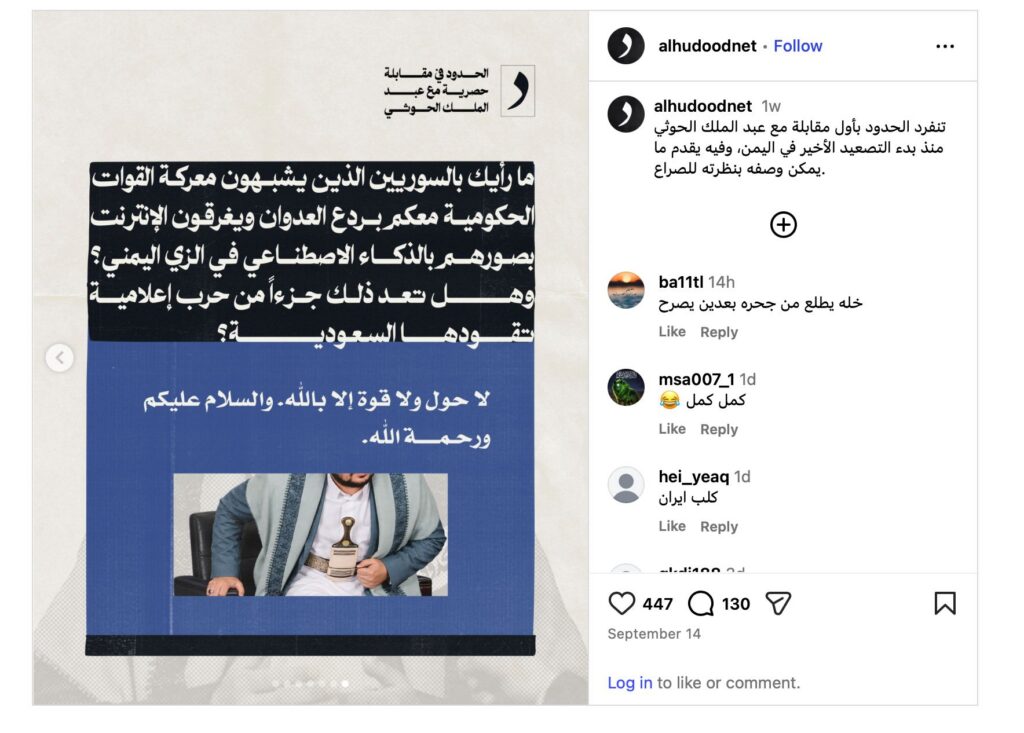
September’s solidarity campaign put victory on people’s screens before any victory appeared. Within days, the news was of retreat. The National Resistance reported 500 dead since Aug.9. By Sep. 14, the satirical news site Al-Hudood published a fake interview with Abdulmalik al-Houthi, asking him about Syrians who had flooded the internet with AI-generated pictures of themselves in Yemeni dress.
The feeds moved on quickly. By Sept. 23, the feed used for this article had swapped Syrians in Yemeni dress for Syrians celebrating Saudi National Day, some of it footage recycled from Damascus’ celebrations of Assad’s fall last December. Across Bab al-Mandab, wooden dhows crowded with women and children began landing near Obock, in Djibouti. The country’s finance minister counted more than 2,000 arrivals in two days, and its social affairs minister, Ouloufa Ismail Abdo, asked the world for help with the children, the sick and people with disabilities among them. Leaders in Aden and Riyadh were still talking about restoring the Yemeni state. Djibouti was the one taking Yemenis in.
September’s promises of a quick victory didn’t account for the families who would end up in Obock. The hope behind those promises was never the problem. Syrians have every reason to celebrate the end of tyranny, and Yemenis are right to want the same. The problem is what the campaign’s promoters did with that hope. They turned it into a call for loyalty, money and fighters, and gave no honest account of what would come after.
Anyone asking Yemenis to fight should be able to explain who will command the fight, who will govern what is taken and how civilians will be protected from reprisals. Outside money and weapons should go to forces with one accountable command, not to whoever gets them through publicity. Saudi Arabia has to decide whether it wants a partner in Yemen or a client, since only a partner can end this war. As for Washington, its reported understanding with the Houthis protects American shipping while Yemen’s coastline changes hands. A “deal” may work for Washington but is no policy for Yemen.
Yemenis have every right to continue hoping the Houthis will be defeated. That hope has to be treated as politics, with real conditions, rather than as fate waiting for a hero. September sent more people across the sea and pushed their return further away. This is not the first time they have been told to hold on until the next offensive. Yemenis deserve a political future that can outlast the next promise of victory.
Become a member today to receive access to all our paywalled essays and the best of New Lines delivered to your inbox through our newsletters.