


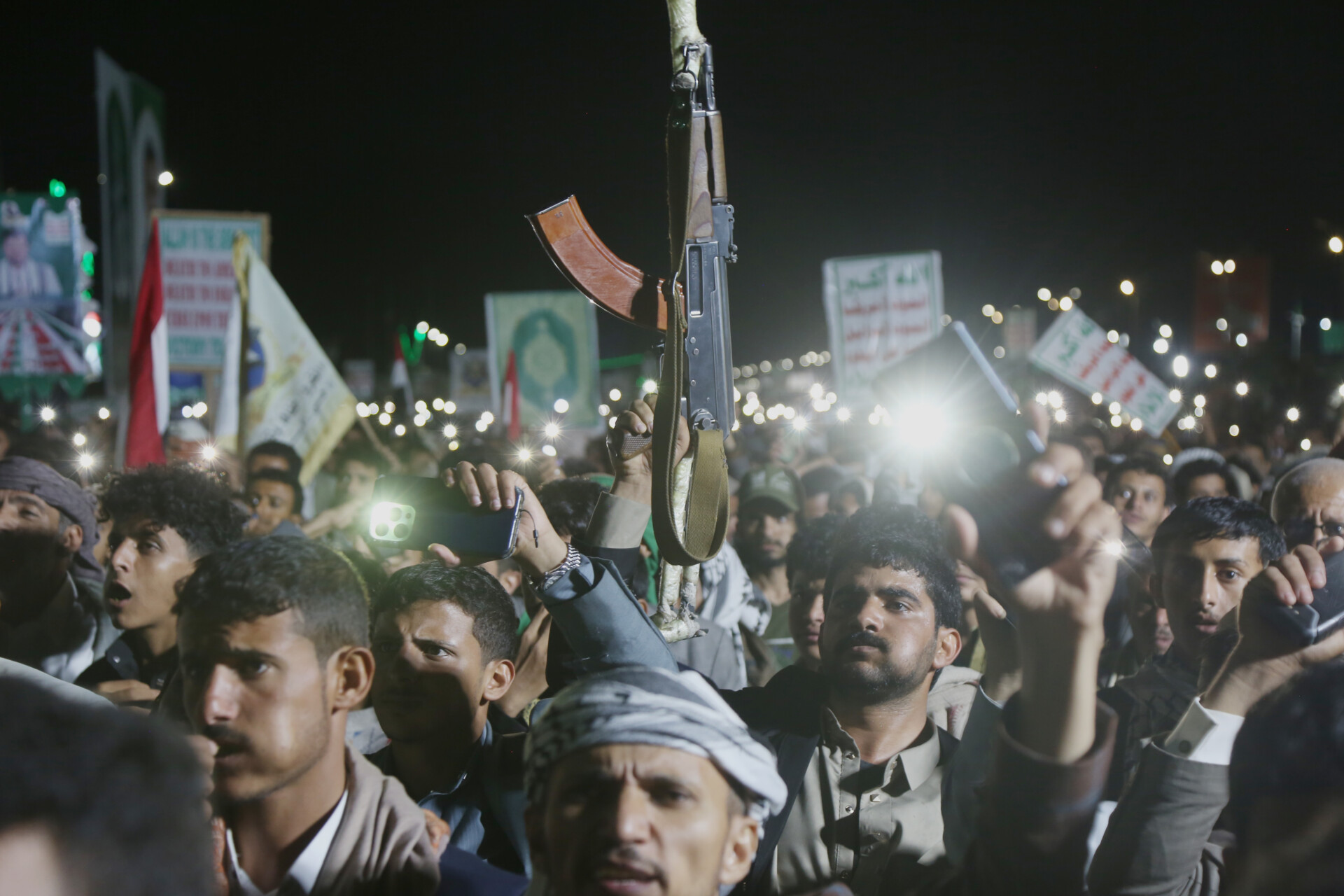
There are moments in Yemen’s long war when the map changes faster than politicians can understand it. The collapse of the western coast this month was one of them.
The lightning offensive by Yemen’s Houthi movement and its seizure of key positions around the strategic Bab al-Mandab Strait between the Red Sea and the Gulf of Aden are game changers in the country’s 12-year conflict, fundamentally reshaping the domestic balance of power and bearing consequences that go far beyond Yemen’s borders. By extending their reach to one of the world’s most vital maritime choke points, the Houthis have opened a new strategic dimension in the conflict, giving Iran further leverage against the United States, in addition to its existing influence around the Strait of Hormuz. This development presents a serious challenge to Saudi Arabia and other Red Sea states, as well as maritime traffic in the south of that sea.
For years, retaining hold of the coastline stretching from Mokha to Bab al-Mandab had represented one of the most important military achievements of the forces fighting the Houthis. In 2017, forces backed by the Saudi-led coalition, particularly those supported and led by the United Arab Emirates (UAE), fought their way down the coast in an operation known as Golden Arrow. It began on Jan. 7, and Mokha had been declared recaptured by Jan. 23. This first stage secured roughly 50 miles of coastline, although several more weeks were required to clear Houthi pockets from the surrounding areas. The operation had taken about 16 days to reach Mokha. Almost a decade later, the same geography changed hands in roughly seven days.
On Sept. 4, the Houthis launched a massive lightning offensive that swept through Hays and Khawkha and brought their forces back to Mokha and the entrance to the strait. There was no prolonged battle for the cities. Instead, government forces commanded by Vice President Tareq Saleh withdrew unexpectedly at dawn on Sept. 10.
I followed the developments closely and spoke with senior officials and field commanders both before and as the front collapsed. What I was told was striking: The withdrawal was not simply the result of forces being overwhelmed in the final hours. A decision had been made to pull out. Why was that decision taken, how was it implemented, and why did a military formation built over years unravel so quickly?
The answer begins months before the withdrawal, when the Houthis started preparing the battlefield. The latest offensive did not come out of nowhere — for nearly two years, the Houthis had been recruiting, mobilizing forces and preparing for a major military push. Yemen’s National Resistance Forces (NRF) estimate that the mobilization exceeded 76,000 fighters. The Houthis used the confrontation with Israel to mobilize fighters for the western coast, with the aim of altering the military balance and seizing areas around Bab al-Mandab.
The coast is significant because it gives the Houthis direct control over the strategic strait. During the Gaza war, the Houthis attacked ships crossing the strait with long-range missiles and drones, but now they can attack vessels with other weapons. The Houthis already controlled the coastline from Hajjah down to Hodeidah. Their new gains expand their territorial control along the lengthy coastline, which could also help them smuggle weapons and consolidate their connections with nonstate actors like al-Shabab in Somalia.
On Aug. 9, the Houthis opened the major phase of their offensive with ballistic missiles and drones directed at the headquarters of the NRF. Four missiles struck the vicinity of Saleh’s headquarters, though he escaped the attacks.
According to sources familiar with the preparations, the Houthi leadership had made a strategic decision several weeks ago to destroy Saleh and the forces he had built along the western coast.
The decision was reportedly taken by the Houthi Jihadist Council under Abdul-Malik al-Houthi, with Iranian members and advisers involved in the planning. The purpose was not simply to weaken a military opponent, but to remove the obstacle standing between the Houthis and their access to Bab al-Mandab. This force was a major problem for the Houthis, interdicting their vessels smuggling weapons through the Horn of Africa.
The offensive was part of a broader effort to seize the initiative before the government and its regional allies could do so.
The Houthis had already attacked government compounds between oil-rich Marib and Hadramawt, arguing that Saudi Arabia and the Yemeni government were preparing to launch an operation to recapture the capital, Sanaa. Instead of waiting for that confrontation, the Houthis sought to force a battle on their own terms. The government, backed by Riyadh, mobilized extensively on social media and gave the impression that, this time, the battle would put an end to Houthi influence.
The Houthis destroyed camps belonging to the Saudi-backed Nation’s Shield forces in remote areas between Marib and Hadramawt governorates, and intensified their confrontation with Saudi Arabia after announcing what they called a blockade of Saudi vessels passing through the strait.
But the escalation started earlier. One important stage began on July 3, when a plane operated by Iran’s Mahan Air flew from Tehran to Sanaa. The aircraft remained at the airport for about three hours before carrying a Houthi delegation to Iran for the funeral of the Iranian supreme leader Ali Khamenei, who had been killed by Israel.
Ten days later, the same aircraft returned with the same Houthi delegation, Iranian experts and sophisticated military equipment, including drone engines and missile warheads, according to sources.
The aircraft soon became part of the widening confrontation over Sanaa Airport. Fighters bombed the airport. The Houthis accused the Saudis, while the Yemeni government claimed responsibility for the attack. The Iranian aircraft was forced to divert to Hodeidah on the Red Sea.
Hodeidah’s runway had been destroyed in 2015, and its rehabilitation, together with preparations at other airstrips, suggested that the Houthis were preparing for a new phase of escalation. Sources said that runways had also been built in Saada, Dhamar and elsewhere.
The Houthis said the Mahan Air flight was intended to break the Saudi blockade. Yet Sanaa Airport was not completely cut off: Flights to Amman continued, while discussions were taking place over expanding its operations before and during the Houthis’ involvement in the war in Gaza. In May 2025, Israel bombed Yemeni aircraft at Sanaa Airport as retaliation for Houthi strikes on Israeli territories. The Houthis refused to take them to neighboring countries like Djibouti to avoid their destruction during the clash with Israel. Three aircraft were destroyed at once, and the airport was closed.
The bombing of Sanaa Airport in July nevertheless helped push the confrontation into a new phase. The Houthis announced what they called “blockade for blockade,” banning Saudi vessels and beginning to strike them. The escalation came after the Saudi-Houthi understanding of 2022 had largely frozen the main front lines.
By the summer of 2026, the relationship between the Houthis and Saudi Arabia was once again moving toward open confrontation.
When the ground offensive finally came, the Houthis had already spent several weeks shaping the battlefield. According to NRF officials, between Aug. 9 and Sept. 9 they launched approximately 130 ballistic missiles, 145 suicide drones and 15 explosive boats against government forces. Mokha’s port was destroyed, while the forces defending the western coast endured a sustained campaign with little substantial airpower support.
Tens of thousands of fighters were mobilized, including elite units. Senior commanders were deployed to al-Hawban, northeast of Taiz, among them Mohammed Alattifi, the defense minister in the Houthi government; Yousef al-Madani, the chief of staff and Red Sea front commander; Abdullatif Almahdi (aka Abu Nasr Alshaaf), commander of the Fourth Military District; and other senior intelligence and military officers. Some of Iran’s Islamic Revolutionary Guard Corps (IRGC) experts were also involved, according to sources. The operation against Mokha was directed from there. The assault was far from a secret.
But the Houthis were fighting on another battlefield as well: communications. After abandoning the use of “Claude” over fears that it had been infiltrated by the United States or Israel, the Houthis reportedly assembled a team of Houthi, Hezbollah and Iraqi experts. Vehicles carrying sophisticated communications software were sent to intercept communications between government forces on the front lines extending from western Taiz to Mokha. According to NRF officials, electronic warfare units detected and were able to listen to 5,346 radio communications devices near the front line: 3,181 around the al-Barh front in Taiz and 2,165 around Hodeidah.
According to information I received, the system was then used to send withdrawal orders to front-line units while those same positions were being massively struck by missiles and drones. The effect was devastating. After the fall of Alwaziah district in Taiz, some fighters were afraid the Houthis might storm Dhubab and cut the supply line, particularly those who have families there; they abandoned some front-line positions to rescue their families. The residents thought it was a final pullout. The fighters thought they would come back to their front-line sites, but time was not on their side, according to military and political sources. Some were informed about the withdrawal while others, including commanders, were not.
“The people fought bravely and ferociously for days,” according to a senior leader. “Some fighters were besieged for two days and repulsed massive attacks while sleepless for long hours. The fighter jets did not show up, and no other front lines were activated in a proper way, either in Taiz or other governorates, to distract Houthi forces and disrupt supply lines. The pullout was thus disorganized and undisciplined, and this is why it was a rout.”
The Houthis’ primary objective, according to sources, was to kill Saleh and seize Mokha and Bab al-Mandab, regardless of the consequences. The IRGC had reportedly given the operation a 10-day deadline. A few days before the collapse, Abdulmalik al-Houthi, the leader of the Houthi group, reportedly reduced that deadline to 72 hours. The deadline was met. But the speed of the defeat cannot be explained by Houthi military strength alone.
The government front was already divided. The fall of al-Kadaha in western Taiz was an early indication of what was coming. The area was held by the Al-Nasr Brigade, affiliated with the Taiz Military Axis. The commander of the brigade, Rami al-Khulaidi, was in Aden at the time of the Houthi attack on his forces, whose numbers were few, according to reports. On Sept. 6, it fell with little substantial resistance. Saleh had warned the Taiz Military Axis months earlier that the front line was strategically important and needed reinforcement. His warnings did not produce the response he wanted, according to military sources.
There was deep distrust between Saleh and elements of the Taiz forces, as well as the Muslim Brotherhood-oriented Islah party at large. Some viewed Saleh primarily as an ally of Abu Dhabi, despite his subsequent realignment with Riyadh following the political and military developments that led to the departure of the UAE-backed Southern Transitional Council (STC) forces in late December and early January, when the Saudis bombed the STC forces and UAE military vehicles in Hadramawt, giving the UAE a 24-hour ultimatum to leave Yemen. Its allies, including Saleh, had no choice but to realign with the new order led solely by Riyadh.
Those political suspicions mattered when the fighting began. Once the Houthis seized al-Kadaha, they cut the road between Mokha and Taiz city, which had been built with UAE funding. Military experts regarded the fall of al-Kadaha as a decisive development because it isolated Mokha from Taiz city and any potential supply or pressure to support the forces in Mokha and the western coast at large. No other front lines around Taiz were activated to cut Houthi supply lines or distract them from their objectives.
But the division went deeper than one road or one military front. The relationship between the Islah party and its allies and rivals had been shaped by the wounds of 2011. The years of war created new alliances, but they did not erase old rivalries.
When the western coast collapsed, those old grievances resurfaced. Some in Islah and other activists demanded that Saleh be prosecuted and blamed him for the defeat, arguing that his forces had been heavily armed and should have been able to defend the area. Others, including some Saudi writers, went so far as to accuse Abu Dhabi of having a hand in what happened.
The problem was that the anti-Houthi forces were never a single army.
The NRF were backed during the fighting by forces from the Giants Brigades (Salafist and formed by the UAE) and Nation’s Shield (also Salafist but built by the Saudis), but these forces did not necessarily function under a unified field command. Some had reportedly gone unpaid for months. Others did not fully accept Saleh’s authority as commander of the western coast. The result was a force that possessed weapons, manpower and territory, and which was fighting on multiple front lines, but which lacked an effective unified military command at a critical time. The minister of defense, who was supposed to be on the hot front lines like the western coast, chose, according to many, the wrong front line to visit at the wrong time. He went to Dhale, a stronghold of southern separatists, who ambushed the defense minister’s convoy and held him there for some time. It was a meaningless visit.
The Houthis faced the opposite situation. Their command was centralized, their objective was clear, and their leadership was able to concentrate tens of thousands of fighters on a single front. The difference proved decisive. The price of collapse and the territorial consequences were enormous. The Houthis seized roughly 2,000 square miles in a single offensive and returned to Bab al-Mandab after almost a decade.
What they captured was not simply territory. The western coast contained a military infrastructure developed over years with significant Emirati support: weapons and ammunition depots, military compounds, communications systems and strategic positions surrounding Mokha.
Among the facilities that fell into Houthi hands were Mokha’s port, which was subsequently destroyed by their missiles; the airport; a solar power station; the security and military system around Jabal al-Nar (a military base and command and control center built by the UAE); the al-Omari compound (a government military compound overlooking the areas near the strait); and the mountain positions surrounding Mokha. Mokha has seen unprecedented development in recent years, and its population has been growing. Alongside Marib, it had become a model for development in the areas under government control.
The Houthis also captured large quantities of weapons and ammunition. One senior former intelligence chief described the system left behind as “a military and security system for a state,” a phrase that captures what was lost in those few days.
The collapse was not simply the abandonment of a defensive line. It was the disappearance of a military structure that had taken years to build. Arguably one of the gravest mistakes was to build a strategic command-and-control base at Jabal al-Nar, just 11 miles away from the front line with the Houthis, presumably to use the cover of the mountain to avoid strikes. Yet while the base was fortified enough to avoid Houthi missiles, it was fragile enough to fall to their ground forces.
Once seized, the operation’s control room fell, and communication with military units was lost. According to people from the area and accounts of the battle, the decisive fighting was concentrated around the central section of the western front. The critical axis ran through al-Barh, Mafraq Mokha, Khalid Camp and Jabal al-Nar. The collapse followed a recognizable military sequence. Mafraq al-Barh came under pressure. The defensive system around Khalid Military Camp was compromised. Jabal al-Nar and the command structure were threatened. Communications and coordination deteriorated. The forces began withdrawing. There was no plan for alternative defensive positions to the lost ones. Mokha became increasingly vulnerable.
The significance of this sequence is that the Houthis did not need to destroy every government formation simultaneously. But some sources said the Tihami brigades fighting in the districts of Khawkha and Hays in Hodeidah, which are part of the NRF, reportedly maintained greater cohesion and made a timely withdrawal before becoming completely encircled. These units are now the formations that would take the lead in any future arrangements in these areas.
The casualties were also severe. According to Health Ministry reports, more than 700 Houthis were killed and hundreds wounded. Government forces suffered more than 500 deaths and around 1,500 injuries.
Although the actual numbers could be higher than this, the strategic significance of the defeat goes beyond the numbers. The Houthis now possess weapons and ammunition that could sustain operations for months.
During the 12-year conflict, the Houthis’ principal weakness remained airpower, particularly in flat areas; the Houthis are well-trained to fight in rugged mountainous terrain. Sources said that Saleh appealed for greater air support, but the limited airstrikes he received could not stop the overwhelming numbers of Houthi fighters and did little to slow down the withdrawal. After withdrawing, Saleh’s troops and supporting forces moved toward Khour Omairah in Lahj, while the Houthis followed with missile strikes.
The air support came too late, only after they withdrew. Massive strikes were reported against Houthi targets along the western coast and elsewhere, destroying some of the weapons left behind by the NRF as well as mountain depots. The Houthis counted 450 air strikes in a single week. Field reports indicated that hundreds of Houthis were killed.
The campaign recalled the early days of Operation Decisive Storm in March 2015, when airpower dominated the battlefield. But there is a fundamental difference between destroying a position and holding it. Aircraft can strike weapons depots, command posts and military installations. They cannot occupy a mountain, secure a road or defend a port. Those tasks require ground forces capable of operating under a single command.
No such force existed when the western coast front collapsed. A counteroffensive remains possible, but it would require the surviving forces to regroup and establish a coherent command structure before attempting to recover the territory that was lost. The Houthis are now working to consolidate their positions in the areas they seized, and there are reports that they are planting mines. The longer they stay there, the harder it will be to drive them out. They are also seeking to seize the rugged mountainous areas of Taiz and Lahj that overlook the strait, in order to protect their rear, even as they work very hard toward their probable next move: Marib.
The military collapse quickly became a humanitarian crisis. Around 100,000 people were displaced within a short time. Some, both military and civilians, were reportedly harassed by security forces affiliated with southern separatists as they attempted to reach safer areas in Aden. The new displacement came on top of years of repeated displacement since the beginning of the war in 2015.
For many civilians, the collapse of the western coast was not a change on a military map — it was another forced journey, another home abandoned and another uncertain search for safety.
For Saleh, the defeat carries heavy political and personal meaning. The force he built with Emirati backing, estimated at 50,000 men, has effectively disappeared from the western coast. He lost control of the battlefield and fled to Aden, where he spent some days at the presidential palace before travelling to Riyadh. It was his first return to Aden since 2022.
His history is inseparable from the politics of Yemen’s war. On June 3, 2011, Tareq Saleh was unable to protect his uncle, then-President Ali Abdullah Saleh, when a C4 explosive device detonated inside the Al-Nahdeen mosque after Friday prayers. The president was seriously wounded and hospitalized in Saudi Arabia. Six years later, on Dec. 2, 2017, Ali Abdullah Saleh turned against the Houthis after years of alliance with them. Fighting erupted in Sanaa, and the Houthis killed him a few days after his uprising.
Tareq Saleh escaped the capital and eventually reached government-controlled territory. With backing from Abu Dhabi, he began building the force that would become the NRF, establishing its main base in and around Mokha. Since then, he has tried to bury the political conflicts of the past. His message has been that the Houthis are the principal enemy and that the ultimate objective should be Sanaa. But political memories do not disappear simply because alliances change. For some of his opponents, the wounds of 2011 and the old rivalry between the Saleh camp and Islah remained powerful. When the western coast collapsed, those tensions reemerged at precisely the moment when unity was most needed.
Tareq Saleh was commander of the Republican Guard’s Special Guard unit and the 3rd Republican Guard Brigade before he was ousted by former President Abu Rabbu Mansur Hadi in April 2012, after Hadi was elected unopposed to replace Ali Abdullah Saleh amid the Arab Spring uprising against him. Tareq Saleh opposed the ouster and rebelled against it, but was later pressured to accept the dismissal, which targeted several in Ali Abdullah Saleh’s inner circle of commanders, including his son, Ahmed.
Tareq Saleh stayed loyal to his uncle after the president handed authority peacefully to his deputy. But the former president maintained his leadership position in the General People’s Congress, the ruling party during his reign in office. Tareq Saleh was the main aide to Ali Abdullah Saleh during that period, when he was trying to undermine Hadi’s authority and entered a coalition with the Houthis — his former enemies. The bond with the Houthis was getting stronger, and the shared objective was to get them to Sanaa to oust Hadi and his allies, including the Islah party — a coalition of tribes, military forces and the Muslim Brotherhood.
When Saudi Arabia led a coalition against the Houthis, who took over Sanaa in September 2014, Tareq Saleh and his uncle were supporting the Houthis. Ali Abdullah Saleh formed a cabinet with them in order to confront the government of Hadi, which was then backed by the Saudis and the UAE. Tareq Saleh was fighting alongside the Houthis until December 2017, when Ali Abdullah Saleh broke with them, leading to his death.
Critics of Tareq Saleh would go on to say that he did not learn from his uncle’s mistakes during the latter’s 33 years in power. His close circle of cronies was from his own tribe.
Until April 2022, Tareq Saleh had no relation with the central government. When the Saudis struck a deal with the Houthis, the Presidential Leadership Council, composed of eight members, including Saleh, was established to take power from Hadi. The council was meant to bridge the deep divides within the anti-Houthi block, but they remained.
Saleh, the commander of the NRF, lost the battle and perhaps his political and military career; commanders and leaders who suffer defeat on such a scale are often forced to resign, or face even more severe consequences. After Egypt’s defeat in the 1967 war, President Gamal Abdel Nasser announced his resignation. Millions of people took to the streets and demanded that he stay. Nasser reversed his decision. Saleh can never be Nasser, and there is no indication that the people will even care to ask him to stay and lead the battle again.
His future therefore depends not only on what happens militarily but also on whether Riyadh decides that he remains strategically useful. The next phase may determine whether this defeat becomes a temporary setback or the end of Saleh’s military-political project.
Some, particularly those affiliated with the Islah party, regard Saleh as a traitor because of the swift collapse of his forces. The collapse shocked everyone, including his enemies in Taiz and elsewhere, because they saw these forces as the main bulwark against the Houthis. Others defended him, saying he fought bravely against the Houthis and was probably the only presidential council member to be on the ground the entire time, unlike those living outside the country.
But the collapse of the western coast can’t be attributed to one commander.
The defeat exposed a much broader failure to create a genuinely unified military structure from forces that had been brought together more by their common opposition to the Houthis than by a shared political project.
The Presidential Leadership Council was intended to provide such a framework. The departure of the Southern Transitional Council and the reduction of the UAE’s direct role had created expectations that coordination among the anti-Houthi forces would become easier, particularly because the various formations were now more clearly under Saudi Arabia’s sole leadership.
But the western coast demonstrated that the divisions had not disappeared. The NRF, Giants Brigades and Nation’s Shield forces were nominally on the same side, but they remained separate military structures with different chains of loyalty and command structures.
The Houthis exploited that fragmentation, and their victory has changed Yemen’s strategic geography and the course of the conflict. For almost 10 years, the Houthis had been pushed away from Bab al-Mandab. Now they are back. That matters not only because of Yemen’s internal war but because the strait connects the Red Sea to the Gulf of Aden and has become central to the wider confrontation surrounding the Houthis’ attacks on maritime traffic.
For Iran and its allies, this represents a major strategic gain. Across what Tehran calls the Axis of Resistance, Iranian, Iraqi and Lebanese allies, along with supporters linked to Gaza, applauded the development. Some media outlets described celebrations in Tehran and Sanaa as an “Iranian-Yemeni night.” The Yemen they celebrate is largely the part of the country controlled by the Houthis in the northwest, where most of Yemen’s population lives. For Tehran, Yemen’s strategic value is closely connected to the Houthi-controlled coastline, which stretches for roughly 400 miles from Hajjah to Bab al-Mandab. Their return to the Bab al-Mandab area gives Tehran a wild card to use beside the Strait of Hormuz.
The international consequences are already becoming visible. The Houthis’ involvement in the Gaza war and their attacks on vessels in the Red Sea and Gulf of Aden have changed the way many governments view the movement. Countries that once saw the Houthis primarily through the lens of Yemen’s internal conflict increasingly regard them as a threat to maritime activity. Their control of Mokha, the approaches to the strait and strategically important Red Sea islands has made that concern more acute.
Yet for many Yemenis living around Bab al-Mandab, its strategic importance is almost an abstraction. On the ground, the reality is one of poverty, deprivation and years of neglect. I remember being struck by the contrast during my last visit to the region when, in the early morning of March 7, 2022, I drove back from Mokha to Aden along with some colleagues. Local communities lived with very little in makeshift houses, while fishers went out to sea in tiny boats, struggling to make enough to support their families. The landscape offered few signs of the enormous geopolitical importance attached to it. Around them, regional and international powers were competing for influence over one of the world’s most strategically important waterways, while the people who lived beside it were struggling simply to make ends meet.
This is the paradox of Bab al-Mandab: the narrow stretch of water commands the attention of states and militaries far beyond Yemen, yet many of the people living on its shores have experienced little of the prosperity or development that such strategic importance might imply. For those communities, Bab al-Mandab is not primarily a geopolitical choke point. It is home.
The Houthis have tried to reassure the outside world. The day after their victory on the western coast, during a meeting between their representatives and U.S. embassy officials in Muscat, they said they had no intention of attacking U.S. vessels. They also said they would not target Israeli vessels and that the strait would remain safe except for Saudi vessels until what they called the Saudi blockade was lifted. They spoke with the Russians as well. Egypt reportedly declined discussions on maritime security.
Yet statements from activists and armed fighters on the ground complicated the message from the Houthi leadership. Fighters arrived on Perim Island and spoke about establishing a maritime checkpoint and stopping vessels. The message on the ground was louder than the political message of Houthi leaders.
For shipping companies, such statements create uncertainty, even if the Houthi leadership insists that the strait will remain open. One possible consequence is that shipping companies could choose to divert vessels around Africa, adding considerable time and cost to voyages.
At the same time, the Houthis are consolidating their military presence in the mountains overlooking Bab al-Mandab. They are digging trenches, strengthening mountain positions and using abandoned military compounds. They have returned to areas from which they were pushed out almost a decade ago, but this time they are arriving with the experience of years of war and in a different regional environment.
The Houthis understand that their opponents and the Saudis are unlikely to accept the new reality indefinitely. The airstrikes that followed the collapse may therefore represent more than retaliation or an attempt to destroy captured weapons. They could be the beginning of preparations for a counteroffensive, potentially aimed not only at recovering the territory lost along the western coast but also at opening pressure on other fronts as Houthi attacks against Saudi infrastructure increase.
Some Western diplomats have supported Saudi Arabia’s actions, despite having seen the failure to prevent the Saudi- and UAE-backed offensive against Hodeidah in 2018 as a strategic mistake. For humanitarian organizations, Hodeidah’s port has long been regarded as a lifeline for millions of Yemenis, and the Stockholm agreement that followed the 2018 offensive and aimed to protect that function was never fully implemented. One foreign official, however, described Hodeidah’s role differently: as a lifeline for Houthi weapons.
That contradiction has always defined Yemen’s western coast. The same geography that makes the area vital for Yemen’s civilians makes it strategically valuable to every actor seeking influence over the country. The question now is whether the forces that lost the coast can recover from the defeat.
Saleh may attempt to rebuild his forces. Saudi Arabia may deepen its involvement. The government may try to reorganize the military structures that collapsed. Other Yemeni factions may conclude that the loss of Bab al-Mandab has finally made military coordination unavoidable. But the deeper question is political. Can Yemen’s anti-Houthi camp overcome the rivalries that have repeatedly prevented them from acting as a unified force?
The Houthis have demonstrated what centralized command, concentrated manpower and a clearly defined objective can achieve against a fragmented opponent. They have taken back Mokha, regained access to Bab al-Mandab and captured a military infrastructure built over years to keep them away from the coast.
Mokha was supposed to be a barrier against the Houthis. Instead, in seven days, it became their gateway to Bab al-Mandab.
A government source said that a fact-finding committee would be established to investigate what happened, but that it will not hold anyone accountable. Accountability is not part of Yemen’s political history. While there are demands that Saleh be held responsible, others say that all figures involved in these setbacks — from fleeing Sanaa to the Nehim and Aljawf front lines and beyond — should be held to account. Yet for some, this is not the moment for blame games and recriminations that might divide the anti-Houthi camp further, but for healing wounds and preparing for the next confrontation, lest the Houthis swallow the country while their opponents focus on settling their accounts.
Become a member today to receive access to all our paywalled essays and the best of New Lines delivered to your inbox through our newsletters.