

Two days before the official start of the six-day funeral and burial ceremonies for Iran’s slain leader, Ali Khamenei, the roads out of Tehran had already begun to clog.
Traffic before holidays or major national events is common in a capital of 9 million people, many of them migrants from other provinces who take any chance they can to return to their hometowns. For weeks, Iranians had known that Khamenei’s funeral would bring millions into the city. Some left in advance to avoid the crowds while others left for political reasons, not wanting to be trapped in a city that was preparing not only for mourning, but for a mass ritual of state power, religious memory and revenge.
The funeral organizing committee for the late leader of the Islamic Republic of Iran and his family — whose deaths marked the beginning of the recent war waged by Israel and the United States against Iran — had announced the date and schedule in detail a week before the ceremonies. The funeral, they said, would begin in Tehran, move over several days through the symbolic geography of Shiite Islam and end in Mashhad, Khamenei’s hometown, beside the shrine of the eighth Shiite imam.
By last Friday evening, after a series of initial diplomatic ceremonies welcoming foreign dignitaries had ended, the streets of Tehran and other cities had been gradually handed over to the masses to prepare their send-off to their leader.
Iran has been deeply polarized for years over its governing system and its controversial former leader. But for those millions of Iranians who still support the Islamic Republic, and who decided to stay in Tehran for the start of the ceremonies, the death of Khamenei is a moment that has mixed grief, defiance and a cautious hope for the future, following a war in which Iran is believed by many to have prevailed against two nuclear powers.
“The gathering that formed to bid farewell to the leader is one of those experiences that may happen only once in a generation. It is not something everyone can witness,” said Mohammadreza, a 45-year-old political activist in Tehran. “But beyond that, the gathering demonstrates Iran’s strength and its emergence from the turmoil of the past months of war. For Iran and the axis of resistance in the region, a new chapter has begun, and if we look at Iran’s experience over the past five decades, I believe we can imagine a brighter future.”
A perimeter extending 1.25 miles in all directions around the Grand Mosalla was closed before the initial prayer ceremony. Families, pilgrims and mourners who had come from other cities but had nowhere to rest slept in the streets. Some sat beneath banners with blankets, while others stretched out on the asphalt.
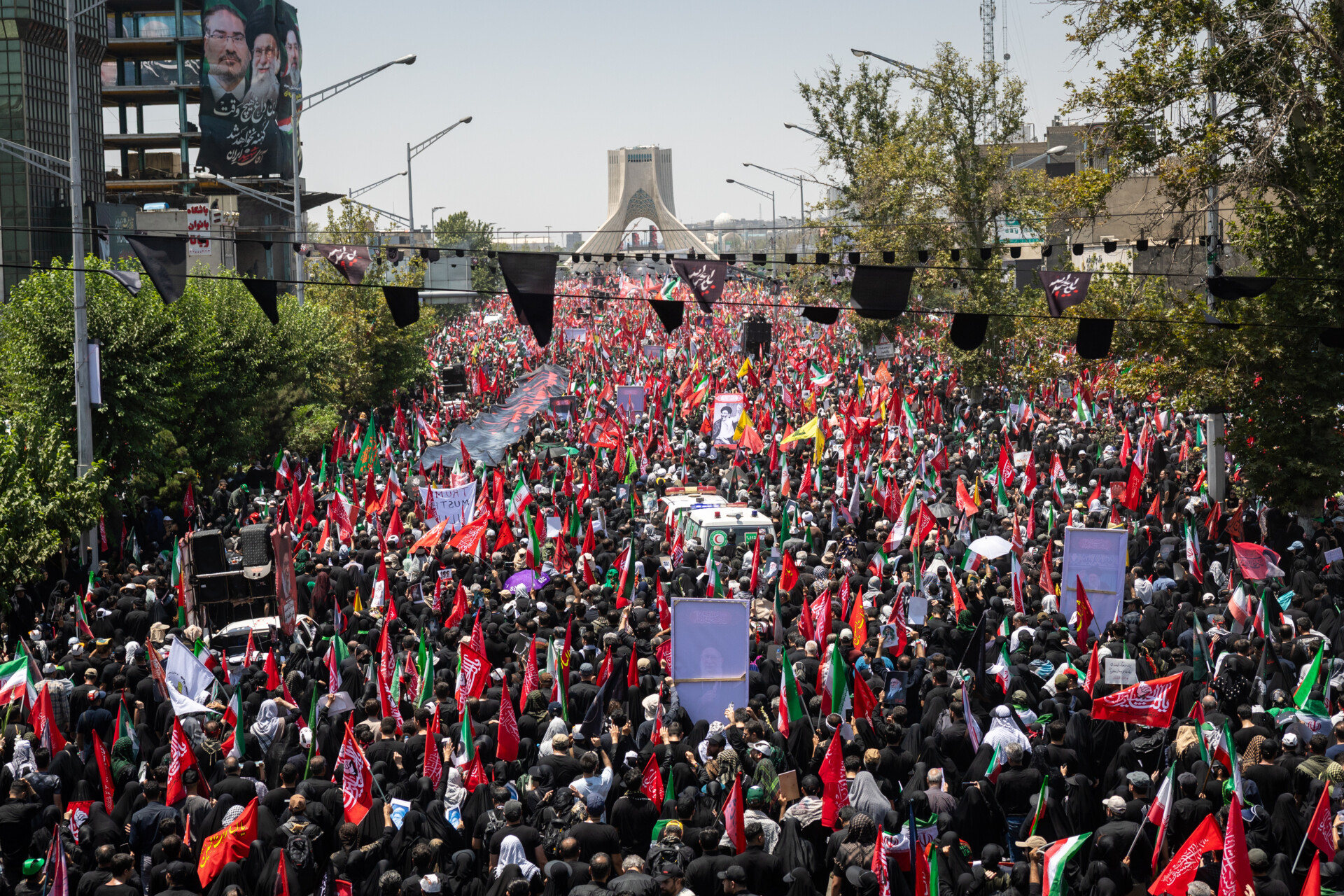
The public farewell was held on Saturday. The coffins of Iran’s late leader and his slain family were placed on an elevated platform inside the mosque. The funeral prayer was held on Sunday morning, and the procession through Tehran took place on Monday. From Saturday onward, no matter where one stood or from which angle one looked, the dominant image in Tehran was red: red flags in the hands of mourners, red flags lifted above the crowd, red flags moving like a field of flame through the capital.
In Shiite symbolism, the red flag is a call for vengeance. During the first 10 days of Muharram, shrines of the Shiite imams are often adorned with red flags to commemorate the tragedy of Karbala, where the family of the Prophet Muhammad was killed centuries ago. Iran’s choice of timing, imagery and route was deliberate.
Khamenei had been killed on the anniversary of the assassination of the first Shiite imam in 661 CE, and nine days after the anniversary of Karbala, where the third imam was martyred in 680 CE. The funeral unfolded during the second 10 days of Muharram and passed through four of the 11 shrines of the Shiite imams. None of the planning was coincidental, and the structure of the funeral was designed as an effort to place Khamenei’s death inside the deepest narrative structure of Shiite history.
For this reason, Khamenei’s funeral cannot be easily compared with that of Ruhollah Khomeini, the first leader of the Islamic Republic. Khomeini died of natural causes nine years after the revolution he had led to victory. The country had just emerged from an eight-year war with Iraq, and the state was still young, wounded and defining itself.
Khamenei, on the other hand, was killed by a foreign enemy 47 years after the revolution, after more than three decades as leader of a political system that, even after his assassination, continued to function through the wars of June 2025 and February-March 2026. The system he built was deeply shaken by the Israeli and U.S. attacks, but it did not collapse.
If there was a precedent for Khamenei’s funeral in recent history, it could be found in the recent funeral of the Islamic Revolutionary Guard Corps commander Qassem Soleimani. Like the commander he loved, Khamenei was carried on a tour of the regions over which his influence had been felt in life. Soleimani’s body moved through Iraq and Iran before burial in his hometown of Kerman. Although Khamenei had not left Iran in decades, his body, which is to be buried in Mashhad on Thursday, left the country to be honored in Iraq’s Najaf and Karbala, the burial sites of the first and third Shiite imams.
“Aside from the fact that, contrary to the announced plan, the convoys carrying the coffins entered from the western end of Tehran instead of following the east‑to‑west route, leaving many people waiting along several kilometers of the route without seeing the procession, the management of the ceremony was excellent,” said Mohammad, another attendee at the Tehran funeral. “Cold water and other amenities were provided everywhere for the people. Having witnessed the funeral of Gen. Soleimani, we can compare the two and confidently say this one was very well organized.”
To many Muslims, especially in the Sunni world, such a prolonged funeral and delayed burial may seem religiously questionable. But in the Shiite world, Khamenei’s funeral has become a thread connecting people and movements committed to political Shiite Islam and resistance against external domination.
Due to security and logistical concerns, Iran could not open its borders to everyone who wanted to attend Khamenei’s farewell. Instead, limited groups of social media activists from Pakistan, Kashmir, Yemen, Lebanon, Iraq, the United States, Italy and other countries were invited to attend and report back home on the ceremonies. Demand from Iraq was so great that, at the request of Iraqi political authorities, Khamenei’s body was transferred for a day of processions and ceremonies in Najaf and Karbala, accompanied by Iranian officials, including President Masoud Pezeshkian.
At the Tehran funeral prayer, many of the political figures who had shaped the Khamenei era were absent from the front row. Most striking was the absence of all three living former presidents. Speculation over their lack of attendance became so widespread that Hosamoddin Ashena, a security figure close to former President Hassan Rouhani, posted on social media that the absence of certain political figures was due to “security and protective considerations.”
That explanation did not settle the matter. Inside the mosque and in the surrounding streets, the atmosphere suggested that some groups in the crowd might have become uncontrollable if confronted with certain political figures perceived as overly conciliatory toward the West. Videos showed mourners criticizing Iran’s negotiating team in recent talks with the United States. In another video, recorded on Tuesday near the funeral site, a group attacked the car carrying Abbas Araghchi, Iran’s foreign minister and a longtime senior negotiator, by throwing stones.
From the early days of the war through the funeral week, Tehran and other major cities had hosted street gatherings in support of their country. After the ceasefire, many of these gatherings turned into political rallies led by hard-line groups opposed to negotiations and demanding continued military confrontation. Some extremist slogans not only condemned talks with the United States but even called for the physical elimination of the president and members of the negotiating team on charges of betrayal.
The successor to Khamenei, his son Mojtaba, also stayed away from the ceremonies. The ostensible reason is for his security, though there have been consistent rumors about the extent of the injuries that he suffered in the initial wave of Israeli and U.S. attacks. His absence has unsettled some mourners. Mojataba Khamenei was chosen as Iran’s new leader 10 days after his father’s assassination at the start of the war, yet more than 110 days later, he has still not appeared publicly.
“Not seeing the leader gives me a sense of insecurity. I feel there are serious concerns about infiltration among senior officials, which has led to caution and his avoidance of public appearances,” said Elham, a 44-year-old participant in the Tehran funeral. “His presence and voice are very important to me personally, because they bring reassurance, unity and a return of security to society. But I understand that under the current circumstances, he must be protected.”
Other supporters of the government were less charitable about the decision to keep Mojtaba hidden from the public, contrasting his absence with the constant visibility that his father maintained as supreme leader.
“The leader was the father of the nation, and his presence gave us peace, hope, security and motivation for the future. His constant reminder that we, the youth, are the future of the country made me wake up each day with purpose,” said Fatemeh Zahra, another mourner. “Losing him makes me feel lonely and hopeless. The fact that we cannot see the new leader shows how much the country has changed with his martyrdom.”
The number of people who attended the Tehran ceremonies is difficult to establish, though estimates in both Western and Iranian media have put turnout in the millions. Organizers repeatedly warned people not to stay too long at the mosque or along the funeral routes because of the heat and crowding, which means aerial images cannot easily be used to calculate attendance.
What the aerial images do show is unmistakable: a sea of red flags of vengeance in the hands of the people. But on the ground, not everyone had come to make a political display. Among many mourners, grief outweighed anger. Some described the feeling as “mourning a father.” In the heat and noise of Tehran, amid flags, chants and security cordons, the language of state ideology gave way to the language of family.
Opponents of the Islamic Republic, including supporters of the deposed shah’s son, claimed that the government inflated the turnout by bringing in mourners from Afghanistan and Yemen. In reality, Afghan mourners arrived on a few buses with special visas from the Taybad border in northern Khorasan, while the Yemeni delegation consisted only of passengers on a chartered Iranian airline flight, which was exceptionally allowed to bypass the air blockade of Sanaa to bring a limited group of Ansarallah members to Tehran.
Zeinab, 38, who attended the Tehran funeral, said in a phone interview: “Only after the leader was killed in that way did I realize what calamities await us and the country in his absence. Until today I couldn’t believe we had truly lost him. I had to attend the ceremony myself and see his body being buried to accept it. For me, it is as hard as losing a father.”
Modern Iran has developed cultural precedents for dealing with the loss of a national leader. In the cult film “From Karkheh to the Rhine,” made two years after Khomeini’s death, an early attempt was made to address the cultural disorientation caused by the loss of a revolutionary leader in the Islamic Republic.
In the film, a fighter blinded by chemical attacks in the war with Iraq regains his sight through surgery. The first thing he chooses to watch is footage of Khomeini’s funeral. Later, he encounters disillusioned revolutionaries and newly committed idealists, each carrying a different idea of what the revolution was and what it was meant to deliver, shedding light on the divisions and complications that the leader left in his wake.
Khamenei’s funeral may become the raw material for a similar cultural memory — not because the Islamic Republic after him is leaderless, but because the funeral showed how many new possible versions of the country are now moving beneath the surface, with visions of hard-line anger, conciliation, revolt and hope for revival all now competing to shape the future in his absence.
In this way, Tehran and other cities in Iran today are not merely processing the death of Khamenei through the grand spectacle of his funeral, but rehearsing their roles for a future Iran built in his absence.