


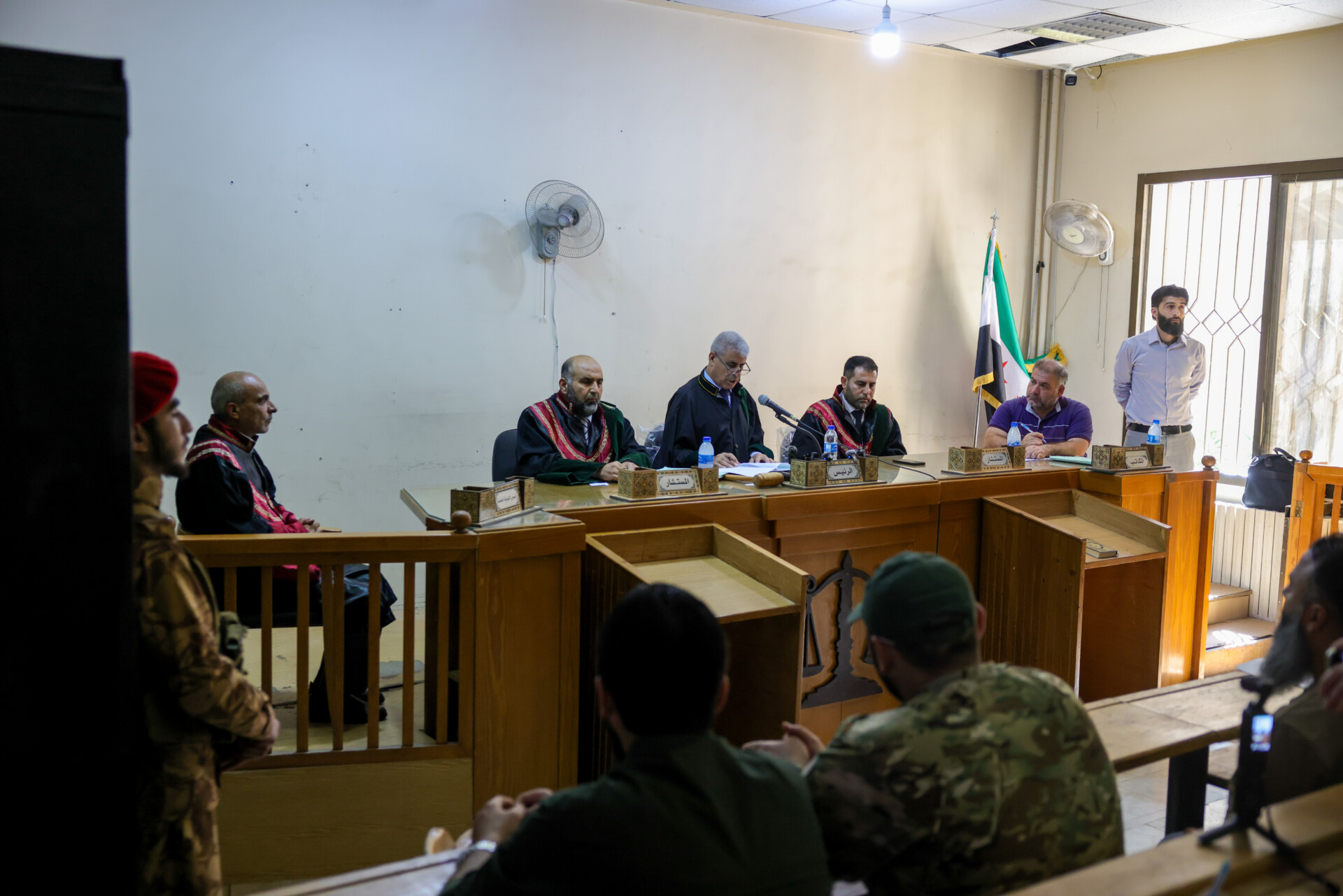
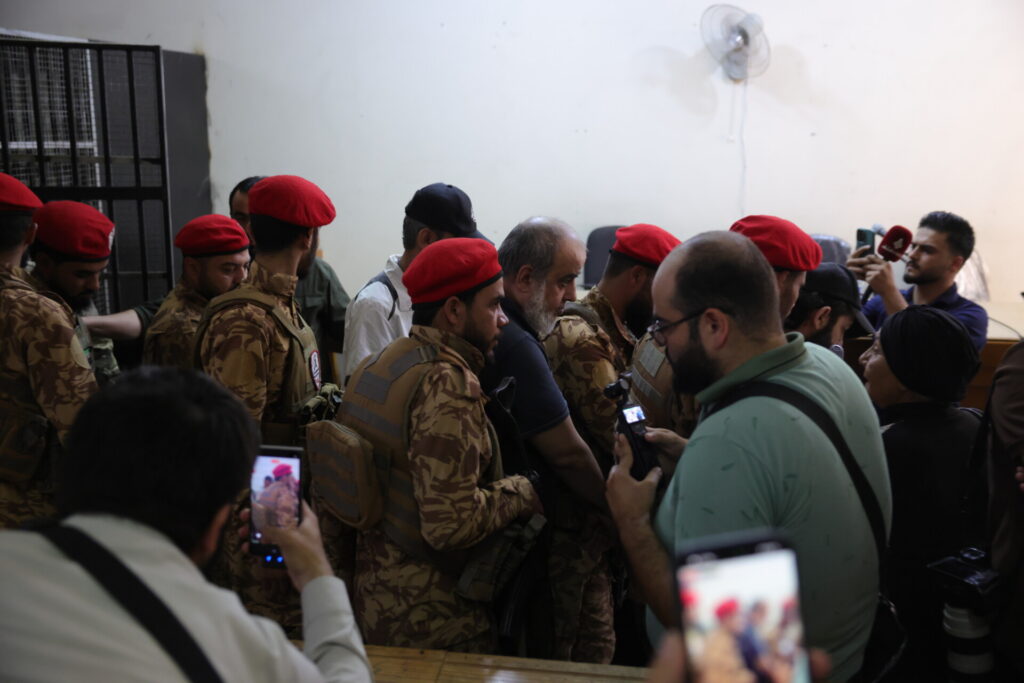
In a half-empty courtroom at the Aleppo Palace of Justice, at 10 a.m. on Thursday, a line of military police soldiers wearing red berets brought the detainees into the room. They led them toward the defendants’ box, a concrete cage with iron bars set to one side of the courtroom.
In the fifth row, two women sat side by side: the mother of one defendant and the wife of another, their faces set in silence.
In this trial, which began on Nov. 18, 2025, 16 people were prosecuted in proceedings concerning the violence that engulfed Syria’s coastal region in March 2025, following an armed rebellion by men who remained loyal to the regime of Bashar al-Assad, and the retaliatory violence that followed. More than 1,400 civilians were killed at the time, according to Syria’s National Commission of Inquiry, which was tasked with establishing the facts surrounding the coastal violence. Some of the killings were summary executions, several of which were filmed and circulated on social media.
It was the first major episode of violence to erupt since the fall of Assad, in a predominantly Alawite coastal region and the former regime’s stronghold.
Eight defendants were accused of taking part in the rebellion, one of whom never showed up to court. Eight others, including one civilian and seven members of government forces, were accused of violence against civilians. The National Commission of Inquiry identified 298 potential perpetrators of violations against Alawite civilians, as well as 265 people potentially involved in attacks against government forces.
Eighteen months after the violence, after more than a dozen hearings and 10 months of proceedings, the court was now delivering its first verdicts.
At the center of the courtroom, Civil Judge Zakaria Bakkar, assisted by two military advisers, began to read in the monotonous, neutral voice that has characterized the hearings.
The first name was Tahani Ahmed Shafik, born in 1974 and detained since September 2025. The judgment was brief. Shafik was found guilty of participating in an armed gang formed with the purpose of committing killings, looting and theft. He was sentenced to life imprisonment.
During previous hearings, Shafik had admitted to stealing military vehicles as events unfolded, and handing them over to people who allegedly later sold them in Idlib, Aleppo and Hama. He denied the other allegations against him.
Bakkar moved on to the second name: Hassan Hleibieh.
Detained since Aug. 6, 2025, Hleibieh faced several charges, including sedition, incitement to civil war, leading and participating in an armed gang, attacking public forces, and offenses connected to killing, looting and destruction.
His defense rested in part on his absence from the country during the violence. Hleibieh said he was in Lebanon, where he worked as a cook in a restaurant in the Hamra district of Beirut. He was acquitted.
From the defendants’ box came Hleibieh’s voice: “God is greatest. Long live justice.” His mother, Raifeh, in her late 60s, was sitting in the sixth row wearing a black head covering. When she heard the verdict, she looked toward the ceiling and burst into tears of relief.
But her relief was immediately tempered by the verdict that was still to come. She knew the family of the next defendant, Hadi Qabalan. His wife, who lived in a nearby village and sat beside Raifeh, had grown closer after attending previous sessions.
This time, the verdict was radically different. The court found Qabalan guilty, sentencing him for the felony of inciting civil war and sectarian fighting to life imprisonment, and to death by hanging for participating in an armed gang formed for the purpose of attacking public forces.
Detained since Aug. 16, 2025, Qabalan was prosecuted in particular for his alleged role in an ambush on March 6 against forces from the Ministry of Defense. Six ministry personnel were killed near a plastic-container distribution center belonging to him in the Latakia countryside. During the preliminary interrogation, one wounded survivor gave his statement. Qabalan was accused of destroying camera evidence, which he initially admitted. Later, as the ambush was led by several armed men, Qabalan claimed they threatened him if he did not destroy the evidence.
In the courtroom, Qabalan’s wife lowered her eyes and clasped her hands. The soldiers took the convicted men out of the courtroom, and the judge called a recess.
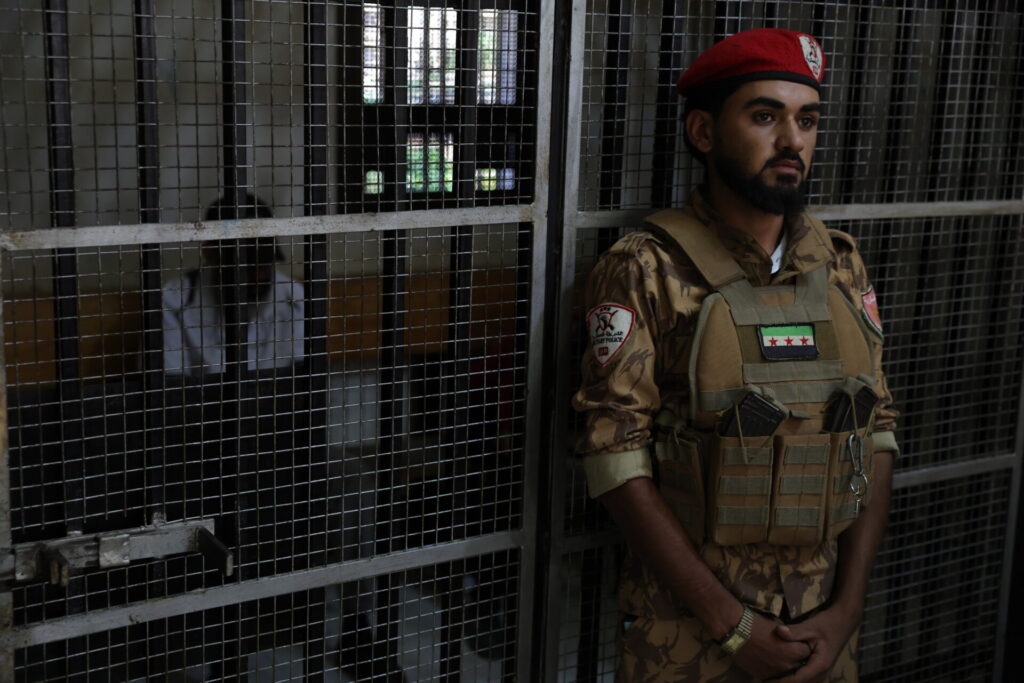
The next batch of defendants entered the courtroom and took their places in the cage. They wore surgical masks that concealed their faces, and they kept their heads down.
Basel Meri al-Hassan, a member of the 52nd Division of the Ministry of Defense, was the only defendant from the government forces to receive a verdict that day.
There is a video in his case file that showed an armed man killing an unarmed person who was kneeling before him. Sectarian remarks can also be heard at the moment of the killing. The scene was filmed in a village in the countryside of Qardaha and appears to be an extrajudicial execution.
During an earlier hearing, al-Hassan had acknowledged that he had killed a kneeling man, before retracting that admission. He denied being the man seen in the video and claimed that the footage had been fabricated using artificial intelligence.
Bakkar had confronted him directly: “You confessed before the investigating judge and the criminal judge that you killed him and for reasons you mentioned. Are you retracting your confession?”
Al-Hassan maintained his retraction. He also said that he had not been on the front lines during the fighting, claiming that he had suffered a head injury in the past that affected his behavior.
Nevertheless, the court found him guilty of intentional murder and sentenced him to 20 years in prison.
Two hours after the hearing, his brother, Abdo Meri, said by phone that he learned about the verdict on Facebook.
“Why didn’t they put the commanders on trial with him?” he said, echoing critiques that people higher up in the chain of command ought to have also been put on trial for the massacres.
Meri said his brother’s superiors sent him to the coast with orders to strike “the remnants” of the former regime. According to Meri’s account, his brother was a soldier carrying out orders from his chain of command, not a rogue murderer.
At the time, the government had deployed its forces to the coast to put down attacks by insurgents.
“They were the ones who took him to the coast and told him, ‘Strike the remnants.’ And then they turned out to be civilians, as [the prosecutors] claim,” he said. “I want to appeal the judgment. … It was the military commander who took him there and ordered him to storm the front line and kill anyone who showed up in front of him, whether military or not. What is his fault?”
“He has four children and does not even have a home. How will his children live?” he added. “If he had not received a military order, he would not have killed anyone.”
The argument points to one of the larger questions running through these proceedings: where individual criminal responsibility ends and the responsibility of commanders and institutions begins. The court’s first verdicts do not resolve that question. Most of the cases involving government forces have yet to be decided. The other cases have been postponed until next week.
Several of the cases have relied on videos recorded during the violence. One shows armed men walking among bodies in al-Sanobar, a coastal village in Latakia. Another shows military personnel, one of whom is beating unarmed men with sticks as they crawl on the ground where many bloodied corpses lay in al-Mukhtariya. The defendant is Ammar Abdul Aal, known by the nickname Abu Ahmad “Aqalliyyat” (“Minorities”), and he is set to be sentenced next week. A third video shows a man getting off a motorcycle and shooting a civilian.
Several cases involving men accused of participating in the rebellion are also still pending. Among them is the case of three men prosecuted in connection with a video showing five armed people, one of whom announces that they are preparing to launch an attack against government forces.
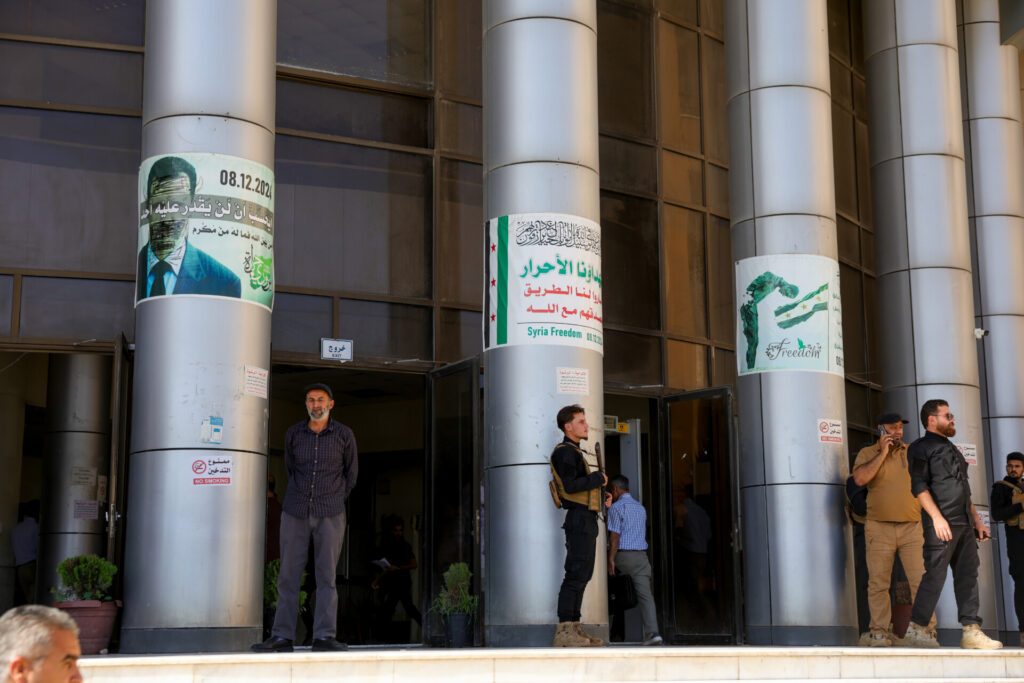
All four verdicts delivered on Sept. 17 remain subject to appeal before the Court of Cassation. The other defendants will have to wait.
For the victims, that wait is no less significant.
More than a year and a half after the violence, Samira (a pseudonym), 66, whose son was killed during the coastal violence in what she says was a field execution, said by phone that she has little hope. Asked about al-Hassan’s 20-year sentence, she answered: “Of course it is fair. I wish him the death penalty, because whoever takes a life should be killed. Honestly, I do not have much hope, but I hope that everyone who committed the massacres will be put on trial, because they killed innocent people who had done nothing wrong, including my son.”
What she wants most, she said, is for the prosecutions not to stop with a handful of defendants.
“Why is only one person being sentenced? They killed people and filmed videos, boasting about killing us, and all their faces were visible. Why don’t they prosecute them when they know who they are?”
For Samira, the passage of time has made the waiting more difficult.
“We have waited too long. Two years have passed, and we have not seen any trials worth mentioning. How long is this going to continue? They have left those who carried out the massacres on the coast free,” she said. “We hope that the course of justice will be broader, and that all those responsible will be prosecuted, regardless of which sect they belong to.”
For Abdulrahman Nahawi, 52, a lawyer and observer for the Syria Justice and Accountability Centre who attended many of the hearings, the trials represent an “imperfect but significant departure from the past.” In his view, the proceedings are an attempt by the court to be fair, while still exposing serious weaknesses in the judicial system.
One of those weaknesses, he said, concerns legal representation. “Court-appointed lawyers often work without pay and can change from one hearing to another, meaning that a lawyer may attend one session while another arrives at the next,” he said. Nahawi argues that a lawyer should instead be appointed through the Syrian Bar Association or the Ministry of Justice and should remain responsible for the case from beginning to end. The problem is compounded by the political and social pressure surrounding these trials: A lawyer who represents someone accused of rebellion can be labeled an “Assad lawyer” and accused of supporting the former regime, according to Nahawi. He believes that many people don’t fully understand that a defendant has the right to legal representation.
Yet Nahawi also draws a clear distinction between the current proceedings and the justice system under Assad. Under the former regime, he said, detainees could be taken before field courts without lawyers or press access and executed. Today, he pointed out, trials are public, and defendants can appoint lawyers, even if finding lawyers willing to represent them remains difficult.
There are also members of the Ministry of Defense now facing trial, he noted, something he contrasts with the former system, where armed members who committed crimes could instead be rewarded or promoted.
For Nahawi, the larger question is one of trust. “If you took any Syrian citizen and asked him about his trust in the judiciary in the past, he would answer in the negative. Today, the state is trying to build trust in the judiciary. The road is long.”
Additional reporting by Hadi Al-Ali.