

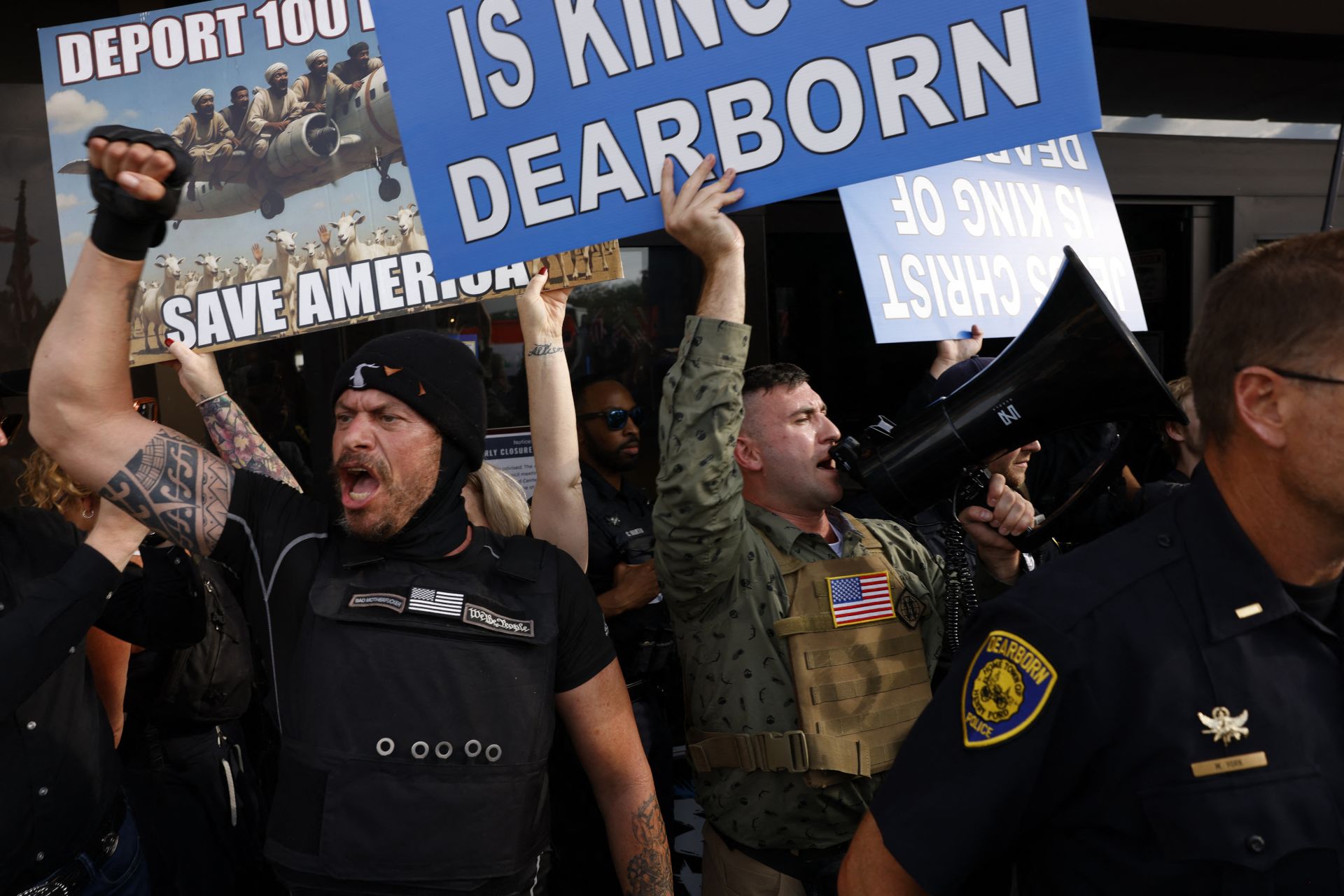
On Aug. 18, a group of self-proclaimed “Crusaders,” some of whom carried anti-Muslim placards while others sported swastika armbands and a Nazi flag, were met by counterprotesters outside what would otherwise have been a routine city council meeting in Dearborn, Michigan. The clash came a mere two weeks after a contentious U.S. Senate primary that tested the bounds of Islamophobia in U.S. politics. Dearborn Mayor Abdullah Hammoud said that the demonstration prompted youth football teams to cancel practices and some businesses to close for the day.
The protest was organized by Jake Lang, a pardoned Jan. 6 insurrectionist from Florida, who has descended on the Michigan city four times. He had previously staged an anti-Muslim protest at a religious procession on Aug. 2, where three counterprotesters were arrested for attacking him. Amy Doukoure, lead staff attorney at the Michigan chapter of the Council on American-Islamic Relations (CAIR), told New Lines that the civil rights advocacy group got more hate crime complaints than usual after that protest.
But Lang’s latest rally, the “Christian Crusader March,” has been followed by an even sharper rise in violent threats. Doukoure said her office has received a spike in reports of hate crimes since the Aug. 18 demonstration, which she called an act of “political terrorism,” because Lang and his supporters came to the city council meeting with the “sole purpose of disenfranchising Dearborn citizens of their civic right.” The reported complaints, including harassment and death threats directed at places of worship and individuals, were concentrated in Dearborn. Staffers at CAIR Michigan also received death threats after the rally, an increasingly common occurrence in recent years.
The city council meeting was relocated from City Hall to a large library in anticipation of the crowd, and police in riot gear surrounded the entrance. Twenty-two people, some of them from as far away as New York and Tennessee, were arrested on a range of misdemeanors, including breach of peace and disorderly conduct. No injuries were reported.
Lang was joined at the rally by Lorenzo Sewell, a pastor at the Detroit-based 180 Church and vocal supporter of President Donald Trump. Sewell falsely claimed in public comments during the city council meeting that Dearborn had been taken over by “Sharia law,” an oft-repeated line of attack used against the Michigan town. Lang, meanwhile, claimed at the meeting that Muslims were “looking to destroy us” and said the “crusade has begun.”
“Your time in this country is running short,” Lang said.
Soon after the rally, flyers and business cards tied to the Ku Klux Klan were spotted in Dearborn Heights and Melvindale, two neighboring towns.
The march is the latest episode in a decades-long history of anti-Muslim animus directed at the city, and one of the latest stops on Lang’s parade of demonstrations. This summer, he has protested women’s right to vote outside the Lindsay Clancy murder trial in Massachusetts, called for the deportation of Muslims in front of a Nashville mosque, burned a pride flag outside a New Jersey Immigration and Customs Enforcement facility, and held racist signs outside the Black Entertainment Television Awards ceremony in Los Angeles.
Trump granted him a pardon on his first day back in office last January; Lang had spent four years in pretrial detention after assaulting police officers at the Capitol riots. The Florida-based agitator called for El-Sayed, who was born in the U.S., to be deported after the primary.
“His goal is to divide America on racial grounds, and then create this sort of picture that anybody who’s not a white Christian is not welcome in the United States, and that has a trickle-down effect. It causes a lot of unease in communities,” Doukoure said of Lang.
El-Sayed, who would be the country’s first Muslim senator if he wins in November, has faced a relentless barrage of identity-based attacks since launching his campaign, and especially since securing the Democratic nomination. The Center for the Study of Organized Hate found that anti-Muslim attacks targeting him skyrocketed twentyfold after the primary, and just seven days “produced more abuse than the preceding seven months.” Overall Islamophobic content on X hit its highest day of the summer on Aug. 5, the day after he won, according to the center’s analysis of more than 409,000 anti-Muslim posts on X from June 1 to Aug. 10.
“What you’ve seen is mainstream Republican and Democratic candidates who are invoking his racial identity, his religious identity and even his name as a way to say that he is not qualified,” Doukoure said of attacks on El-Sayed.
The onslaught against El-Sayed represents the latest mutation of Islamophobia in the United States, which has been driven by reaction to the political success of Muslims, said Saeed Khan, a professor of Near Eastern Studies at Wayne State University in Detroit. This year, CAIR identified an unprecedented 255 Muslim officials across 26 states, serving at nearly every level of government. The organization also reported receiving a record number of complaints of discrimination and bigotry for the third year in a row.
Khan, co-founder of the Institute for Social Policy and Understanding think tank, said that politicians and the media have played the biggest part in fomenting the hate, and the public is emboldened to join the chorus when top officials are “speaking with such impunity.”
At a Michigan rally on Monday, Vice President JD Vance cast El-Sayed as “very, very evil,” claiming that the candidate “has sympathy and compassion for people who share his religion but have nothing for people who don’t.” Last month, after El-Sayed won the Democratic nomination, Republican candidate Mike Rogers released a statement calling his opponent an “extremist” and suggesting he had ties to the Muslim Brotherhood. Sen. Tommy Tuberville of Alabama quickly joined in, calling El-Sayed a “TERRORIST” and “RADICAL ISLAMIST” on social media. Trump, who has endorsed Rogers, has invoked El-Sayed’s full name, hearkening back to his constant references to former President Barack Obama as “Barack Hussein Obama.” He’s also referred to El-Sayed as a “man of hate” and posted a photo of the Senate nominee with his wife, contrasting the couple with him and Melania Trump, with the caption: “Two VERY DIFFERENT America’s.” Laura Loomer, a self-proclaimed “proud Islamophobe” and Trump ally, criticized the Republican Party on social media for not calling El-Sayed a “jihadist.”
While the most virulent rhetoric has come from the right, some of El-Sayed’s Democratic colleagues have maintained silence on the bigotry that he and Muslims in Michigan have faced.
Eli Savit, the progressive Democratic nominee for state attorney general, told New Lines that it “should be the easiest and most straightforward thing in the world” for political candidates to condemn a Jan. 6 insurrectionist and white nationalist who is seeking to intimidate people.
“If you’re not willing to stand with the community in a time where they are being targeted, I think it raises the really serious question of are you running to represent all the people of the state of Michigan, or just the people that look like you.”
In his campaign, Savit said he is used to facing antisemitic bigotry as a Jewish politician in the public sphere. But in this election cycle, he said he is also encountering Islamophobia because of his support for El-Sayed. The simultaneous lines of attack are another sign that these forms of bigotry are “two sides of the same coin.”
“It doesn’t matter to the people that are espousing this bigotry that I am in fact Jewish,” Savit said. “They are targeting me with any type of hate that they can because they see our unified ticket.”
In addition to the reaction to Muslim politicians in the public eye, the spike in Islamophobia is also fueled by a panic among Israel’s supporters who are seeking to weaponize anti-Muslim sentiment against their pro-Palestine counterparts, said Nancy Khalil, a professor at the University of Michigan who researches Arab and Muslim Americans. Khalil said scholars have increasingly traced the roots of the Islamophobia industry back to anti-Palestinian animus, predating the 9/11 attacks. Detroit, in particular, was a hub for Palestine activists in the 20th century.
“There’s been this kind of targeting of Arabs because of Palestine that started to include Muslims at different punctuating moments in our history,” Khalil said, pointing to the Iran hostage crisis, the Gulf War and 9/11.
While El-Sayed is not a resident of Dearborn, the southeastern Michigan town about 10 miles west of Detroit has become a national symbol of Muslim- and Arab-American identities, two communities often conflated as one and the same. A spotlight has been cast on the city because of its reputation, particularly at times when the U.S. was involved in conflicts in the Middle East, as Washington’s policies abroad served to stoke domestic bigotry and division.
“The more involved America was, the more the media focused on Dearborn as a zone of difference,” said Sally Howell, a history professor at the University of Michigan-Dearborn.
Hostility toward Dearborn in the 20th century used to focus on Arabs, Howell said, because media attention would shift to Dearborn at times of foreign conflict, from the 1967 Arab-Israeli war to the 1991 Gulf War and the 2003 Iraq War. The Iranian Revolution started to bring attention to Muslim identity in the late 1970s. But the 9/11 attacks marked the most pivotal turning point, as politicians and pundits “presented Islam as a threat in a way that hadn’t happened before,” Howell said. “Dearborn was the center for that.”
Arabs and Muslims have been a part of Dearborn’s history for at least a century. They began moving to the city in the 1920s after Henry Ford built the Ford Rouge Factory, which generated tens of thousands of jobs, Howell told New Lines. In the 1930s, the first mosques in the city opened. The iconic Dix Masjid, among the first mosques to be built in the state, added a second floor in the 1950s, a symbol of the Muslim community’s growing presence. Today, Dearborn is home to about 30 churches and a dozen mosques.
The community’s growing visibility has at times prompted hostility. Dearborn’s Arab International Festival, which started in 1995, stopped after an 18-year run because agitators became a recurring liability. In 2024, the Wall Street Journal published an op-ed titled: “Welcome to Dearborn, America’s Jihad Capital.” The story prompted a national outcry, and the city increased police presence out of fear of violent backlash from the article. It remains live on the newspaper’s website.
Linda Sarsour, a Palestinian-American Muslim activist, said the media has committed malpractice in its coverage of Muslims and Palestinians by excluding their voices from the conversation.
“The stories about us are left to other people to tell,” Sarsour said.
She also noted that ignorance surrounding Islamophobia has endangered anyone even perceived to be Muslim, and in fact the first victim to be killed in an Islamophobic hate crime after 9/11 was a Sikh man mistaken for a Muslim.
“Most bigots don’t know the difference between Palestinians or South Asians or Muslims or Sikhs,” Sarsour said.
Rev. Halim Shukair, the priest-in-charge at the Christ Episcopal Church in Dearborn, told New Lines that Lang’s demonstrations have impacted the entire city, and noted that Christian nationalism remains conveniently ignorant of both the religious diversity of Arabs and the ethnic diversity of Muslims.
One week after the rally, Shukair hosted a press conference at his church alongside El-Sayed and other leaders to condemn the bigotry, saying he wanted to present the “real message of Christians.”
El-Sayed, for his part, has called the division and bigotry a distraction from the universal hardships facing Americans, staying relentlessly focused on his message around affordability.
“There are people in America who are driving broken roads, breathing unclean air, drinking impure water, and all that this administration and its apologists want to do is figure out how to divide us rather than unite us around the things we can do to actually solve the problems,” he told reporters at the church.
And because of the nature of white supremacy and Christian nationalism, the same people who hold animosity toward Muslims often target other minority communities too. Lang himself has espoused antisemitic conspiracy theories, fulminated against Somali immigrants in Minnesota, vilified Black Americans and insulted “liberal women.”
But as Muslims face increasing bigotry amid heightened visibility, Sarsour said she’s leaning on solidarity with sister communities, pointing to El-Sayed’s diverse coalition of supporters, which has spanned many racial and religious identities.
“I think we’re demonstrating that Muslim-American candidates appeal to their neighbors, appeal to a broad base of people,” Sarsour said. “So for me, I’m just focused to say you don’t allow this anti-Muslim hate to distract us. It is not going to make us smaller.”
Hammoud, who made history in 2022 as the first Arab American and first Muslim to serve as Dearborn mayor, said at the contentious city council meeting that he’s met people over the years who are “genuinely nervous” about the city because of how it’s been portrayed online, but whose minds have been changed after breaking bread with residents.
“One of the most powerful antidotes to fear is simply knowing one another,” he said.
Shukair, for his part, hopes that the next time “Crusaders” want to descend on Dearborn, they’ll instead stop by the Arab American National Museum on Michigan Avenue and learn about the community they are protesting, eat some good food at a restaurant in town and try a cup of Yemeni coffee. “And I believe your mind will be changed.”
Become a member today to receive access to all our paywalled essays and the best of New Lines delivered to your inbox through our newsletters.