


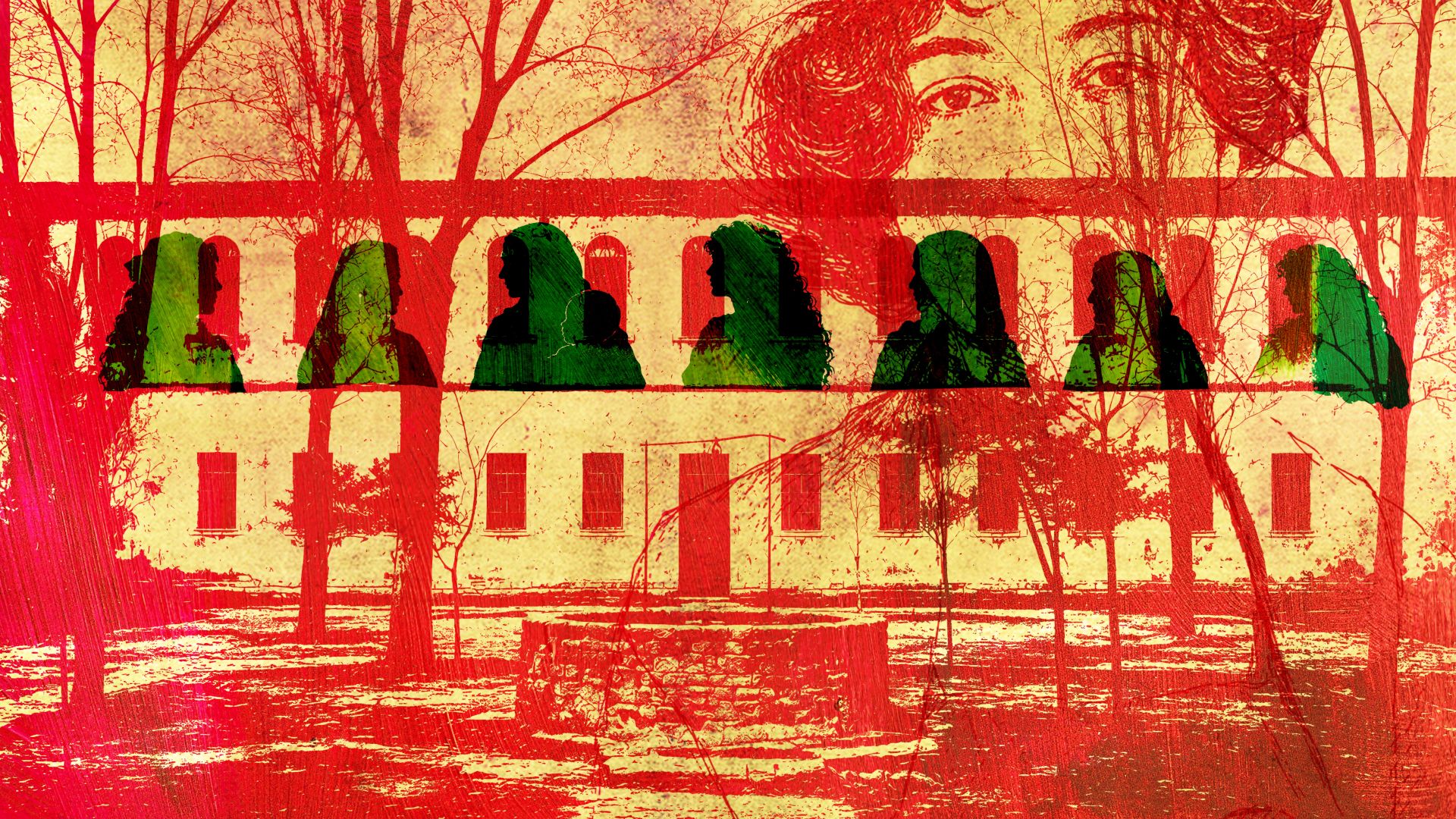
Sometime in the spring of 1915, a 20-year-old woman named Vartuhi Kalantar sat, sobbing, in the middle of Istanbul’s Old City. She was a new inmate at Hapishane-i Umumi, “The General Prison,” the Ottoman Empire’s first modern prison. A month earlier, the Ottomans had begun the systematic arrest, deportation and killing of the empire’s Armenian population, to which Kalantar belonged.
The woman’s ward of the General Prison lay on the ruins of a church dedicated to St. Euphemia of Chalcedon. Euphemia, one of Byzantium’s first Christians, was born just across the Bosphorus from where Kalantar sat crying in 1915, in modern-day Kadikoy. In 303 CE, Euphemia faced “damnatio ad bestias”: public execution by big cats.
But only a decade after Euphemia was condemned to the beasts, the Roman Empire established a policy of tolerance toward its Christian subjects. Within 80 years of her death, the empire adopted Christianity as the state religion, and a few hundred years later, in the seventh century, the Church of St. Euphemia was constructed in her hometown, now called Constantinople.
And a millennium and a half later, Vartuhi Kalantar would be imprisoned on the plot of land that served as a place of worship, as yet another empire sought to shore itself up by attacking its minorities. “You are nothing next to the enormous wheel of history that crushes armies in whole; in only an instant you, too, could be crushed beneath it,” Kalantar wrote later in her memoirs, serialized in the Istanbul periodical Hye Gin (Armenian Woman) after her release from prison in 1918.
Kalantar’s is the first known prison memoir written by a woman in the Middle East. I came across it first in the archives of Hye Gin, which I took an interest in (somewhat selfishly) after learning that multiple relatives had once contributed their own writing to it. More recently, in 2024, it was translated from Armenian into Turkish by Artun Gebenlioğlu.
Although Kalantar wrote in Armenian, I came to her through a Turkish translation, which says as much about the linguistic history of the region as it does about my own family’s linguistic path. Ironically, the Turkish language has allowed Kalantar to be heard after it had come to monopolize the spoken word in Istanbul. After reading the first chapter, I decided to translate the book into English so that my family and friends who read neither language but took an interest in the material could engage with it. Over the months it took to translate the memoir, including a trip to the location of the old prison, I found myself overwhelmed by all of the contingencies that led to the survival of Kalantar’s text: The prison structure is gone, the city changed names, the empire fell, and the cosmopolitan world she describes has all but vanished.
As I dug, word by word, into her account of prison life, it clarified aspects of life amid political violence and social breakdown that I had previously understood only in the abstract: neighbors turning against one another, ordinary people adapting to violence, and a diverse society unraveling under political pressure.
A few years after her release, Vartuhi Kalantar recalled that time in prison: “The idea that your small and insignificant fate is part of a society’s tragic and glorious destiny fills you with excitement. You fix your painfully numb gaze on the dream of a free and enlightened country.”
Before Kalantar found herself staring down that wheel, Ottoman leadership had already begun to roll it over the lives of millions throughout the empire. The Ottoman Empire saw in 1915 with a series of setbacks: An ambitious plan to seize control of the Suez Canal from the British petered out within a week, and more devastating was the poorly planned offensive against the Russians in the Caucasus, which led to catastrophic loss of life. Before fighting even began, some 25,000 troops had frozen to death.
Ottoman failures in battle accelerated their attempts to shore up domestic support and to quash what the empire’s leadership claimed were internal threats. In the spring of 1915, Armenian population centers throughout the empire faced increasing danger. Villages were raided, possessions plundered and leaders arrested. In Van, near the Persian border, Armenian residents who heard reports of massacres advancing eastward began digging trenches and fortifying their neighborhoods. After a group of Armenian women were killed outside the city, intense fighting broke out on April 20.
On the night of April 24, 1915, the state began arresting prominent Armenian intellectuals in Constantinople. They would be deported to detention centers throughout Anatolia and Syria. Kalantar and her parents, apparently further down the list of targets, were arrested in the following weeks.
In a court-martial, a judge accused Kalantar of “being a member of an Armenian nationalist and separatist group” for sending her family a summary of a speech given by an Armenian revolutionary to the Armenian Students Association in Lausanne, France, where she had been an undergraduate student. Kalantar, who was born and raised in Bursa, maintained a belief that Armenians should trust Turks to build a state with equal rights. She and her parents stood trial together.
The charge of being a separatist and betraying the territorial integrity of the empire carried the death penalty, which the prosecutors demanded at trial. In her memoir, Kalantar spends little time discussing the experience, other than her attempts to save her father.
“Do what you want to me, but leave my father alone. He is innocent. Look, his hair is as white as snow, his eyes are fixed on the ground. Let him live out his last years in freedom. Arrest me,” she said to the judge.
Her father wouldn’t comply. Kalantar remembers: “I heard my father say in broken Turkish: My daughter is still young; she wasn’t old when she wrote those things. Arrest me. I am the one who raised her.”
The court concluded that both had acted with malicious intent to promote Armenian separatism abroad.
“Now, you’ll be waiting for an independent Armenia from here,” Kalantar recalls the prison secretary telling her, with the news of her five-year sentence.
Walking into the prison for the first time, Kalantar recounted: “Life itself stood before me dressed in a clown costume, as if it mocked everything that is dignified, sweet and holy.”
Amid the noise, filth, boredom, flirtations, illnesses, prayers and quotidian cruelties of prison life, Kalantar found herself living among fragments of a world being destroyed beyond the gates. This personification of absurdity would stay with Kalantar, frequently pushing her toward a cynical acceptance of being crushed by that destructive wheel of history. But her experiences with her fellow inmates worked against that clownishness and absurdity and presented an argument for a dignified life. This eclectic group was everything that the Ottoman Empire had to offer: young and old, rich and poor, sick and healthy, teachers, prostitutes, Quranic scholars, petty criminals and dancers. Inside the women’s ward, the empire survived. Kurds, Roma, Armenians, Turks, Arabs and Persians slept beside each other.
Outside the prison walls, cities were being razed. But inside the prison, the empire’s violence had produced the opposite effect.
Kalantar couldn’t escape racism inside the prison. “Sometimes I heard them whisper, ‘Traitor to the nation’ or ‘Damned Armenian.’ Sometimes they would sigh, ‘What a pity, she’s so young…’ or ‘What a pity for her elderly mother.’ This racist anger gave way to some human compassion,” she wrote about meeting Akabi, another Armenian prisoner. Luckily, Akabi had connections that she was willing to share with Kalantar. The memoir describes how one day, after weeks of considering what could be done to help Kalantar transition to prison life, Akabi ran up to Kalantar.
“The matter is settled. I spoke with Sinem Hanım [Madam Sinem], and you will be staying in our room tonight,” said Akabi Hanım. She was staying in the room of the dignitaries.
Out of curiosity, I asked, “Who is this Sinem Hanım?” Akabi Hanım spoke of her as if referring to a ruler. “You’ll find out soon enough,” said my guide.
Toward evening, when we entered our new room, we saw Sinem Hanım lying alone in the area reserved for five people at the front. Two mattresses, each covered in red-striped silk, were placed one on top of the other, and her pillows were placed against the wall. Sitting atop this throne-like structure was a thin, vigorous woman, a head taller than average, with Kurdish features. The rice powder covering her pockmarked face, the reddish streaks etched into her face here and there, and the kohl that had run from her eyes to her cheeks formed a strange trinity. A terrible illness had not only taken half her nose but also left the rest covered in scars. She had the hard stare of a tribal chief.
A wide headscarf, adorned with blue and white flowers, was wrapped around her head like a turban. Through the yellow robe that wrapped around her parched and rigid body, you could see her red shirt underneath. Her plank-straight neck and arms resembled pieces of wood draped haphazardly with jewelry — gold and copper, real and fake. A large medallion on a thin chain hung around her neck, tarnished and layered.
Her blackened feet were stretched imperiously, out to the center of the room where a copper cauldron of rice was boiling on a stove. I felt as if I had walked into a painting.
“They call me Sinem the Kurd.”
Outside the prison walls, women like Sinem could appear in official records as brigands or criminals. Inside, she became a protector, storyteller, educator, almost a sovereign. Sinem took a quick liking to Kalantar, who reluctantly trusted her Kurdish ally. On that spring day, when Kalantar sat in the prison sobbing, Sinem came to cheer her up with news from outside. “Why are you crying?” Sinem asked Kalantar. “Today, the Armenian flag is hung atop the Van barracks.”
Sinem spoke of shocking news from Van, where — with the help of Russian troops at the eleventh hour — 1,500 Armenians, lacking sufficient weaponry, had repelled much larger invading Ottoman forces. This saved hundreds of thousands of Armenians in Van, along with countless others from Anatolia who fled to Van after news broke of its successful defense.
Seeing the joy and pride in her eyes, Sinem kissed Kalantar’s forehead and sat down next to her. Kalantar let her Kurdish fellow prisoner wax poetic about the news. Though they grew closer, Kalantar still resented the position she was in, getting news of Armenian resistance from inside the prison:
She began to tell me at length what she knew about the events on the Eastern Front. She explained things with the rough eloquence that came from her past as a bandit and outlaw. She embellished events with her vivid imagination. I listened, mesmerized. As she spoke, I began to think grander thoughts and feel deeper feelings.
Just like Sinem’s, my soul was filled with that primal force that instilled in a person the joy of fighting and conquering. We shared boundless hope and self-confidence as we confronted an enemy evil and cruel, who crushed, mercilessly, all these women who now submitted, without a murmur, to the command of Sinem, some Kurdish banditess, more obediently than a slave. Pity the oppressed.
Then there was Atiye, a tobacco smuggler and career courtesan with half a century of experience, who entered the prison weeping dramatically, undressing without embarrassment, checking the money in her purse, and dancing before the afternoon was out. She had risen, as Kalantar put it, “from soldier to commander.” The old imperial city lived in her: morally ambiguous, impossible to classify, cosmopolitan to the bone. Her most revealing quality was her grief over the street dogs that the Unionist government had famously rounded up and exiled to an island off the city’s banks, where most starved or died of thirst. She wept over them and spoke of the kindness she had shown them, certain they would speak well of her to God.
Kalantar’s verdict: “I bet that the dogs would be the only ones to speak well of her.”
Nuriye, Sinem’s old neighbor from Kasimpasa, a neighborhood on the European side of Istanbul, was the prison’s de facto warden. Also Kurdish, she had bloodshot eyes and her elaborate finger-rings “looked as though they could have been taken from the mutilated hands of Armenian brides,” Kalantar wrote. Nuriye maintained absolute silence toward everyone, and she hated Armenians and Turks equally. While the other women organized parties or slept, Nuriye knitted winter socks for her husband and spun her own wool while she rocked a cradle in the corner of the room with a string she had tied to her little toe. In the cradle lay her 6-month-old baby wrapped in a blue blanket, adorned with tiny gold trinkets.
“Every citizen of the empire,” Kalantar wrote in reference to the prison, “from the greatest to the smallest, showered that child with thousands of compliments every day.” It was a quick way to get on Nuriye’s good side; she worshipped that child. “The stern and cruel expression on the mother’s face softened every time she looked at her son.”
Finally, there was Fatma, the prison’s trusty — its overseer, its janitor, choir conductor — who was madly in love with Ibrahim, the guard. She bought him gifts. She cleaned floors until evening and spent her wages on handkerchiefs and cigarettes.
But when Ibrahim turned toward Sinem instead, Fatma sought supernatural help. She had the prison greengrocer fetch black pepper, spent the day in prayer, and when everyone had fallen asleep, went out alone into the dark courtyard with a coal-filled brazier. She counted the peppers seven by seven in the firelight, saying bismillah seven times for each one. Then she stood, opened her robe, stretched her arms toward the door where he might miraculously enter, and waited. Kalantar recounts the episode in full:
In the darkness of the night, her dark gray body partially illuminated by the fire, her head lost in the smoke, she stretched her arms toward the door where he might miraculously enter, and she said bismillah seven more times. She waited like this for a long time. In the frightening silence of the night, only she heard the earth and sky suddenly split apart, the doors opening with a great noise. That’s what they had said. But her ears heard only the crackling of the pepper, gradually fading, as her eyes and nose filled with blood and tears from the combination of her passion and the sharp smoke. Fatma grabbed the hot coals and angrily scattered them across the garden. She left the door open and went to her corner, where she would moan all night from the pain in her burned hands and her deep sorrow.
Istanbul, indeed the Ottoman Empire itself, was made less by territory than by its fractious peoples — Kurds, Persians, Arabs, Armenians, Turks, Greeks and Jews, to name a few. When the calculation was made to liquidate this diversity through genocide, imprisonment and ethnic cleansing, the General Prison began to display precisely what was so beautiful about the empire’s capital city.
At mealtimes, the women gathered around the dining table, covering their heads before the male orderlies entered silently with trays of food. They lunged greedily at leeks, tahini, molasses — whatever had arrived that day — arguing loudly over one another as they ate. Then, almost ceremonially, entertainment began. Patriotic marches gave way to romantic gazels (traditional improvised vocalized poems), ciftetelli (a lively folk dance from Anatolia and the Balkans), zeybek (a heroic dance from western Anatolia), and laz dances (intricate, fast-paced dances from the Black Sea region of Anatolia). Even lancers and cotillions, 19th-century European ballroom dances, appeared inside the prison walls. Fatma, conducting the choir, shouted “Faster!” while women from across the empire sang songs of their hometowns that made listeners of every background sigh.
Every afternoon, the courtyard filled with the clatter of metal bowls and the smell of whatever was boiling in the cauldrons. A woman with a huge ladle and dyed red hair stood at the center; beside her, the guard held the key to the kingdom. Feride, the toilet cleaner with ambitions above her station, arranged the plates by rank.
The fights that broke out were, superficially, about beans. But Kalantar saw them clearly for what they were: “These wars, which occurred at regular intervals, were based on economic grounds.” The savvy ones had made arrangements with the yard guard to receive two or three portions, then sold the surplus back to the hungry for bread, clothing, or whatever else could be extracted. There were those who came to prison poor and got rich there. Those who arrived with something had it taken from them down to the shirt on their back — and went hungry besides.
The warden’s solution, when the fights grew loud enough to carry all the way across the compound to them, was a threat: Complain again, and we remove the cauldron entirely. It worked.
The fear of losing the little they had was enough to quiet the rebels and restore order. It was, Kalantar understood, the same mechanism operating at every scale inside and outside of the prison: “The injustices of the country’s rulers,” and the unilateral power held by those in charge, were reflected in these daily battles over beans.
Kalantar’s memoirs don’t fit neatly into most modern narratives of the fall of the Ottoman Empire. The Turkish government categorically denies that what happened to the Armenians was a concerted effort, or genocide. Instead of a genocide, it is said, there was, in the context of World War I, a war between Armenians and Ottomans. Nationalism was ascendant. Some emphasize that the Russians, who were at war with the Ottomans, fanned the Armenians’ nationalist flames for the war’s sake. Others claim that many Armenians were traitors who were seeking battles with Ottoman forces, like that in Van, which in this telling of events was not an act of defense but of rebellion.
Kalantar wrote in Western Armenian, a language spoken by dwindling clusters of people around the world. Communities in the Ottoman Empire, like Kalantar’s, that had spoken, read and written the language were devastated and largely dispersed during and after the genocide, with survivors reestablishing communities across the Middle East and, over time, forming sizable communities in European and American cities, like Paris, Marseille, Cologne, Boston and Los Angeles.
In 2009, UNESCO added Western Armenian to its “Atlas of the World’s Languages in Danger,” diagnosing it as “definitely endangered,” the second level of a five-point scale that ranges from “vulnerable” to “extinct.” In simple terms, the category means that most children of native speakers are no longer learning the language through intergenerational transmission at home; instead, they speak the majority language, like Turkish in Istanbul, French in Marseille, English in Los Angeles or Arabic in Beirut.
A century after she wrote her memoir, a Turkish press published the first translation of it. This English version is translated from that Turkish edition — which means Kalantar’s voice has traveled from Armenian into the language of the empire that imprisoned her, and then into English.
I am Armenian-American. As I write, my Turkish is much better than my Armenian. Many Armenians have asked me about this, with an eyebrow raised, wondering why my family stayed in Istanbul after the genocide. There’s no clean answer. That was their home; they spoke both languages; they loved the city that had been theirs for generations. Like many of the Armenians who stayed, younger generations of Armenians in the family rely more on Turkish, and it was easier for me to communicate with them using it. And the Turkish translation made Kalantar available to me in a way that Armenian would not have; the empire’s language became, a hundred years later, the unlikely vessel for her recovery.
I’ve heard versions of that official story countless times, most recently last summer, when I was visiting friends and family in Istanbul. One evening, a Turkish friend who was born, raised and educated in Turkey explained this history to me as if I had no idea about any of it. We were sitting in his living room, not far from where Kalantar was imprisoned on the city’s European side, sipping tea and snacking on melon after watching a local basketball game.
Without solicitation, he told me that “what happened to Armenians was not fair.” Wars are unfortunate, he said, and it’s too bad that so many left Istanbul, given their historical contributions to the city’s landscape and history. “The building across the street,” he pointed out the window at an Ottoman-style apartment building, “used to be owned by an Armenian woman. She was a great neighbor. She cared about that building. But now, some pimp from the countryside owns it.” Her family had left decades ago, and when she died, no one was here to take ownership.
My friend paused. I wanted him to stop talking. His eyes turned back from the window, unfocused. “Armenians are a miserable people,” he said. “But so are Turks,” he paused, staring at a kilim on the floor. “I don’t know why, but we are.” I stayed quiet. “We keep trying to destroy this city, but somehow it’s still beautiful.”
I didn’t respond. I wanted to throw my dainty little tea glass against his wall. Perhaps, I thought, Turks are miserable because of their decades of lying to themselves about perpetrating one of the greatest crimes of the 20th century. Without the history of the genocide, even something as minute as the disappearance of the Armenian neighbor’s family makes little sense.
I wanted to launch into a history lesson and liberate my friend from his ignorance. I could start with my own family tree and the holes that appear across generations — my grandmother, for example, never knew her father’s identity; he was killed, and no one spoke of him again. Or I could start from a bird’s-eye view: the Hamidian massacres of 1895, before World War I, which killed hundreds of thousands of Armenians; the Adana massacres, also before World War I, in which mobs razed half of the city, torching thousands of Armenian homes and killing tens of thousands. Maybe he would rebut with a comment about violence committed by Armenians — bank raids, assassination attempts. I could start my lesson with a slew of laws — from Ottoman forced migration laws to the Turkish Republic’s confiscation of “abandoned” property, to targeted wealth taxes, to restrictions on speech — that show an intent to destroy the Armenian people.
But before I could say anything, he surprised me one last time: “Turkey is your country, too,” he said meekly. He looked up at me for the first time in a few minutes. “And this city is yours, too,” he said. I held onto my tea glass, took a sip, and remembered why this man was my friend.
The entire conversation took place in Turkish — the same language that, a century on, had carried Kalantar’s voice back to me.
Kalantar had to contend with the politics of translation, too. Inside the prison, she found a way to see her father, who was being held in the men’s ward. Through the prison’s kind-hearted doctor, she negotiated visiting rights in exchange for translating a German manual on the hygienic organization of prisons.
From the empire’s first “modern” prison, Kalantar was performing the labor of Ottoman modernization in order to reach the father that “modern” Ottoman justice had taken from her. She worked inside the empire’s machinery to recover something the empire had stolen. Reading her in Turkish was, more or less, the same process for me.
Kalantar belonged to my grandparents’ generation, and though they weren’t ever in an Ottoman prison, her memoir immediately brought me closer to them and the world — the imperfect but multilingual, fragrant, fascinating world — that they had left behind. Kalantar writes the way my family did about Istanbul, a place they longed for deeply, even after it hurt them, almost like Fatma in the courtyard, arms outstretched toward Ibrahim’s door that wouldn’t open — knowing it wouldn’t open, and waiting anyway.
The Hapishane-i Umumi was demolished in 1939; whatever remained of Sinem’s silk-covered throne, Fatma’s courtyard, the cauldron and its wars was rubble. The Armenian periodical that published Kalantar’s memoir, Hye Gin, is now forgotten, save for the dedicated academics who read it in archives. The building across the street from where my friend and I drank tea, the one that used to belong to an Armenian woman who cared about it, belongs to someone else now.
But the text survived. It survived in a magazine almost nobody read, was recovered by a Turkish press a century later, and now exists in English. Kalantar understood as well as anyone that cultural survival in the face of genocide is long and implausible. And if a text does survive, it still does not make the other countless losses less glaring.
She wrote about the wheel of history that crushes armies whole, that could crush any one of us in an instant. She was not wrong. Before her, the wheel crushed Euphemia. Then, centuries later, Euphemia’s church. The wheel came for Kalantar’s city, her community, her language, even, eventually, destroying her unchosen home of five years, about which she wrote so beautifully.
But after reading Kalantar, one can hardly say that she was crushed: Eventually, she would move to the U.S., fall in love, marry, and with her husband write one of the first histories of the genocide. As she wrote as a 20-something: “The idea that your small and insignificant fate is part of a society’s tragic and glorious destiny fills you with excitement.”
As that wheel of history kept turning, she kept writing, and here we are reading.
Back in my friend’s living room, after he confessed his — and apparently my — misery, we sat in silence for a few moments, finishing our melon and listening to the quiet hum of a nearby throughway. I told him about a writer, Jozef Korzeniowski. He didn’t recognize the name, but he knew the nom de plume: Joseph Conrad.
“In the preface to one of his novels,” I told my friend in Turkish, “Conrad claims that all of human history can be summed up in three sentences.”
“What are they?” he asked me.
“They were born. They suffered. They died.” My friend sighed.
“Ama,” I said, meaning “but” in Turkish, “Harika bir hikayedir!” — ”It is a great story!”
Become a member today to receive access to all our paywalled essays and the best of New Lines delivered to your inbox through our newsletters.