


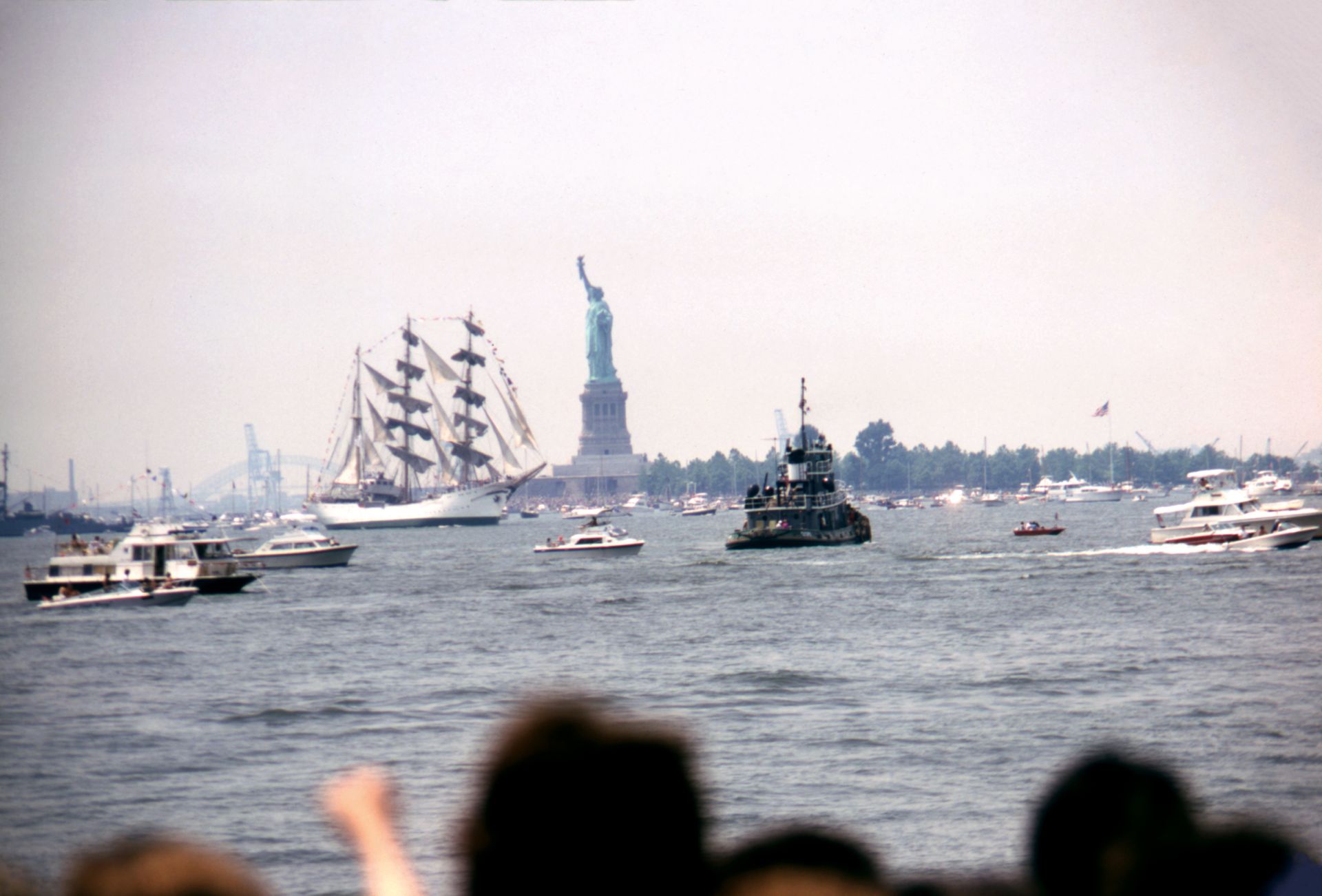
When over 200 ships flying over 30 different flags sailed into New York Harbor and up the Hudson River on July 4, 1976, something like 6 million people, by some estimates, lined the shore to take in the sight. Almost 30,000 pleasure boats competed for views on the waters themselves. The “Tall Ships” parade was underway.
Sailors aboard the Japanese Nippon Maru, Portugal’s Sagres II and Spain’s Juan Sebastian de Elcano climbed the masts of their respective vessels to wave their hats at President Gerald Ford, who was aboard the USS Forrestal aircraft carrier to welcome the ships as they passed. Vice President Nelson Rockefeller, Secretary of State Henry Kissinger and Defense Secretary Donald Rumsfeld observed the proceedings from the USS Wainwright, a Navy cruiser. The Sir Winston Churchill from the United Kingdom featured an all-woman crew, while the four-masted sloop Club Mediterranee had a crew of just one man. Built in 1855, the Chinese junk Mon Lei was the oldest ship afloat in the harbor. Even the Soviet Union sent a ship, the 378-foot Kruzenshtern. There were also ships from Denmark, Norway, Chile, Argentina, Colombia, Poland and other nations.
Officially known as “Operation Sail,” the Tall Ships parade provided a glimmer of hope for many at a time when, nationally, Americans had lost faith in their government and perhaps even each other. In the aftermath of the Watergate scandal, the defeat in the Vietnam War, the OPEC oil embargo, rising inflation, growing deindustrialization and other ills, many Americans were doubtful that the U.S. should celebrate the bicentennial at all. As the political theorist Sheldon Wolin wrote, America had been “forced to enter history a second time, in this our bicentennial year. The first time we entered proclaiming our independence and liberty, the second time frantically trying to conceal our dependence and servitude.”
Locally, New York City itself was on the brink of bankruptcy and suffering from high crime, decay and depopulation. The enormous success of Tall Ships suggested that the nation and its most famous urban area might survive the struggles of the 1970s. “New York must be the most wonderful city in the world,” Bonnie Rhodes, a young Californian, told The New York Times as she hawked bicentennial T-shirts on a Manhattan street corner. “I’ve never seen anything quite like it.” Maybe the revolutionary spirit, while flagging, was not entirely gone. The Tall Ships parade left Americans, and New Yorkers in particular, feeling, well, a bit taller.
What is largely overlooked, however, is that the event was more than merely a local or national triumph. It was, in fact, an international venture. It had been organized by a private, nonprofit group led by retired U.S. Navy and Coast Guard officers, maritime businesspeople, yachters, ship historians and hobbyists. It was funded to the tune of $70 million, mostly by foreign governments that participated in the event. What looked local and national was, in fact, profoundly global.
The international dimensions of the bicentennial are often forgotten today, overshadowed by memories of local events and a torrent of commercial kitsch in the U.S. itself. One could find Revolutionary War commemorations organized in almost every municipality and on television, Broadway, fast-food burger wrappers, beer cans and much else. Yet there was also a strong effort by the American government to foster a worldwide awareness and celebration of the 200th anniversary of the United States. One could even think of the bicentennial as a first shot across the bow in a coming era of so-called “globalization,” in which the U.S. would extend its worldwide hegemony not through brute force but rather soft power.
The story of an international U.S. bicentennial celebration can be told, broadly, in three parts. First came the early, centralized aspirations of the initial proposal for an event, broached in 1963 and made official by President Lyndon Johnson in 1966, just as he was escalating U.S. involvement in Vietnam. Then came the attempt by the Richard Nixon administration to use the bicentennial in service of a more right-wing approach to international politics, particularly as the U.S. withdrew its combat troops from Vietnam in 1973. Finally, there was an embrace of a decentralized bicentennial under Ford, which featured myriad local celebrations and commercialized, privatized consumer products that were coordinated from on high with a light touch, and which included worldwide participation on these new terms.
The concept of a national bicentennial celebration first appeared in 1963. Right away, it possessed international dimensions as a fundamentally Cold War project. Rep. John O. Marsh Jr., a conservative Democrat from Virginia, entered a House joint resolution to establish a bicentennial commission to commemorate the American Revolution. “The point I am trying to emphasize,” he explained in a document officially entered into the Congressional Record, “is that perhaps through this reexamination of the American past, we can better appreciate the values of our Republic and better understand the stakes involved in the present world struggle.” “After all,” Marsh continued, “the words, ‘liberty,’ ‘freedom,’ and ‘justice,’ that are crudely painted on the posters carried by those who riot today through southeast Asia, Latin America and Africa do not have their origins in the Communist Manifesto but rather have their inspiration in the American Declaration of Independence.”
The problem, Marsh further remarked, was that “in our present approach to the Sino-Soviet challenge … we frequently resort to sterile objectivity without promulgating some of the basic concepts of one of the greatest idea movements man has witnessed.” For Marsh, a stronger sense of the power of ideas during the Revolutionary War era was needed, for it marked the height of the Enlightenment. It was a moment in history when, he believed, liberalism, democracy and free-market capitalism replaced monarchy, hierarchy and nationalist mercantilism. Ideas mattered, and the U.S. had led the way toward a revolutionary age intellectually as well as economically and politically. “A reexamination of the issues and idea forces which produced the American Revolution,” he thought, could show how “the American Revolution was the fire that took the dross out of much of the 18th century English social-political institutions and refined many Western ideas.” By contrast, “communism,” he argued, “as we know it, is an idea force, marked by many lofty aspirations and ideals, which has resulted in intense motivation and dedication of its disciples even though much of the theory is false.”
A few years later, in 1966, Johnson would bring Marsh’s proposal to pass when he created an official Bicentennial Commission. Again, the international dimensions of the celebration figured prominently. “America’s Declaration of Independence was more than an assertion of political independence,” LBJ announced. “It did more than spark a revolution in America. It kindled a revolution in the hearts and minds of men that continues to this day.” He even directed the U.S. State Department to seek approval from the Bureau of International Expositions, based in Paris, to reserve 1976 as a year when a Bicentennial World’s Fair could be held in either Philadelphia or Boston.
The international exposition would never come to pass, however. While it did offer some bold ideas, Johnson’s American Revolution Bicentennial Commission would eventually come apart, without much to show for its efforts. Johnson surprisingly decided not to run for reelection in 1968, and the staunch anti-communist Republican Nixon returned from the political wilderness to win the presidency. One would think this would have merely intensified the Cold War focus of the international bicentennial, but instead, in an era of faltering American efforts in Vietnam, detente with the Soviet Union and Nixon’s surprise 1972 diplomatic breakthrough with China, the Nixon administration shifted the international efforts toward something more subtle.
When the entire setup of the American Revolution Bicentennial Commission came undone over accusations of politicization by Nixon for his reelection campaign in 1972, a new American Revolution Bicentennial Administration (ARBA) emerged one year later. Its task was not so much to centralize and push forward the boldest of Marsh’s original ambitions to study and spread the word about American freedom in the fight against communism, but rather to step back and simply coordinate local events. The domestic bicentennial celebration would have no central exposition, site, city or event. Instead, ARBA encouraged Americans to “DIY” the commemorations, and to express their own sense of the meaning of the United States in its 200th year. Congress provided funds, but by the logic of Nixon’s — and then Ford’s — “New Federalism,” these came in a form more like block grants, giving localities discretion for the content of their bicentennial events. ARBA created advertisements, circulated an official logo, published a newsletter and even developed a proto-internet computer network — BINET, the Bicentennial Information Network — but it did not lead the way.
Yet even as the federal government stepped back domestically, members of the State Department, the United States Information Agency (USIA), foreign missions and other parts of the American foreign policy apparatus pressed on with plans for participation by other nations. Crucially, however, their plans were now tinged by the shift toward democratization back at home. No longer was the bicentennial a key part of Marsh’s vision for a centralized “strategy for freedom” in the fight against communism; instead, it was to emphasize a more generalized and participatory exploration of “quality of life” around the world. “The Bicentennial Era provides a unique opportunity to promote cooperative relationships between the United States and other countries of the world,” a USIA background report put it in 1970. “The foreign affairs agencies should encourage dialogue among opinion leaders,” it explained, “on those questions to which our own ancestors two centuries ago sought answers: the purposes of human communities, the nature of political authority, reason and justice.” These discussions would, the USIA report proposed, emphasize an “enhanced ‘quality of life.'” This was, after all, now “the central theme of the commemoration in the U.S.” itself. The focus on “an understanding of the concepts from which the American Revolution was derived” could therefore be “made universal in interest,” the USIA officials believed.
The State Department, USIA, the Bureau of Education and Cultural Affairs, the Smithsonian Institution and other U.S. agencies would collaborate with foreign national, municipal and local governments as well as private institutions and citizens to create programming, publications and more about the nature of the American Revolution and its connections to events in other lands.
There would be broadcasts, lectures, tours by famous American performers, radio and film documentaries, the promotion of American studies programs at universities and many other forms of dissemination, but just as crucially, the USIA report explained, the U.S. would dedicate itself to “encouraging and facilitating local initiatives, official and unofficial.” For USIA and other institutions of U.S. foreign policy, “the Bicentennial should be presented … as an American program … in which others are invited to take part if they desire to do so.” The goal for the U.S. overseas was to coordinate participation rather than insist upon it. With a new emphasis on self-expression and participation rather than ideological rigidity, the U.S. would seek “involvement” from people around the world in shaping, designing and enjoying events. They would, the USIA background document explained, pursue a focus on “the present and the future” and not merely celebrate the American past.
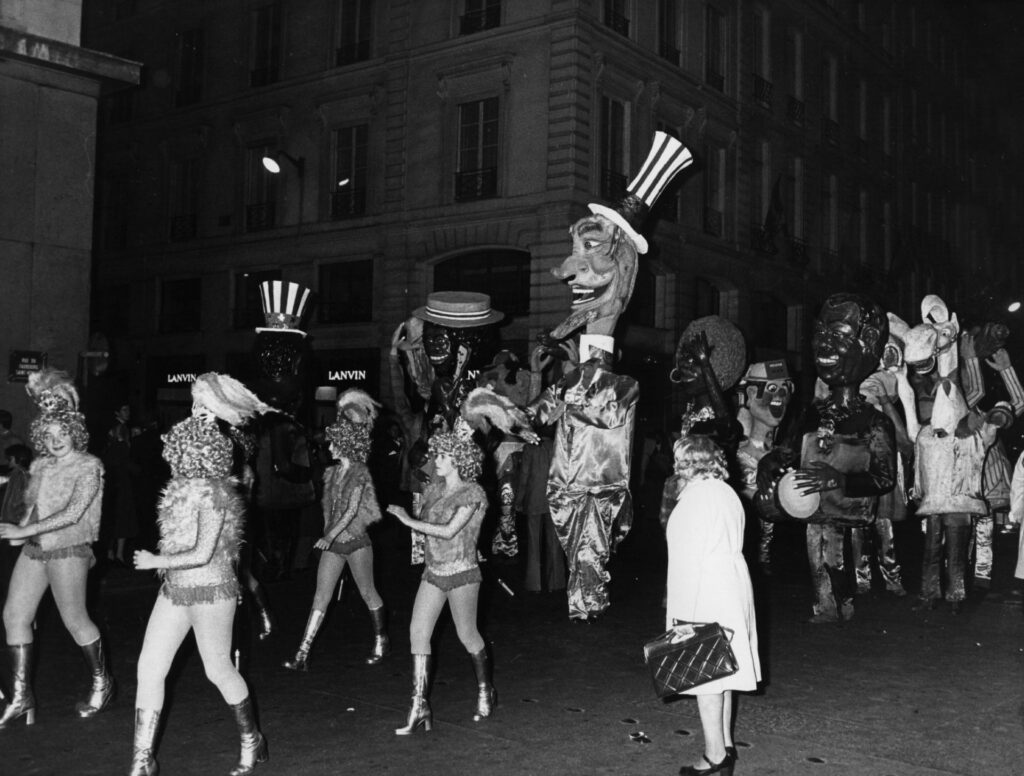
The U.S. effort to internationalize the celebrations was dealt a blow after Nixon resigned from the presidency in 1974 and the country lost the Vietnam War, though efforts to link America’s founding to the world stage persisted. ARBA’s “Final Report to the People,” a long publication about the bicentennial submitted to Congress in 1977, spent many pages exploring the bicentennial within America, but it also listed pages and pages of international events alongside its main focus on domestic commemorations. Eventually, it explained, over 100 nations participated, and the list of activities was quite wide-ranging. The U.S. itself organized many of these, as USIA had hoped in 1970, but, ARBA was careful to note, just as many activities were organized by governments and private institutions in other nations independently of the U.S. The American bicentennial really did become a dispersed international celebration.
To be sure, this took the form it always has throughout history. Bicentennial gifts to the U.S. from other nations were modern-day updates of the tribute sent to earlier seats of imperial power. An “International Salute to the States” organized by the Smithsonian Institution found other nations loaning “national treasures of such importance that they had never been exhibited outside their countries” to the U.S. The Netherlands contributed rare art to “The Dutch Republic in the Days of John Adams, 1775-1795.” Argentina sent “175 ecclesiastical and secular silver objects typical of Argentine life during the 18th and 19th centuries.” Australia included rare artifacts in an exhibition titled “The Fourth Part of the World.” Belgium sent over rare artworks and even some guns. Canada toured “Pitseolak: A Retrospective,” featuring drawings by Indigenous graphic artists and 100 watercolors, drawings and prints from the 18th and 19th centuries. There were exhibitions from Cyprus, Denmark, Yugoslavia and elsewhere. Finland toured a collection of mostly 18th-century Eastern Orthodox icons. France sent over the Marquis de Lafayette’s own copy of George Washington’s “Farewell Address,” rare paintings as part of a Louvre exhibition that toured the U.S. and even a light and sound spectacle, “The Father of Liberty,” presented at Washington’s former home, Mount Vernon.
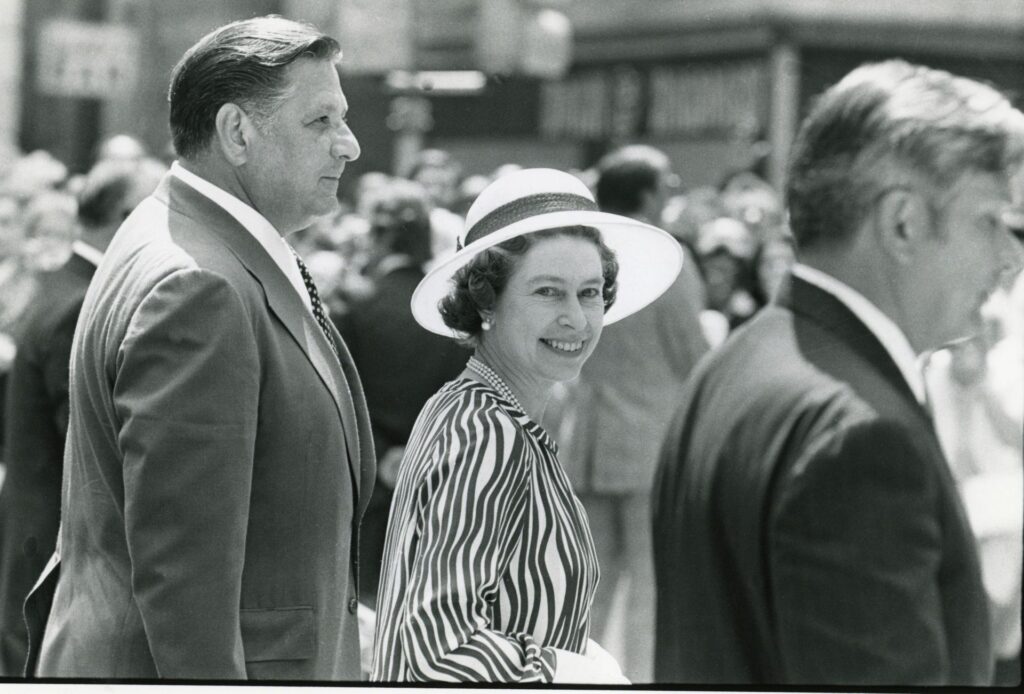
Not to be outdone, Britain sent over the “best collection of British silver ever to visit the U.S.” in one exhibition; a $60,000 reproduction of the Liberty Bell, cast at the Whitechapel Bell Foundry in East London by “master founder” William Hughes, delivered to Philadelphia; a gold-embossed copy of the Magna Carta (still on display to this day at the Library of Congress) — and even the queen herself, Elizabeth II, who made a royal visit and participated in bicentennial ceremonies on the actual day of July 4, 1976. England had, of course, lost the Revolutionary War, but the ARBA report slyly remarked that Britain “seemed to enjoy the celebration almost as much as we Americans.”
There were also coordinated efforts to bring bicentennial culture to the rest of the world by way of USIA, the Smithsonian Institution and other agencies both American and foreign. Two Britons organized “1776: The British Story of the American Revolution” (its original title, they jokingly told The New York Times, was “The Losers”) and the British government publicized a set of “1776” trails in the U.K. One tracked Benjamin Franklin’s travels around the country. More than 4,000 bicentennial-related events took place in West Germany alone in 1976. Similar events occurred all around the world.
Perhaps the most famous bicentennial export was “The World of Franklin and Jefferson,” an exhibition designed by Charles and Ray Eames and funded by IBM. The show traveled to London, Paris, Warsaw and elsewhere before touring cities in the U.S. itself. The Eameses created a multimedia evocation of Franklin and Thomas Jefferson as international figures. A U.S. newspaper reported that the 7,500-foot exhibition “will not be a flag-waving propaganda display” but instead an effort to present a wealth of artifacts and information. Charles Eames told The New York Times it was “the best color tabloid you could make,” not “just a bunch of relics.”
Stacked cubes in the opening room presented individual figures arranged into a global revolutionary network of men: Lafayette, Rochambeau (leader of the French expeditionary force during the American Revolutionary War), Edmund Burke (Anglo-Irish political philosopher and member of Parliament), Washington, Thomas Paine (revolutionary pamphleteer and author of “Common Sense”) and others. Paintings, furniture, famous documents and even a stuffed bison connected the expanding U.S. empire in the New World to ideas from the Old World. There was nothing to document the seizure of lands from Indigenous peoples, but there were Native American artworks and artifacts included. The exhibition strived to be “human-scale,” Charles Eames explained to the Times. There were also portraits of anonymous colonial Americans. The culmination of the exhibition was a room that used Franklin and Jefferson’s time in France to celebrate Franco-American relationships. When it opened in Paris, a critic for the French newspaper Le Figaro wrote that it presented a strong case for the “globalism” of the American Revolution.
Another successful export was “Sacred Circles: Two Thousand Years of North American Indian Art,” which traveled from the Atkins Museum in Kansas City to London before exhibiting around the U.S. It featured more than 900 works from across North America. While still mired in romanticizations of “Red Indians,” the exhibition did mark a nascent but crucial moment in the global rethinking of Native American art and culture’s value by way of its global circulation. “The formal power and psychic inventiveness of the objects in this exhibition demonstrate that North American Indian art can stand on its own alongside the great traditions of world art,” curator Robert T. Coe told The New York Times.
Paralleling similar exhibitions that toured the U.S., organized by the Department of the Interior and countless local municipalities, there was even a bicentennial exhibition in the USSR. Organized by USIA in exchange for a Los Angeles show to commemorate the 60th anniversary of the Bolshevik Revolution, “USA 200 Years” appeared at Moscow’s Sokolniki Park in 1976. It took place in the very location where Nixon and Soviet premier Nikita Khrushchev had squared off at the famous “Kitchen Debates” in front of an appliance-filled model of a U.S. kitchen in 1959. This time, there was less direct political confrontation and more range to the show. The exhibition presented, among other features, a “circlorama” movie tour of the U.S., created by Walt Disney Productions and appearing on nine screens simultaneously to surround audiences. It was, one American diplomat remarked to a nearby Russian, meant to be “psychologically, not ideologically, disorienting.” There were also photographs of American people, jazz recordings and souvenir copies of the Constitution and Declaration of Independence in Russian, according to news reports. “With special stress on history and political freedoms,” The New York Times reported, “the exhibition relegates gadgetry — normally the centerpiece of such displays overseas — to a lesser role.” Instead, “film, music, slides, videotape, an evocative collection of photographs, and tasteful selection of cultural artifacts — both antique and modern — convey the texture of life so vividly that an American in Moscow is likely to suffer an acute attack of nostalgia.”
The exhibition proved enormously popular, attracting 270,000 visitors, with still more turned away at the door after waiting in long lines. There were even fake bomb threats, possibly instigated by a jealous Kremlin itself, according to Time magazine. In some sense, Marsh’s original quest of using the bicentennial to combat communism persisted, but now it took the form of an art show exhibiting diverse stories and seeking “engagement” more than asserting American superiority directly. Surrounding Russians with screens about the “quality of life” in the U.S. and symbolic stories to celebrate the bicentennial of the American Revolution would perhaps prove more effective than outright Cold War calls for violent upheaval, political overthrow or revolution in the name of freedom.
The international dimensions of the bicentennial came to look a lot like the domestic ones. Both became efforts to coordinate not through direct, top-down command, but by creating the structures in which diversity might flourish. Realizing freedom, American-style, could encompass more spontaneous assertions of particular meaning, identity and bottom-up participation both at home and overseas. The national boundary grew permeable, paradoxically, in a bicentennial celebration of the nation. Here was the key aspect of the bicentennial that pointed to the coming era of “globalization,” one that would outlast even Ronald Reagan’s reescalation of Cold War brinkmanship in the 1980s. Through cultural heterogeneity rather than political uniformity, the U.S. empire could persist.
One would think this growing globalization weakened American state power, but it did not. Instead, it rendered the American nation-state oddly more invisible. An even softer approach to “soft power” emerged out of the bicentennial commemoration of 1976. Yes, Reagan brought Cold War geopolitics back in the 1980s, but below the surface of a renewed arms race and intensified interventions in Latin America, Afghanistan and elsewhere, the bicentennial’s ethos of a new sort of sunny, self-expressive Americanism was beginning to suffuse the mood (exemplified in some ways by Reagan’s own smile beaming around the world, even as he put in place far harsher policies). By the post-Cold War 1990s, and through the post-9/11 “war on terror,” the rhetoric of freedom shifted from an emphasis on political assertions of rights and justice toward cultural moods and “quality of life.” The bicentennial vibes had a way of rippling far beyond 1976. The idea that people could wave their flags with as many different colors and meanings as they wished, so long as they joined the American parade, survived even Reagan’s time in office.
This suggests something little noticed. Many historians characterize the bicentennial moment as setting the stage for the rise of Reagan and the New Right in the 1980s. It was an early hint of light in the predawn of Reagan’s “morning in America.” That teleology is not wrong, of course. Yet at the time of the bicentennial, it was not preordained. One might glimpse another, different ray of light beginning to beam forth. The celebration suggested a growing blur between home and overseas, domestic American life and its international ramifications. The “nation of nations,” as the Smithsonian Institution imagined the U.S. in one bicentennial exhibition, began to think of itself as capable of incorporating all the world into its fiefdom. It could do so through the display of 5,000 objects from around the world as much as through the bellicosity of troops and bombs. No need to fire the cannonballs again for another “shot heard round the world,” as Ralph Waldo Emerson first celebrated in his 1837 poem, “Concord Hymn.” Instead, the U.S. could sustain an empire simply by leaning more into the Declaration of Independence’s call to cultivate “a decent respect to the opinions of mankind.”
In our own semiquincentennial year, which finds the U.S. projecting brute force in its foreign policy as never before, it’s worth remembering how the 1976 bicentennial shifted away from demanding subservience and welcomed people and countries around the world to do their own thing as part of celebrating America’s thing. This was, to be sure, not an entirely new approach to sustaining U.S. power overseas. The U.S. had always been good at hiding its empire within an international sense of global fellowship. And yet alongside that rather pernicious subterfuge, the bicentennial celebration also reminds us of something else: Buried within decentralized forms of cultural imperialism is always the dream of realizing a more egalitarian global community. Actually existing freedom, justice and democracy lurk in projections of these ideals. In the case of the bicentennial, cultural commemoration suggested the outlines of a more authentic global life that outright political confrontation could not achieve.
In a strange way, Marsh’s original “strategy for freedom” from the height of the Cold War in 1963 lived on, albeit in a new guise. Like the sublime sight of so many sails entering New York Harbor on July 4, 1976, at the Tall Ships parade, it flickered on murkier waters. The tides had shifted by 1976. A simple, straightforward American attack on communism had become a complex, global procession of many nations, but it proceeded nonetheless. Passing under the Verrazzano Bridge and past the soaring presence of the recently built World Trade Center’s twin towers at the foot of Manhattan, the Tall Ships pointed their bows upriver, toward America itself, before heading back out to international waters.
Become a member today to receive access to all our paywalled essays and the best of New Lines delivered to your inbox through our newsletters.