


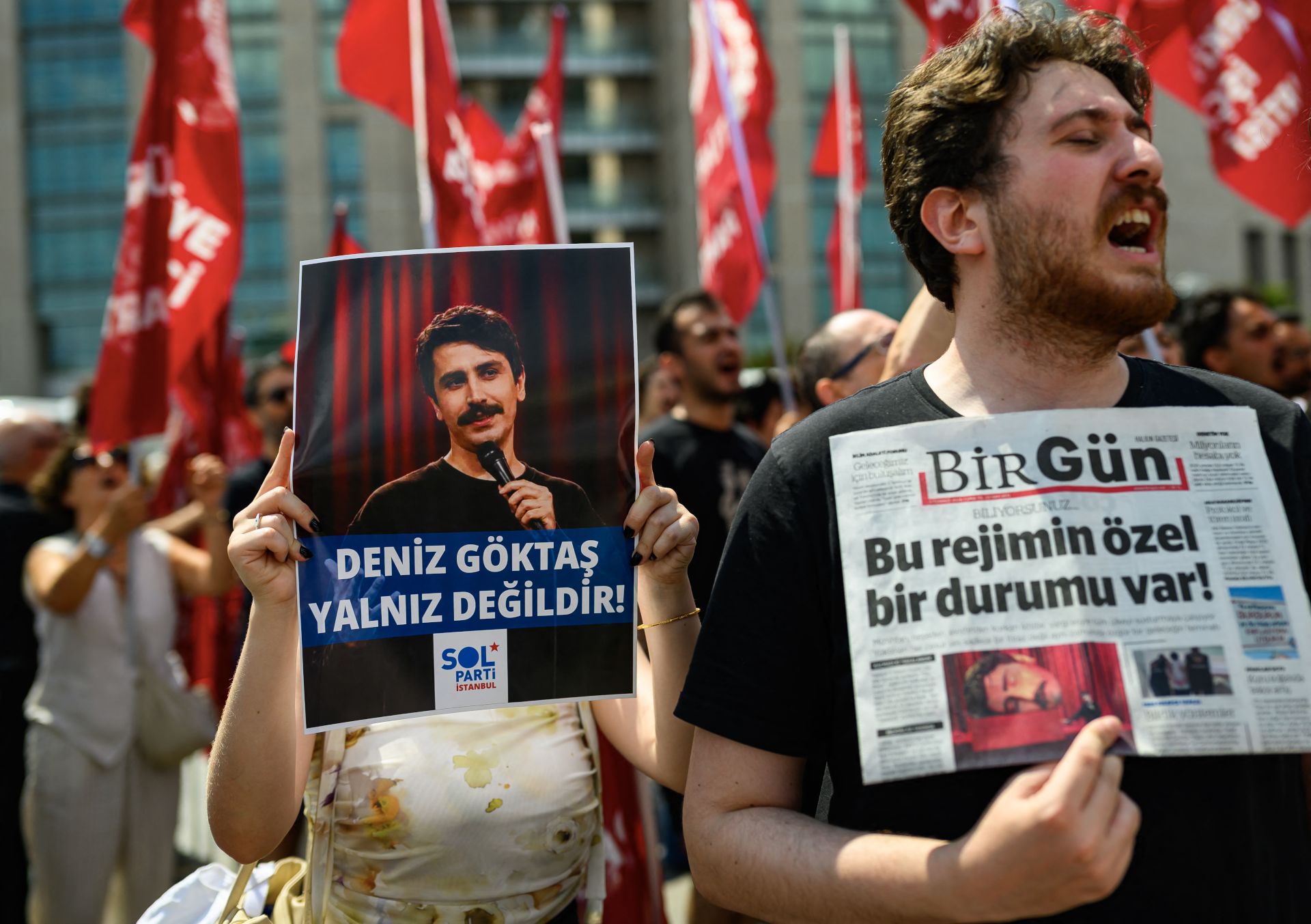
For those keen to forget the Great Turkish Football Fiasco of 2026, with the country’s exit after two goalless games, 32-year-old comedian Deniz Göktaş has come to the rescue with a scathing new special, “Olu Deniz,” that has taken Turkey by storm. Since its release on June 24, the 90-minute roast of every conceivable target has gotten over 13 million views and 28,000 comments, and spurred several criminal investigations and even parliamentary rows. The list of charges is daunting: insulting religious values and the president, for starters. Nor does he only come for the big man himself. With ecumenical bravado, Göktaş swipes at politicians, religious orders, racists, mafiosos, therapists, wokistas, public intellectuals, suicide bombers and the secular bourgeoisie. Since “deniz” means “sea” in Turkish, the title “Dead Sea” or “Dead Deniz” couldn’t be more appropriate.
Filmed at an iconic amphitheater in Istanbul’s upscale Harbiye quarter, he skewers his audience, too. A leftist from the minority community of Alevi in Ankara — a doubly disenfranchised identity — Göktaş immediately goes in for the kill. “We’re all good people here, aren’t we?” he taunts them. “But not as good as we were 10 years ago,” a dig on the popular mantra that life was always better a decade ago. “Back then, we apologized and made vows to improve ourselves. These days, we pride ourselves on sins we haven’t committed.” After a big fake diploma scandal, for example, his friends get smug about having real degrees. Others brag about not abusing cats. “‘That makes me an animal lover!’ they say, ‘I stand with all women’ is what every perv says until he’s denounced.”
William Hazlitt wrote that “Man is the only animal that laughs and weeps; for he is the only animal that is struck with the difference between what things are, and what they ought to be.” If politically charged stand-up is hardly a new phenomenon in Turkey — political satire flourished in the 1990s with legends such as Levent Kırca and Ferhan Şensoy — it has reached a boiling point with this release. In addition to the World Cup debacle, the opposition Republican People’s Party (CHP) is under full assault by the judiciary; celebrities are rounded up on drug charges; universities are closed and reopened by spontaneous fiat; vast swaths of Istanbul are sealed off to prevent Pride parades; and much of Ankara is under de facto house arrest for the much-trumpeted Nato summit. As the show’s most viral comment on social media puts it, “Watching this made me feel as if I lived in a free country for a little while.”
Not surprisingly, Göktaş’ most brazen move was to go for the big man. “I never liked Erdoğan,” he reassures the crowd. “Not for his charisma, his height, nor the way his mustache is always the same length. But for better or worse, our journeys went hand in hand,” he admits. “I was born in 1994; he became mayor in 1994. I was there for all his triumphs. He’s like a neighbor — an unpleasant one — but a neighbor all the same. We’re curious. What’d they do today? What’s in their trash? You know his greatest accomplishment? His journey from a shy dictator to one at peace with himself. Forget how it affects the rest of us: It’s a huge individual accomplishment! Why accept limitations — social pressure, letters from the public, constitutions? Be yourself! Break out of your shell! Honestly, I’m happy for him. I hope we can all follow in his footsteps.”
Perhaps wisely, Göktaş left the country for a preplanned trip on June 28. With great hullaballoo in the rumor mill over pending criminal investigations, he might have done well to keep his distance. Yet part of him longs to quaff from the cup of persecution, too. His father, for example, is always giving him a hard time. “How come they arrest all these celebrities who protest but not you?” — a reference to the massive demonstrations that rocked the country after Istanbul mayor and opposition leader Ekrem İmamoğlu was arrested in March 2025. “What are you,” his father constantly taunts him, “some kind of collaborator?”
After all, prison is a rite of passage in Turkey. Think of the greats who’ve gone through its gates: Nazim Hikmet, Orhan Kemal, Sevgi Soysal, Yaşar Kemal, Yılmaz Güney, İsmail Beşikçi and Recep Tayyip Erdoğan, to name but a few. “Like all kids, I wanted to be an astronaut, a footballer and a district official,” jokes Göktaş. “But above all, I wanted to be an intellectual. My family always had a great reverence for them,” he explains. “There was a strict hierarchy: the standard intellectual, the exiled intellectual, the imprisoned intellectual and the dead intellectual.”
As you ascend the ladder, Göktaş explains, the love and respect you get only grow. “If you’re in prison, people talk about you. If you die, you get to have your face on a poster. I’m excited about becoming an intellectual for free,” he gloats. “Just think of the luxury — I don’t have to do journalism or write any books! I’ll be the first intellectual cracking jokes about watercoolers on YouTube,” a reference to his first breakout special in 2023, “Selam Selam,” after which he eagerly expected to get arrested … but didn’t.
George Carlin memorably ridiculed the popular misconception that American politicians were different moral creatures than their fellow Americans. “Where do people think these politicians come from?” railed the great bitter bard from Morningside Heights. “They don’t fall out of the sky. They don’t pass through a membrane from another reality. They come from American parents and American families, American homes, American schools, American churches, American businesses and American universities, and they are elected by American citizens. This is the best we can do, folks. This is what we have to offer. It’s what our system produces: Garbage in, garbage out.”
Göktaş doesn’t go this far, but he does skewer many shibboleths. First are the various “tarikats,” or religious orders, that have blossomed in wealth, power and influence over the past few decades. “I’m baffled that so many of you have shown up tonight without having the faintest idea what I’ll say,” he prods the crowd. “With the right text, I could convert all of you into a new tarikat. The protocols are all in place: the charitable trusts, the land. And the categories of beneficiaries,” a reference to the many downtrodden who rely on them — not to mention the opportunists who enrich themselves at their members’ expense. “Audis and Mercedes for people like me in the first category,” he quips. “And soup for those in the sixth!”
In another risky move, he awakens the ghost of the Gulenist movement, the most notorious of all the religious orders in recent Turkish history. Once closely aligned with the ruling AKP party, the Gulenists — known to themselves as “Hizmet” (“Service”) but rebranded by the press and government as the Fethullah Gülen Terrorist Organization (FETO) after their failed coup attempt of July 15, 2016 — have mostly been jailed, fled abroad, or gone into hiding. Thought to once number up to 2 million members in Turkey alone, over 630,000 people were detained or investigated for suspected ties to the organization after that murderous night in 2016. Of these, 127,000 were convicted and 125,000 acquitted, while 374,000 cases dropped for insufficient evidence. Another 32,000 fled the country, according to government estimates, while thousands more fester in legal limbo. “With this many people here tonight,” quips Göktaş. “A few of them must be with us!”
“Hoş geldiniz” (“Welcome”), he says to the potential Gulenists in the crowd, to which the respondent would typically say “Hoş bulduk,” (“Happy to be here”). “But don’t say ‘Hoş bulduk’!” he warns. “What a pity it would be if after 10 years in hiding you suddenly blew your cover.” Like the Mormons, the Gulenists were a hardworking, upwardly mobile religious movement that eventually infiltrated many organs of the state. Given their social origins and peculiar organizational proclivities — Dexter Filkins wrote an excellent profile in which he details how devotees once ate their leader’s shoe — members of the audience are unlikely to be sympathetic to their plight. Göktaş, of course, doesn’t care.
“I’m not here to judge you,” he tells them. “If anyone in this room understands you, it’s me. I really tried to join the movement!” he jokes. “In fourth grade, I took second in the math olympics and got recruited by a Gulenist school. They were gonna give me a computer and a scholarship. I begged my parents: They’ll brainwash me by day, but you guys will fix it by night! But they weren’t commercially minded, so didn’t send me,” he sighs. “Think of where I’d be today if I had. In New York with a green card,” a reference to the many members with murky American connections. “Or a Cabinet minister in Turkey!” a dangerous allusion to the belief that many elite cadres were not only never caught, but even continued to serve in Cabinet positions.
His next target is Istanbul Mayor Ekrem İmamoğlu, the candidate it was once hoped would run against President Erdoğan in 2028. Under lock and key since March 2025, the charismatic son of a construction magnate notoriously failed his university entrance exams. In a country where a mandarin-like adherence to a strict exam system created a modicum of meritocracy in Turkish academia and bureaucracy, exams were — and for millions still are — the be-all and end-all of middle-class aspirations. Never mind that Gulenists would leak the exam questions to their own people. İmamoğlu never passed them, so he studied in Cyprus instead.
“I hear İmamoğlu has lots of time in jail to read now,” jokes Göktaş. “Maybe now he’ll pass his exams! Like everyone just learning to read, he’s breezing through multiple books at once. First, of course, is the Quran,” a cliched effort to appeal to conservative voters. Second is “Nutuk,” the famous 600-page speech by Atatürk, a nod to nationalists. Third is Nazim Hikmet, the great communist poet, in a sop to leftists. “Fourth is a tiny book on Hacı Bektaş,” a 15th-century saint revered by Turkey’s Alevi minority. “A very tiny book,” he jokes, “as tiny as the Alevi vote he needs,” a bitter reminder of their status as a captured constituency. “But people get confused reading so many books at once,” he adds. “What was that wonderful thing I read the other day?” impersonating the mayor. “Was it from the Quran or Nazim Hikmet?”
Apart from pinpointing society’s more obvious flaws, the real theme of the show is so many people’s insatiable desire to have their cake and eat it. Men of God who must have a Mercedes; social movements seeking egalitarian mobility and inherited privilege; self-regarding rogues who want to feel sanctimonious; womanizers who want to be seen as allies; lackadaisical liberals loudmouthing Turkey from bars in Berlin; and, of course, YouTubers passing as intellectuals. At the end of the day, these are human themes, not just Turkish ones. But the best comedians are those who eviscerate national and human vices with equal vigor, blurring one line to sharpen the other.
His biggest beef is with secular kids from conservative families. If a universal phenomenon of modernity, depending on the decade and country, in Turkey it’s a controversial trend: kids who grow up in the warm embrace of tradition before eschewing the old ways for the good modern life the moment they turn 18. “You’re born into a country that’s yours,” Göktaş complains. “You turn on the TV and see families just like yours: crowded living rooms, Friday prayers, Ramadan feasts, traditions and rituals, all in perfect family harmony. You connect with the country through trust.” Then, after a little bit of family pushback, you pivot to sex and alcohol. “A true win-win!”
“They even have placards!” Göktaş complains: It seems only secular kids from conservative families can save Turkey, despite all the talk about the “undecided deciding this election.” When will working-class leftists be the target audience, he asks. “These kids get to reap what they haven’t sown,” he says. “If I could be born again, I’d be one of them. They’re like the rock stars who party until they’re 60. Then they sign into rehab, get clean and poof! Metallica’s soloist has the same health as my father. But my dad only drank a beer a month — and has no albums to show for it!” he laments. “These kids are no different. If I’d have known we’d be drinking beer together at the same table at age 30, why spend my first 18 years in perpetual sufferance?”
For anyone looking to brush up on the last 50 years of Turkish history, Göktaş’ special is an excellent crash course. At age 6, for example, he asks his parents why he’s named Deniz. They simply point to the wall, i.e., the handsome young revolutionary, Deniz Gezmiş, whose face adorns thousands of homes, cafes, bars and businesses around the country. In looks and attitude, he’s Turkey’s own Che Guevara. “And what happened to him?” he asks his parents. “‘They hung him!’ ‘Who?’ ‘The state!’ ‘And where will I go to school this year?’ ‘The state school!’” Soon after classes start, he gets reprimanded for repeating something he sees on TV. The principal calls his parents. “What kind of words are these? Is your son trying to divide the country?”
Whatever theological convictions some members of the government may have, the real ideology of the Turkish state is its indivisibility. One of the great slogans of the era of Erdoğan’s Justice and Development Party has been: “One people. One flag. One homeland. One state.” To which others would no doubt like to add “one religion, one language, and one dynastic leader.” If the Turkish state does have some justification for its paranoia — it was only forged after repelling Russian, Greek, British, Italian, French and Armenian forces — its obsession with indivisibility as an end rather than a means does little for anyone outside the jobs-program security apparatus. As young Göktaş told his principal: “Don’t make a country that 6-year-olds can divide!”
Not that he has any plans to abandon it. Unlike many of his peers who have flocked to Europe or North America, Göktaş is going nowhere. For one, it’s the only place he feels cutting-edge. No matter how hard he tries, he just can’t feel conservative in Turkey. Someone always outdoes him. When his best friend in elementary school learned there would be wine in heaven, he cursed God. Only abroad can he enjoy the sweet bliss of being holier than thou. For example, when a man starts playing with himself in the New York subway, Göktaş is the only one shocked. When a musician goes strutting about Edinburgh wearing naught but a guitar and collecting tips from every Scot, he’s equally horrified. “Where are these people’s zabıtas?! [Turkey’s neighborhood police watch]” He licks his lips. “Muah! It felt wonderful to be the most conservative person!”
After slaying every dragon in sight, Göktaş finishes on a more hopeful note. He tells the story of an arduous breakup after he and his girlfriend failed to agree on a podcast. But at least it taught him to empathize in ways he never had before. “Recent Turkish history is full of tragic woes,” he says. “This tragedy, that massacre. Bahcelievler, Sivas, Maras,” notorious massacres in 1978 and 1993 whose perpetrators were never brought to justice. “But there’s a good side to it, too. Learning about all the terrible things that happened to everyone while cleaning up my flat, I was able to empathize with every group in Turkey for the first time,” he confesses. “I understood the Kemalists, the leftists, the Kurds, the feminists, the Islamists, the liberals, the democrats.”
The only ones he doesn’t quite get are the nationalists, he admits. Which is ironic, since the overwhelming majority of people in Turkey are nationalist to some degree. “Their biggest phobia is the division of the country. Which is reasonable,” he concedes. “I’ve got phobias, too. For example, I’m afraid of the dark. So I install special lighting at home and avoid certain streets at night,” he explains. “But despite these nationalists’ phobia, every time they see a Kurd they erupt into raptures about the glories of having a state. Yum, yum, yum! They lick their lips. Life’s a bouquet of roses when you have a state! And to think we’ve founded 16 of them!” the oft-quoted number of Turkic states that culminated in the creation of the Turkish Republic in 1923.
“I get it,” says Göktaş. “You’re proud. Celebrate it. You’ve every right to. But do it amongst friends. Keep it in the hearths [the far-right social centers where nationalist and mafia-aligned men like to meet]. Why go putting highfalutin ideas into other people’s heads? If a Kurd is walking down the street, far better to let him overhear you say: I’ve got a state, and my, the woe it brings. Take it from me! You stateless folk have got it far better than us.”
As widely predicted, Deniz Göktaş was detained on July 2 as he reentered the country after a four-day vacation. As he said prior to his departure, he was leaving Turkey with three T-shirts and three pairs of boxers. “Once they’re dirty,” he vowed, “I’ll go home.” Remarkably, he kept his word. A day later, he was transferred first to Metris Prison on the outskirts of Istanbul, then to Corlu Karatepe Maximum Security Prison, 75 miles further west. Though clips of his show have been blocked on X, and a judge ordered access to the full special to be blocked on YouTube, it remains online for now. Despite some speculation that he would be released once the hullabaloo over the July 7-8 NATO summit in Ankara died down, he is now expected to remain in custody until his trial, where he faces anywhere between 18 months and seven years of prison if convicted.
As the most wanted comic in the world, Göktaş could have easily made a new life in Paris or Berlin. Instead, he made the whole system a part of his show, as one commentator aptly put it. Why’d he do it? Perhaps, as his ex-girlfriend suggested, because he’s an “empathy whore.” Or perhaps to ascend the intellectual ladder. Whatever the case, he’s made his father — and a hopeful plurality of 86 million people — awfully proud.
Become a member today to receive access to all our paywalled essays and the best of New Lines delivered to your inbox through our newsletters.